
1/4 Carat Diamond Value: Natural, Lab and Resale
A 0.25 ct natural diamond may retail for hundreds, while lab-grown examples can cost less. Value the stone and mounting separately.
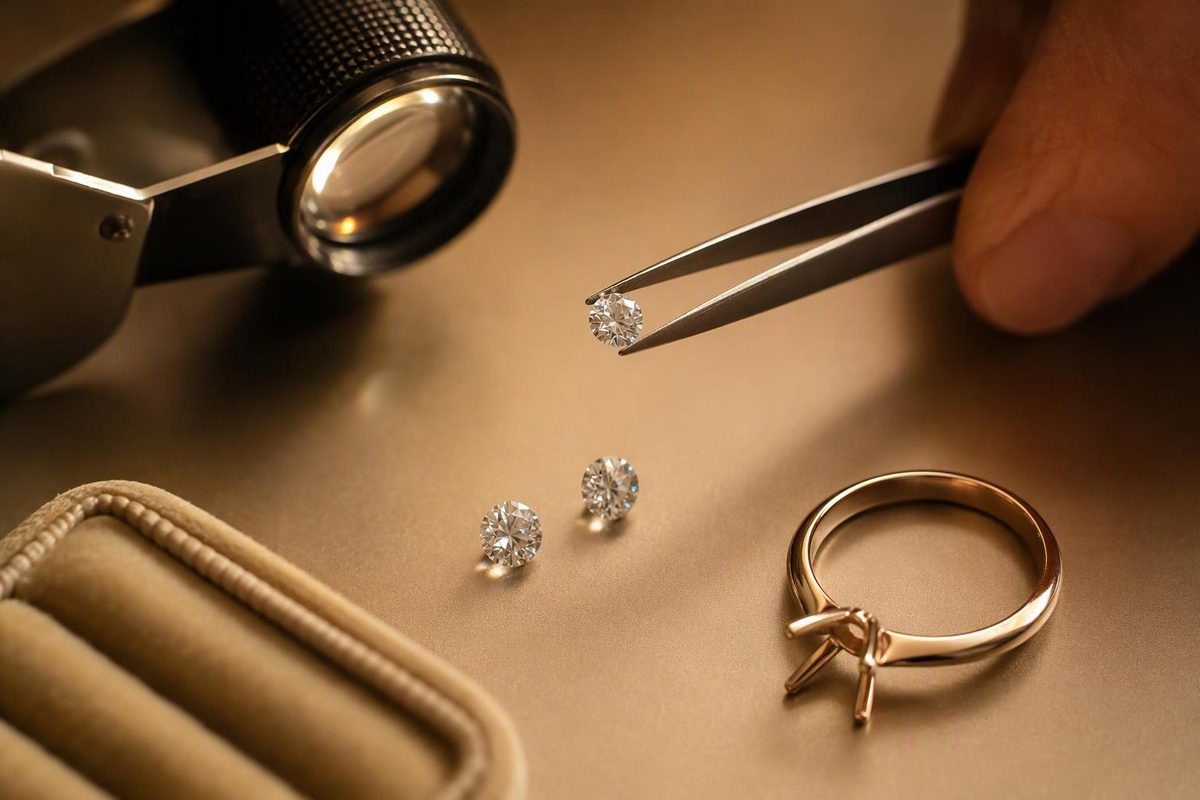
A loose 1/4-carat natural diamond may retail for a few hundred dollars, while a comparable lab-grown stone can cost less. But carat weight alone cannot establish value: origin, shape, color, clarity, cut, measurements and documentation all matter. In a finished ring, the metal, design, brand and workmanship may be worth as much as—or more than—the center stone.
In a retail snapshot taken September 22, 2026, Ritani displayed a broad quarter-carat natural-diamond category at $150 to $7,100, with a $500 median. Its lab-grown category showed $63 to $310, with a $200 median. These were one seller’s asking prices for changing inventory, not appraised values or resale offers. The natural range was especially broad and should not be treated as evidence that an ordinary 0.25 ct diamond is a four-figure asset (natural inventory; lab-grown inventory).
First confirm what “1/4 carat” describes
One-quarter carat means 0.25 ct, also called 25 points. It does not mean 1.4 carats. One carat equals 200 milligrams, so a 0.25 ct stone weighs 50 milligrams (GIA).
A jewelry description can use the fraction in two different ways:
- 0.25 ct center: one diamond weighs approximately one-quarter carat.
- 0.25 ctw or tcw: all diamonds in the piece weigh one-quarter carat combined.
A ring with ten small diamonds totaling 0.25 carat should not be valued as though it contains one 0.25 ct center. GIA defines total carat weight as the combined weight of all diamonds in a piece and notes that a single larger stone differs in rarity and price from many small stones of the same total weight (GIA).
Useful 2026 price benchmarks
| What is being valued? | Retail reference from the snapshot | What the figure does not establish |
|---|---|---|
| Loose quarter-carat natural diamond | $150 low end; $500 median | Finished-jewelry value or resale proceeds |
| Loose quarter-carat lab-grown diamond | $63–$310; $200 median | Setting cost or future resale proceeds |
| Finished ring, pendant or stud | Stone and mounting must be assessed separately | Value cannot be derived from carat weight alone |
| Pre-owned jewelry | Use matched completed sales and actual offers | Receipt or insurance appraisal is not a resale guarantee |
The category included weights close to, rather than always exactly, 0.25 ct. Lower-priced natural listings included GIA-graded 0.26 ct rounds at $126 for K/SI2 and $134 for L/SI2. A lab-grown listing showed an IGI-graded 0.26 ct D/VS2 round at $73. These were dated asking prices for individual stones, not interchangeable valuations for every quarter-carat diamond (natural listings; lab-grown listings).
The upper end of a broad search may contain fancy colors or unusual specifications. Do not apply it to an ordinary near-colorless diamond without matching origin, shape, color, clarity, cut and report.
What changes the value most
Natural or lab-grown origin: These are separate markets. If the price depends on origin, do not rely on the seller’s description alone; look for an appropriate laboratory report or independent verification.
Color and clarity: GIA’s D-to-Z color scale measures the absence of color, while clarity grading evaluates inclusions and blemishes under 10× magnification (GIA buyer’s guide). Grade differences can affect price even when they are difficult to distinguish without controlled comparison. At 0.25 ct, paying heavily for IF or VVS clarity may buy a rarer grade without producing an obvious face-up improvement. For context, VVS is not flawless.
Cut and dimensions: Carat is weight, not face-up diameter. GIA notes that a poorly proportioned diamond can carry weight below the girdle without looking larger from above (GIA). Compare millimeter dimensions and face-up appearance, not weight alone.
The quarter-carat threshold: GIA identifies 0.25 ct as a “magic size” at which price per carat can increase. A well-cut 0.23 or 0.24 ct stone may look nearly the same while avoiding some threshold pricing (GIA).
Documentation: A grading report can record weight, dimensions, color, clarity, cut information where applicable and detected treatments. It does not state what a particular buyer must pay (GIA).
How to estimate a ring’s value
Do not multiply 0.25 by a generic “price per carat.” Instead:
- Confirm whether 0.25 ct refers to one stone or total weight.
- Identify natural or lab-grown origin and check for treatments.
- Record shape, exact weight, measurements, color, clarity and cut information.
- Compare the stone with current listings of the same origin and closely matched specifications.
- Assess the mounting separately, including metal, condition, workmanship and any supportable signed-brand or antique premium.
- Use the right value for the purpose: replacement cost for insurance, current retail comparisons when buying, or real cash offers when selling.
A replacement appraisal can legitimately exceed an immediate resale offer because the two figures answer different questions. If an insurance figure looks unusually high, see how to check whether a ring is overinsured.
For resale, do not start with the original receipt or replacement appraisal and apply a universal percentage. Compare completed sales where possible and obtain offers from multiple buyers. Ask what each buyer will pay for the complete piece and, if practical, how much value they assign to the diamond and mounting separately. Lab-grown resale is especially buyer-specific, as explained in our lab-grown diamond resale guide.