
VVS Clarity Is a Microscopic Distinction—Here’s What Buyers Actually See
The short answer: VVS means Very Very Slightly Included
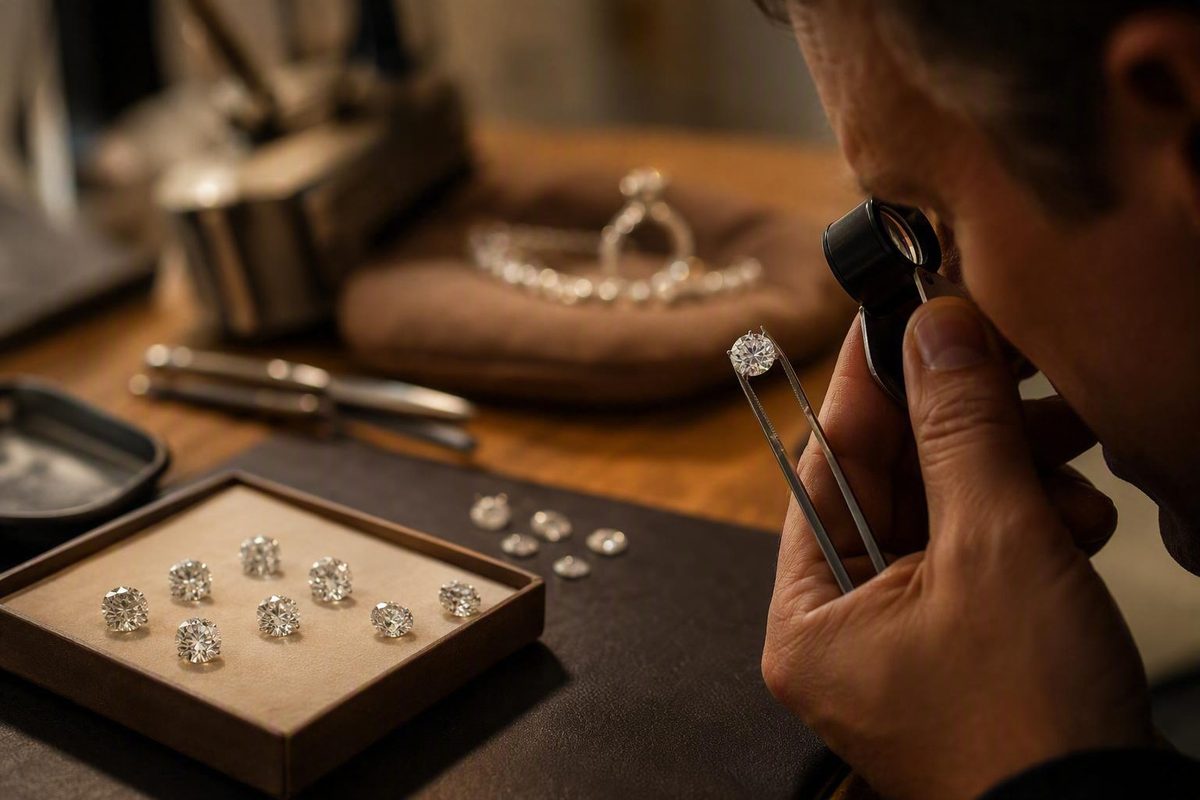
VVS stands for “Very Very Slightly Included.” It is a high diamond-clarity category for stones with minute clarity characteristics that are difficult for a trained grader to detect at standard 10× magnification. The category contains two grades—VVS1 and VVS2—with VVS1 ranking higher. GIA describes VVS1 characteristics as extremely difficult to see at 10× and VVS2 characteristics as very difficult to see.
In practical terms, VVS diamonds generally appear free of inclusions to an unaided observer in ordinary viewing. The distinction is made through controlled examination under magnification, not by casually looking at a ring on someone’s hand.
That does not make a VVS diamond flawless. Flawless and Internally Flawless grades sit above VVS on the clarity scale. A VVS diamond has clarity characteristics; they are simply exceptionally small or difficult to locate.
Clarity is one of the diamond 4Cs, alongside cut, color, and carat weight. It describes the presence and visual significance of internal inclusions and surface blemishes. It does not, by itself, determine whether a diamond is attractive, well cut, appropriately priced, or right for a particular ring.
That distinction matters when shopping. A VVS grade can sound like an obvious upgrade because it is close to the top of the scale. But if a VVS diamond and a lower-graded VS diamond both look clean without magnification, the practical difference may be more apparent on the grading report than in everyday wear.
Where VVS sits on the diamond clarity scale
A compact version of the conventional clarity ladder, from highest to lower clarity, is:
- FL — Flawless
- IF — Internally Flawless
- VVS1 — Very Very Slightly Included 1
- VVS2 — Very Very Slightly Included 2
- VS1 — Very Slightly Included 1
- VS2 — Very Slightly Included 2
- SI1 — Slightly Included 1
- SI2 — Slightly Included 2
- Included grades — I1, I2, and I3
This full scale contains 11 grades. VVS1 and VVS2 sit below FL and IF but above VS, SI, and Included grades. The published clarity sequence runs from FL through I3 and is evaluated at 10× magnification.
The terms at the top of the scale have specific meanings:
- Flawless: No inclusions or blemishes are visible to a skilled grader under the prescribed grading conditions.
- Internally Flawless: No internal inclusions are visible under those conditions, although surface blemishes may be present.
- VVS: Minute clarity characteristics exist, but they are extremely or very difficult to detect.
An inclusion is an internal characteristic. A blemish is a surface characteristic. Clarity grading can account for both, which is why clarity should not be reduced to a simple count of “flaws.”
Graders consider how significant each characteristic is within the diamond as a whole. A tiny, low-contrast feature near an edge does not necessarily have the same grading effect as a similarly sized feature beneath the table. Multiple minor features may also be evaluated differently from one isolated characteristic.
Moving upward on the scale means that the relevant characteristics become progressively harder to detect under grading conditions. It does not mean that every step produces an equally large improvement in unaided appearance. The difference between VVS1 and VVS2, for example, is ordinarily a matter for trained inspection rather than normal viewing.
Nor is the clarity ladder a complete ranking of beauty. A VVS diamond can have an unappealing cut, color, outline, or facet pattern. A lower-clarity diamond can be visually compelling if it is well cut and its inclusions are unobtrusive. Clarity should therefore be read alongside cut, color, carat weight, shape, and the appearance of the individual stone.
VVS1 vs VVS2: what separates the two grades
VVS1 is the higher grade. Its clarity characteristics are harder for a skilled grader to locate at 10× magnification. VVS1 characteristics are conventionally described as extremely difficult to detect, while VVS2 characteristics are very difficult to detect. Whiteflash’s VVS2 guide summarizes the grade as involving characteristics difficult for a skilled grader to find at 10×.
That is a narrow distinction. Graders do not apply a single test such as counting inclusions or measuring only their diameter. They consider several interacting factors:
- Size: How large is the characteristic?
- Number: Is there one characteristic or a group?
- Location: Is it beneath the table, near the girdle, or obscured by facets?
- Relief: How strongly does it contrast with the surrounding diamond?
- Nature: What kind of inclusion or blemish is it?
A small feature with noticeable contrast in a prominent location can matter more than a larger but faint feature in a less conspicuous area. The grade reflects the combined effect rather than one characteristic in isolation.
VVS1 characteristics are often described as detectable primarily through the pavilion—the lower portion of the diamond—while VVS2 characteristics may be somewhat easier to locate through the crown. This is a common pattern, not a complete rule. Size, number, location, relief, and nature still determine the overall clarity assessment.
Without magnification, VVS1 and VVS2 diamonds generally look alike. The distinction is therefore most relevant to laboratory grading, relative rarity, personal preference, and price. An otherwise comparable VVS1 will typically cost more than a VVS2, although cut, color, carat weight, shape, origin, laboratory, and seller can all affect the final price. Barkev’s comparison likewise notes that VVS1 generally carries a higher price than comparable VVS2.
That does not make VVS1 the better purchase in every case. A beautifully cut VVS2 may be more attractive than a mediocre VVS1. The choice depends on whether the higher grade itself carries personal value, not merely on which line sits higher on the chart.
Can you see inclusions in a VVS diamond?
Generally, VVS inclusions are not visible to the unaided eye in ordinary viewing. They are grading-level characteristics that require magnification and skill to locate. That is why a VVS diamond can look flawless even though it does not qualify for the Flawless grade.
It is still better to avoid promising that every stone labeled VVS will look identical under every condition. Visibility can be influenced by:
- The observer’s eyesight
- Lighting intensity and direction
- Viewing distance
- Whether the diamond is loose or mounted
- Viewing angle and diamond orientation
- Diamond size
- Shape and facet pattern
- Inclusion position and contrast
- The laboratory that issued the grade
The term “eye-clean” is informal industry shorthand for a diamond whose inclusions cannot readily be seen without magnification under the stated viewing conditions. It is not an official clarity grade, and it has no universally fixed test.
One seller might assess a loose diamond face-up from a normal viewing distance. Another person might inspect it from a few inches away under concentrated lighting. For that reason, an eye-clean assessment should come with context: ask about viewing distance, lighting, orientation, and whether the diamond was loose or mounted.
Representative characteristics that can occur in the VVS range include:
- Pinpoints: Very small crystal-like points
- Needles: Thin, elongated internal crystals
- Clouds: Groups of minute pinpoints or other features
- Internal graining: Irregularities associated with crystal growth
- Minute surface-reaching features: Tiny characteristics that extend to the surface
The presence of one of these feature types does not determine the grade by itself. Its size, contrast, position, number, and effect within that particular diamond all matter.
Location is especially important. A characteristic directly beneath the table—the large central facet—occupies a relatively open viewing position and may receive greater scrutiny. One near the edge may be less conspicuous, particularly if crown facets obscure it or a prong later covers that part of the perimeter. A dark or high-relief feature may also attract attention more readily than a transparent, low-contrast one.
A normal inspection and a grading examination are therefore different activities. Looking at a ring in daylight or ordinary indoor lighting tells you whether the diamond appears clean in real use. Examining it under magnification reveals and helps classify microscopic characteristics. Finding something with a loupe does not necessarily mean you have found an eye-visible defect.
VVS vs VS: appearance, rarity, and price
VS means “Very Slightly Included.” Its two grades, VS1 and VS2, sit immediately below VVS2:
VVS1 → VVS2 → VS1 → VS2
VS clarity characteristics are easier for a skilled grader to detect under standard grading conditions than VVS characteristics. That difference is real within the grading system, but it does not follow that a buyer will notice it across a jewelry counter or while the diamond is being worn.
Many VVS and VS diamonds look alike to an unaided observer. An individually verified, eye-clean VS1 or VS2 may therefore provide the same practical clean appearance as a VVS diamond.
Otherwise comparable VVS diamonds generally command a premium because higher clarity is less common and carries a higher report grade—not necessarily because it creates a visible improvement. Rare Carat’s VVS-versus-VS comparison likewise places VVS higher on the scale and notes that comparable VVS diamonds generally cost more.
Price comparisons are useful only when the diamonds are genuinely comparable. Hold as many of the following variables constant as possible:
- Cut quality and proportions
- Color grade
- Carat weight
- Shape
- Natural or lab-grown origin
- Grading laboratory
- Fluorescence and other report details
- Seller and sales channel
- Market date
Comparing a VVS1 round diamond from one seller with a VS2 emerald cut from another tells you little about the clarity premium. Differences in shape, cut, sourcing, grading, and seller pricing may overwhelm the effect of clarity.
The same warning applies to isolated price examples. A single retailer listing or an old pricing sheet is not a reliable current-market benchmark. The effect of clarity varies with the stone’s other specifications, so the useful comparison is between matched candidates available when you are ready to buy.
The choice is personal:
- VVS may suit you if you value a high report grade, relative rarity, or exceptionally minute clarity characteristics.
- VS may suit you if your priority is an eye-clean appearance and you would rather direct more of the budget toward cut, size, color, or the setting.
Neither decision is inherently more sophisticated. The efficient choice is the one that buys the qualities you will actually value.
Why shape, size, and inclusion location change the decision
The practical value of VVS can change with a diamond’s facet pattern and dimensions. A clarity grade does not operate in visual isolation: the cut controls how much of the interior is exposed and how readily the eye can focus on it.
Emerald and Asscher cuts are step cuts. Their broad, open facets and hall-of-mirrors pattern can provide long, relatively uninterrupted views into the diamond. Small clarity characteristics may consequently be easier to locate than they would be in a stone with a busier facet pattern.
Brilliant cuts use numerous facets to break light into smaller flashes. This activity can make small clarity characteristics harder to isolate visually. It does not erase inclusions, but it may provide more visual concealment than the open architecture of many step cuts. Retailer guidance comparing facet styles similarly notes that step cuts can reveal inclusions more readily than brilliant patterns.
Facet style also varies within broad shape categories. Antique cushions, for example, can have broad, chunky facets rather than the finer pattern associated with many modern cushions. Buyers considering one should evaluate its individual face-up pattern rather than assuming that every cushion conceals clarity characteristics in the same way. Our guide to antique cushion-cut diamonds explains how those older facet patterns differ.
Diamond size can also change the evaluation. A larger stone may have larger facets and more visible interior area, giving the observer more opportunity to notice a characteristic. But size alone does not establish a mandatory minimum clarity grade. A large diamond with a low-contrast, well-positioned VS inclusion may still look clean, while buying by carat-based clarity rules can lead to paying for refinement that is not visually necessary.
Location adds another layer. A feature beneath the table is likely to attract more scrutiny because it occupies the central viewing area. One close to the perimeter, hidden beneath crown facets, or concealed by an appropriate setting may be less noticeable.
A grading report’s clarity plot and comments can help identify where characteristics are located. They should be considered alongside actual photographs or video, however, rather than treated as a complete simulation of appearance.
VVS may be more defensible when:
- The diamond is large enough to invite close inspection.
- It has an open step-cut facet pattern.
- The buyer is particularly sensitive to visible clarity characteristics.
- The buyer personally values a high clarity grade.
- The available VS alternatives contain central or distracting features.
“More defensible” does not mean mandatory. An emerald or Asscher cut does not automatically require VVS, nor does every round brilliant become a good purchase at a lower grade. Retailer-created minimums based on shape or carat weight are shopping guidelines, not official grading standards.
Inspect the individual stone. Two emerald-cut VS1 diamonds can differ in inclusion type, position, contrast, cut quality, and face-up appearance. Shape and size tell you how carefully to examine clarity; they do not decide the grade for you.
Does VVS make a diamond sparkle more?
No—VVS is a clarity grade, not a cut grade. It does not, by itself, establish superior brightness, fire, scintillation, or overall light return.
Cut describes how effectively a diamond’s proportions and facets manage light. Clarity describes inclusions and blemishes. Because they measure different qualities, a high-clarity diamond can have mediocre light performance, while an eye-clean diamond with a lower clarity grade can display excellent brightness and sparkle.
For a buyer whose priority is sparkle, a practical order of operations is:
- Find a well-cut diamond with appealing light performance.
- Choose enough clarity to satisfy your normal-viewing and inspection preferences.
- Decide whether a higher microscopic clarity grade has additional personal value.
Upgrading an already eye-clean VS diamond to VVS will not automatically make it sparkle more. If the VVS candidate performs better, that may be because it is better cut—not because the letters VVS appear on its report. RockHer’s VVS2 discussion also treats cut as a separate priority from upper-level clarity.
This does not mean inclusions can never influence appearance or that every clarity characteristic is irrelevant to durability. It means only that clarity and cut answer different questions. The report should be reviewed for the individual characteristics present, while light performance should be judged through appropriate images, video, or in-person observation.
Color, carat weight, shape, setting, and budget also affect the finished ring. A setting can change perceived size or conceal parts of the diamond’s perimeter. A buyer who spends heavily on VVS while compromising on more visible priorities may end up with a technically higher clarity grade but a less satisfying ring.
How to decide whether VVS is worth paying for
VVS is worth considering when the high clarity grade itself matters to you, when its premium fits comfortably within your budget, or when the diamond’s size and facet style justify especially close clarity scrutiny. It is less compelling when selecting it requires sacrificing cut quality or another visible quality you value more.
The most useful comparison is not “VVS versus every lower grade.” Compare a specific VVS candidate with an otherwise similar, individually verified eye-clean VS1 or VS2. Keep shape, dimensions, cut quality, color, carat weight, origin, laboratory, and seller as close as possible.
Then ask two separate questions:
- Can I see a meaningful difference in normal viewing?
- Do I value the VVS grade even if I cannot see a difference?
A “no” to the first question does not make the VVS choice irrational. Some buyers value the higher grade independently of appearance. But if the answer to both questions is no, the lower-clarity candidate may better match your priorities.
Verify the issuing laboratory
Identify which laboratory issued the grading report and confirm that the report number and diamond details match. Do not assume that every laboratory applies clarity terminology with identical consistency. If two diamonds have reports from different laboratories, their printed grades should not automatically be treated as perfectly equivalent.
Also check whether the report applies to a natural or lab-grown diamond and what terminology the laboratory uses for that product. Origin and clarity are separate attributes.
Read the report, not just the headline grade
Review any available clarity plot and report comments. A plot can help you understand whether characteristics are central or peripheral and how they are distributed. Comments may disclose relevant characteristics that are not plotted.
Do not overinterpret individual symbols without context. A feather, cloud, pinpoint, or needle is not automatically good or bad simply because it appears on the report. Its size, position, relief, and relationship to the rest of the stone matter.
Use magnified and normal-viewing media
Magnified photographs and rotating video are useful for locating characteristics and comparing facet patterns. They can also make microscopic features appear dramatic because the diamond fills the screen.
Balance that inspection with media showing the diamond at a realistic size. A feature that dominates a highly enlarged image may disappear in normal viewing. Conversely, normal-viewing media can reveal brightness, contrast, outline, and distracting areas unrelated to clarity.
This two-level review is particularly useful for larger diamonds and step cuts. Magnification answers, “What is there?” Normal viewing answers, “What will I notice?”
Preserve the right to inspect the actual stone
Whenever possible, choose an inspection or return period that gives you enough time to view the diamond in different lighting. Check it in daylight, ordinary indoor lighting, and diffused conditions rather than relying solely on intense jewelry-store spotlights.
If the stone is mounted, examine it face-up and from the side. If it is loose, remember that a setting may conceal some perimeter characteristics while making those areas harder to inspect later.
Before committing, work through this checklist:
- Cut quality and light performance
- Unaided face-up appearance
- Clarity under magnification
- Inclusion type, contrast, and location
- Color
- Carat weight and physical dimensions
- Shape and facet style
- Natural or lab-grown origin
- Issuing laboratory and report verification
- Total price, including the setting and applicable fees
- Inspection, return, and exchange terms
Finally, keep the VVS label within its proper limits. It describes clarity. It does not prove ethical sourcing, natural origin, durability, superior cut, investment performance, or likely appreciation. Those questions require separate documentation and evaluation.
Frequently asked questions
Is VVS better than VS in diamonds?
VVS is higher on the clarity scale than VS because its characteristics are harder to detect under standard grading conditions. In that technical sense, it has the higher clarity grade.
It is not automatically the better purchase. If an eye-clean VS diamond and a VVS diamond look alike without magnification, the decision depends on whether you value the higher report grade or would prefer to allocate your budget elsewhere.
Is VVS1 noticeably better than VVS2?
Usually not without magnification. VVS1 is the higher grade because its characteristics are harder for a trained grader to locate, but VVS1 and VVS2 generally look alike to an unaided observer.
The distinction is most relevant to grading, relative rarity, price, and personal preference. Compare actual stones rather than assuming the higher grade will be visibly superior.
Is a VVS diamond considered flawless?
No. VVS diamonds contain minute clarity characteristics, even though those characteristics are generally not apparent in ordinary viewing.
Flawless and Internally Flawless grades sit above VVS. A VVS diamond may look flawless to the unaided eye without meeting the technical definition of Flawless.
Do lab-grown diamonds have VVS clarity grades?
Both natural and lab-grown diamonds can contain inclusions. A lab-grown diamond may receive a VVS clarity description when the issuing laboratory uses the traditional clarity scale for that product. VRAI’s clarity overview confirms that both mined and lab-grown diamonds can have inclusions.
Because reporting terminology and practices can differ among laboratories or change over time, check the actual report rather than assuming that every lab-grown diamond will be described in the same way.
Is VVS clarity worth it for an engagement ring?
It can be, but it is not necessary simply because the diamond will be used in an engagement ring.
VVS may be worthwhile if you value the grade itself, are buying a large or open-faceted step cut, or can comfortably choose it without compromising cut or another preferred quality. If your main concern is unaided appearance, compare it directly with an eye-clean VS diamond before deciding.
The bottom line
VVS is a very high clarity category for diamonds with minute characteristics that are difficult for a trained grader to locate even under standard magnification. VVS1 ranks above VVS2, but both generally appear clean to an unaided observer.
For most buyers, the central question is not whether VVS is technically higher than VS—it is. The question is whether that report-level distinction adds enough personal value to justify its premium after cut quality, unaided appearance, shape, size, and budget have been considered.