
1 Carat Lab-Grown Diamond vs Natural: Price Comparison
Compare dated 1-carat lab-grown and natural diamond prices, calculate the ring-budget difference, and check what matching grades do—and don’t—prove.
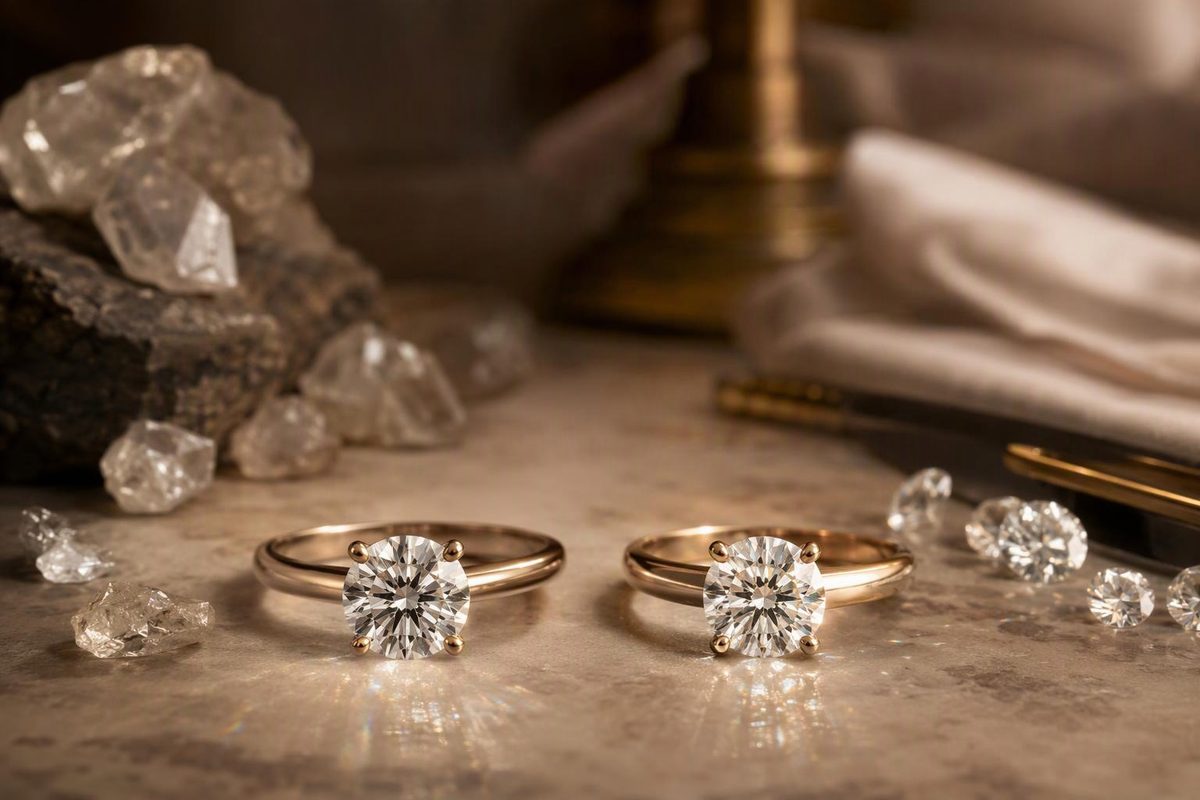
A loose 1-carat lab-grown diamond can cost hundreds of dollars rather than the thousands asked for a similarly specified natural diamond. In an October 10, 2026 retail snapshot, Ritani listed a 1.00 ct round D/VS2 lab-grown diamond at $311 and a 1.00 ct round D/VS2 natural diamond at $4,791. Those are individual asking prices—not market averages or finished-ring prices. (Lab-grown listing, natural listing)
Comparing stones with similar listed specifications
The following prices are in US dollars, for loose stones, before any additional checkout promotion, setting or applicable tax. Specifications are seller-listed unless noted otherwise.
| Specification | Lab-grown diamond | Natural diamond |
|---|---|---|
| Retailer | Ritani | Ritani |
| Weight and shape | 1.00 ct round | 1.00 ct round |
| Color / clarity | D / VS2 | D / VS2 |
| Seller’s cut label | Ideal | Ideal |
| Listed report | IGI LG802602685 | GIA 7562132239 |
| Listed dimensions | 6.41 × 6.38 × 3.94 mm | 6.45 × 6.41 × 3.92 mm |
| Asking price, October 10, 2026 | $311 | $4,791 |
Sources: Ritani lab-grown stone and Ritani natural stone.
For this pair, the lab-grown stone was $4,480 cheaper—about 93.5% less. The natural asking price was approximately 15.4 times the lab-grown price. Do not treat that percentage as a universal discount across retailers, shapes or quality levels.
There is also a documentation distinction. IGI’s record confirms the lab-grown stone’s 1.00 ct weight, D color, VS2 clarity and Ideal cut grade. On the comparison date, GIA’s verification page for the listed natural report returned “Results Not Yet Available,” stating that the item was still undergoing service. The natural specifications therefore remain seller claims here; obtain and verify the completed report before committing to that stone. Matching listed grades does not establish identical appearance or light performance.
Retailer choice and specifications still matter. On the same date, a separate Brilliance listing showed a 1.00 ct round D/VVS2 lab-grown diamond, seller-labeled “Super Ideal,” at $920 before its advertised code discount. It is not an exact match, but it shows why “1-carat lab-grown” does not identify one price.
What the natural premium buys
The price gap does not mean the cheaper stone is imitation diamond. GIA explains that laboratory-grown diamonds have essentially the same chemical, physical and optical properties as natural diamonds; distinguishing their origin reliably requires professional laboratory methods or specialized equipment. (GIA’s explanation)
The extra expenditure buys natural origin, alongside the characteristics and selling terms of the particular stone. It does not automatically buy more sparkle. Cut quality is central to light performance, and even diamonds within one cut grade can have different face-up appearances. (GIA on diamond quality)
Choose natural if geological origin has enough personal or collecting significance to justify the premium. Choose lab-grown if your priority is the appearance of a diamond at a lower acquisition cost. Neither preference establishes that an individual listing is good value.
Compare the finished ring, not just the center stone
Adding the same mounting cost to both options reduces the percentage saving.
For example, assuming the same hypothetical $1,000 setting, with no other charges:
- Lab-grown ring: $311 + $1,000 = $1,311.
- Natural ring: $4,791 + $1,000 = $5,791.
- Difference: still $4,480, but roughly 77% of the natural ring total, rather than 93.5%.
That setting allowance is an illustration, not a retailer quote. Request an itemized total covering the center stone, metal and setting, side stones, mounting labor, applicable taxes and any delivery or resizing charges. Confirm that “1 carat” means the center stone—not the combined weight of every diamond in the ring.
What to check before paying
Keep the comparison genuinely comparable. Match shape, actual weight, color and clarity, then compare dimensions, proportions, fluorescence and visible appearance. A seller’s “Ideal” label is not necessarily the laboratory’s grade: GIA’s natural round-brilliant cut scale tops at Excellent. (GIA cut-grade explanation)
Pay for visible improvements first. Inspect video and, where possible, the stone in different lighting. Do not upgrade from an acceptable, eye-clean stone merely because a higher clarity grade sounds better. Our guide to whether lab-grown diamond grades matter explains that trade-off.
Check the report system and date. GIA announced an October 1, 2025 launch for its Premium and Standard quality assessments for D-to-Z lab-grown diamonds. These overall assessments are not interchangeable with an IGI D/VS2 description. (GIA service announcement)
Separate resale from purchase price. A buyback policy is not a guaranteed recovery percentage. As of October 10, 2026, Ritani’s Reclaim program excluded lab-grown diamonds and reserved the right to decline natural submissions despite its stated eligibility thresholds. (Program terms) If resale matters, compare written cash offers and selling costs—not an assumed percentage of retail. See how lab-grown resale value depends on the buyer.
For a price-led purchase, shortlist acceptable lab-grown stones first. Pay the natural premium only when natural origin itself matters to you, after verifying the stone and the complete ring quote.