
How to Compare 3 Carat Diamond Stud Earrings
Check each stone’s weight, origin, cut, dimensions, matching and reports, then verify the setting, backs, returns, delivery and warranty.
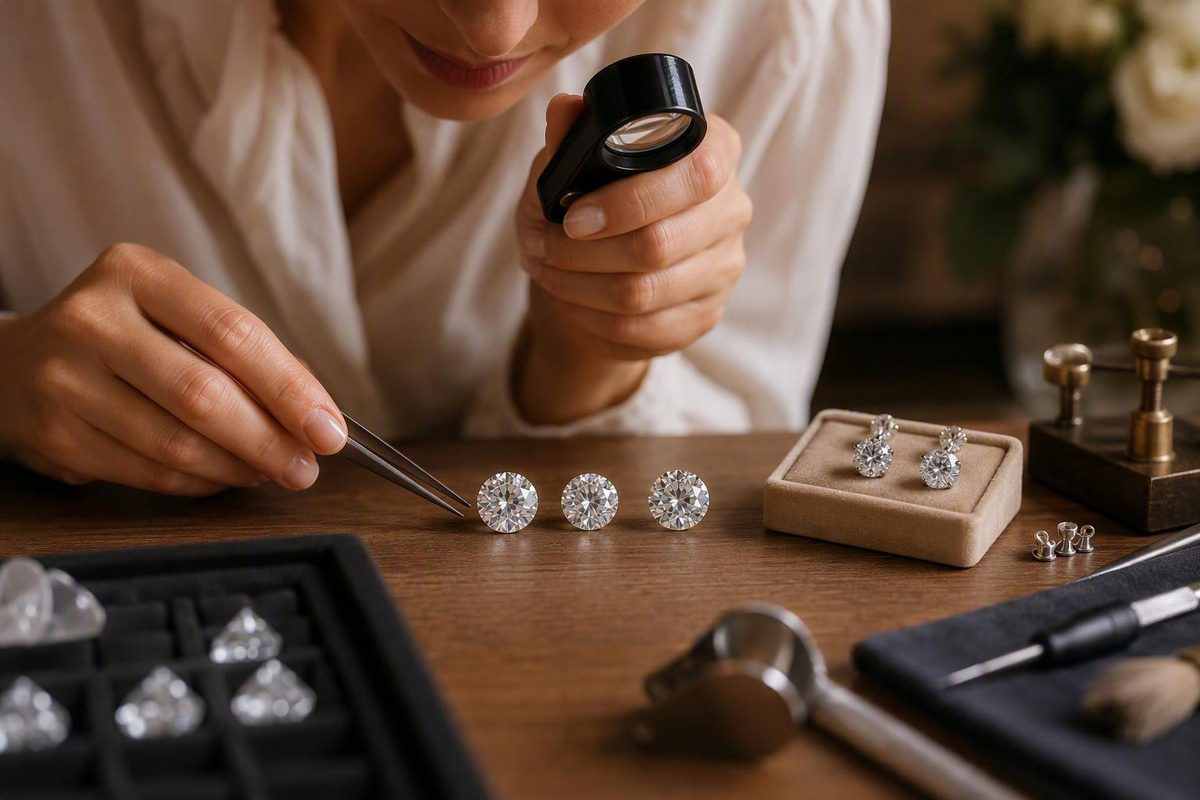
A pair advertised as 3 ctw usually has about three carats of diamonds across both earrings. That commonly works out to about 1.50 carats per ear, as illustrated by a Little Switzerland listing that describes 3.00 ctw as 1.50 carats per earring. Before comparing prices, confirm each diamond’s exact weight and origin, then compare cut, dimensions, matching, grading reports, setting, backs, return eligibility, delivery terms, and warranty coverage. Total carat weight and advertised discounts alone do not establish comparable quality or value.
First, confirm what “3 carats” means
In the listings compared here, “3 ct. tw.” or “3 ctw” denotes a combined weight of approximately 3 carats across two earrings. Sellers may describe that as roughly 1.50 carats per ear, but buyers should not assume every pair contains two diamonds weighing exactly 1.50 carats.
The two stones may differ slightly while still reaching the advertised total, and a seller may apply a stated weight tolerance. Ask for the exact weight of each diamond to two decimal places, along with the tolerance used for the advertised total. This matters even when a title appears to promise a simple 1.50-and-1.50 split.
Carat is a measure of weight rather than visible size. One metric carat equals 200 milligrams, and equal-carat diamonds can have different face-up dimensions because their proportions distribute weight differently. These distinctions follow the GIA explanation of carat weight and the 4Cs.
Millimeter dimensions are therefore essential. For a round diamond, ask for minimum diameter, maximum diameter, and total depth. Those measurements reveal whether the stones have similar visible spread and whether either one carries unusual depth.
As a product-specific reference, Ring Concierge lists an approximate diameter of 7.40 mm for its 3-carat-total option and says total weight may vary by as much as 0.05 carat. Those figures apply to that listing and should not be treated as universal dimensions or tolerances for every nominal 1.50-carat round diamond. The page also does not explicitly clarify whether its approximate diameter applies to each stone, so that point should be confirmed with the seller before purchase. (Ring Concierge listing)
Terminology
- ct.: Carat, a unit of diamond weight.
- ct. tw. or ctw: Total carat weight, usually the combined weight of all diamonds in the item.
- Per-ear weight: The weight of the diamond in one earring. For a nominal 3 ctw pair, this is commonly about 1.50 carats.
- Millimeter diameter: The face-up width of a round diamond. It describes visible spread, not weight.
The safest interpretation is that “3 ctw” describes the combined pair unless the seller clearly states otherwise. Exact per-stone weights and measurements remain separate facts to verify.
Compare natural and lab-grown pairs separately
Choose your origin preference first, then compare pairs with similar specifications. A lab-grown pair and a mined pair can differ greatly in price without the headline carat weight explaining that difference.
| Compare | Ask for | Why it matters |
|---|---|---|
| Both diamonds | Individual weight, dimensions and reports | Total weight does not prove matching |
| Appearance | Pair photographs or video in neutral light | Similar grades can still look different |
| Construction | Metal, basket, post and backing | Changes handling, protection and price |
| Complete offer | Final quote and written return terms | Advertised variants may have different exclusions |
“Average H–I,” “minimum G,” or “E–F” descriptions do not identify the exact grade of each delivered stone. Ask for the individual details before deciding that two offers are comparable. Keep the seller’s quoted date and selected configuration alongside the price.
Prioritize cut and matching before premium color or clarity
Use the 4Cs—cut, color, clarity, and carat weight—as a framework, but evaluate them together. No single grade or weight determines whether a pair will be attractive, well matched, or appropriately priced.
For round brilliant studs, cut is usually the first quality specification to protect. Cut governs how a diamond interacts with light and influences brightness, fire, scintillation, and overall face-up appearance. GIA recommends looking for Excellent or Very Good GIA cut grades in round brilliant studs and cautions that a poorly cut diamond may look dull regardless of its carat weight. GIA also notes that earrings can permit some flexibility in color and clarity because nearby hair, skin, and metal affect perceived color, while inclusions may be less conspicuous at ordinary viewing distance. (GIA diamond-stud guidance)
That flexibility is not a reason to buy from the grade alone. Similarly, two diamonds within a broad color range may not show identical tint.
Grouped, average, and minimum grades conceal important detail:
- H–I average does not identify either stone’s exact color grade.
- E–F may allow one diamond at E and the other at F.
- G minimum establishes a floor but does not identify the delivered grade.
- VS minimum does not show whether both stones have the same clarity.
- An average grade does not guarantee that both diamonds received the same individual grade.
VS1 is not Flawless. Flawless is a separate clarity grade in which no inclusions or blemishes are visible to a skilled grader under 10× magnification. Clarity assessment considers the size, number, position, nature, and visibility or relief of inclusions and blemishes. A VS1 diamond can contain clarity characteristics even when they are difficult to see. (GIA diamond-quality factors)
Be especially deliberate with I1 diamonds. The grade alone does not reveal whether an inclusion is central or peripheral, light or dark, isolated or concentrated, or whether transparency is affected. Inspect both stones individually rather than assuming every I1 diamond will be eye-clean—or necessarily look visibly included.
A practical budget order for round studs is:
- Cut and visible light performance
- Close matching between the two diamonds
- Color and clarity that look acceptable to you
- Metal, setting, and backing preferences
Premium color and clarity can still matter. The risk is paying for those grades before confirming cut, visible diameter, transparency, and pair matching—characteristics that may have a greater effect on how the earrings look when worn.
Judge the two diamonds as a matched pair
A combined 3-carat weight does not prove that the diamonds are equally weighted, equally sized, or visually balanced. Treat the earrings as two individual diamonds that must also work together as a pair.
Start with exact weight and measurements. For each round diamond, request:
- Exact carat weight
- Minimum and maximum diameter
- Total depth in millimeters
- Table percentage
- Depth percentage
- Crown and pavilion information, when reported
- Girdle description
A meaningful diameter difference may remain visible even when their combined weight reaches the advertised total.
Next, request both stones’:
- Exact color and clarity grades
- Cut grade, where applicable
- Polish and symmetry
- Fluorescence
- Treatment status
- Natural or laboratory-grown origin
- Grading laboratory and report number
Compare the diamonds together in neutral-light photographs or video if the seller provides them. Look for differences in apparent diameter, outline, tint, transparency, brightness, and the location of visible inclusions. Media can help expose a mismatch, but it cannot replace grading documentation or an independent physical inspection.
A concise request to the seller could read:
Please provide the grading laboratory and report number for each diamond; each stone’s exact carat weight and millimeter dimensions; natural or laboratory-grown origin; treatment status; color, clarity, cut, polish, and symmetry grades; fluorescence; table, depth, and available proportion details. Please confirm in writing that both reports correspond to the diamonds mounted in the earrings I will receive, and send neutral-light photographs or video showing the pair together.
When a GIA report is claimed, check each number using GIA Report Check. A matching database record does not, by itself, establish that the two diamonds look perfectly matched, that the setting is well made, that the reports correspond to the mounted stones, or that the asking price is fair.
Report formats differ. Since October 1, 2025, GIA’s D-to-Z laboratory-grown diamond assessments use Premium or Standard. Do not expect every lab or older report to use that format; inspect the actual document and date.
If the earrings arrive with meaningful value at stake, consider arranging an independent inspection during the return window. The inspection should reconcile each stone with its report, assess visible matching, and examine the prongs, posts, backs, and finish before the right to return expires.
Choose the setting, metal, and backs for how the earrings will be worn
Construction affects appearance, protection, handling, and comfort. No configuration is universally best, so choose according to how often the earrings will be worn and how the wearer balances convenience, coverage, and resistance to accidental removal.
| Feature | Prong setting | Bezel setting |
|---|---|---|
| Diamond exposure | More of the diamond remains visible | A metal rim surrounds more of the diamond |
| Apparent openness | Airier, less metal-forward appearance | More enclosed, with a defined metal outline |
| Protection | Less coverage around the edge | Greater edge coverage and protection |
| Main tradeoff | More exposed diamond, but less edge protection | More protection, but more diamond area covered |
Prong settings expose more of the diamond and can support a more open presentation. Bezel settings surround the stone with a metal rim, covering more of its area while providing greater edge protection.
Three- and four-prong designs both appear in the compared listings. Prong count alone does not prove that a setting will sit lower, resist tilting, appear larger, or be structurally superior. Those outcomes depend on the basket, post placement, dimensions, workmanship, and the wearer’s ear.
Backs present a separate set of tradeoffs:
- Friction or push backs are quick to use but rely on tension.
-
Screw backs thread onto the post and offer greater resistance to accidental removal, although the thicker threaded post may feel less comfortable to some wearers.
-
Guardian backs should be treated as a named product feature, not a guarantee against loss.
GIA describes screw and locking backs as more secure than friction backs while noting that thicker threaded posts may be uncomfortable for some wearers. Its guidance also explains that prong settings expose more of the diamond, whereas bezels cover more area and provide greater protection. (GIA diamond-stud guidance)
Before buying, ask the seller to explain how the selected backs operate. Confirm whether replacement backs are readily available or proprietary and whether changing the backing style alters the post, price, production time, or return eligibility.
Metal choices represented in the compared listings include 14K and 18K white gold, yellow or rose gold, and platinum. White gold or platinum can support a bright-white presentation for diamonds in the D–J range, while yellow or rose gold creates more visible contrast. Style preference remains central, and the exact metal selected may change the price or fulfillment terms.
Do not rely on a generic description when the page offers several variants. Confirm that the invoice identifies the selected metal, setting, prong count, post, and backing type.
Use this pre-purchase verification checklist
Obtain the important specifications and policies in writing before placing an order.
Diamond identity and grading
- [ ] Origin and treatment disclosures for both stones
- [ ] Individual weights and millimeter dimensions
- [ ] Actual laboratory reports, numbers and report dates
- [ ] Applicable grades or assessment categories—not just a retailer average
- [ ] Confirmation that the documents match the mounted stones
Laboratory-grown diamonds should be clearly distinguished from mined diamonds. Material treatments should also be disclosed when they affect value, durability, or required care. FTC consumer guidance explains that carat describes weight rather than physical dimensions, that decimal weights are subject to stated precision, and that buyers should retain paperwork identifying origin, weight or size, and relevant treatments. (FTC consumer guidance)
Exact configuration and price
- [ ] Price for the exact natural or lab-grown selection
- [ ] Price for the selected quality tier
- [ ] Metal type and color
- [ ] Setting style and prong count
- [ ] Post and backing type
- [ ] Taxes, shipping charges, duties, and certificate or customization fees
- [ ] Confirmation that the displayed discount applies to this configuration
A promotional percentage is not a substitute for a documented final price. Confirm the complete amount for the exact pair rather than relying on a headline discount or a price shown beside multiple size, metal, or backing options.
Production and delivery
- [ ] Ready-to-ship, made-to-order, or pre-order status
- [ ] Expected production completion date
- [ ] Expected ship and delivery dates
- [ ] Insured shipping
- [ ] Signature requirements
- [ ] Responsibility for international duties and taxes
- [ ] Procedure and deadline for reporting loss or damage in transit
A ready-to-ship pair and a made-to-order pair are not equivalent purchase experiences. If the earrings are intended for an event or gift date, preserve the promised production and delivery schedule in writing. Clarify whether the return period begins at shipment, delivery, or another stated point.
Returns and warranty
- [ ] Length of the return period and when it begins
- [ ] Refund method
- [ ] Return-shipping or restocking charges
- [ ] Eligibility of made-to-order pieces
- [ ] Eligibility after changing the metal, setting, post, or backs
- [ ] Rules for customized, modified, engraved, resized, or exchanged items
- [ ] Required condition, packaging, paperwork, and certificates
- [ ] Fees or loss of eligibility for missing grading reports
- [ ] Written confirmation that the warranty applies to these earrings
- [ ] Coverage for manufacturing defects in settings, posts, and backs
- [ ] Exclusions involving normal wear, loss, theft, cracked stones, posts, backs, or prongs
Get return and refund terms in writing. A general “30-day returns” statement may not apply to made-to-order, modified, engraved, previously exchanged, or otherwise customized earrings. Some sellers also require all original certificates and paperwork or impose fees when they are missing.
Likewise, do not rely on a “lifetime warranty” badge without reading the detailed policy. Confirm that the warranty applies to earrings rather than only bridal jewelry or selected product categories, and identify what it excludes. A warranty covering manufacturing defects does not necessarily cover wear, accidental damage, loss, theft, cracked stones, bent posts, damaged prongs, or missing backs.
Keep the invoice, written origin and treatment disclosures, grading reports, report-number verification, photographs, delivery records, seller correspondence, and any appraisal supplied. These records can help resolve a product mismatch and support an insurance application where appropriate.
Red flags
- “Certified” diamonds with no named laboratory or report numbers
- A displayed price that may apply to another size, metal, grade, or backing option
- Contradictory color grades, prices, stock labels, or delivery statements
- Broad average, range, or minimum grades with no per-stone detail
- No individual weights or millimeter measurements
- Reports that cannot be matched to the mounted diamonds
- Return language that excludes the selected made-to-order or modified configuration
- Warranty language that does not clearly apply to earrings