
2 Carat Lab Grown Diamond Cost by Shape
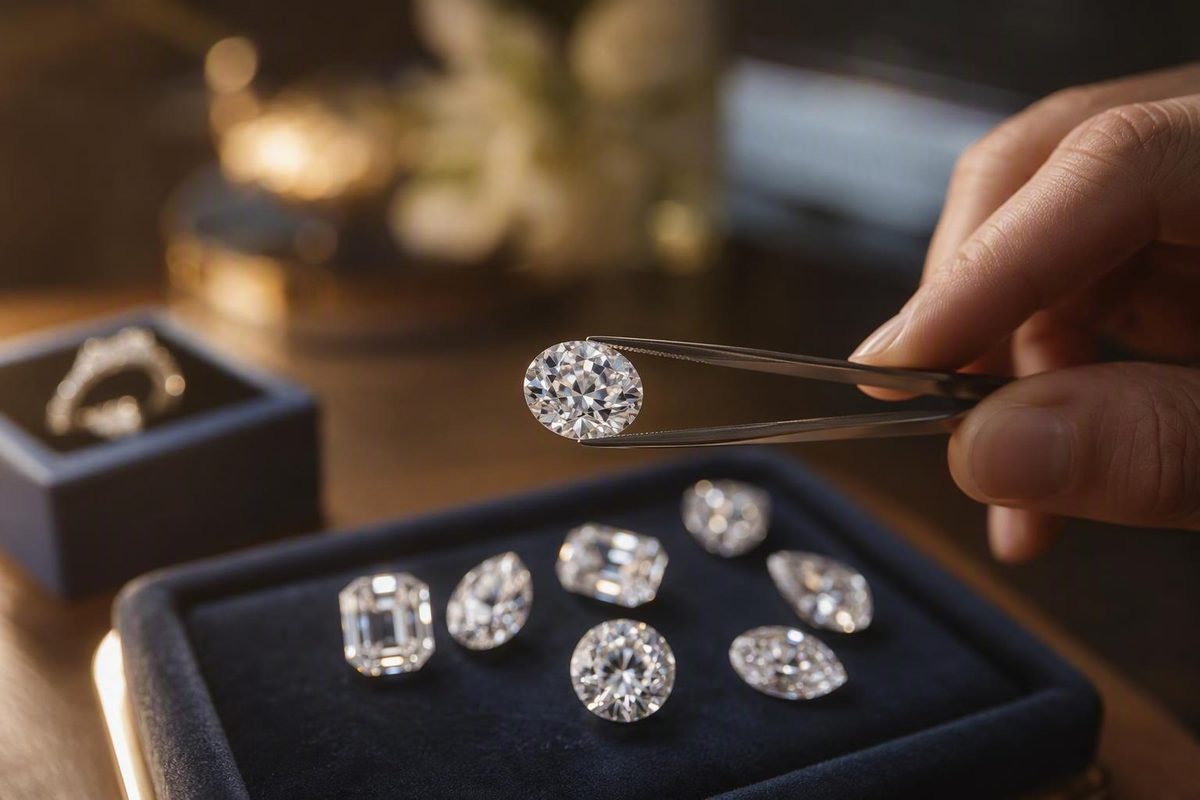
$1,000 can be enough for a loose 2-carat lab-grown diamond. Price the finished ring separately to account for the setting and other applicable costs.
Updated August 10, 2026. This guide compares an August 2026 inventory-derived index with retailer and marketplace snapshots supplied for review. Where a retailer snapshot has no verified observation date, it is identified as a supplied snapshot rather than described as current inventory. All quoted figures are advertised prices or index values—not verified completed-sale prices.
The short answer: expect roughly $900–$1,400 for many loose stones
A practical starting budget for many advertised loose lab-grown diamonds around 2 carats is approximately $900–$1,400. This is a shopping benchmark, not a universal average or a guarantee of what a buyer will ultimately pay.
The benchmark combines two kinds of evidence. A supplied retailer snapshot showed loose stones weighing about 2.00–2.09 carats at advertised prices from $877 to $1,198, while the broader shape index detailed later extends from the low $900s to the low $1,400s. The retailer snapshot included exact 2.00-carat rounds at $931–$997 and a 2.08-carat D/VS1 Excellent-cut round at $1,198. See the supplied 2-carat retailer inventory and specifications.
The closest available same-shape, same-weight snapshot—not a true like-for-like comparison—contained:
- A 2.00-carat F/SI1 round with Excellent cut at $997
- A 2.00-carat E/SI1 round with Fair cut at $931
- A 2.00-carat G/SI1 round with Fair cut at $943
- A 2.08-carat D/VS1 round with Excellent cut at $1,198
Those diamonds differed in color, clarity, cut grade, exact weight, and potentially their proportions. The group is useful for establishing an advertised-price neighborhood, but it cannot isolate what any one specification was worth.
The same retailer snapshot included a 2.05-carat E/SI1 radiant with Fair cut at $877. That example illustrates how shape, cut information, and individual inventory can move a quote below the central benchmark.
Offers below $800 also exist. A price-sorted Rare Carat extract displayed 2.00–2.04-carat round diamonds at $740–$755. The visible stones were predominantly J color and VS1 clarity, and the first result was explicitly labeled as the lowest price. These are credible low-end listing examples, not evidence that every 2-carat diamond should cost less than $800. Review the price-sorted marketplace inventory.
At the other end, premium color, clarity, cut specifications, particular shapes, or seller positioning can produce quotes of several thousand dollars. The supplied retailer guides include estimates reaching $5,000–$8,000 or more, but the visible inventory provides less direct support for treating those figures as a representative current price.
A several-thousand-dollar quote may describe an unusually specified stone, an older market, a complete ring rather than a loose diamond, or a higher-priced seller. Do not reset your expectations until the quote has been matched against alternatives with the same shape, exact weight, grades, dimensions, report, and product type.
A useful initial interpretation is:
- About $740–$900: low-price territory that deserves close inspection
- About $900–$1,400: a productive search range for many advertised loose stones
- Several thousand dollars: possible for premium specifications or higher-priced offers, but not automatically necessary
Prices and availability can change quickly. Use these figures to set filters and identify outliers, not as a promise that a particular stone will remain available.
Why published price ranges disagree so dramatically
Search for “how much is a 2 carat lab grown diamond,” and the answers may run from less than $800 to $8,000 or more.
The evidence falls into three broad, non-universal tiers:
| Pricing tier | What the evidence represents | How to interpret it |
|---|---|---|
| About $740–$900 | Low-price listings and lower-priced visible inventory | Real advertised examples, often connected to particular grades or sorted from the cheapest results |
| About $900–$1,400 | Retailer inventory and broad shape indices | A useful search benchmark for many loose stones, not a completed-sale average |
| Several thousand dollars | Broad retailer guides and premium estimates | Specification-dependent guidance that may reflect older prices, exceptional grades, or seller positioning |
The $740–$755 marketplace examples are particularly easy to misuse. They appeared at the low end of a price-sorted extract and were dominated by J-color, VS1 round diamonds. A buyer seeking D color, a different shape, particular proportions, or a specific grading report is not comparing the same product.
Conversely, J color does not automatically make a diamond unsuitable. It simply means those low-price listings cannot represent every possible combination of color, clarity, cut, shape, and documentation.
Commercial price guides frame the market differently. Washington Diamond describes a range of $1,000–$8,000, dividing it into a “basic” tier of $1,000–$3,000 and a “high quality” tier of $3,000–$8,000 or more. The guide associates its higher tier with VS-or-better clarity, D–F color, and Excellent cut, but it does not disclose a transparent inventory sample or visible pricing date. Read the retailer’s broad pricing guide.
Another retailer guide, published in March 2024, starts entry-level pricing around $995, places mid-range pricing near $2,000–$3,000, and says premium specifications can cost $5,000 or more. It connects the premium tier with exceptional cut, D–E color, and VVS-or-better clarity. Because that commercial guide predates the August 2026 index evidence and moves between loose diamonds and jewelry examples, it should not outweigh live, specification-matched inventory. See the March 2024 price breakdown.
Do not average these figures. An arithmetic midpoint between a price-sorted J/VS1 listing and an older D/VVS premium estimate would not describe a consistently specified diamond.
Sources may differ in:
- Observation or publication date
- Seller and seller margin
- Shape and exact carat weight
- Color, clarity, cut information, and proportions
- Grading laboratory
- Face-up dimensions
- Included services
- Whether the item is loose or set
- Whether a promotion is active
- Whether results are sorted from the lowest price
- Whether “quality” means a grade, visible appearance, or a seller-defined category
It also matters what kind of number you are reading.
Advertised listing price: The amount displayed for a particular stone. It may change and does not prove that the diamond sold at that price.
Promotional sale price: A temporary advertised price tied to a discount. A crossed-out reference amount is not proof that routine purchases occurred at the higher figure.
Inventory-derived index: An aggregated or modeled view of online asking prices. It can indicate broad levels and direction, but it is not a record of completed transactions.
Completed-sale price: The amount a buyer actually paid after any discount, negotiation, or adjustment. The supplied evidence does not include a representative dataset of completed sales.
When comparing a $900 quote with a $4,000 quote, first determine whether both describe the same shape, weight, grades, dimensions, report, visual performance, seller terms, and product type. Frequently, they do not.
Loose diamond versus finished ring: build two separate budgets
The $900–$1,400 benchmark concerns the loose center diamond. It should not be presented as an all-in engagement-ring budget.
A finished ring may include the center stone, metal setting, labor, accent diamonds, and design features. Tax, shipping, resizing, insurance, or customization may be additional, depending on the seller.
Build the budget in two stages:
- Decide what you are willing to spend on the loose center diamond.
- Add the exact setting and every other applicable cost.
A supplied promotional retailer snapshot showed the following complete-ring prices for designs with 2.00-carat center stones. All were advertised at 55% off, so they are time-sensitive examples rather than permanent market benchmarks. See the promotional ring listings.
| Product type | What the advertised example includes | Promotional advertised range |
|---|---|---|
| Loose center diamond | Diamond only; no setting | Use a separate loose-stone benchmark |
| Simple solitaire | A 2.00-carat center in a relatively simple setting | $1,324–$1,341 |
| Halo, side-stone, or channel-set ring | Center stone, setting, and additional diamonds in many designs | $1,489–$1,928 |
| Three-stone ring | Center stone, setting, and two principal side stones | $2,092–$2,336 |
Some of those rings had total weights above 2.00 carats because the designs included additional diamonds. That makes the distinction between center-stone weight and total carat weight essential:
- A ring with a 2.00-carat center diamond has one principal stone weighing 2.00 carats.
- A ring labeled 2.00 carats total weight—often written as 2.00 ctw or 2.00 tcw—may divide that weight among a smaller center and multiple accent stones.
These are not equivalent products. A halo or multi-stone ring can reach 2.00 carats total without containing a 2.00-carat center. If you want the appearance of a 2-carat solitaire, confirm the center weight separately.
Use this all-in formula:
Loose center diamond + setting + accent stones + applicable tax + shipping + resizing + insurance or other services not expressly included = total purchase budget
Do not assume every component in a photograph is included.
Confirm whether the displayed amount includes:
- The exact center diamond
- The pictured setting
- All accent stones
- The selected metal and ring size
- Design customization
- Shipping and transit insurance
- Resizing
- Applicable taxes
- A matching wedding band, if one is pictured
Some retailer examples approach $4,990 but are inconsistent about whether the quoted amount includes only a setting or a complete ring. Ambiguous examples should not anchor your finished-ring budget.
Use two columns when comparing sellers: center stone and finished ring. If one seller quotes $1,100 for a loose diamond and another quotes $1,650 for a completed solitaire, the second seller is not automatically $550 more expensive. You need the cost of an equivalent setting from the first seller—or the loose-stone component from the second—before making that comparison.
The specifications that move a two-carat diamond’s price
Two lab-grown diamonds can both weigh 2 carats and differ substantially in price and appearance. Carat weight is only one input.
Exact carat weight matters because a “2-carat” category may include stones weighing 2.00, 2.01, 2.08, or more. Collection pages can also include diamonds approaching 3 carats. Record the exact weight rather than relying on a category label.
A cut grade can help with filtering, but it does not replace an examination of measurements, depth, table, outline, symmetry, and moving video.
With ovals, cushions, radiants, pears, and other outlines, appearance should carry substantial weight. Look for a pleasing outline, balanced light return, and no distracting dark or transparent-looking areas.
Color describes the stone’s position on a grading scale. Higher grades such as D–F generally carry higher asking prices than near-colorless or warmer grades, but there is no universally correct choice. Shape, setting, viewing conditions, personal sensitivity, and the individual diamond all affect whether a higher color grade is worth its premium.
Higher grades generally cost more, but the label alone does not reveal how visible a particular inclusion will be.
Neither an SI nor a VS grade guarantees an eye-clean diamond. Inclusion type, location, size, contrast, and viewing distance matter. Review magnified imagery, video at a realistic scale, the report’s clarity information where available, and the seller’s return terms.
The exact-weight examples in the opening demonstrate how multiple variables operate together. Because color, clarity, cut grade, proportions, and exact weight changed between the stones, the observed price differences cannot be attributed to one characteristic alone.
Shape affects the available inventory and the asking price. It also influences outline and apparent spread. Avoid blanket rules such as “every fancy shape is cheaper than a round,” because the August 2026 index does not support that conclusion.
A stone can carry more weight in its depth rather than in visible length or width. Two equal-weight diamonds can therefore present differently in a ring.
It can help verify what is being offered and make comparisons more consistent. It does not prove that the diamond is beautiful, fairly priced, eye-clean to you, or likely to retain value.
Check that the report number matches the listing and, where possible, any inscription on the diamond. Compare the report’s weight, measurements, color, clarity, shape, polish, symmetry, fluorescence, and relevant comments with the seller’s description. A material mismatch is a reason to pause.
Lab-grown diamonds may be produced by HPHT or CVD. The supplied commercial sources identify both methods but do not establish a reliable, universal price premium for either. Evaluate the finished stone, grading information, visual appearance, and final price rather than paying more based on an acronym alone.
Seller pricing can also create differences that are not obvious from the report. A higher price is not automatically unreasonable, but it should correspond to a benefit you can identify—such as a better-looking stone or materially better written terms—not merely a larger crossed-out reference value.
Price by shape—and why carat weight is not visible size
StoneAlgo’s August 2026 snapshot provides the following inventory-derived indices for 2-carat lab-grown diamonds. The index covers broad D–K color and FL–SI2 clarity ranges, so the figures are not controlled comparisons of otherwise identical stones. Review the 2-carat shape index and methodology.
| Shape | Reported 2-carat index |
|---|---|
| Round | $1,096 |
| Oval | $1,231 |
| Princess | $949 |
| Emerald | $1,100 |
| Cushion | $932 |
| Radiant | $1,061 |
| Pear | $1,002 |
| Heart | $1,094 |
| Marquise | $1,427 |
| Asscher | $1,055 |
Cushion had the lowest index in this snapshot at $932, followed by princess at $949. Marquise had the highest at $1,427. That does not establish a permanent ranking: the available mix of grades can differ by shape and change over time.
The table also disproves the simplistic idea that every fancy shape must cost less than a round. Oval and marquise were above the $1,096 round index, while emerald was almost level with it.
When comparing shapes, hold exact weight, color, clarity, cut information, dimensions, and documentation as constant as practical. Otherwise, what looks like a shape premium may partly reflect a different inventory mix.
Carat measures weight, not face-up width or area. A retailer describes a 2-carat round as approximately 8 millimeters across, but that is only a rough reference. The actual diameter depends on the stone’s proportions, while fancy shapes require both length and width measurements.
For each candidate, record:
- Length, width, and depth in millimeters
- Length-to-width ratio
- Total depth percentage
- Table percentage, where relevant
- Outline and symmetry
- Face-up appearance in video
- Exact carat weight
Two 2-carat ovals can have very different visual personalities: one may be shorter and broader, while the other is longer and narrower. The ratio helps filter for preference but cannot determine whether the outline is attractive.
That does not mean the shallowest diamond is always best. Poorly coordinated proportions can undermine visual performance even when the millimeter measurements look large.
Compare actual dimensions and video rather than assuming the heavier number must look larger.
How to target value without paying for grades you cannot appreciate
There is no single cut, color, and clarity combination that guarantees the best value for every buyer. Value depends on what you can see, the setting you choose, the shape you prefer, and how much you are willing to pay for subtle differences.
A sensible sequence is:
- Choose a shape you genuinely like.
- Prioritize attractive cut, proportions, and face-up appearance.
- Find a clarity grade that looks acceptably clean in that specific stone.
- Choose a color that looks right to you in the intended setting.
- Compare the result with closely matched alternatives.
This order reduces the risk of paying automatically for the highest labels. A D-color diamond occupies a higher position on the grading scale than a lower color grade, but that does not make the premium valuable to every buyer. Likewise, a VVS clarity grade may cost more than a lower grade even when both stones look equally clean without magnification.
“Eye-clean” must be judged stone by stone. A VS diamond is not guaranteed to be visually clean under every viewing condition, and an SI diamond is not guaranteed to show an obvious inclusion. Ask for useful magnified imagery, then review the stone at a realistic scale.
Color should also be judged in context. A near-colorless or warmer diamond may look entirely acceptable to one buyer and visibly tinted to another. Avoid purchasing a grade solely because a commercial guide calls it the universal “sweet spot.”
Use the grading report and visual evidence together:
- The report documents identity and assessed characteristics.
- Video helps reveal outline, inclusions, and face-up behavior.
- Dimensions show how the carat weight is distributed.
- Written seller terms determine whether you can inspect and return the stone under acceptable conditions.
If the available video is heavily edited, shown only under intense spotlighting, or limited to one angle, request additional material. Multiple angles and a normal-scale view are more useful than one glamorous still image.
Stones weighing 1.90–1.99 carats can be worth considering, but the supplied evidence does not establish a guaranteed dollar or percentage saving. A 1.96-carat diamond can cost more than a 2.00-carat stone if its color, clarity, cut information, proportions, or seller differs.
Use the tactic correctly: compare the just-under-2-carat candidate with a 2.00-carat diamond of similar shape, cut information, color, clarity, documentation, and dimensions. If the smaller stone has nearly the same face-up measurements and a meaningfully lower final price, it may offer better value. If it is substantially smaller or only marginally cheaper, the threshold strategy has achieved little.
Create a comparison sheet for three to five candidates:
| Comparison field | Why it matters |
|---|---|
| Shape and exact carat | Establishes the basic product |
| Cut grade or available cut data | Adds context for proportions and appearance |
| Color and clarity | Prevents accidental comparison of different quality tiers |
| Measurements | Reveals face-up spread and weight distribution |
| Table, depth, and ratio | Provides proportion context |
| Grading laboratory and report number | Helps verify identity and specifications |
| Video observations | Captures appearance that labels cannot |
| Loose or set price | Prevents product-type confusion |
| Final checkout price | Shows the amount that matters |
| Return and other seller terms | Adds the practical value of the offer |
The goal is not to find the lowest number attached to “2 carats.” It is to find the lowest defensible all-in price for a stone you actually like, with documentation and written seller terms that make the purchase acceptable.
A listing-by-listing checklist before you buy
A low advertised price can represent a genuine opportunity, a stone with visible tradeoffs, or an incomplete comparison. Apply the same process to every listing.
1. Identify what the price covers
Confirm whether the amount is for:
- A loose diamond
- A setting only
- A complete ring
- A starting configuration that changes after customization
For a complete ring, verify that the center diamond, pictured setting, accent stones, and selected metal are included.
2. Separate center weight from total carat weight
Record the center stone’s exact weight. If the listing uses total carat weight, determine how much belongs to the center and how much belongs to accent stones.
Do not compare a 2.00-carat-total halo ring with a solitaire containing a 2.00-carat center.
3. Capture the full specifications
Save the following information:
- Exact carat weight
- Shape
- Color grade
- Clarity grade
- Cut grade, where provided
- Polish and symmetry
- Fluorescence
- Measurements
- Table and depth
- Length-to-width ratio for fancy shapes
- Girdle and culet information where relevant
- Growth method if stated
- Treatment or post-growth information documented in the report
A listing that omits important specifications may still be worth investigating, but missing information should not be treated as favorable information.
4. Verify the grading report
Obtain the report number and match its specifications with the listing. Check the exact weight, measurements, color, clarity, shape, and identifying comments. If an inscription is stated, ask the seller to confirm it.
The report is a verification and comparison tool. It is not a guarantee of beauty, eye cleanliness, fair pricing, or future value.
5. Inspect the visual appearance
Review useful imagery or video for:
- A pleasing outline
- Balanced brightness as the stone moves
- Persistent dark or transparent-looking areas
- Distracting inclusions
- Visible tint
- Bow-tie effects in elongated shapes
- Windowing or overly glassy areas in step cuts
- Symmetry that looks acceptable to you
No single defect checklist applies equally to every shape. The larger question is whether the diamond remains attractive in ordinary movement rather than only in a selected still frame.
6. Compare the final checkout price
Ignore the emotional effect of a crossed-out “original” price until you know the amount due. Compare final prices for equivalent products, including mandatory charges.
A seller’s comparison value is not proof of savings. It is also not an appraisal, resale offer, or evidence that buyers routinely paid the crossed-out amount.
7. Check promotion and availability details
Determine:
- Whether a coupon is required
- When the promotion ends
- Whether the stone is still available
- Whether a setting discount depends on buying the center diamond
- Whether the pictured item is the exact product being sold
- Whether customization changes the price
- Whether the seller or a separate marketplace participant fulfills the order
Do not assume that saving a listing or adding it to a wish list reserves the diamond.
8. Read the seller terms
Compare the disclosed:
- Return period and conditions
- Refund method
- Restocking or customization restrictions
- Warranty
- Resizing terms
- Upgrade policy
- Buyback policy
- Shipping coverage and insurance
- Inspection or repair procedures
The evidence does not establish uniform market-wide terms. A slightly higher price may be rational if it buys materially better written protections, but only if those protections are useful to you.
9. Give sub-$1,000 stones additional scrutiny—not automatic rejection
A sub-$1,000 2-carat lab-grown diamond is plausible in the supplied advertised inventory. Price alone does not prove that it is a bargain or a poor stone.
Examine its color, cut information, proportions, dimensions, video, grading documentation, and seller terms. A lower price may accompany a warmer color, less appealing proportions, or weaker cut information. It may also reflect a competitively priced listing. Only a matched comparison can distinguish the two.
10. Save a dated copy
Before paying, save screenshots or a PDF showing:
- The listing price
- Diamond specifications
- Report number
- Included components
- Promotion terms
- Return policy
- Expected delivery
- Written commitments from the seller
A dated record provides a reliable reference if the page or price later changes.
Falling prices and resale: buy the diamond, not an investment story
Recent price history matters because an older guide may materially overstate what comparable inventory costs today. Historical declines, however, are not forecasts.
In its August 2026 snapshot, StoneAlgo’s 2-carat lab-grown index reported declines of 11.79% over three months and 30.58% over six months. It also reported that available 2-carat inventory had increased by 16.48%—65,197 diamonds—during the preceding month. These figures describe changes in an inventory-derived measurement, not verified transaction prices, and do not establish that every shape or grade moved at the same rate. See the index underlying the reported trend figures.
The practical lesson is narrow: check live inventory close to the day you plan to buy. A guide from 2022 or 2024 may still explain pricing factors, but it should not determine a 2026 budget without a fresh comparison.
This matters even when a page itself has been updated recently. One retailer article was updated in May 2026, but its detailed 2-carat round price table used observations from June 20, 2022. The date of the underlying prices is therefore more useful than the page’s update label. Review the dated table and methodology.
Should you wait? Possibly, but the supplied evidence cannot identify a guaranteed market bottom. Waiting may expose you to lower prices, but the particular shape or specifications you want may move differently from a broad index.
Resale requires even more caution. Washington Diamond’s commercial guidance describes the resale market for lab-grown diamonds as uncertain and advises against treating the purchase as a financial asset. That is retailer commentary rather than independent resale-market data, and it does not prove that every lab-grown diamond has no resale value. Read the retailer’s resale discussion in context.
Keep three figures separate:
Purchase price: What you pay for the loose stone or finished ring.
It is not cash available to you.
Actual resale proceeds: What a willing buyer offers after considering the individual stone, prevailing market, selling costs, and demand.
A seller’s comparison value is not evidence that you can resell the diamond for that amount. A grading report is not a valuation guarantee. If resale matters, review explicit buyback terms or obtain written offers rather than relying on general assurances.
The sound decision rule is simple: buy when the individual stone, documentation, written seller terms, and total ring cost suit your needs. Do not pay extra because someone presents the diamond as an appreciating asset, and do not delay indefinitely while trying to predict a guaranteed bottom.
Frequently asked questions
Is $1,000 enough for a 2-carat lab-grown diamond?
Yes, $1,000 can be enough for a loose 2-carat lab-grown diamond. In the supplied retailer snapshot, exact 2.00-carat rounds were advertised at $931, $943, and $997. See the listings supporting those examples.
That does not mean every desirable 2-carat stone will cost $1,000 or less. At this budget, compare cut information, proportions, color, clarity, dimensions, video, documentation, and return terms carefully. The setting is normally additional unless the product is explicitly described as a complete ring.
How much is a 2-carat lab-grown diamond ring with the setting included?
In the supplied promotional snapshot, complete rings with 2.00-carat centers were advertised at $1,324–$1,341 for solitaires, $1,489–$1,928 for halo, side-stone, and channel-set designs, and $2,092–$2,336 for three-stone rings. Those examples were advertised at 55% off. Review the complete-ring examples and included designs.
Confirm the exact center specifications, metal, accent stones, ring size, taxes, shipping, and resizing before treating a displayed price as the final total.
Is a 2-carat center diamond the same as a 2-carat total-weight ring?
No. A 2-carat center diamond is one principal stone weighing 2.00 carats. A ring labeled 2 carats total weight may divide those carats among a smaller center and multiple accent diamonds.
Always look for a separately stated center-stone weight. If it is missing, ask the seller before comparing the ring with a 2-carat solitaire.
How large does a 2-carat lab-grown diamond look?
A retailer describes a 2-carat round as approximately 8 millimeters across, but that is only a rough reference. Actual diameter varies with proportions, and fancy shapes require both length and width measurements.
Carat measures weight rather than visible size. Compare the report’s dimensions, depth, length-to-width ratio, and face-up video. Equal-weight diamonds can look different because their weight is distributed differently.
Are 2-carat lab-grown diamond prices still falling?
The supplied August 2026 index snapshot recorded historical declines, but it cannot establish that prices are still falling now or that they will continue to decline. An index describes its measurement period; it is not a forecast.
Check live, closely matched inventory when you are ready to purchase. Compare the shape and specifications you actually want rather than relying on an older guide or a broad market prediction.
Approximately $900–$1,400 remains a useful starting point for many advertised loose 2-carat lab-grown diamonds in the supplied evidence, while low-end and premium examples extend beyond it. The right purchase depends on the individual stone’s cut, appearance, dimensions, grading documentation, seller terms, and finished-ring cost—not carat weight or a headline discount alone. Compare live, specification-matched listings immediately before buying, and treat every quoted price as a time-sensitive asking price rather than a guaranteed value.