
Jewelry Safe With Drawers: Buying Checklist
Compare in-drawer safes with true internal drawers, then verify dimensions, anchoring, backup access, burglary and fire ratings, and insurer requirements.
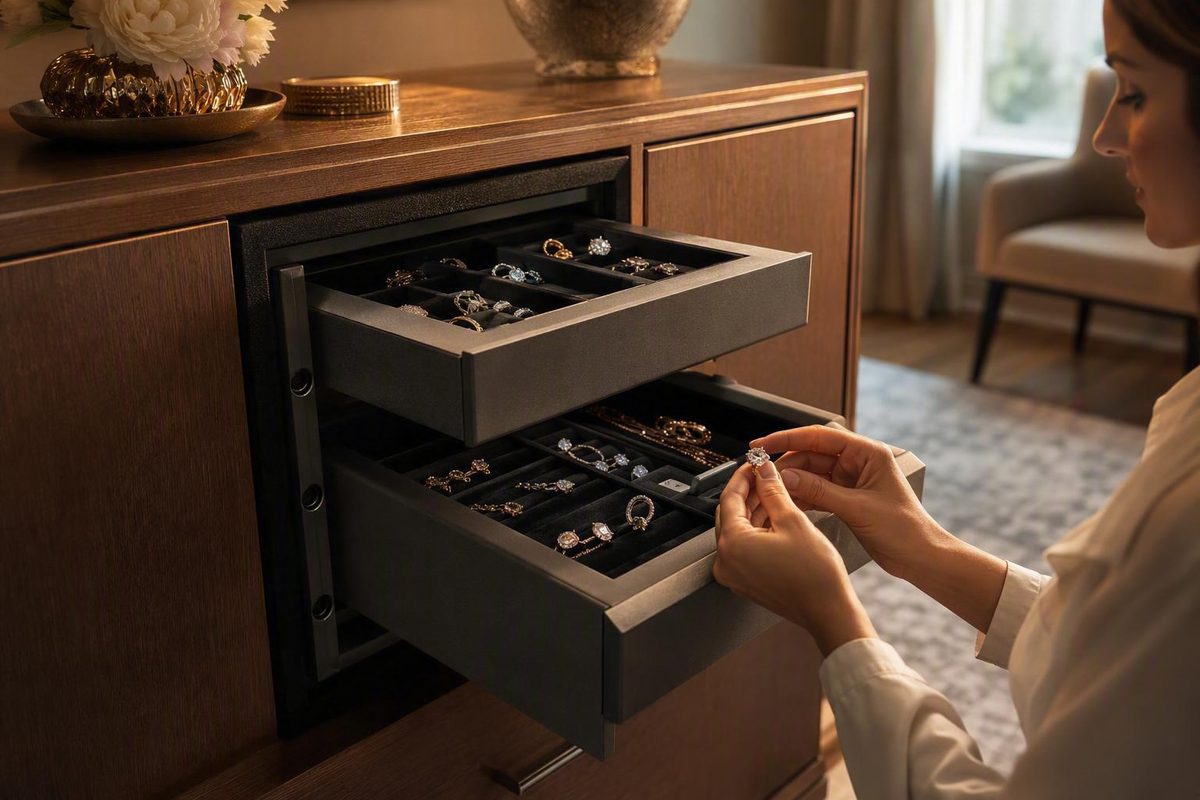
The available product evidence establishes only the first format: drawer-installed safes and separate organizers. Before buying, verify the format, full dimensions, furniture compatibility, anchoring instructions, backup access, certifications, installation needs, and insurer requirements. Treat biometric entry and soft-lined storage as conveniences—not proof of burglary or fire protection.
First, decide what “with drawers” means
An in-drawer safe installs inside a nightstand, dresser, desk, or cabinet drawer. By contrast, a product advertised as a safe with internal drawers would need to contain verified pull-out storage within the safe itself.
The captured Mycube listings show safes intended for installation inside furniture drawers, plus separately listed organization accessories. They do not establish that any cited model contains built-in pull-out jewelry drawers.
Removable compartment trays can provide drawer-like organization, but they are inserts rather than structural drawers. If you want actual internal drawers, check model-specific photographs, specifications, manuals, and parts lists. Confirm that the drawers are included, identify their usable dimensions, and determine whether they lock independently or only sit behind the safe’s main door.
Use this buying checklist before comparing models
Evaluate physical security, fire protection, access convenience, and interior organization separately. A convenient layout does not prove burglary resistance, while a burglary-rated safe may require additional organizers to store jewelry effectively.
| Factor | What to verify | Why it matters |
|---|---|---|
| Collection value | Current appraisals and replacement values | Establishes the potential financial loss |
| Current volume | Jewelry, watches, documents, and loose stones to be stored | Exterior width does not show usable capacity |
| Likely growth | Space needed for future or inherited pieces | Reduces the risk of quickly outgrowing the safe |
| Burglary certification | Exact rating, model listing, and issuing organization | Seller descriptions are not test results |
| Fire certification | Separate rating, duration, and test conditions | Fire and burglary claims cover different hazards |
| Lock backup | Override, battery-failure, and external-power procedures | Electronic access may become unavailable |
| Anchoring | Model-specific installation instructions | Concealment alone does not establish resistance to removal |
| Placement | Privacy, daily access, and installation location | Affects usability and installation planning |
| Safe weight | Published weight for the exact model | Helps determine handling and building-support needs |
| Structural support | Whether the building can support the safe | Heavy units may require structural review |
| Insurer requirements | Requested rating, installation details, alarm information, and appraisals | Coverage terms depend on the individual policy |
Jewelers Mutual recommends considering inventory value and volume, future growth, burglary rating, placement, safe weight, and structural capacity. Its guidance is directed mainly at commercial jewelers, but the questions also provide a useful framework for a residential collection.
Before purchasing, ask your insurer what information it needs to evaluate the proposed safe. Provide the exact model rather than a general description, and ask whether certification records, installation details, alarm information, or current appraisals affect your policy. Do not assume that buying any safe automatically changes coverage.
Measure the furniture, safe, and installation path
For an in-drawer installation, create a measurement worksheet covering:
- Clear internal drawer width, depth, and height
- Available opening width and height
- Full drawer travel
- Space around slides, handles, hinges, and stops
- Drawer and surrounding cabinet construction
- Any published compatibility or load information
- The proposed installation and anchoring location
Obtain the safe’s complete external dimensions rather than relying on its nominal width. Also check usable internal dimensions, lid or door opening clearance, lock and handle projections, battery access, power-cable clearance where applicable, and the space consumed by organizers.
Because the supplied evidence does not establish furniture compatibility for a particular installation, confirm the proposed arrangement with the safe manufacturer’s instructions and any available furniture specifications.
Do not treat concealment as a substitute for anchoring or independently verified burglary resistance. Obtain the installation instructions for the exact safe and determine what the manufacturer specifies before modifying furniture or beginning installation.
For a larger safe, measure the complete delivery route, including exterior doors, corridors, stairs, landings, turns, elevators, thresholds, and the final approach. Jewelers Mutual advises confirming that a building can support the safe, particularly on an upper floor or where a basement is below the installation point, and involving a structural engineer when necessary. Its commercially focused guidance also recommends avoiding exterior or common walls where practical.
Compare the available in-drawer options carefully
The captured Mycube listing showed the following widths and prices. These are seller-listed figures from the time of sourcing, not current-price guarantees.
| Approximate listed width | Captured price |
|---|---|
| 15.5 inches | $545 |
| 19.5 inches | $595 |
| 23.5 inches | $645 |
Mycube also listed a Nightstand Jewelry Safe for $545 and described it as securing into a drawer, using biometric locking technology, and having a soft-touch interior. The captured description appears to reuse or mislabel “In-Drawer” wording, so confirm the model identity and complete specifications before ordering. Review the seller’s In-Drawer listing.
Width and price do not establish usable capacity, furniture compatibility, construction quality, or independently tested security. A wider model is not automatically the better choice.
The available evidence is therefore sufficient for a preliminary size-and-price check, not a model ranking. Before choosing a size, obtain:
- Complete external and usable internal dimensions
- Required opening clearance
- Published model weight
- Installation and anchoring instructions
- Included and optional organizers
- Current price and availability
- Shipping and delivery terms
- Warranty conditions
- Return costs and eligibility, including rules for opened or installed products
Separate organization features from protection
Soft interiors, compartment trays, jewelry cases, passport holders, watch winders, and biometric access can improve organization or convenience. None of these features independently establishes burglary resistance or fire protection.
Mycube lists jewelry-organization accessories separately, so verify what the safe includes and what must be purchased as an option. Consider how each insert affects usable depth and whether it leaves enough room for watches, boxed pieces, documents, or other larger items. Layered removable trays can be flexible, but they may require lifting one organizer to reach another.
Match the interior arrangement to what you own:
- Give rings, earrings, loose stones, and other small items separate compartments.
- Use suitably sized supports for watches instead of stacking them.
- Separate necklaces where practical to reduce contact and tangling.
- Check closing clearance around raised settings, clasps, and bulky pieces.
Treat biometric entry as an access feature unless independent evidence addresses both lock reliability and the safe’s physical resistance. For any electronic lock, consult the manual for the exact model and lock version. Verify the backup-entry process, battery-failure instructions, battery accessibility while the safe is locked, and any documented external-power option. The captured product listing does not answer those questions.
Read burglary ratings without overestimating them
The cited Jewelers Mutual guidance explains common burglary-safe terminology as follows:
- TL means tool resistant.
- TR means torch resistant.
- X6 indicates protection on all six sides under the applicable rating.
- 15, 30, or 60 identifies the applicable controlled-test duration.
Under that guidance, TL-30 describes tool resistance for 30 minutes at the door, while TRTL-30X6 describes torch-and-tool resistance for 30 minutes on all six sides. These durations refer to controlled testing; they do not guarantee that every real-world burglary attempt will take the same amount of elapsed time. Read Jewelers Mutual’s rating explanation.
A current, independently verifiable UL or ULC burglary rating is more informative than general seller language such as “high security” or “heavy duty.” A rating identifies a defined classification and controlled evaluation; marketing descriptions do not provide the same evidence.
The Jewelers Mutual article was published in 2015 and was written for commercial jewelers. Use it as introductory guidance, then verify current terminology and the exact certification record for the model being considered.
The supplied product evidence does not establish a UL or ULC burglary rating for the cited drawer-installed safes. Do not infer one from the lock type, price, weight, appearance, or use of security-oriented language.
Verify fire protection and insurance suitability separately
A burglary classification should not be treated as proof of fire protection.
The available evidence does not support describing the cited drawer-installed models as fireproof, fire rated, waterproof, or water resistant. If protection from a particular hazard matters, request the exact model number, current certification, test standard, duration, and applicable test conditions. Verify the certification with the issuing organization rather than relying only on a retailer category or product description.
Give your insurer the exact safe model, available certification documents, proposed installation details, alarm information, location, and current jewelry appraisal values. Ask for confirmation before assuming that the purchase will satisfy any coverage condition.
Before ordering, verify:
- Exact model identity and lock version
- Complete external dimensions and opening clearances
- Usable internal dimensions and capacity
- Included and optional organizers
- Published model weight
- Model-specific installation and anchoring instructions
- Backup entry and battery-failure procedures
- Current burglary certification
- Current fire certification, if needed
- Insurer acceptance
- Warranty exclusions and claim procedures
- Return eligibility and costs
- Current shipping and delivery conditions
- Installation and building-support needs
What does a TL-30 safe rating mean?
In the cited guidance, TL means tool resistant and 30 refers to a 30-minute controlled-test duration, with TL-30 resistance applying at the door. It is not a guarantee that every real burglary attempt will take 30 minutes. Confirm the current certification for the exact safe rather than relying on a seller’s general use of “TL-30.” See the cited rating guidance.
Can a heavy jewelry safe go on an upper floor?
Possibly, but the building must be able to support the safe at the proposed location. Upper-floor installations—and ground-floor locations above a basement—deserve particular attention. If capacity is uncertain, involve a structural engineer as necessary and plan the delivery route before purchasing.