
Jewelry Protectant Spray: How to Choose and Apply It
Use one only when the maker supports the complete jewelry assembly and provides current application, curing, aftercare and removal directions.
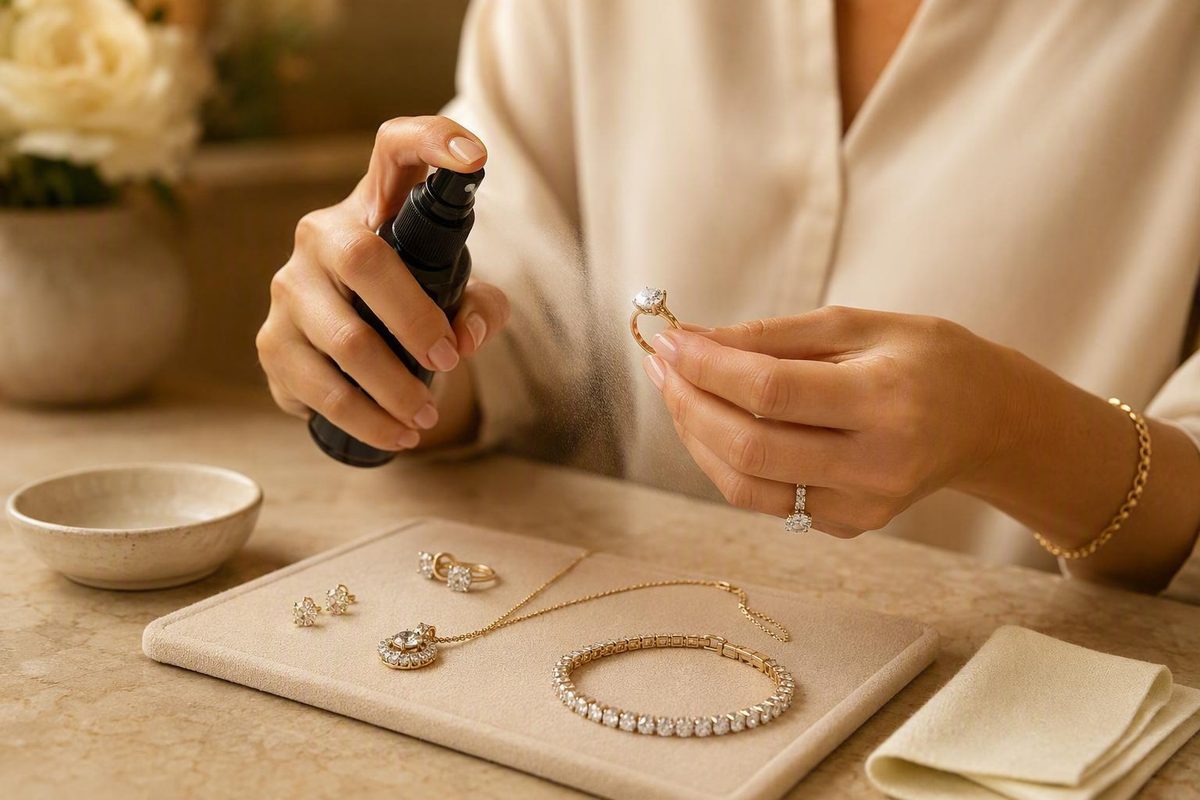
It leaves a film intended to separate the jewelry surface from environmental or skin contact and may slow particular forms of tarnish, oxidation, wear, or discoloration. Consider one only when the manufacturer supports the complete jewelry assembly, supplies current application and curing directions, and explains aftercare and removal. No available evidence establishes a universally best spray or permanent protection.
Related: Jewelry Cleaning Cloth: How to Choose and Use One Safely.
The short answer: when a protectant spray makes sense
A protectant remains on the surface after application. Cleaning may be required before coating, but the two products are not interchangeable.
Use this three-part decision rule:
- Compatibility is documented. The maker addresses the metal, plating, finish, stones, enamel, adhesives, elastic, and other relevant components—not merely “jewelry” in general.
- Current instructions are available. You can obtain the label and Safety Data Sheet for the exact formula and application format.
- Maintenance is defined. You know the required coats, full cure time, approved aftercare, reapplication guidance, and removal method.
Be precise about the intended result.
Selection table: match the coating to the jewelry—not just the metal
Judge the complete piece rather than stopping at “silver,” “brass,” or “costume jewelry.”
| Jewelry type | Concern and evidence status | Ask the manufacturer | Conservative decision |
|---|---|---|---|
| Plain solid silver, copper, or brass | Appearance and adhesion; seller-claimed compatibility | Is this exact metal and finish approved, and how should it be prepared? | Proceed only with current directions and a hidden-area test |
| Chains and intricate metalwork | Missed recesses, pooling, or impaired movement; aerosol use is seller-claimed as helpful for chains | How should links, hinges, and clasps be positioned and coated? | Use light passes only if the exact product supports aerosol application |
| Plated or costume jewelry | Plating, base metal, enamel, stones, and adhesives may respond differently; broad compatibility is seller-claimed, but assembly-level compatibility is often unknown | Are every plating layer, finish, stone, adhesive, and base metal approved? | Do not rely on “all jewelry” language |
| Intentional patina | Color, contrast, or gloss may change; preservation is seller-claimed | What appearance changes should be expected on this patina and finish? | Test first; do not coat if any change is unacceptable |
| Beadwork | Flexibility and drape may change; stiffening is a seller-claimed effect | Will the coating stiffen the thread, wire, or beadwork? | Coat only if added stiffness is an acceptable tradeoff |
| Stone-set or glued assemblies | Clouding, seepage, trapped coating, or adhesive interaction; compatibility is unknown without specific instructions | Are the stones, treatments, adhesives, and setting method expressly approved? | Do not coat without complete-assembly approval |
Everbrite promotes ProtectaClear for silver, copper, brass, plated, costume, beaded, metal-clay, and wire-wrapped jewelry. It also promotes aerosol application for chains because spraying may reduce links sticking compared with other methods, and says its coating may stiffen beadwork. These are commercial compatibility claims, not independent proof for every construction or finish. Review Everbrite’s stated jewelry uses and application formats.
Treat pearls, porous stones, enamel, elastic, adhesive-set components, heat-sensitive parts, and undocumented surface treatments as unknown unless current instructions expressly approve them. “Excluded” should be used only when a product’s current instructions prohibit a particular use; omission from a summary page does not by itself prove exclusion.
Consider future repair before coating. Ask whether an approved removal process exists for both the coating and the underlying jewelry, and whether the film must be removed before polishing, replating, soldering, sizing, or stone work. If removal is undocumented, consult the jeweler who would service the piece.
How to evaluate the label and marketing claims
Before buying, confirm:
- Compatibility with every metal, plating layer, finish, stone, enamel, adhesive, and flexible component
- Access to the current label and Safety Data Sheet
- Required number of coats and recoating interval
- Dry-to-touch and full-cure times
- Ventilation and personal-protection requirements
- Skin-contact or jewelry-location restrictions
- Approved cleaners and aftercare
- Reapplication indicators or schedule
- An approved removal method for the coating and jewelry
Treat terms such as “waterproof,” “non-toxic,” “100% hypoallergenic,” “skin-safe,” “dermatologist-approved,” and “toxicologist-approved” as seller claims unless the company defines them and provides appropriate documentation.
For example, Tarnish-Me-Not is marketed as a clear, waterproof anti-tarnish and skin-contact barrier. Its listing also makes hypoallergenic and approval claims, but the supplied product information does not provide ingredients, test reports, a patent number, named reviewers, quantified durability, or complete directions with which to evaluate those statements independently. See the claims presented in the Tarnish-Me-Not listing.
A continuous film may reduce direct contact between skin and metal while it remains intact. That does not establish that the finished jewelry is medically hypoallergenic or that an allergic reaction will be prevented. Missed or worn areas can expose the underlying metal again.
Application safety is a separate question from claims about the cured coating. A statement such as “skin-safe once cured” does not explain aerosol inhalation, eye exposure, ventilation, flammability, spill response, or protective equipment during application.
Maintenance claims deserve equal attention. JTV’s Alchemy listing suggests reapplication approximately every 2–4 weeks, depending on wear, and excludes piercings that contact a mucous membrane. That product-specific interval illustrates why some coatings are recurring maintenance layers rather than permanent treatments. Read JTV’s Alchemy application and use restrictions.
Spray, brush, or dip: choose by shape and control
The appropriate format depends on the piece’s geometry and the level of control required. Available evidence does not show that spraying, brushing, or dipping inherently provides better durability.
| Format | Coverage and control | Main considerations | Best-supported use case |
|---|---|---|---|
| Spray | Broad, light coverage that can reach intricate areas | Overspray, missed recesses, pooling, and excessive buildup | Manufacturer-approved chains and complex metalwork |
| Brush | Localized control on accessible surfaces | Possible brush marks or bridging around small moving parts | Flat or reachable areas where placement matters |
| Dip | Immerses complex geometry | Drainage, trapped coating, pooling, and greater product use | Approved all-metal pieces that can drain freely |
ProtectaClear is sold for spray, brush, and dip application, but availability in all three formats does not demonstrate equivalent results on a particular piece.
Do not substitute products merely because their names include “jewelry” or “spray.” Marketplace categories may mix protective coatings with cleaners, piercing aftercare, and ultrasonic solutions. Jewelry waxes and mold-release sprays also have different intended uses and should not be assumed suitable as coatings for finished wearable jewelry.
Application workflow: test, clean, coat, and fully cure
Product-specific directions override generic technique. For a piece the manufacturer approves:
- Read the current label and SDS. Confirm the exact formula, ventilation, protective equipment, application method, cure schedule, storage, and disposal requirements.
- Remove detachable incompatible parts when appropriate. Do not dismantle settings or structural components without the necessary skill.
- Test a hidden area. Check for clouding, gloss or color changes, tackiness, lifting, or finish damage. A visual test cannot predict an allergic reaction.
- Clean by an approved method. Remove oil, makeup, polish residue, and other contamination. Remove tarnish only if that matches the intended finish.
- Dry the piece completely. Residue or moisture can prevent an even film.
- Arrange the jewelry for access. Keep links, clasps, hinges, and other moving parts separated.
- Apply a light, even coat. Use the distance stated for the exact product.
- Observe the specified recoating interval. Dry-to-touch does not necessarily mean ready for another coat.
- Wait for full cure before wear. Do not substitute touch-dry time for the manufacturer’s full-cure period.
Published distances are product-specific. JTV’s Alchemy listing says to spray clean jewelry from 6–8 inches away; that number should not be transferred to another formula. See the Alchemy product-specific directions.
A user-uploaded ProtectaClear guide dated 2019 gives a different historical example: a quick pass from 5–6 inches, a second coat after the first is dry to the touch with a minimum one-hour interval, and approximately 4–5 days for full cure under normally ventilated conditions. Because this is not a verified current manufacturer-hosted document, do not treat those numbers as present-day instructions; confirm them on current packaging and the SDS for the exact formula. Review the uploaded ProtectaClear guide and its stated limitations.
That older guide also mentions particular solvents and an accelerated heated cure. These are not general preparation or curing methods. Their hazards and material compatibility must be evaluated under current product instructions, and the evidence does not establish that every stone, enamel, plating layer, adhesive, elastic component, or assembled piece can tolerate them.
For a plain metal chain that the manufacturer expressly approves, hang it with the links separated. Apply a quick, light pass at the product-specific distance, avoid flooding the clasp and joints, and follow the exact recoating and full-cure schedule.
Safety during spraying and curing
Use the current label and SDS for the exact formulation. Before opening the container, verify:
- Required ventilation
- Specified glove material
- Eye protection
- Ignition and static-control precautions
- Spill response
- Storage conditions
- Disposal requirements
The uploaded ProtectaClear guide recommends nitrile or chemical-resistant gloves, eye protection, and good ventilation when spraying, while directing users to follow packaging cautions and the SDS. Because its current status has not been verified, those statements are historical product-specific information rather than a replacement for today’s safety documents. Consult the uploaded guide for the cited protective measures.
Do not borrow precautions from another jewelry-related product. A compiled Rio Grande document contains separate information for several wax products and identifies a jewelry mold-release spray, but information for one formula cannot characterize another or establish suitability as a wearable-jewelry coating. Some of those documents also date from 2014–2017. See the product-specific distinctions in the compiled Safety Data Sheet.
Do not assume heated curing is compatible with an assembled piece merely because an instruction mentions it. Compatibility remains unresolved unless the temperature is approved for the stones, treatments, solder, plating, enamel, adhesives, elastic, and every other component.
Keep the jewelry unworn and away from prolonged contact with other surfaces until the specified full cure is complete.
Durability, aftercare, and signs of coating failure
There is no universal lifespan for jewelry protectant spray. A reapplication interval supplied for one product is not a rule for another.
Inspect coated jewelry for:
- Worn edges and skin-contact points
- Peeling or flaking
- Clouding or milkiness
- Persistent tackiness
- Uneven gloss or discoloration
- Buildup in recesses
- Reduced movement in links, clasps, hinges, or joints
If the coating beads, separates, or fails to level during application, stop rather than covering the defect with additional layers. Reclean only by a method approved for the jewelry and coating, or ask the manufacturer how to proceed.
One jewelry maker’s preliminary experiment found that a single coat of several sealants was inadequate on porous, steel-backed metal-clay charms during two weeks of continuous wear. The test involved mixed metals, differently finished surfaces, and rust on iron-containing material, so it cannot establish performance on sterling silver, copper, brass, plating, or gemstones. Review the experiment and its limitations.
For aftercare, use only a cleaner approved for the cured coating and underlying jewelry. The older ProtectaClear guide advises avoiding abrasives and solvent-based or petroleum-distillate cleaners, but that advice should be confirmed against current directions. Use only a documented removal process suitable for both the exact coating and the complete piece; removability should not be assumed for the category.
A protectant is best treated as a wear-dependent maintenance layer whose suitability depends on documented compatibility, controlled application, complete curing, and an acceptable removal plan.
Can jewelry protectant spray make nickel jewelry hypoallergenic?
A continuous coating may reduce direct contact with nickel while the film remains intact, but that does not prove the jewelry has become medically hypoallergenic or that a reaction will be prevented. Marketing language such as “100% hypoallergenic” is not a substitute for supporting documentation, and worn or missed areas can expose the underlying metal.
Can I use protectant spray on earrings or body jewelry?
Only if the manufacturer explicitly approves the exact jewelry, materials, location, and contact conditions. Restrictions vary by product. Alchemy’s retailer instructions, for example, exclude piercings that contact a mucous membrane, including lip and nose rings. Do not extend that restriction—or any permission—to other products without their current instructions.
Is jewelry protectant spray waterproof enough for showers or swimming?
Do not assume so. “Waterproof” marketing alone does not establish resistance to hot water, chlorine, salt water, soap, shampoo, sweat, sunscreen, or repeated immersion. Follow the manufacturer’s defined exposure limits. If no limits are provided, the product information is insufficient to promise shower or swimming performance.
Why is my jewelry coating cloudy, tacky, or uneven?
Stop adding coats, keep the piece unworn, and compare the elapsed time with the product’s stated full-cure schedule. If the defect remains, contact the manufacturer and remove the film only by a method approved for both the coating and the jewelry underneath.