
Engagement Ring Hand Placement Has a Default
The left ring finger is customary, not mandatory. Right-hand wear may reflect culture, family practice, comfort or preference.
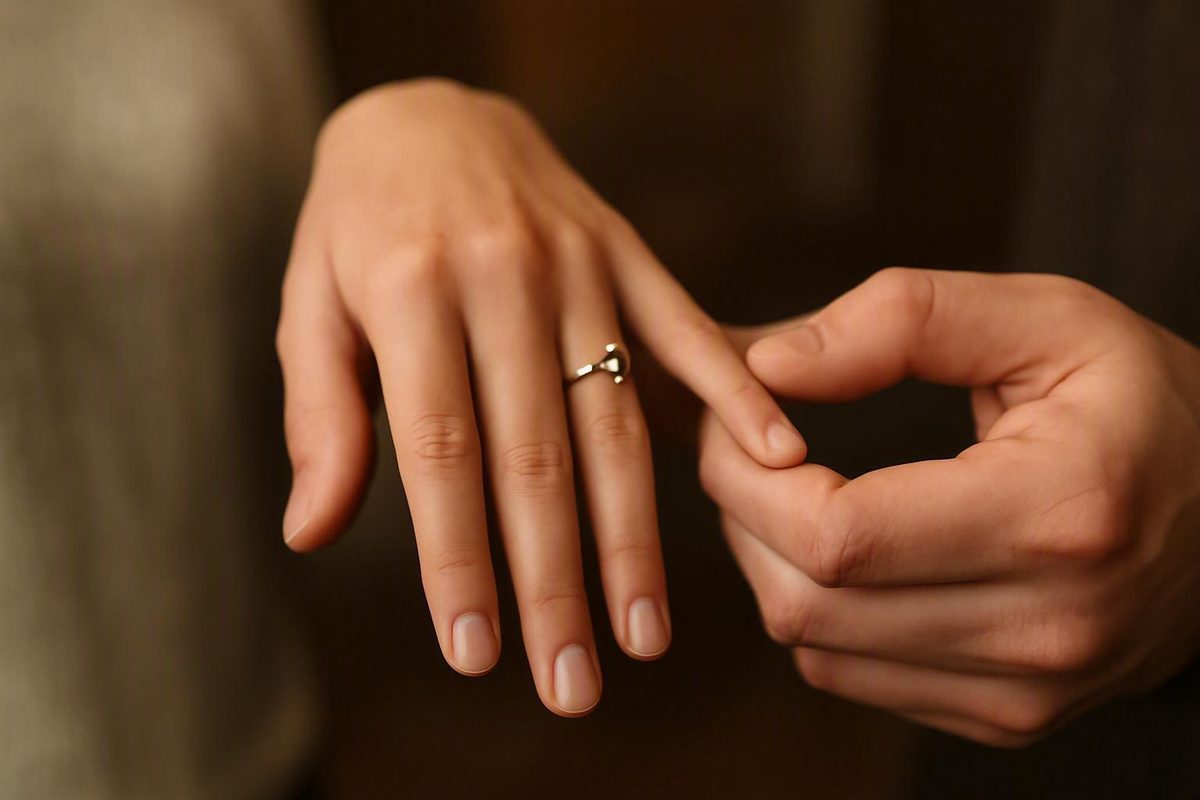
The short answer: traditionally, the left ring finger
In the United States and many Western settings, an engagement ring traditionally goes on the fourth finger of the left hand. Commonly called the ring finger, it sits between the middle finger and little finger. The Gemological Institute of America identifies this as the traditional placement for engagement rings and wedding bands while emphasizing that comfort, meaning, and personal preference may support another arrangement (GIA’s guide to wearing engagement rings and wedding bands).
That is the customary answer, not a mandatory etiquette rule. You may wear an engagement ring on your right hand, another finger, a necklace, or only on selected occasions. None of those choices makes the engagement less genuine or the ring less meaningful.
Quick answer
Question Answer What is the traditional placement in the United States? The ring finger of the left hand Which finger is the ring finger? The finger between the middle finger and little finger Can an engagement ring go on the right hand? Yes Must it stay on the same hand after marriage? No Is there one required stacking order? No; there is only a customary arrangement
The left ring finger is therefore a useful default, especially if you want the ring to be readily recognized as an engagement ring in a setting where that convention is familiar. From there, consider your culture, family customs, comfort, dominant hand, daily routine, and plans for a wedding band.
The intended finger also matters to how the ring feels. This is simply a comfort check, not a conclusion that switching hands will necessarily require an adjustment.
Why the left ring finger became the traditional choice
The symbolism of the left ring finger is commonly linked to the vena amoris, Latin for “vein of love.” According to the familiar story, a vein ran directly from the left ring finger to the heart, making that finger a romantic place for a ring representing commitment.
It is an appealing legend, but it is not an anatomical fact. The supposedly unique vein connecting that finger directly to the heart does not exist; the anatomical explanation behind the tradition has been disproven (GIA’s account of the ring-finger tradition).
The legend nevertheless provides memorable symbolism. A ring worn on the left hand can represent a connection among love, commitment, and the heart even when the explanation is understood as folklore rather than science.
Historical accounts often associate the story with ancient Rome, while some extend it to Greek or Egyptian traditions. It is more accurate to describe the placement as a custom that developed and endured over time than to credit one civilization with inventing the modern practice.
There is also a distinction between symbolic history and personal choice. You do not need to believe in the vena amoris to wear an engagement ring on the left. Choosing the right hand does not reject the sentiment behind the tradition, either. The meaning belongs to the wearer and the couple, not to a particular piece of anatomy.
Can you wear an engagement ring on your right hand?
Yes. An engagement ring can be worn on the right hand.
Right-hand placement may reflect cultural or religious practice, family tradition, comfort, lifestyle, handedness, personal symbolism, or simple preference. Some people use the right hand from the proposal onward; others begin on the left and move the ring during the wedding or after marriage.
International customs vary, but country-by-country rules should be treated cautiously. Published guides sometimes disagree about the same country, and some examples concern wedding bands rather than engagement rings. A community’s wedding-band custom does not automatically determine where its members wear engagement rings.
Practices can also differ within a country according to region, religion, generation, community, and family. Broad cultural tendencies are useful context, not instructions that apply to every individual.
There is no hand placement with one universal social meaning. In one setting, a ring on the right ring finger may be recognized as an engagement or wedding ring. Elsewhere, it may be interpreted simply as jewelry. Observers may make assumptions, but those assumptions are not consistent across cultures.
When right-hand wear may make sense
The right hand may be a suitable choice when:
- Your culture, religion, or family traditionally uses it.
- You want to continue a custom observed by parents or grandparents.
- The ring feels more comfortable there.
- You are left-handed and find left-hand wear intrusive during routine tasks.
- You plan to keep your wedding band on the left hand.
- The engagement ring and wedding band do not sit comfortably together.
- Right-hand placement has personal meaning for you or your partner.
Handedness is a consideration, not a formula. A left-handed wearer may prefer the right hand because the ring feels less noticeable during writing or other frequent movements. Another left-handed person may prefer the conventional left-hand position and experience no inconvenience. Moving a ring to the nondominant hand also does not guarantee that it will avoid contact, scratching, or ordinary wear.
If either partner attaches a particular meaning to placement, discuss a nontraditional choice before treating it as permanent. This is not about seeking permission from etiquette. It is about making sure both people understand what the arrangement is intended to represent.
A simple timeline: engagement, ceremony, and married life
Ring placement can seem confusing because the answer may change at different stages. The arrangement used during the engagement does not have to be the arrangement used during the ceremony or after marriage.
| Stage | Traditional option | Alternative options |
|---|---|---|
| Before the wedding | Wear the engagement ring on the left ring finger in keeping with common US custom. | Wear it on the right ring finger, on the hand intended for the wedding band, or in another personally suitable way. |
| During the ceremony | Move the engagement ring temporarily so the wedding band can be placed on the left ring finger first. | Remove it temporarily, leave it in place, or use whichever order suits the ceremony. |
| After the wedding | Wear the wedding band nearer the base of the finger, with the engagement ring outside it. | Reverse the stack, divide the rings between hands, wear one at a time, or reserve the engagement ring for selected occasions. |
Every arrangement in the table is optional. The traditional column describes a familiar convention, not a requirement.
Before the wedding
Under the common US convention, the engagement ring remains on the left ring finger throughout the engagement.
If you already plan to wear your wedding band on another hand, you may instead place the engagement ring on that intended hand. This creates continuity between the engagement and married arrangement. You can also wear the engagement ring on one hand while engaged and move it after the ceremony.
There is no need to decide on a permanent arrangement immediately after the proposal. Wearing the ring in ordinary situations can help you notice whether that placement feels natural and whether you enjoy seeing it on that side.
During the wedding ceremony
Two commonly described options are:
- Move the engagement ring to the opposite hand before the ceremony. This leaves the intended wedding-band finger open.
- Remove the engagement ring temporarily. Put it back on after the ring exchange.
These options make it easy to place the wedding band first when the couple wants it nearer the base of the finger. Windsor Fine Jewelers describes temporarily moving or removing the engagement ring as common ceremony choices rather than fixed requirements (ceremony and post-wedding placement options).
You may also leave the engagement ring in place. The wedding band can be added outside it and rearranged afterward, or the rings can remain in that order. If the order matters to you, tell the relevant participants beforehand so the ring exchange reflects your plan.
If you remove the engagement ring, decide in advance who will hold it and how it will be returned. A simple, agreed-upon plan reduces the chance of confusion during the ceremony without turning ring placement into a complicated ritual.
After the ceremony
After the wedding, the engagement ring may return to the wedding-band finger, stay on the opposite hand, or be worn separately. You may also alternate between the rings or wear the engagement ring only for particular occasions.
Marriage does not create an obligation to stack the rings. It introduces another ring and another set of choices.
How to wear an engagement ring with a wedding band
When both rings are worn on the same finger, the common traditional stack is:
- Wedding band nearer the base of the finger
- Engagement ring outside the wedding band
This order is sometimes explained by saying the wedding band is “closer to the heart.” That phrase is romantic symbolism, not an anatomical explanation. The supposed unique pathway from the ring finger to the heart is folklore rather than medical fact.
The traditional stack can work particularly well when the engagement ring and wedding band were designed as a coordinated pair. It also gives the wedding band a visually foundational position. Neither consideration turns the order into a fixed rule.
Other valid arrangements
Depending on comfort, design, and preference, you may:
- Put the engagement ring nearer the base of the finger.
- Place the wedding band outside the engagement ring.
- Divide the rings between your left and right hands.
- Wear one ring at a time.
- Alternate the rings according to the occasion.
- Reserve the engagement ring for occasions when you want a more decorative look.
A reverse stack may look more balanced with a particular design. Separate-hand wear may be more comfortable if the rings rub, create an awkward gap, or make the combined stack feel too wide. Gemmyo likewise treats stacking order as flexible and suggests separate hands when two rings cannot be worn comfortably together (Gemmyo’s engagement-ring guidance).
Consider the rings as a pair
Before settling on a regular stack, make a brief comfort and design check:
- Do the rings sit together naturally?
- Does the combined width feel comfortable?
- Does one ring push the other out of position?
- Does the arrangement feel comfortable when you bend your finger?
- Do you like the overall balance?
These observations can help you choose an arrangement, but they are not professional sizing or repair guidance. If the rings are consistently uncomfortable or do not sit as intended, a jeweler can assess the specific pieces.
Neither look is inherently correct. The relevant question is whether the pairing suits the design and your preferences.
Most importantly, do not assume that a culture’s reported wedding-band position also dictates where the engagement ring must go. The two rings have related but distinct roles, and their customs should not be treated as interchangeable.
How to choose the placement that works for you
The best placement usually balances three priorities:
- Recognizable tradition
- Personal or cultural meaning
- Comfortable, practical wear
You may give one priority more weight than the others. Someone who values family continuity might follow a right-hand custom while living in a place where left-hand wear is more familiar. Someone else might begin with the conventional left ring finger and change the arrangement after learning what works in daily life.
Start with local and family custom
Ask what the people involved actually expect rather than relying on a generalized online list.
Useful questions include:
- Which hand do engaged people in your family usually use?
- Is that placement associated with engagement, marriage, or both?
- Does either family observe a religious or ceremonial practice involving a particular hand?
- Is continuing that practice meaningful to you?
- Would an arrangement using both hands better represent your traditions?
If the couple comes from different backgrounds, there is no need to declare one tradition correct. You might follow the convention used in the ceremony, the custom of the place where you live, or an arrangement that acknowledges both families.
Decide what you want the placement to symbolize
For some people, the familiar left-hand position clearly communicates engagement within their social setting. For others, the right hand may represent family heritage or a deliberate personal choice.
Consider whether you want the ring’s meaning to be readily recognized by other people. If so, the locally familiar placement may be useful. If private meaning matters more than public recognition, you have greater freedom.
The symbolism can also change over time. You might wear the engagement ring on the left while engaged and move it after the wedding. Alternatively, you might keep it in the same place because continuity matters more than distinguishing between the stages.
Consider your dominant hand and routine
Notice how you use your hands during an ordinary week. Think about writing, typing, cooking, making art, handling equipment, wearing gloves, or performing other frequent tasks.
A left-handed wearer may find right-hand placement less intrusive, but that will not be true for everyone. The nondominant hand still encounters surfaces and objects. Base the decision on your actual experience rather than assuming one side will always be easier.
If hand jewelry is inconvenient for a particular task or activity, temporary removal or occasional wear may be more practical than changing hands permanently. This is a matter of convenience; any activity-specific rules should be considered separately.
Assess everyday comfort
Keep the comfort check concise and specific:
- Does the setting catch during ordinary wear?
- Does the ring interfere with routine hand movements?
- Is one hand noticeably more comfortable than the other?
- Does another ring press against it?
- Does a two-ring stack feel too wide?
- Are you repeatedly removing the ring because its placement is inconvenient?
Comfort may differ between corresponding fingers. Do not assume that moving the ring from left to right will necessarily require an adjustment, but do not assume the fit will be identical. Try the intended finger and evaluate how the ring actually sits.
Plan for the wedding band
If you expect to wear both rings on one finger, consider that plan before finalizing your arrangement. Decide whether you prefer:
- The traditional stack
- A reverse stack
- A fitted or contoured pair
- A deliberate gap between the rings
- One ring on each hand
- One ring for everyday wear
If you have not selected the wedding band, keep the decision flexible.
Use an alternative when traditional hand wear is impractical
An engagement ring does not have to remain on a ring finger every day. Alternatives include:
- Wearing it on the opposite hand
- Using another finger
- Wearing it on a necklace
- Reserving it for selected occasions
- Alternating it with the wedding band
Necklace wear can keep the ring symbolically present without placing it on a hand. Occasional wear may suit someone who appreciates the engagement ring but prefers a simpler band in daily life. These choices are different ways of incorporating the ring into an engagement or marriage, not lesser ones.
A short decision checklist
Before choosing your regular placement, ask:
- Tradition: What is customary where I live or in my family?
- Culture: Does a particular hand carry an important meaning for us?
- Communication: Have my partner and I discussed that meaning?
- Comfort: Which hand and finger feel better?
- Routine: Does the ring interfere with frequent tasks?
- Handedness: Does dominant-hand wear feel intrusive?
- Fit: Does the ring sit differently on the other hand?
- Wedding band: Will the rings share a finger?
- Design: Do the rings feel comfortable and look balanced together?
- Flexibility: Would another finger, necklace wear, or occasional wear work better?
If one arrangement meets both your symbolic and practical needs, use it. If it stops working, changing how you wear the ring is entirely reasonable.
Common misconceptions about engagement-ring placement
“Every engagement ring must be worn on the left hand”
The left ring finger is the customary US answer, not a universal requirement. Right-hand wear and other placements may reflect culture, family practice, comfort, or personal preference.
An engagement is defined by the couple’s commitment, not by whether other people can identify the ring’s meaning from its location.
“The vena amoris is a real vein running directly to the heart”
It is not. The “vein of love” is a romantic legend associated with the left-ring-finger tradition, not a distinctive anatomical pathway. The Cape Town Diamond Museum likewise describes the direct connection as a historical belief that was later discredited (the museum’s discussion of the vena amoris tradition).
You can appreciate the imagery without treating it as science.
“Every country or religion has one uniform rule”
Practices vary within countries, religions, communities, and families. Generalized cultural guides may also disagree or blur the distinction between engagement rings and wedding bands.
Treat country-level examples as broad reported tendencies rather than rules for every individual. If a particular practice matters to your ceremony, ask someone familiar with that specific family, congregation, or community.
“The rings must always be stacked in one prescribed order”
Placing the wedding band nearer the base of the finger is traditional in many Western settings, but it is optional. Reverse stacking, separate hands, and wearing one ring at a time are also workable arrangements.
Comfort and design may be more useful guides than symbolism. A visually pleasing stack that feels uncomfortable is unlikely to be a satisfying long-term choice.
“A right-hand engagement ring has one universal social meaning”
It does not. Right-hand wear may communicate engagement or marriage in one community, reflect family tradition in another, or be interpreted simply as personal style elsewhere.
If interpretation matters to you, consider local convention and explain your choice when relevant. You do not need to organize your jewelry around every assumption another person might make.
The guiding principle is simple: understand the customary default, then choose the placement that fits your relationship, traditions, and practical needs.
Frequently asked questions
Which finger is the engagement-ring finger?
In the United States, the customary engagement-ring finger is the ring finger of the left hand, located between the middle finger and little finger.
“Ring finger” describes the finger traditionally used. It does not mean an engagement ring is prohibited on another finger or hand.
Is it okay to wear an engagement ring on the right hand?
Yes. Culture, family tradition, comfort, handedness, personal symbolism, or plans for the wedding band may all support right-hand wear.
If either partner attaches a particular meaning to placement, discuss the choice so that its intended symbolism is understood.
What should I do with my engagement ring during the wedding ceremony?
You have three straightforward options:
- Move it temporarily to the opposite hand.
- Remove it until after the ring exchange.
- Leave it in place and add or rearrange the wedding band afterward.
Moving or removing the engagement ring makes it easier to place the wedding band first, but that order is optional.
Does the wedding band or engagement ring go on first?
In the traditional stack, the wedding band goes on first, nearer the base of the finger, and the engagement ring sits outside it.
You may reverse the order if that arrangement looks or feels better, keep the rings on different hands, or wear one at a time.
Can I wear my engagement ring on a necklace or only on special occasions?
Yes. Necklace wear or occasional wear can be practical when wearing the ring on a hand is uncomfortable or inconvenient.
The useful default remains the left ring finger in the United States and many Western settings. The best long-term arrangement, however, is the one that respects your traditions, feels comfortable in everyday life, and works with your plans for a wedding band.