
Tulip Setting Engagement Ring: Styles, Fit & Cost
See how plain, cathedral, accented and hidden-halo versions differ, what dimensions to request, and how to verify band fit and final price.
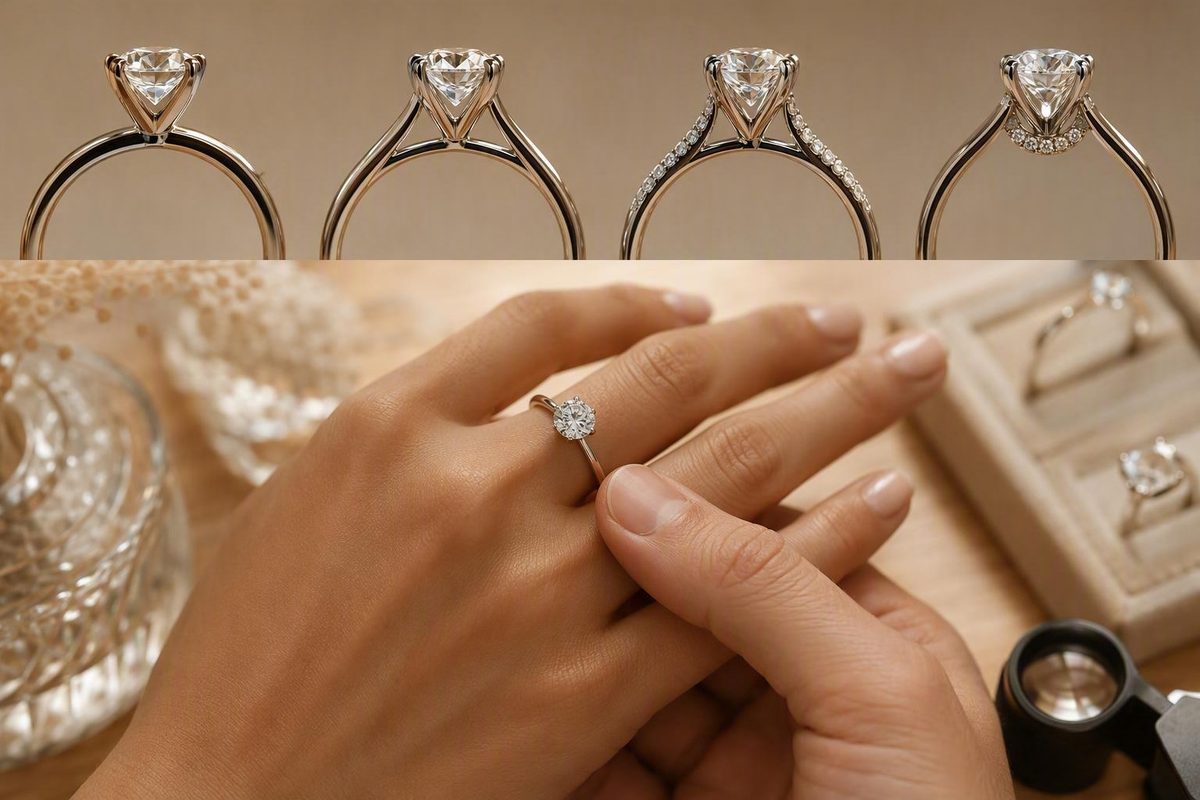
Retailers generally use “tulip setting engagement ring” for a design with curved, petal-like prongs or a floral basket around the center stone, often most visible from the side. Compare the actual basket, profile, prongs, stone compatibility, wedding-band clearance, metal, accents, and completed price—not merely the floral name.
What a tulip setting is—and what the name does not tell you
In common retail terminology, a tulip setting replaces conventional-looking supports with prongs or basket elements that sweep upward around the center stone like petals. The floral effect may be subtle from above and much more prominent in profile.
The floral geometry and the supporting architecture are separate design layers. A tulip head can be attached to:
- A plain solitaire shank
- Raised cathedral shoulders
- An interwoven trellis
- A bezel or partial-bezel treatment
- A hidden halo
- A diamond-accented bridge, basket, or set of petals
That distinction matters because two rings sold as tulip settings can look and wear very differently. One might place a plain four-petal head on a restrained band; another might combine six prongs, cathedral shoulders, pavé diamonds, and a hidden halo.
The name alone does not establish:
- How high the stone sits above the finger
- How many prongs hold it
- Whether the prongs have additional basket or gallery support
- How far the prongs project beyond the stone
- How the ring will interact with clothing or gloves
- Whether a straight wedding band will sit flush
- How the gallery will feel between adjacent fingers
- Whether the setting accepts a particular stone size or shape
Always examine side-profile and three-quarter photographs in addition to the face-up view. If the listing does not provide them, request photographs, a dimensioned drawing, or the approved CAD for your exact configuration.
Tulip setting styles compared
Tulip designs often combine several jewelry terms. A ring can simultaneously be a cathedral, tulip, hidden-halo, pavé engagement ring. Treat each label as a description of one component rather than as a mutually exclusive category.
| Style | Defining feature | Visual effect | Details to verify before ordering |
|---|---|---|---|
| Plain tulip solitaire | Petal-like prongs on an otherwise restrained band | Clean face-up appearance with floral detail from the side | Prong count, basket support, profile height, shank dimensions, and band clearance |
| Cathedral tulip | Raised shoulders sweep toward the center setting | More architectural, elevated-looking silhouette | Actual setting height, shoulder width, gallery opening, and intended wedding-band fit |
| Hidden halo | Small accent stones encircle the center below its widest point | Sparkle concentrated in side and angled views | Halo diameter, accent specifications, cleaning access, service terms, and band clearance |
| Diamond basket or accented petals | Diamonds are set into the basket, bridge, or petal structures | More elaborate floral detail in profile | Accent-stone specifications, exposed areas, service terms, and number of individual settings |
| Pavé tulip | Small diamonds cover part of the shank while the head retains petal geometry | More continuous sparkle across the ring | Pavé coverage, sizing limits, shank dimensions, and whether resizing affects the accents |
| Diamond bridge | Accent stones appear beneath or between the center-setting supports | Decorative detail below the center stone | Bridge dimensions, wedding-band clearance, cleaning access, and accent-stone service terms |
| Trellis tulip | Prongs cross or interweave as they rise toward the stone | Flowing, woven side profile | Exact prong placement, basket support, setting height, and compatibility with the selected stone |
| Bezel variation | A rim of metal surrounds all or part of the stone while floral elements remain elsewhere | More visible metal and a less conventionally pronged appearance | Whether the stone is fully or partially enclosed, the exact floral component, and future service options |
By Bonnie Jewelry, for example, groups solitaire, cathedral, French pavé, bezel, diamond-bridge, trellis, and diamond-basket versions within its tulip collection.
For a quick decision:
- Choose plain petals if you want a floral side profile without making the entire ring ornate.
- Choose cathedral shoulders if you prefer a stronger architectural transition between the band and center.
- Choose accented petals, a diamond basket, or a hidden halo when side-view detail is a priority and you accept the additional individual settings to clean and inspect.
- Choose a trellis or bezel variation only after examining how that particular maker has combined the two design concepts.
Stone shapes, metals, and customization options
Documented tulip listings collectively include round, oval, pear, radiant, cushion, emerald, marquise, princess, Asscher, moval, long-cushion, old-mine, Portuguese, and other specialty shapes. Stienhardt’s product page, for example, lists round, emerald, radiant, oval, cushion, long cushion, Asscher, princess, Portuguese, old mine, and moval configurations, while other retailer collections supply additional shapes such as pear and marquise (review the listed Stienhardt configurations).
A cut name does not establish compatibility with every tulip model. Ask the jeweler to confirm that the basket will be made or adjusted for the exact measurements of the selected stone. For pear, marquise, or other pointed outlines, obtain written confirmation of the proposed prong placement and how the point will be accommodated.
Documented metal choices include 14k and 18k yellow or white gold, rose gold, platinum, and two-tone construction. In a documented two-tone option, a yellow- or rose-gold shank is paired with platinum center prongs. Where a listing refers only to a contrasting white-metal head, ask the seller to identify the exact prong metal and alloy in writing.
Possible customization requests include:
- Engraving
- A hidden halo
- A hidden birthstone or other gemstone
- Diamonds set into the petals
- Mixed-metal prongs and shank
- East-west orientation for an elongated stone
- Changes to the number or shape of the petals
- Adjustments to the shank width or profile
These options are not available from every maker or for every model. Plum, for example, describes engraving, hidden halos, hidden birthstones, two-tone construction, and east-west orientation among the options associated with its made-to-order tulip solitaire.
Commercial tulip-setting guidance also suggests diamonds, sapphires, rubies, and emeralds as possible center stones. That does not mean every gemstone is appropriate for every exposed design or wearer. Ask the jeweler to assess the exact stone, its condition, the proposed amount of exposure, and the intended use of the ring.
Before approving the order, obtain a written configuration that records:
- Exact center-stone length, width, and depth
- Stone orientation
- Metal and alloy for the shank and prongs
- Prong count and placement
- Basket or gallery structure
- Accent-stone locations and specifications
- Shank width and thickness
- Approved CAD or dimensioned drawing, if applicable
Security, setting height, snagging, and wedding-band fit
The tulip label alone does not establish greater security, and the documented product information does not demonstrate that tulip settings are more secure than conventional prong settings. Assess the completed ring by its exact construction, including the number and placement of prongs, support beneath the center, stone dimensions, workmanship, and current condition.
Do not treat decorative petal geometry as a guarantee against stone loss. Ask the jeweler to explain how the selected stone is supported and what inspections or servicing the finished ring will require.
Tulip settings are not inherently high- or low-set. Documented listings range from low or tapered constructions to raised cathedral designs, and cathedral shoulders do not by themselves establish either the overall height or wedding-band clearance.
Ask for these measurements in millimeters:
- Overall setting height: From the finger-side base of the ring to the top of the center stone.
- Gallery width: The widest part of the structure beneath the stone.
- Prong projection: How far the prongs or petals extend beyond the stone’s outline.
- Shank width and thickness: Preferably at both the base and shoulders.
- Band clearance: The horizontal and vertical space available beside the basket for the intended wedding band.
If clothing interaction is a concern, inspect side-profile images and ask how far the prongs, accent settings, and center stone project. Do not rely on “low profile” or similar marketing language without measurements. Discuss how the exact design is expected to interact with gloves, knitwear, pockets, and the wearer’s routine activities.
Wedding-band fit deserves its own test. Stienhardt identifies one tulip setting as stackable, while Charleston Rings describes its cathedral tulip shank as intended for pairing with wedding or stacking bands. Neither seller-specific description proves that every straight band will sit flush with every configuration; the intended pairing should be demonstrated for the actual rings (see Charleston Rings’ cathedral tulip configuration).
Ask the jeweler to photograph or demonstrate the engagement ring beside the wedding band you intend to buy. Obtain written confirmation of whether you need a straight, curved, notched, or contoured band before committing to either ring.
What tulip engagement-ring settings cost
First determine whether the displayed amount is a setting-only price, a configurable starting price, or the total for a completed ring. These are fundamentally different figures.
Prices, options, and availability can change, so verify every amount immediately before ordering.
| Listing type | What its price covers | Ask before comparing |
|---|---|---|
| Setting only | Metal head and shank, plus stated accents | Center stone, selected metal and customization |
| Collection starting price | Lowest advertised configuration | Exact design, dimensions and stone inclusion |
| Completed ring | Stated center stone and setting variant | Exact stone report, size, tax and delivery |
Examples of different price bases include Plum’s setting-only tulip, Stienhardt’s selectable metals, and By Bonnie’s collection. Request a current quote for your configuration.
These price bases are not directly comparable. They differ in metal, accent stones, design complexity, customization, and whether a center stone is included or its inclusion is unclear. A setting-only platinum price should not be compared directly with a configurable ring that includes a lab-grown center diamond.
Use this completed-budget formula:
Setting + center stone + accent upgrades + metal upgrade + customization + sizing charges, if any + tax + shipping, if applicable = estimated final cost
Request a written final quote identifying every included component. A collection-page price is useful for initial screening, but it is not the completed-ring cost until the seller confirms the exact stone, metal, size, accents, services, taxes, and delivery charges.
A pre-purchase specification and policy checklist
Copy this checklist into an email and ask the jeweler to answer each applicable item.
Design and fit
- [ ] Exact center-stone length, width, depth, and carat weight
- [ ] Confirmation that the basket will be made or adjusted for those measurements
- [ ] Number, position, and style of the prongs
- [ ] Description of the supporting basket, gallery rail, bridge, or trellis
- [ ] Overall setting height
- [ ] Gallery width
- [ ] Maximum prong projection beyond the stone
- [ ] Shank width and thickness
- [ ] Accent-stone count, dimensions, type, color, and clarity
- [ ] Clearance beside the intended wedding band
- [ ] Demonstration with a straight band, if flush fit is expected
- [ ] Confirmation if a curved, contoured, or notched band is required
Configuration
- [ ] Selected metal and alloy for both the shank and prongs
- [ ] Center-stone orientation
- [ ] Hidden-halo or hidden-gemstone details
- [ ] Engraving text and placement
- [ ] Approved CAD, rendering, or dimensioned drawing
- [ ] Written resolution of any inconsistency among the product title, URL, images, option menus, and checkout page
Price
- [ ] Center stone included or excluded
- [ ] Accent stones included
- [ ] Selected metal included
- [ ] Ring size included
- [ ] Engraving included
- [ ] Custom-design or CAD charges included
- [ ] Current and future sizing charges
- [ ] Taxes and insured shipping
- [ ] Final payable total
Documentation
- [ ] Grading report for the exact center diamond, where applicable
- [ ] Report number matched to the stone
- [ ] Inscription checked, if the stone is represented as laser-inscribed
- [ ] Receipt describing the center stone and completed setting
Production, delivery, and service policies
- [ ] Estimated production time
- [ ] Insured delivery method and signature requirements
- [ ] Geographic shipping restrictions
- [ ] Return eligibility for made-to-order, engraved, resized, or customized pieces
- [ ] Return deadline and any restocking or shipping deductions
- [ ] Permitted resizing range
- [ ] Whether resizing can affect accents, alignment, returns, or warranty coverage
- [ ] Included cleaning, polishing, plating, or inspection services
- [ ] Warranty duration, exclusions, and required maintenance
- [ ] Responsibility for a loose or lost center stone
- [ ] Process and cost for replacing an accent stone
Policy details vary by seller and configuration. Plum lists an approximate four-week production time for its made-to-order tulip solitaire, while its shipping, returns, resizing, and servicing language includes order-specific conditions (review Plum’s stated terms). Do not infer another seller’s policies—or the terms for every configuration from the same seller—from one product page.
Cleaning and maintaining petal prongs
Follow care instructions for the actual stone, any treatments and the setting. A diamond routine may not suit a treated emerald or delicate accent stone. Ask the jeweler to demonstrate cleaning beneath the petals and avoid bleach, chlorine and harsh cleaners. Do not use steam or ultrasonic cleaning unless the jeweler confirms that the complete ring is suitable.
Store the ring separately so it does not rub against other jewelry. If a stone moves or a prong lifts, stop wearing the ring and have it checked; cleaning cannot correct a loose setting.
Arrange professional inspection according to the ring’s construction, condition, use, and the jeweler’s service guidance rather than assuming one universal schedule. Request an inspection promptly if:
- The center stone moves or makes a sound
- A prong appears lifted, damaged, or noticeably different from the others
- An accent stone appears loose or missing
- The ring receives a hard impact
- The shank or basket becomes visibly distorted
- The ring begins interacting with clothing more often than before