
Why Wedding Rings Go on the Left Hand: Tradition
A romantic “vein of love” legend supplied the symbolism; Western wedding rituals and repeated social use made the placement customary, not anatomical.
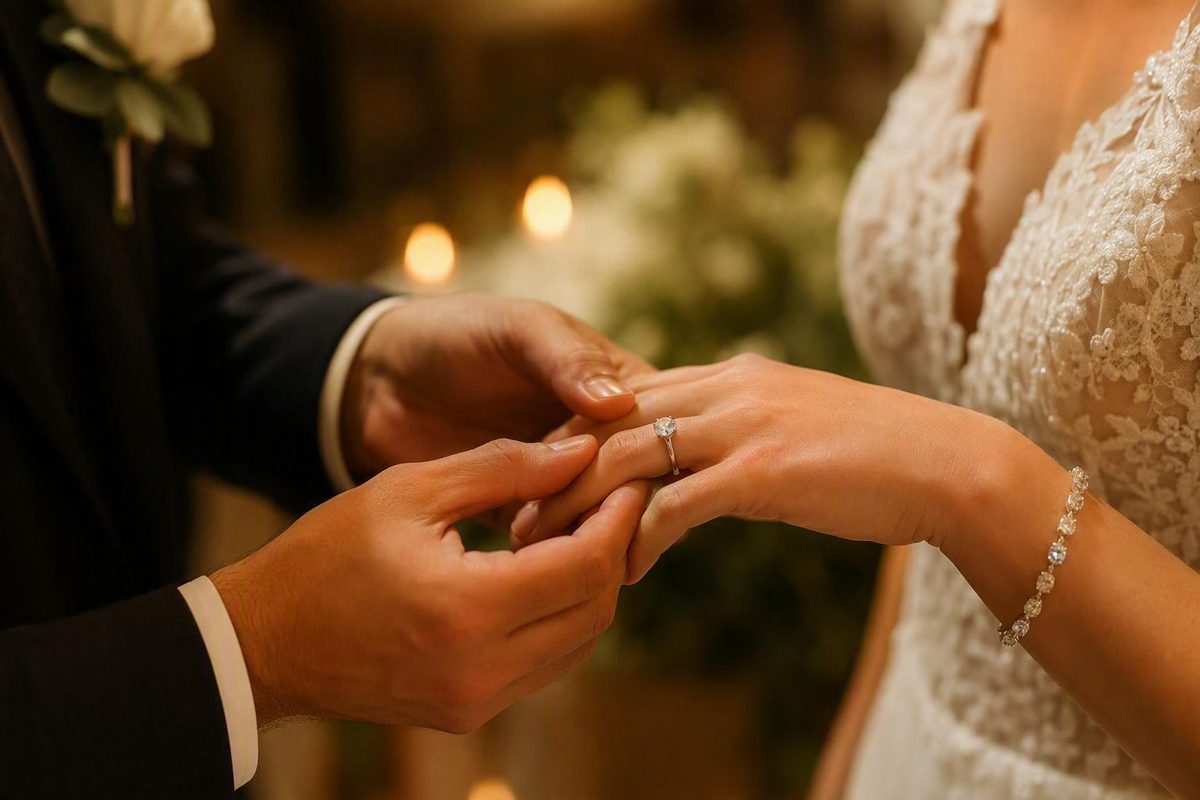
The short answer: tradition, symbolism, and ceremony
Why does the wedding ring go on the left hand? In many Western cultures, inherited convention places the wedding band on the fourth finger of the left hand—the finger between the middle and little fingers, commonly called the ring finger. The Gemological Institute of America describes this as the traditional Western placement, while noting that customs differ elsewhere.
The practice endured through romantic symbolism, wedding ritual, and social repetition rather than anatomical necessity. In particular, an old story linked the left ring finger directly to the heart. That explanation gave an otherwise conventional choice of finger an appealing emotional meaning.
The finger itself became recognizable as a sign of marriage.
A careful answer therefore separates three ideas:
- Romantic legend: The left ring finger was said to contain a special vein leading directly to the heart.
- Historical uncertainty: Popular accounts associate this belief with Romans, Greeks, or Egyptians, but the evidence does not identify one definitive ancient origin for the modern custom.
- Later convention: Wedding ceremonies and repeated social use helped make the left ring finger the expected location in many Western communities.
Left-hand placement is not a worldwide rule. Wearing a wedding ring on the right hand is a long-established custom in numerous countries and religious communities. Some ceremonies also use a different finger for the ritual itself, after which the ring may be moved.
The short answer, then, is not that anatomy assigns marriage to the left ring finger. It is that symbolism became custom, and custom was reinforced by ceremony.
The vena amoris: a romantic legend, not human anatomy
The best-known explanation for left-hand wedding-ring placement is the vena amoris. The Latin phrase is commonly translated as “vein of love.” According to the story, this special vessel ran directly from the fourth finger of the left hand to the heart, making that finger the natural place for a symbol of romantic commitment.
The idea is memorable because it joins three familiar symbols: marriage, the ring, and the heart. A wedding band placed on the supposedly connected finger becomes a visible bond between a person’s love and spouse.
It should not, however, be treated as a description of human anatomy. The ring finger is associated with ordinary digital veins rather than a unique vessel reserved for that finger, and modern consumer guidance on ring traditions identifies the direct “vein of love” story as scientifically disproven. An anatomical summary of the ring finger lists its palmar and dorsal digital veins, not a special vein running independently to the heart.
The related statement that the left hand is “closer to the heart” is also best understood as symbolic language, not as a medical reason to use that hand. The supplied evidence does not support treating either hand as anatomically designated for a wedding ring.
| Myth | What the evidence supports |
|---|---|
| A unique vein runs directly from the left ring finger to the heart. | The supposed vena amoris is folklore, not an identified special vessel. |
| The wedding ring belongs on the left because that hand has a privileged connection to the heart. | Left-hand placement is a cultural convention rather than an anatomical requirement. |
| Disproving the vein makes the tradition meaningless. | The symbolism can remain culturally meaningful even when its literal explanation is rejected. |
This distinction does not reduce the emotional value of the tradition. The heart is routinely used as a symbol of affection without making a literal claim about cardiac anatomy. In the same way, a ring on the left finger can evoke closeness to the heart even though the connection is metaphorical.
The legend may have persisted partly because it offers a more satisfying explanation than simple convention. “A vein of love joins this finger to the heart” is more romantic than “this is where our community expects the ring to be worn.” Yet custom is the better-supported explanation: people repeated the placement until it acquired recognizable ceremonial and social meaning.
What history establishes—and what remains uncertain
Popular histories often associate the vena amoris story with ancient Rome. Other versions connect the belief with Greeks or Egyptians. These attributions are widely repeated, but the available evidence does not establish one of those civilizations as the conclusive originator of modern left-hand wedding-ring placement.
That uncertainty matters because several distinct historical questions are often compressed into one neat origin story:
- Did a particular ancient society exchange rings?
- Were those rings specifically marital?
- Did that society associate one finger with the heart?
- Was the left hand consistently used?
- Did later European wedding practice inherit the same rule directly?
- When did written ceremonies begin prescribing the placement?
Evidence for one proposition does not automatically prove the others. A society could exchange rings without placing them on the modern Western ring finger. A belief about a finger could exist without creating a marriage custom. A later ceremony could also standardize a practice whose original reasoning had already changed or been forgotten.
For that reason, phrases such as “traditionally attributed to Rome,” “commonly associated with ancient belief,” or “popularly explained by the vein-of-love story” are more defensible than saying that Romans, Greeks, or Egyptians invented the custom.
The original reason for selecting the fourth digit is not definitively known. Romantic folklore, ritual gestures, local customs, and later etiquette may all have contributed at different times. What now appears to be one continuous tradition may instead be the result of several practices converging.
Practical theories are sometimes offered as well. Because many people are right-handed, for example, wearing a ring on the left hand may interfere less with daily activity. That can be a reasonable modern consideration for an individual, but the supplied evidence does not establish it as the historical cause of left-hand placement.
It is equally unwise to assign the practice a precise age. Doing so would imply a documented, uninterrupted line from antiquity to the modern wedding ceremony. The evidence supports saying that the convention has old associations and was later formalized in identifiable ceremonies; it does not securely establish one moment of invention followed by unchanged use.
That uncertainty is typical of long-lived customs. Social practices often accumulate meaning gradually. People repeat a gesture, explain it through stories, incorporate it into ritual, and adapt it across regions. The result can be deeply meaningful even when no single origin can be proved.
How Christian wedding ritual reinforced the left-hand custom
A custom does not need a clearly documented beginning to become standardized. Repeated use in a formal ceremony can turn one possible way of doing something into the expected way.
A commonly reported account of medieval European Christian weddings describes an officiant touching or moving across several fingers before leaving the ring on the ring finger. The gesture is often interpreted through a Trinitarian formula. The surviving evidence supplied for this account is limited, so it is best treated as a reported ritual tradition rather than as proof of when or why the ring finger was first selected.
Later English prayer-book instructions provide evidence that left-hand placement had become formally prescribed within a particular religious setting. A historical overview reports that the 1549 English Prayer Book directed placement on the left hand and that the 1662 Book of Common Prayer specified the fourth finger of the woman’s left hand. These precise claims would ideally be checked against archival editions before being used as primary historical evidence, but they illustrate the important distinction between origin and later formalization.
A written instruction from the 16th or 17th century can show that a practice had become established in an English ceremony. It cannot, by itself, prove an ancient Roman origin, validate the vena amoris, or demonstrate an unbroken chain of practice from antiquity.
Once ring placement became part of the marriage service, however, it could be enacted repeatedly in public. Repetition made the placement socially legible.
By that stage, the practice no longer depended on belief in a literal vein. It had acquired religious, social, and emotional meaning of its own.
Christian practice is not uniform. Christianity encompasses many churches, jurisdictions, countries, rites, and local customs. Some Christian communities use the right hand, with right-hand placement often associated with Orthodox Christian traditions. It would therefore be inaccurate to describe left-hand placement as a universal Christian rule.
The broader historical lesson is that ritual can preserve a convention while also adapting it. The left hand became established in some Western Christian settings, while other Christian communities maintained or developed right-hand customs. Within each context, the chosen hand can serve as a traditional expression of marriage.
Why wedding rings go on the right hand in many traditions
A wedding ring on the right hand is not an error, a lesser version of the custom, or reliable evidence that the wearer is unmarried. It can be the customary marital placement for that person’s country, faith, region, or family.
Right-hand wedding-ring customs are reported in countries including Germany, Russia, Poland, and Greece. Other broad lists include Austria, the Netherlands, Norway, Bulgaria, Lithuania, and Ukraine. These examples should be treated as orientation rather than rigid national rules: ring customs vary by country, region, and religion.
National labels can conceal substantial variation. Two people from the same country may follow different practices because they belong to different religious communities, come from different regions, or inherited different family traditions. Migration and intercultural marriage add further possibilities. Some people adopt the custom of where they live, while others retain the placement with which they grew up.
Orthodox Christian traditions are among the religious contexts associated with wearing wedding rings on the right hand. “Associated with” is the important qualification. Practice can vary among churches, jurisdictions, local rites, families, and couples.
Some Jewish wedding ceremonies illustrate another distinction: ceremony-day placement and everyday placement need not be identical. In some ceremonies, the ring is placed on the right index finger and may be moved afterward. The question “Which finger does the wedding ring go on?” can therefore have one answer for the ritual and another for daily wear.
This flexibility is not necessarily a rejection of tradition. The ceremony may assign meaning to a particular gesture, while the wearer later adapts the ring to local custom, comfort, or preference.
There is no single well-proven explanation for why some communities settled on the right hand. Theories involving ancient beliefs, religious symbolism, or historical protest are sometimes offered, but the supplied evidence treats them as speculation rather than established causes. No one theory should be presented as a universal explanation.
For multicultural or interfaith couples, this diversity creates options. They might:
- follow the requirements or customs of their ceremony;
- use the practice of one family, country, or faith;
- wear rings on different hands;
- choose one placement for the ceremony and another afterward;
- combine traditions in a way that represents both backgrounds.
A country list or etiquette guide cannot settle that decision better than a conversation between the couple and, when relevant, the person conducting the ceremony.
Wedding band versus engagement ring placement
Wedding bands and engagement rings are related, but their customs are not identical. An engagement ring marks an intention to marry, while a wedding band is exchanged or adopted in connection with the marriage. Their placement may change during or after the wedding.
In common Western practice, both rings are worn on the left ring finger. A conventional married stack places the wedding band on the finger first and the engagement ring above it. Traditional stacking guidance describes this order, which is often explained as keeping the wedding band “closest to the heart.”
That phrase is symbolic rather than anatomical. It gives emotional meaning to the order of the rings; it does not identify a special physical connection between the lower ring and the heart.
During the wedding ceremony, some people temporarily move the engagement ring to the right hand. This leaves the left ring finger open so the wedding band can be placed on it first. The engagement ring can then be returned to the left hand above the band.
That sequence is convenient for someone who wants the conventional stack, but it is not mandatory. Other arrangements include:
- leaving the engagement ring on the left and placing the wedding band above it during the ceremony;
- moving the engagement ring to the right and keeping it there;
- returning it to the left after the ceremony;
- wearing the rings on separate hands;
- alternating between the rings;
- wearing only the wedding band;
- wearing only the engagement ring;
- arranging a larger stack according to fit and design.
Ring design may matter as much as etiquette.
There is no requirement that both partners use the same arrangement. One person may prefer a plain band while the other wears an engagement ring and wedding band together. Shared marital meaning does not depend on identical jewelry habits.
The useful principle is to keep the two categories distinct. An engagement ring does not dictate the wedding band’s ceremonial placement, and the wedding band does not have to remain underneath it. The familiar stack is a recognizable convention, not a test of whether someone is representing a marriage correctly.
How to choose the right hand for your ring
A wedding ring does not have to stay on the left hand. There is no universally correct placement, and a thoughtful choice can account for tradition, personal meaning, and daily life.
Consider the following factors before deciding.
Cultural or religious practice. If your ceremony has a customary hand or finger, ask the officiant how the ring is normally presented and whether it may be moved afterward. This is especially useful when ritual placement differs from everyday wear.
Family tradition. The way parents, grandparents, or community members wear their rings may carry personal meaning. You can continue that practice, adapt it, or combine it with your partner’s tradition.
Shared meaning. Couples do not need to inherit a ready-made explanation. They may decide that matching hands matters, that different hands honor different backgrounds, or that each person should choose independently.
Comfort and dominant hand. Some people prefer the nondominant hand because the ring interferes less with ordinary tasks. That is a valid personal consideration, but it should not be confused with a proven explanation for the historical custom.
Occupation and routine. Gloves, equipment, repeated hand use, frequent washing, sports, and other activities may make one placement more convenient than another. Where a workplace has specific jewelry rules, those rules take precedence over general etiquette.
Ring design. Width, profile, setting height, and interaction with other rings can affect comfort.
Choose the intended hand before final sizing. Corresponding fingers on the two hands can differ in thickness, so a ring fitted for one ring finger may be too loose or tight on the other. Tell the person sizing the ring exactly where you intend to wear it.
A straightforward decision process can help:
- Check the ceremony. Ask whether your faith, community, or officiant has a customary hand or finger.
- Discuss family and cultural meaning. Decide which traditions you want to preserve or combine.
- Try both hands. Pay attention to comfort during normal movement and routine tasks.
- Test the complete stack. If you will wear an engagement ring and wedding band together, assess their fit as a pair.
- Size for the chosen finger. Do not assume the corresponding finger on the other hand is identical.
- Allow for change. Your preferred placement may evolve with your work, comfort, ring design, or circumstances.
Switching hands after marriage is acceptable. People move rings because of culture, family tradition, comfort, work, injury, fit, a new ring stack, or personal preference. Changing the placement does not erase the ring’s meaning.
Ordinary ring-finger wear is not the only option. Someone may use another finger or wear the ring on a necklace when work, sports, injury, fit, or comfort makes the usual placement impractical. These alternatives are not inferior expressions of commitment.
The left ring finger became powerful because communities agreed on what it represented. A particular couple’s rings likewise derive their significance from the commitment they express—not from compliance with a supposedly universal placement rule.
Frequently asked questions
Is the vein of love in the left ring finger real?
No. The vena amoris, or “vein of love,” is a romantic story about a special vessel running directly from the left ring finger to the heart. The supplied anatomical and consumer guidance does not support the existence of such a unique vein; GIA identifies the direct vein-to-heart belief as scientifically disproven. The tradition remains meaningful as symbolism, not as a medical fact.
Is it wrong to wear a wedding ring on the right hand?
No. Right-hand placement is an established tradition in numerous countries and religious communities, including customs reported in Germany, Russia, Poland, Greece, and some Orthodox Christian contexts. Practices vary within countries, churches, regions, and families, so the right hand should not be treated as either universally required or incorrect.
Which ring goes on first, the wedding band or the engagement ring?
In a conventional Western stack, the wedding band goes onto the finger first and the engagement ring sits above it. This is often described as keeping the band “closest to the heart,” but the explanation is symbolic. You may reverse the order or wear the rings separately if comfort, design, culture, or preference makes another arrangement more suitable.
Should the engagement ring be moved during the wedding ceremony?
It may be, but it does not have to be. Some people move the engagement ring to the right hand so the wedding band can be placed first on the left ring finger, then return the engagement ring above it. Others leave it in place, keep it on the right, or do not wear it during the ceremony. Follow any relevant ceremonial practice and choose the arrangement you prefer.
Can you switch your wedding ring from one hand to the other?
Yes. You can switch because of culture, family tradition, comfort, work, injury, fit, or personal preference. Because corresponding fingers may differ in thickness, check the fit before regularly wearing the ring on the other hand. Its agreed meaning does not depend on keeping it permanently on one side.