
Can You Scratch a Diamond? What Can Damage It
Another diamond can scratch a diamond, but impacts can chip it. Learn what a visible mark might mean, how to clean safely and when to see a jeweler.
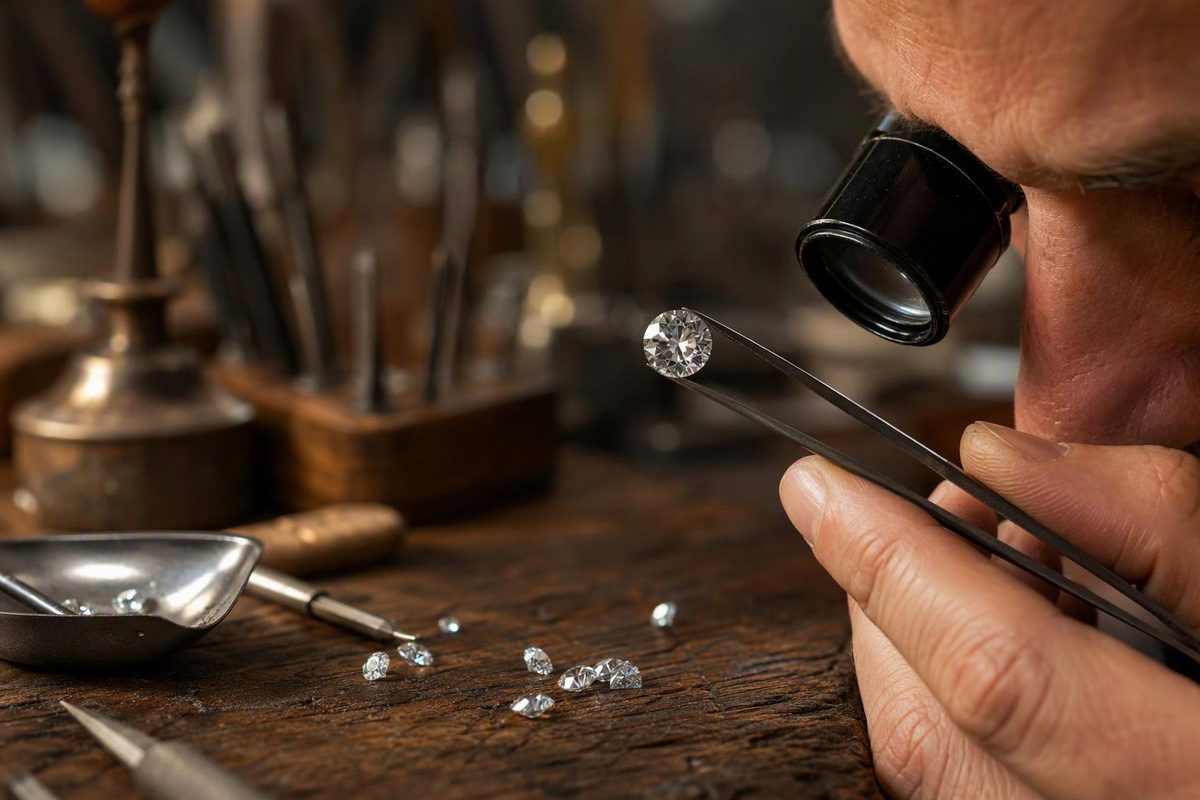
Yes—another diamond can scratch a diamond. Diamond ranks 10 on the Mohs hardness scale, so it resists scratching exceptionally well. Ordinary contact with keys or a metal ring setting should not scratch the diamond itself. That does not make it unbreakable: a hard blow in the wrong place can chip, crack or cleave it. GIA’s diamond care guide distinguishes scratch resistance from resistance to impact.
If you have noticed a line or dull patch on your stone, do not try to prove its identity by scratching it. First establish whether you are seeing surface dirt, a scratch or a different kind of damage.
What can scratch a diamond—and what can chip it?
The useful distinction is between hardness and toughness:
- Hardness measures resistance to scratches and abrasion. Another diamond can scratch a diamond, which is why diamond jewelry should not be allowed to rub together in storage.
- Toughness measures resistance to breaking and chipping. A hard impact can damage a diamond even when the object striking it cannot scratch its surface.
The Mohs scale is a ranking, not an evenly spaced measurement: diamond is many times harder than ruby or sapphire at 9, not simply a little harder. Yet its crystal structure has weaker directions, called cleavage directions, along which it can break. Extremely thin girdles—the edges around a diamond—and exposed points are particularly vulnerable. GIA explains these durability differences.
For a ring owner, this means protecting points and corners, checking the setting and avoiding hard knocks matter alongside preventing scratches.
Are lab-grown diamonds easier to scratch?
Lab-grown diamonds are not softer substitutes such as glass or cubic zirconia. They have essentially the same chemical, physical and optical properties as natural diamonds, so the same basic scratch-resistance and impact precautions apply. GIA’s natural-versus-laboratory-grown comparison explains the shared properties.
What to do if your diamond looks scratched
If the mark appeared after a hard knock, or the stone seems loose, stop wearing the ring and have a jeweler inspect it before cleaning. Ask them to check both the stone and its prongs. A loose diamond can gradually wear through the metal holding it, not just move around harmlessly. GIA’s care guide describes this setting risk.
If there was no impact and the setting appears secure:
- Clean gently. For diamond jewelry suitable for home cleaning, soak it in water with a few drops of mild dish soap, then use a soft, clean toothbrush reserved for jewelry. Rinse and dry with a lint-free cloth; close the drain if working over a sink. Do not scrub fragile antique settings; have those assessed professionally.
- Look again in good light. Oil attracts dirt and can reduce sparkle, so a dull-looking surface is not by itself evidence of abrasion.
- Have any persistent mark examined under magnification. Ask whether it is a surface scratch, an existing polish feature, an internal characteristic or a chip. A photograph alone may not settle that distinction.
These cleaning steps follow GIA’s diamond-cleaning guidance, which also warns against toothpaste, abrasive household cleaners and chlorine bleach. Abrasives can scratch the setting’s metal even though the diamond resists them. Leave ultrasonic cleaning to a professional when damage, treatments or setting condition are uncertain; fracture-filled diamonds should not be cleaned ultrasonically.
Do not attempt to buff out the mark yourself. If a professional confirms surface damage, ask whether repolishing is appropriate and what it would mean for the stone’s weight, proportions and documentation before authorizing work.
Do not use a scratch test to check authenticity
A stone scratching glass does not prove it is diamond. Glass is only about 5–6 on the Mohs scale, and many other materials can scratch it. GIA recommends gemological testing instead.
Likewise, a visible chip does not prove a stone is fake: genuine diamonds can chip. For an unknown stone, request professional identification rather than a destructive test. For everyday care, store diamond pieces separately and have adjacent rings checked if their stones touch.