
Are Gemstone Identification Apps Accurate?
See when a gemstone app can shortlist a gem, read a stamp, or flag a fake—and when only a tester, jeweler, appraiser, or lab will do.
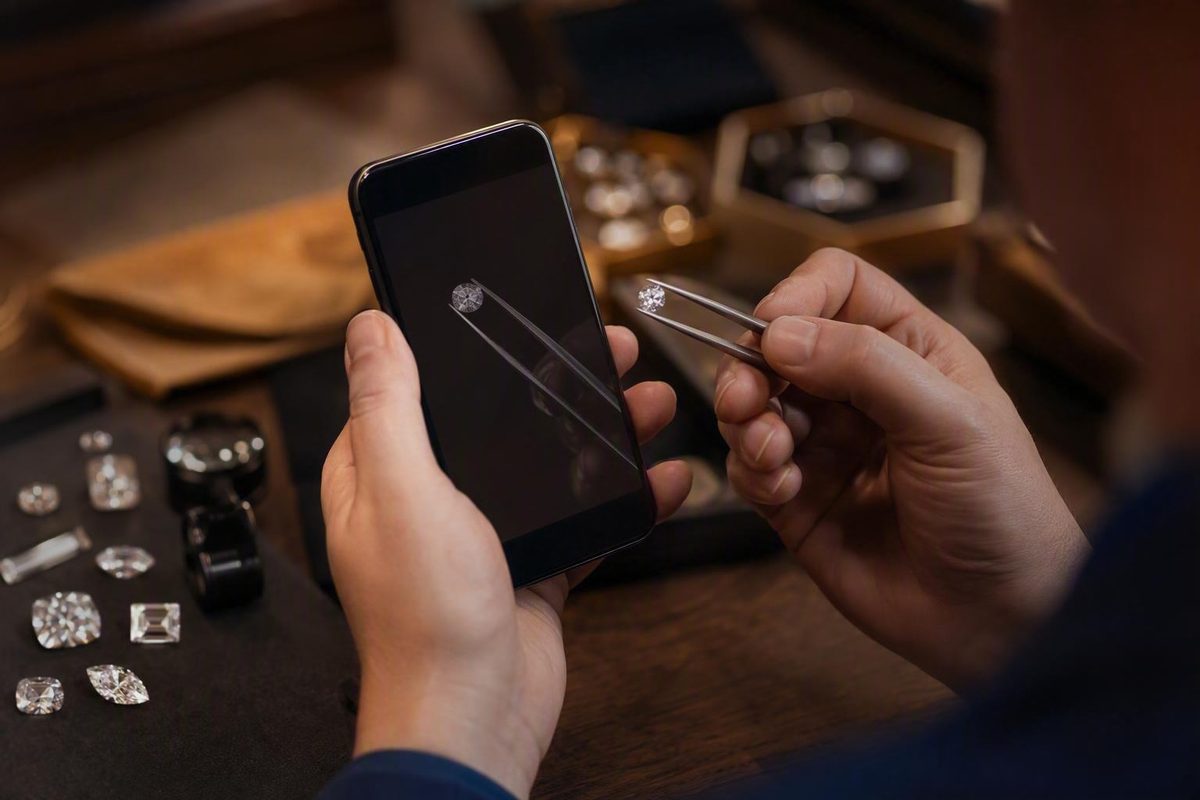
A gemstone identification app is accurate enough to suggest candidates, read a clear karat stamp, and flag some obvious visual inconsistencies—but not to prove a gem is natural, lab-grown, treated, valuable, or from a claimed origin. No defensible universal accuracy percentage exists. Trust a scan as a shortlist; use a tester, jeweler, appraiser, or gemological laboratory when the answer affects money or disclosure.
Choose the question you need answered; the tool shows what can settle it and what remains uncertain.
Select your goal and circumstances. The recommendation distinguishes a useful screen from evidence that can support a transaction or disclosure.
1. What do you need to know?Compare several clear photographs and retain every plausible alternative. Cost: free for GemstoneAI. Turnaround: —.
| Question | App | Tool That Answers It | Cost / Turnaround |
|---|---|---|---|
| Possible gem variety | Shortlist only | App for leads; gemologist for confirmation | App: free; professional: — / — |
| Whether it may be diamond | Visual guess | ~$20 thermal/electrical tester for screening; jeweler if uncertain | Tester: ~$20 / immediate; jeweler: — / — |
| Natural versus lab-grown | Cannot settle | Specialized screening or gemological laboratory report | — / — |
| Formal value | Rough estimate only | Qualified appraiser, with supporting report where needed | — / — |
| Whether gold is genuine or stated fineness | Cannot settle | Jeweler inspection and appropriate metal testing | — / — |
| Visible karat stamp | Can transcribe | App or loupe to read it; jeweler testing to verify metal | App: free; loupe/jeweler: — / — |
| Designer-setting authenticity | May flag obvious errors | Jeweler/appraiser or brand specialist; check provenance | — / — |
| Treatment or geographic origin | Cannot settle | Qualified gemological laboratory where feasible | — / — |
Source note: GemstoneAI feature limits and free release are reported by National Jeweler and its Google Play listing. The ~$20 tester figure comes from the topic brief. Unpublished costs and turnaround times are shown as —.
A Scan Can Shortlist More Than It Can Identify
Photo apps compare visible characteristics with possible materials. Depending on the image, those clues may include apparent color, transparency, texture, luster, crystal form, facet arrangement, inclusions, fractures, banding, and the appearance of a stamp or hallmark.
That can be useful for candidate retrieval: placing ruby, spinel, glass, or another red material on a list for further investigation. It is not the same as determining which material is actually present.
GemstoneAI, released free on the App Store and Google Play in August 2026, illustrates the distinction. National Jeweler reports that it returns a likely identity, confidence score, and visually similar alternatives. Its stated coverage includes more than 200 gem varieties, treatment or synthetic indicators, hallmark reading, and value estimates. The founder describes it as a starting point rather than a replacement for an appraiser or gemological laboratory. National Jeweler reports the features and limitations.
The app’s Google Play listing similarly offers photo identification, confidence scores, possible treatment or synthetic flags, collection tools, and value estimates. It also says a phone camera does not replace a gemological laboratory and that certified reports remain decisive for high-value stones and natural-versus-synthetic or treatment questions. The GemstoneAI listing states those qualifications.
Coverage is not accuracy. Supporting more than 200 categories means those categories may be available as outputs. It does not show how often the correct category ranks first, how well the system separates look-alikes, or whether its confidence scores correspond to real-world correctness.
The distinction applies to every output:
- A candidate name is a visual match, not confirmed identity.
- An alternative list records unresolved possibilities.
- A synthetic or treatment flag is a prompt for testing.
- A hallmark reading transcribes visible characters; it does not verify the metal.
- A photo-based value is conditional on facts the photograph may not establish.
Apps Are Best at Low-Stakes Visual Questions
An app can be useful when the desired answer is visible and provisional. It may recognize a broad gem family, suggest alternatives for a collection label, transcribe a sharply photographed “750” stamp, or notice that a supposed designer setting differs visibly from reference examples.
These uses remain limited. A “750” result means the software likely read the characters. It does not prove that the piece is 18-karat gold, that the stamp is legitimate, or that every component has the same fineness. See what a 750 jewelry stamp means before treating the mark as evidence.
An app may also flag an obvious fake when a logo is misspelled, a mark is crudely formed, or the construction is visibly inconsistent. Passing that visual check does not authenticate a designer item. Counterfeiters can copy marks, while genuine pieces can have wear, repairs, replacement components, or variations that complicate comparison.
The safest app-level conclusions sound like “possible quartz,” “stamp appears to read 750,” or “construction deserves closer inspection.” Statements such as “confirmed natural sapphire,” “genuine 18-karat gold,” and “authentic designer setting” require evidence beyond the scan.
A Diamond Tester Answers One Narrower Question
A roughly $20 thermal or electrical tester can provide more relevant evidence than a photograph when the question is whether a stone behaves like diamond. It measures a property rather than visual resemblance.
That still makes it a screening tool, not a universal gem laboratory. Its result depends on the tester, contact, stone size, mounting, cleanliness, temperature, and the range of materials the device is designed to separate. A positive reading should not be expanded into claims about natural origin, laboratory growth, treatment, grade, or value.
A tester also does not establish that gold is real. Metal fineness requires appropriate examination or metal testing. Do not use improvised scratch, hardness, or acid tests on a finished piece or potentially valuable stone. Such tests can damage surfaces and still fail to answer every authenticity question.
For a mounted diamond, a jeweler can combine a tester result with magnification, setting inspection, measurements, and other observations. If natural-versus-lab-grown status matters, specialized screening or a laboratory report is the appropriate next step.
Natural Versus Lab-Grown Requires Evidence Outside the Photo
Natural and laboratory-grown gemstones can share the same basic material and closely similar visible appearance. A phone image does not contain all the growth, inclusion, spectral, fluorescence, or trace-element evidence that may be needed to separate them.
National Jeweler reports that GemstoneAI cannot distinguish natural from lab-grown material with a phone camera. The app also cannot determine geographic origin. A displayed synthetic warning is therefore a reason to investigate, not a final finding.
Treatment status has the same limitation. A photograph may show color concentrations, surface-reaching fractures, coatings, or other features that justify closer examination. It cannot reliably establish that treatment is present, absent, or fully characterized.
Depending on the material and question, professional work may involve microscopy, refractive-index measurement, polariscopy, spectroscopy, ultraviolet examination, or further laboratory analysis. Not every test works on every mounted stone, and no single instrument answers all gemological questions.
Geographic origin is narrower still. Appearance alone cannot establish a mine, country, or region. Where an origin opinion is feasible and consequential, it belongs with a qualified gemological laboratory using methods appropriate to that material.
Value Estimates Cannot Replace an Appraisal
A photo app may estimate value from apparent gem type, size, color, clarity, cut, and comparable sales. If the scan has the identity wrong—or cannot resolve natural versus lab-grown, treatment, measurements, condition, or setting quality—the estimate rests on uncertain inputs.
An appraisal is a documented value opinion for a stated purpose, market, and date. Insurance replacement, resale, estate distribution, donation, and liquidation are different assignments. A generic photo estimate does not establish which market or appraisal premise applies.
Do not use an app estimate alone to buy, sell, insure, divide, donate, or advertise a gemstone. First establish the facts that materially affect value. A qualified appraiser may rely on direct examination and supporting laboratory documentation where the assignment requires it.
The same caution applies to designer jewelry. A gemological report generally describes the stone, not the authenticity of the brand or the entire piece. Designer authentication may require inspection of construction, marks, serial information, provenance, service records, and comparison with documented examples. The appropriate specialist may be a jeweler, appraiser, auction specialist, or the maker—not a gemstone photo app.
Confidence Scores Are Not Accuracy Percentages
A confidence score shows how strongly the software favors an answer within its own system. It does not independently verify the object. A high score can accompany a wrong answer when the model has not captured the relevant alternatives or when the photograph emphasizes a misleading feature.
A meaningful accuracy claim would need independently verified specimens, a representative test set, disclosed app and model versions, repeatability testing, top-one and top-three results, material-specific errors, false-positive rates, and confidence calibration. The accessible app listings do not provide that benchmark.
The International Gem Society says it evaluated 24 Apple identification apps, but the accessible portion of its review does not disclose the complete methods, specimen composition, app-level results, or accuracy figures needed to calculate a general rate or identify a current winner. It also notes that gemstone identification may require information beyond unaided visual appearance. The International Gem Society outlines its 2022 evaluation.
Store ratings and download totals do not fill the gap. Users may reward speed, design, reference material, collection tools, or entertainment value without independently confirming the identification. Database size shows how many answers might be returned, not how reliably similar materials are separated.
No available evidence therefore supports naming a most accurate current gemstone app. No reliable overall percentage can be calculated either.
Informal Reports Show Why Rescanning Matters
User reports cannot establish an error rate, but they reveal plausible failure modes. Reported problems include different answers after changing the angle, lighting, or background; incorrect first choices with more plausible alternatives; repeated suggestions for unrelated specimens; and high confidence attached to disputed answers.
One displayed app reviewer informally estimated roughly 80% correct for known rocks while also reporting sensitivity to lighting, angle, and background. The review did not disclose the sample size, specimen mix, protocol, or independent ground truth. The figure cannot be generalized to gemstones, valuable jewelry, other users, or current versions. The App Store review is an uncontrolled anecdote.
A small PriceScope forum test from 2022 reported that an image described as spinel was labeled ruby with 100% confidence. The same informal exercise produced useful, approximate, and incorrect results involving sapphire, glass, jasper, quartz, and faceted jewelry. The sample was small and uncontrolled, and the asserted identities were not documented there with laboratory reports. The discussion records the test and its limitations.
These reports do not prove typical performance. They support four practical cautions: inspect the entire shortlist, scan more than one view, treat changing answers as unresolved, and never equate displayed confidence with authentication.
Better Photographs Improve the Shortlist, Not the Proof
Use diffuse neutral light, a plain background, accurate focus, and no filters or saturation adjustments. Photograph the complete item and then capture multiple sides, visible inclusions, surface patterns, and any matrix or host rock. Include a scale where practical.
For mounted jewelry, photograph the face-up view, side profile, complete setting, prongs or bezel, accessible back, and separate close-ups of every mark. Do not force access behind a stone or remove it merely for an app scan. A professional can decide whether the setting prevents the necessary observations.
Change one photographic variable at a time when rescanning. If the answer changes after a new angle, record both results rather than selecting the more valuable or appealing one. Agreement across photographs makes a candidate more useful, but repeated agreement still does not add refractive index, microscopic growth structure, or other missing evidence.
Preserve the original photographs, app name and version, top result, alternatives, displayed confidence, and existing receipts or reports. This prevents an exploratory label from gradually being remembered as an established identification.
Cleaning can also change what the camera sees. If the material or setting is uncertain, do not alter it merely to improve the scan; use a suitable jewelry-cleaning method only when it is safe for the piece.
Stop Scanning When the Answer Has Consequences
An app shortlist is sufficient for casual curiosity, schoolwork, provisional field notes, or basic collection organization, provided the label remains visibly unconfirmed.
Consult a jeweler or gemologist when a mounted piece needs direct examination, a stamp must be corroborated, the setting conceals useful features, or a screening tester produces an uncertain result. Practitioners may combine microscopy, polariscopy, spectroscopy, ultraviolet examination, and refractometry where feasible; the suitable combination depends on the stone and question. A GemologyOnline discussion describes approaches to mounted stones.
Use a qualified appraiser when the required conclusion is value for a defined purpose. Use a gemological laboratory when natural-versus-lab-grown status, treatment, origin, or another specialized disclosure materially affects the transaction.
Stop relying on the app when the top answer changes among photographs, documentation conflicts with the result, valuable and ordinary alternatives remain open, or the proposed identity would materially affect price. The more money, rarity, disclosure risk, or permanence involved, the less weight a photo scan should carry.