
How Are Lab-Grown Diamonds Made? HPHT and CVD Explained
Follow HPHT and CVD diamond growth from seed to polished gem, compare temperatures and timelines, and learn what growth and treatment labels actually mean.
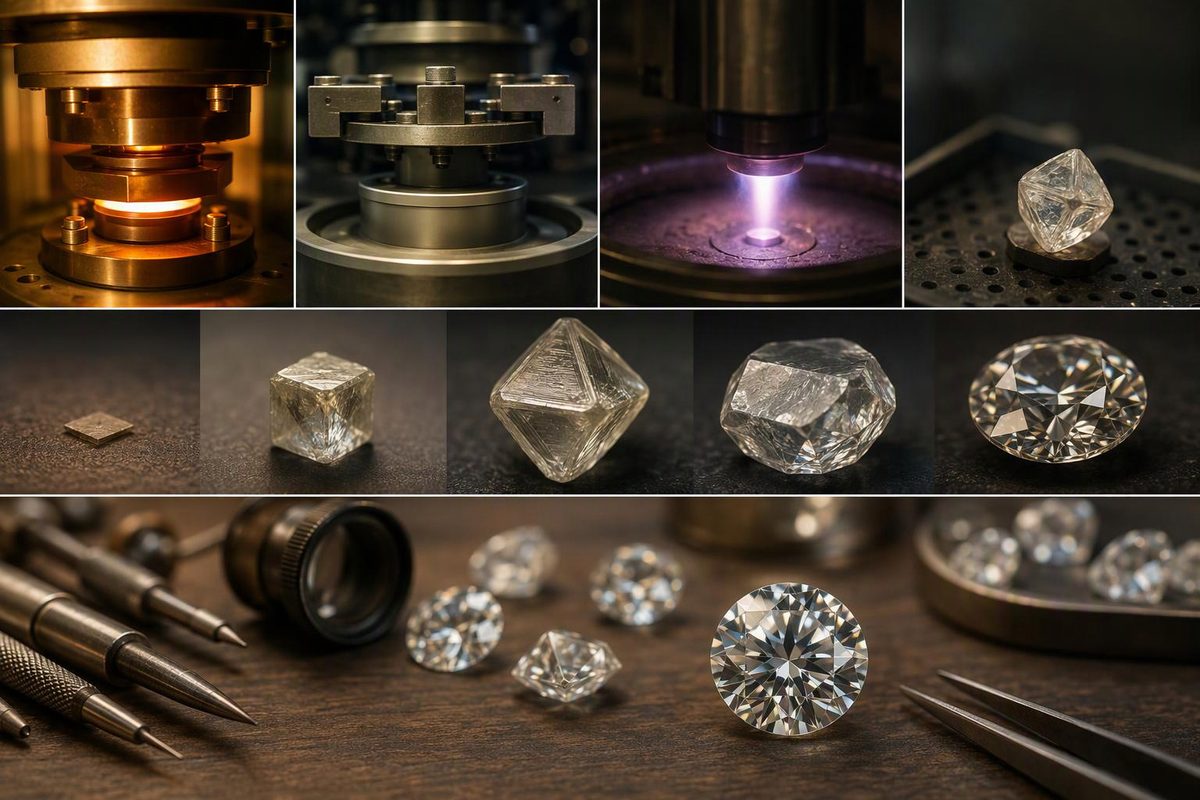
Lab-grown diamonds are made by growing carbon into a diamond crystal on a small diamond seed. Manufacturers use two main methods: high-pressure, high-temperature (HPHT) growth, which crystallizes carbon under extreme pressure, and chemical vapor deposition (CVD), which builds diamond from carbon-containing gas. The resulting rough crystals are then cut and polished into gemstones; some also receive color treatment after growth. Both methods produce real diamond, not a diamond imitation. GIA explains the two growth processes.
Choose the label on a diamond listing to see what it establishes—and what remains unknown.
Decode a Diamond’s Manufacturing Label
CVD Is the Growth Method
The crystal grew from carbon-containing gas on diamond seed plates.
Still to check: Whether it received post-growth treatment. CVD alone does not establish treatment status or cut quality.
Label Reference
| Listing Label | Growth | What It Establishes |
|---|---|---|
| CVD-grown | CVD | Gas-based growth; treatment status not established. |
| HPHT-grown | HPHT | Growth under high pressure with a metallic flux. |
| CVD-grown, HPHT-treated | CVD | CVD growth followed by HPHT color treatment. |
| HPHT only | — | Ask whether HPHT refers to growth or later treatment. |
Sources: GIA’s growth-process guide and 2024 research summary. — means the growth method is not established by that wording.
A Diamond Seed Starts the Crystal, Not an Imitation Stone
The seed is a small piece of diamond that provides the crystal structure on which additional diamond grows. It is not a finished lookalike gemstone that receives a decorative diamond surface. In both HPHT and CVD gemstone production, the manufacturing goal is to grow a rough diamond crystal that can later be fashioned into a polished stone.
Lab-grown diamonds have the same tightly bonded carbon crystal structure as natural diamonds and nearly the same chemical, optical and physical properties. Moissanite and cubic zirconia are different materials. The distinction between laboratory-grown and natural diamond is therefore its growth history—not whether the material is diamond. GIA’s diamond and simulant guide explains that separation.
That distinction also keeps two buying questions apart. Identifying a stone as diamond establishes its material; identifying it as laboratory-grown establishes its origin. Neither statement, by itself, tells you how attractive the finished stone will be or how well it has been cut.
HPHT Grows Diamond From Carbon Dissolved in Metal
HPHT reproduces some of the heat and pressure conditions associated with natural diamond formation, but inside a specially designed press. The process uses a carbon source, a diamond seed and a metallic flux to grow the crystal.
The Growth Capsule Contains the Starting Materials
The manufacturer loads a capsule with a diamond seed, a high-purity carbon source such as graphite, and a metallic flux—commonly involving iron, nickel or cobalt. These materials have different jobs. The carbon supplies the material for the growing diamond; the metal helps transport that carbon; the seed supplies the structure on which it crystallizes.
Describing HPHT as simply “squeezing carbon until it becomes diamond” leaves out this transport mechanism. Pressure and heat create the necessary growth conditions, but the carbon still has to reach the seed and crystallize there.
Heat and Pressure Allow Carbon to Reach the Seed
GIA’s 2024 research summary describes HPHT growth temperatures of approximately 1,300–1,600°C and pressures of 5–6 gigapascals (GPa). The carbon dissolves in the molten metal, moves toward the cooler seed and crystallizes on it as diamond. The seed grows into a larger rough crystal through this controlled process.
Those figures describe the growth conditions reported by GIA, not a universal setting for every manufacturer or every production run. They are useful for understanding the scale of the process, not for calculating the quality or size of a finished gemstone. GIA’s research summary covers the materials and conditions.
Once growth is complete, the rough crystal is recovered. It still needs to be fashioned into a gemstone. The press grows diamond material; it does not produce the finished facets that determine the appearance of a polished stone.
CVD Grows Diamond From Carbon-Containing Gas
CVD takes a different route to the same diamond material. Rather than dissolving solid carbon in molten metal, it supplies carbon through a gas mixture in a low-pressure chamber. Flat diamond seed plates provide the surfaces on which the crystals grow.
Activated Gas Supplies Carbon to the Seeds
The chamber contains hydrogen and a carbon-containing gas, typically methane. Microwaves commonly create a plasma—an energized gas—which drives the reactions that deposit diamond material on the seeds. The crystals build up layer by layer.
Hydrogen helps suppress graphite and other non-diamond carbon, allowing diamond to grow. The distinction matters: supplying carbon is not enough on its own. The process must favor the diamond crystal structure rather than other forms of carbon.
GIA’s introductory guide gives CVD growth temperatures of about 900–1,200°C, lower than the HPHT range cited above. CVD nevertheless remains a high-temperature manufacturing process. “Low pressure” describes its chamber relative to HPHT; it does not mean the diamond is grown without heat.
Growth Can Stop and Restart
CVD growth may be interrupted to remove non-diamond carbon from the surface before continuing. A production cycle therefore need not be one uninterrupted period of deposition. GIA’s process explanation describes these stop/start cycles alongside the gas mixture and growth conditions.
The resulting material is a rough diamond crystal, not merely a diamond coating on a finished imitation stone. As with HPHT, the crystal must still go through the stages needed to become a polished gemstone. A seller’s “CVD” label identifies the growth route, not the finished shape, cut quality or treatment history.
HPHT and CVD Use Different Routes to Grow the Same Material
The practical process differences can be summarized without treating either method as a quality grade.
| Growth Feature | HPHT | CVD |
|---|---|---|
| Carbon supply | Solid source, such as graphite | Gas, typically methane |
| Growth environment | High-pressure press | Low-pressure chamber |
| Carbon transport | Molten metallic flux | Activated gas reactions |
| Reported temperature | ~1,300–1,600°C | ~900–1,200°C |
| Starting surface | Diamond seed | Flat diamond seed plates |
The temperature ranges come from different GIA explanations: its 2024 research summary for HPHT and its introductory process guide for CVD. They are descriptive ranges, not a matched experiment proving that one route produces better jewelry diamonds. GIA’s process guide explains how both methods work.
Neither a hotter process nor a lower-pressure process establishes superiority. For a buyer, the useful distinction is how the crystal grew and whether it underwent later treatment—not which manufacturing label sounds more advanced.
Growth Usually Takes Days to Weeks, Not a Fixed Time per Carat
Think days to weeks for many crystals, rather than a fixed recipe for every carat weight. GIA’s introductory explanation describes HPHT crystallization over several days to weeks and CVD batches taking roughly three or four weeks, including stop/start cycles.
These descriptions are not directly interchangeable. One refers to an HPHT crystallization period; the other describes a CVD batch with interruptions. Neither supplies a reliable rule for converting a requested finished carat weight into a production time.
Size, desired quality and production conditions affect duration. Exceptionally large crystals can take much longer: GIA’s 2024 research summary describes one large CVD crystal reportedly grown over nine months. That is an example of a particular large crystal, not the normal waiting time for a CVD engagement-ring diamond. GIA reports the large-crystal example in its research summary.
Growth time also differs from delivery time. Recovering and processing the rough, any color treatment, cutting, polishing and any laboratory assessment are separate stages. A seller’s ring-delivery estimate cannot be inferred from the chamber time alone. The cited sources do not provide a universal total manufacturing time for a finished jewelry diamond.
Post-Growth HPHT Treatment Is Separate From HPHT Growth
A crystal leaving the growth equipment is not necessarily ready for a jewelry setting. Non-diamond material may need to be removed, and some diamonds undergo treatment to improve their color. Growth and treatment should be read as separate parts of the stone’s manufacturing history.
In particular, a CVD-grown diamond can receive post-growth HPHT treatment to reduce brown coloration. That does not turn it into an HPHT-grown diamond. CVD describes how the crystal grew; HPHT treatment describes what happened afterward.
GIA notes that this treatment does not add new diamond material. It is therefore different from the HPHT process in which carbon crystallizes on a seed and enlarges the diamond. GIA’s research summary explains the growth-versus-treatment distinction.
A listing that says “CVD-grown, HPHT-treated” is not contradictory. It describes two successive stages. A listing that says only “HPHT” is less informative unless it makes clear whether the term refers to growth or treatment. The wording should identify the stage rather than leave the buyer to infer it.
Treatment information also should not be used as a shortcut for judging the finished appearance. It explains part of the processing history. You still need to assess the actual polished diamond rather than assume that treated or untreated wording settles the purchase.
Cutting Determines the Finished Gemstone, Not the Growth Label
After growth and any relevant processing, the rough is fashioned into a polished gemstone. Crystal growth and cutting are separate stages: one creates the material, while the other creates the finished diamond’s shape and facets.
Consequently, knowing that a diamond was grown by CVD or HPHT does not tell you how well it has been cut. Two stones carrying the same growth label can still differ in dimensions, visible inclusions, appearance and light pattern. Those are characteristics of the finished stones that must be compared directly.
The same separation applies to production time. A longer growth period does not establish a better cut, and a faster growth period does not establish a worse one. The cited growth timelines do not provide a quality ranking for polished diamonds.
Buyers Should Verify Origin and Compare the Finished Stones
Treat HPHT and CVD as manufacturing information, not quality rankings. Both methods can produce high-quality gemstones, and both can leave characteristic inclusions or growth features. Laboratories use those features, together with instrumental testing, to help identify origin. GIA describes the diagnostic differences between growth methods.
For a purchase, confirm laboratory-grown origin in a gemological laboratory report rather than relying only on the seller’s description. Ask for growth and treatment information where available, keeping the original growth method separate from later color treatment. Do not infer missing treatment information from a growth label alone.
Then compare the finished diamonds: their appearance, dimensions, visible inclusions and light pattern. A CVD or HPHT label does not, on its own, justify paying more. It explains a process, not a demonstrated advantage in the stone you are considering.
Our guide to whether lab-grown diamond grades matter explains how to use quality information without letting a paper upgrade make the purchase decision for you. The manufacturing label belongs alongside that evidence—not in place of it.