
IGI-Certified Lab-Grown Diamonds: Read and Verify the Report
Learn what an IGI lab-grown diamond report covers, how to verify it, and which cut, treatment and seller claims still need checking.
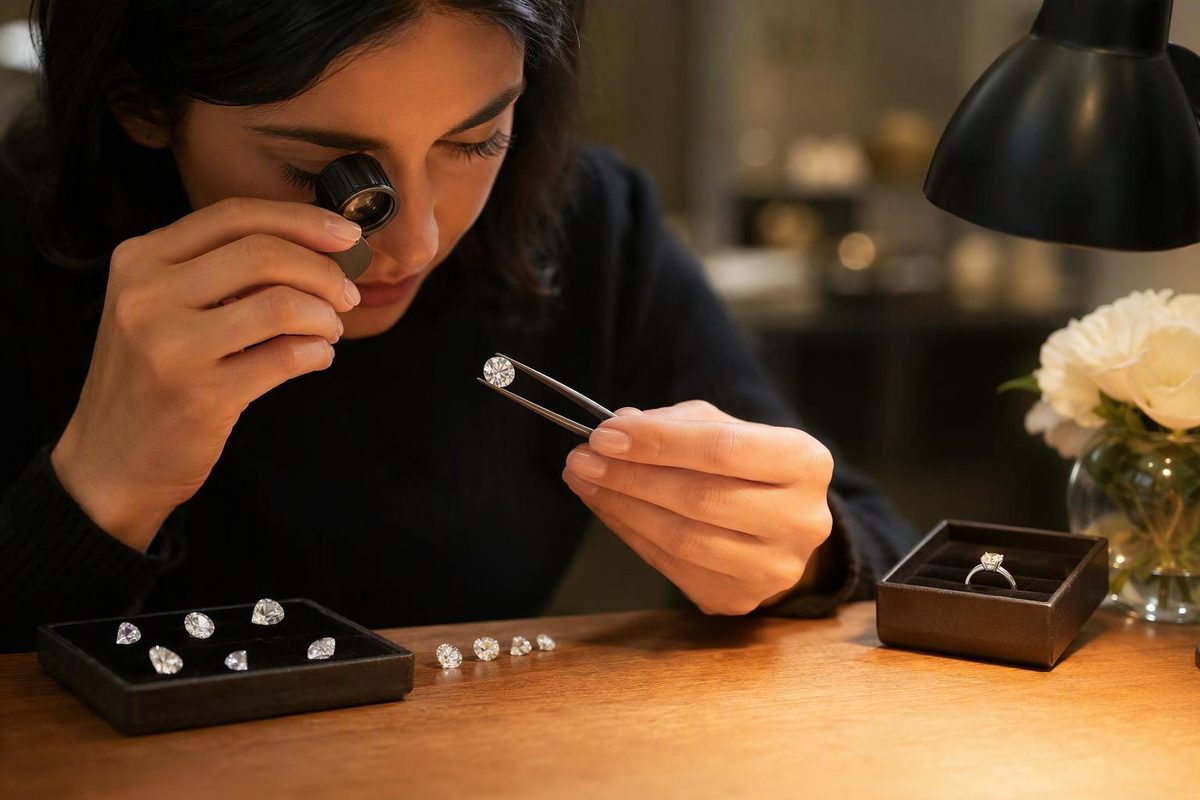
An IGI-certified lab-grown diamond is a laboratory-grown diamond accompanied by a grading report from the International Gemological Institute. The useful part is not the word “certified” in a listing: it is the documented identity, measurements and grades of the specific stone.
IGI screens diamonds to distinguish natural, laboratory-grown and simulant origin, then assesses their gemological characteristics. But its report is a grading opinion—not a guarantee, warranty or appraisal. Use it to check what you are buying, then judge appearance and price separately. (IGI report services, report limitations)
What to read on the report
Ask for the complete report before paying, not just a seller’s summary of “F/VVS2” or “Excellent.” For a loose-diamond report, work through these fields:
| Report field | What to check as a buyer |
|---|---|
| Report number and date | Use the number to retrieve IGI’s record; note the date when comparing report formats. |
| Description | Confirm that it explicitly identifies a laboratory-grown diamond. |
| Shape and cutting style | Match the report to the advertised stone, such as pear brilliant or round brilliant. |
| Carat weight and measurements | Compare both weight and millimeter dimensions; weight alone does not describe face-up size. |
| Color and clarity | Read the actual grades rather than a broad seller category such as “colorless” or “premium clarity.” |
| Cut, polish and symmetry | Keep these separate. Excellent polish and symmetry do not, by themselves, establish an Excellent overall cut grade. |
| Comments and inscriptions | Read growth-method and treatment wording exactly, and note the inscription to be checked on the stone. |
If you are buying finished jewelry, check whether the document is a jewelry report rather than a loose-stone report. IGI says its lab-grown jewelry reports provide center-stone measurements and 4Cs assessments as the mounting permits. (IGI report services)
IGI grades D-to-Z color in a standardized environment with the diamond upside down, viewed through the side. Clarity is assessed at 10× magnification. These are controlled grading observations, not descriptions of everything you will notice while wearing a ring. (IGI grading explanation)
For purchasing purposes, ask to see the stone face-up in neutral lighting and in motion. Check whether its color, visible inclusions and light pattern bother you at ordinary viewing distance. A higher clarity grade should not replace that inspection.
A real report shows why individual fields matter
IGI report LG544263745, dated August 25, 2022, describes a 0.31-carat pear brilliant measuring 5.93 × 3.82 × 2.30 mm, with F color and VVS2 clarity. Its polish and symmetry are both Excellent, but its cut-grade field is blank.
That distinction matters if a listing calls the stone “Excellent cut.” IGI’s current service page describes cut assessment for fancy shapes as well as rounds, but you must read what that particular report actually provides—not assume every report has the same fields. (Current IGI cut-grading description)
The same pear report says it was grown by Chemical Vapor Deposition (CVD) and “may include post-growth treatment.” That is not confirmation of an untreated stone. If a seller claims “as-grown” or “no post-growth treatment,” ask for documentation supporting that narrower claim. IGI says growth process and treatment information can be noted upon request, so silence should not be treated as proof of no treatment. (IGI report services)
Verify the record—and connect it to the diamond
- Enter the report number yourself on IGI’s Verify Your Report page. Do not rely only on a screenshot or seller-hosted PDF.
- Compare the returned details with the listing: origin description, shape, weight, dimensions, grades, comments and inscription.
- Have the inscription checked under magnification, where present. It is typically on the girdle—the diamond’s outer perimeter. Ask the jeweler to compare it with the report’s inscription entry, not merely confirm that a number exists.
- Resolve discrepancies before the return deadline. If the inscription cannot be read or the details do not match, seek an independent gemologist’s assessment or contact IGI before accepting the stone.
An online match verifies the report record; it does not independently authenticate the physical diamond in your hand. In January 2024, IGI reported a lab-grown pear carrying a false inscription linked to a GIA natural-diamond report with closely matching specifications. The case involved a natural-diamond identity being misused, but it demonstrates why an inscription number alone is insufficient. (IGI’s documented case, National Jeweler coverage)
Is IGI or GIA better for this purchase?
For buyers who want individual color and clarity grades, IGI’s report supplies useful comparison detail. As of October 2026, GIA’s current assessment for eligible colorless-to-near-colorless lab-grown diamonds uses Premium or Standard rather than the former individual-grade reporting format. GIA announced the revised service with an October 1, 2025 start date. This is a difference in reporting approach, not proof that one laboratory’s diamond is inherently more attractive. (GIA current services, service-change announcement)
If you are comparing an IGI report with GIA paperwork, check the GIA document’s date and service type; our GIA lab-grown report guide explains the distinction.
What makes it worth buying?
An IGI report is useful purchasing evidence, but “IGI certified” alone does not justify a premium. Compare the asking price with other lab-grown stones of similar shape, weight, dimensions and grades. Keep the setting cost separate, and check the return policy and any written buyback or upgrade terms.
Before committing, require three things: a matching report, an acceptable view of the actual stone, and clear written sale terms. If one is missing, the certificate has not finished the buying job.