
Is Platinum Cheaper Than Gold for a Ring? 2026 Math
Compare platinum, 14K, and 18K ring metal values at 2026 spot prices, then identify whether a platinum premium comes from metal or the quote itself.
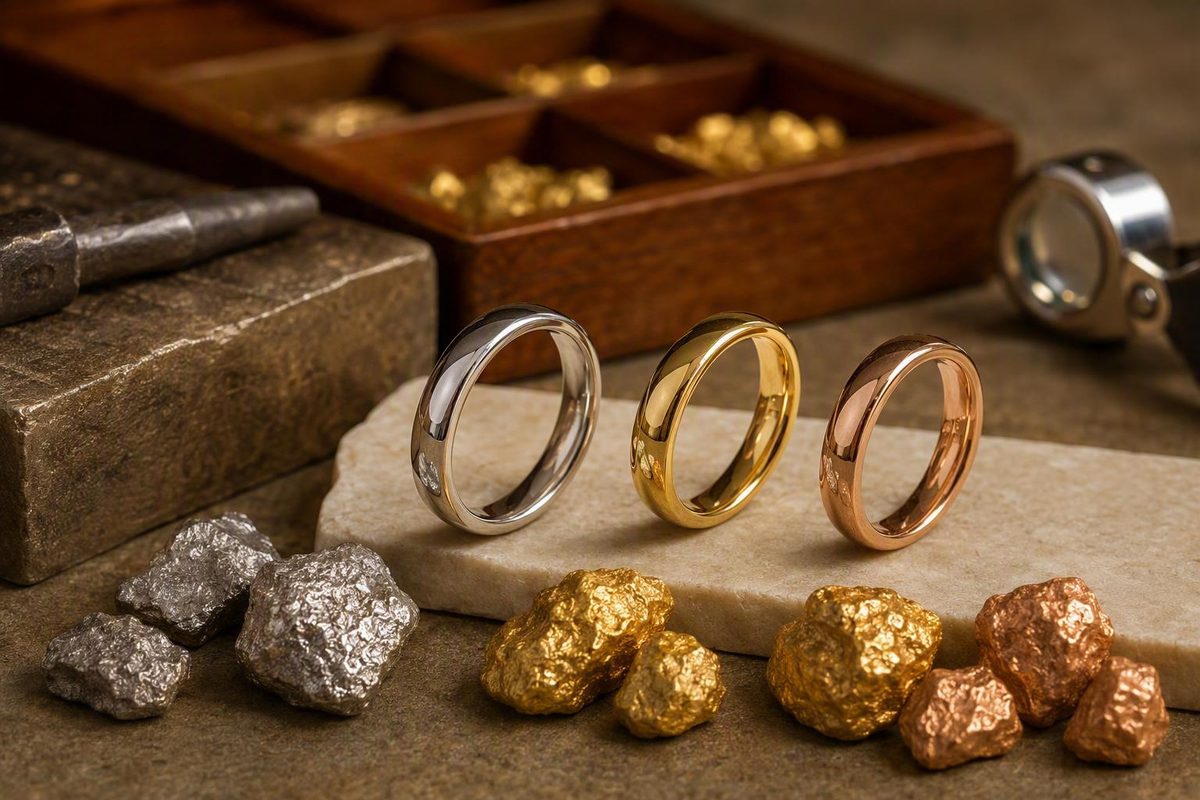
Yes—platinum can be cheaper than gold for a ring on raw-metal value. On April 16, 2026, platinum was listed at $1,883.95 per ounce against gold at $4,562.75, or about 41 cents per gold dollar. After allowing for platinum’s greater density and 95% purity, the metal in a same-volume platinum 950 ring was still about 28% cheaper than the metal in 18K gold (Minted Metal’s price history). A finished platinum ring may nevertheless cost more because its quote also includes fabrication, setting, finishing, services, and retailer pricing.
Enter the ring weight and current spot prices; the calculator shows which metal wins and where platinum’s price advantage disappears.
The entered weight is the 18K reference ring. Platinum weight adjusts for density; 14K is shown only on an equal-weight basis because no 14K density is assumed.
| Comparison | Calculated Weight | Named Metal | Metal Value |
|---|---|---|---|
| 14K gold, equal-weight reference | 4.00 g | 2.34 g gold | $343 |
| 18K gold, reference ring | 4.00 g | 3.00 g gold | $440 |
| Platinum 950, same volume | 5.54 g | 5.26 g platinum | $319 |
Enter matched finished-ring quotes. The remainder can include alloying metal, manufacturing loss, labor, stones, overhead, services and margin; it is not a profit calculation.
Source note: April 16, 2026 spot figures from the cited Minted Metal history; purity and density figures are those stated in the article. Calculations use one troy ounce = 31.1035 grams. The source page is not a live quote.
Why Jewelers Still Quote Platinum As the Upgrade
The received wisdom has a sound basis: platinum rings have traditionally been positioned as the luxury alternative to gold. Platinum 950 contains about 95% platinum, compared with 75% gold in 18K and approximately 58.5% gold in 14K. Platinum is also denser, so a ring made to comparable dimensions weighs more. Retailer guides describe its casting and finishing as more specialized or labor-intensive and commonly present 14K gold as the budget starting point (25karats’ metal comparison; Do Amore’s gold-versus-platinum guide).
That consensus is often right about the final store price. A platinum ring can cost more than its gold counterpart even when platinum bullion costs less.
The outdated part is the assumption that a platinum premium must come from the precious metal itself. That explanation worked more naturally when platinum traded above gold. It does not fit the April 2026 benchmark, when platinum’s per-ounce price was only about 41% of gold’s.
For a matched design, the question is no longer whether platinum uses more grams. It does. The question is whether those extra grams overcome platinum’s much lower price. At the cited prices, they do not overcome it against 18K gold.
The Same-Volume Ring Math Favors Platinum
An equal-weight comparison is misleading because platinum and gold rings of the same dimensions do not weigh the same. The cleaner bench calculation starts with volume.
The supplied figures put 18K gold at roughly 15.5 grams per cubic centimeter and platinum at 21.45 grams per cubic centimeter. Platinum therefore weighs about 38% more for the same volume. Purity then changes the amount of named precious metal in each cubic centimeter:
| Alloy | Density | Purity |
|---|---|---|
| 14K gold | — | About 58.5% |
| 18K gold | About 15.5 g/cm³ | 75% |
| Platinum 950 | 21.45 g/cm³ | 95% |
The available evidence does not provide a single density figure for 14K gold, whose density can also vary with alloy composition. The calculator therefore treats 14K as an equal-weight reference rather than claiming that it has exactly the same dimensions as the entered 18K ring.
For 18K gold, one cubic centimeter contains about 11.63 grams of pure gold: 15.5 grams multiplied by 75%. At $4,562.75 per ounce, that is approximately $1,700 of gold value per cubic centimeter.
One cubic centimeter of platinum 950 contains about 20.38 grams of platinum: 21.45 grams multiplied by 95%. At $1,883.95 per ounce, that is approximately $1,240 of platinum value per cubic centimeter.
The platinum version is heavier, but its named metal is so much cheaper per ounce that its calculated metal value remains roughly 28% lower. For the calculator’s default four-gram 18K band, the corresponding same-volume platinum ring weighs about 5.54 grams. Its platinum contribution is about $319, compared with about $440 of gold in the 18K version.
These are raw-metal benchmarks, not predictions of scrap value or retail price. They exclude alloying metals, manufacturing loss, recovery, casting, finishing, stones, taxes, services, and retailer pricing.
The source page also presents inconsistent 2026 figures in different places, so the April 16 prices should be treated as a dated comparison rather than a reliable live quotation. Substitute the spot prices used by the jeweler when evaluating a current quote.
Platinum’s Crossover Is Higher Than Its 2026 Price
The crossover is the platinum price at which the same-volume metal contributions become equal. Using the stated densities and purities, platinum reaches parity with 18K gold when its spot price is about 57% of gold’s spot price.
With gold at $4,562.75 per ounce, that puts the platinum crossover near $2,603 per ounce. Below that point, a same-volume platinum 950 ring contains less named-metal value than an 18K gold ring. Above it, platinum’s greater density and purity overcome the lower per-ounce price.
The cited April platinum price of $1,883.95 was about $719 below that crossover. This is why a modest change in ring weight does not restore the old assumption that platinum must be the more expensive material.
The historical inversion is not a one-day anomaly. The cited price history reports that the platinum-to-gold ratio moved below 1 in January 2015 and remained there through its latest discussion, describing the post-2015 discount as the longest sustained inversion in at least a century of price records (Minted Metal’s price history).
A Platinum Premium Now Needs a Non-Metal Explanation
Suppose a jeweler quotes the platinum version above the 18K version while keeping the ring’s volume and design substantially the same. At the April benchmark, the premium cannot be explained by the value of the named precious metal. Platinum’s calculated metal contribution is lower.
The difference may still be legitimate. Platinum can involve different casting, fabrication, soldering, setting, polishing, or finishing work. A shop may alter the shank, gallery, prongs, wall thickness, or production method for the platinum version. Warranty coverage, resizing terms and maintenance services may also differ.
Retailer guides consistently describe platinum work as more specialized, but the supplied evidence does not establish a universal labor surcharge. It also does not reveal an individual jeweler’s production costs or margin. A higher quote should therefore be described as a non-metal premium—not automatically as excessive markup.
The useful calculation is: non-metal remainder equals the finished quote minus the calculated named-metal value. Compare that remainder across matched platinum and gold quotes. If the platinum remainder is substantially higher, ask what additional construction, labor or service it buys.
This analysis depends on a genuinely matched ring. If the platinum version is thicker, has a different head, includes stone setting that the gold quote excludes, or comes with broader after-sales service, subtracting metal value will not isolate labor or margin cleanly.
Gold’s Price Is Already Changing Jewelry Demand
The bullion difference is large enough to affect the broader jewelry market. The World Gold Council reported that global gold-jewelry demand fell 17% year over year in Q2 2026 to 278.2 tonnes, one of the weakest second quarters in its data series. Buyers shifted toward lighter-weight and lower-carat designs, even as first-half spending rose 22% to $86 billion (World Gold Council’s Q2 2026 analysis).
Those figures do not determine the price of an individual ring. They do show why the old shopping shorthand—choose gold to avoid platinum’s material cost—has stopped matching the commodity market. Consumers and manufacturers are already reducing gold weight and purity in response to its price.
Platinum Versus 14K Gold Is a Closer Retail Contest
Platinum’s raw-metal advantage is clearest against 18K gold because 18K contains 75% gold. A four-gram 18K ring contains three grams of gold, worth about $440 at the April benchmark.
On an equal four-gram weight basis, 14K contains about 2.34 grams of gold, worth approximately $343. That is still slightly above the calculator’s roughly $319 platinum value for the same-volume platinum counterpart to the 18K ring. It is not, however, a valid same-volume 14K comparison because the evidence supplied here lacks the exact 14K alloy density.
In stores, 14K gold remains the stronger starting point when minimizing the initial purchase price. Retailer comparisons commonly position it below platinum because it contains less gold, generally produces a lighter ring, and uses familiar gold-jewelry production processes (25karats’ metal comparison).
Platinum is more likely to challenge 18K than 14K on the finished quote. The actual ranking still depends on the design and jeweler.
White Gold Adds a Maintenance Difference, Not a Guaranteed Saving
Platinum is naturally white. White gold is a gold alloy commonly finished with rhodium plating to produce a bright white surface. An otherwise identical platinum ring also weighs more because of platinum’s density (Long’s Jewelers’ white-gold and platinum guide).
That creates a legitimate ownership difference. Someone who wants to preserve white gold’s plated appearance may periodically pay for refinishing or replating. Platinum does not require rhodium plating to remain white.
The evidence does not support a fixed replating schedule or a universal lifetime-cost winner. Service frequency and price vary by wearer, ring, jeweler and service plan. Yellow and rose gold also avoid the rhodium-plating issue, so the maintenance comparison applies specifically to white gold.
Weight is a preference rather than proof of quality. Platinum’s greater density gives a comparable ring more heft; gold generally feels lighter. Trying on bands of similar dimensions is more useful than inferring comfort from metal prices.
Ask for a Quote That Exposes the Difference
Request all versions from the same jeweler first. That keeps workmanship standards, production methods, warranty policies and much of the retailer’s pricing structure consistent.
A precise request is:
Please quote this exact ring in platinum 950, 14K gold and 18K gold. Keep the ring size, width, thickness, profile, setting, prong design, stones, finish, engraving and production method the same wherever possible. For each version, identify the exact alloy, estimated finished weight and any changes in dimensions or construction. Include setting work, custom work, taxes, shipping, warranty, resizing and maintenance in the final total, and state how long each quote is valid.
The estimated finished weights are essential. Without them, the jeweler cannot show whether a price difference follows from extra metal, altered construction or another part of the quote.
If itemization is unavailable, enter the two finished prices in the calculator. It will subtract the benchmark metal contributions and display the difference between the non-metal remainders. That remainder is not automatically profit: it can include alloying materials, manufacturing loss, labor, stones, overhead, services and margin.
Dated forum reports show that some shoppers have received platinum quotes below gold or white-gold quotes, while others were quoted more for platinum. The reports do not include enough consistent information about weights, dimensions and labor to establish why the prices differed or how common either result is (PriceScope’s platinum-setting discussion). They do confirm that the retail ranking is not universal.
At the 2026 benchmark, platinum wins the same-volume raw-metal comparison with 18K gold by about 28%. A jeweler can still reasonably quote platinum higher, but the explanation must come from outside the named-metal value: more work, different construction, included service, retailer pricing, or some combination of them.