
Men’s Engraved Wedding Bands: What to Check
Check size, material, width, inscription details, proofing, total cost, delivery timing, and personalized-item policies before authorizing production.
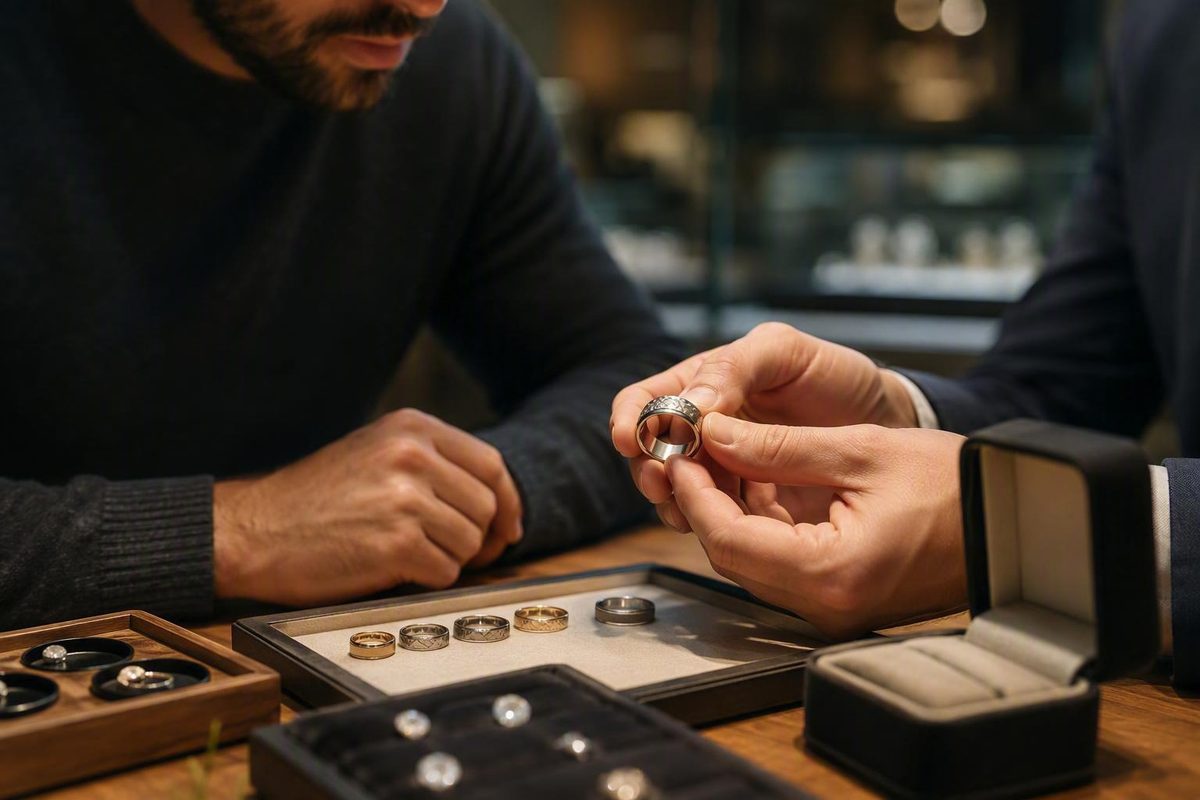
Choose men’s engraved wedding bands in this order: confirm the ring size, set the complete budget, select the material, choose the width and style, define the inscription, and verify every personalization term before paying. Before authorizing production, obtain written confirmation of the ring specifications, exact inscription, proofing process, total cost, delivery commitment, and policies for personalized merchandise.
This is a pre-purchase verification checklist rather than a market-wide product ranking. It helps you compare documented terms without assuming that every retailer or ring offers the same engraving service.
Start with the nonnegotiables
Use a fixed sequence to eliminate unsuitable options:
- Confirm the ring size. Determine the required size, then verify that the selected design is available in that size before authorizing engraving.
- Set the total budget. Include the band and any disclosed engraving, tax, shipping, expedited-production, correction, or restoration charges.
- Choose the material. Record the complete material description, including stated purity or alloy information where applicable.
- Choose the width and style. Compare appearance and fit profile without assuming that a particular width guarantees comfort or inscription capacity.
- Define the inscription. Settle the wording, capitalization, punctuation, symbols, location, and preferred orientation.
- Verify the personalization terms. Confirm the fee, proof process, production time, delivery commitment, and personalized-item policies in writing.
One retailer category reviewed for this guide offered filters for ring size, material, width, style, and price and labeled its assortment as engravable. Because the available retailer-page capture did not establish a reliable date, its exact inventory count should not be treated as current. Inventory, prices, promotions, and filter counts can change, and one seller’s assortment does not represent the entire market.
Record your requirements before comparing products:
| Field | Your requirement |
|---|---|
| Ring size | |
| Material and stated alloy or purity | |
| Width | |
| Fit profile | |
| Exact inscription | |
| Engraving location | |
| Font and symbols | |
| Complete order price | |
| Required delivery date | |
| Post-personalization policy |
The worksheet defines what you need. It does not confirm what a seller provides. That requires checking the product page and obtaining answers for the exact configuration you intend to order.
Use a decision table to compare bands
Compare identical fields for every candidate. Category filters describe an assortment, while product-level choices determine whether a particular ring can meet your requirements.
| Decision | Visible in a listing | Confirm with the seller | Why verify |
|---|---|---|---|
| Size | Size menu or category filter | Selected design and exact size are available before engraving | The reviewed filters spanned sizes 3.0–16.0, but availability varied by design |
| Width | Millimeter width or width filter | Finished width and available engraving locations | The filters ranged from 3.00–3.99 mm through 9.00 mm and above, but did not establish inscription capacity |
| Material | General material or color name | Material, stated purity or alloy details, and construction | A broad category name may not fully describe the ring |
| Fit | “Comfort fit,” “standard fit,” or another profile | Interior profile and its relevance to the selected size | Similar-looking bands may have different profiles |
| Style | Finish, color, pattern, stones, or mixed materials | Final configuration matches the description and images | Selected options may alter the appearance |
| Engraving | “Engravable” label | Method, location, limits, fonts, symbols, fee, proof, and timing | The label alone does not define the service |
| Price | Base or promotional price | Complete personalized-order total | Engraving and other charges may be separate |
| Policies | General policy pages | Terms that apply after personalization | General policies may not answer personalized-order questions |
The size and width ranges above come from an undated Helzberg men’s engraved-ring category capture and must be rechecked before purchase.
Materials represented in that assortment included yellow, white, and rose gold; platinum; titanium; zirconium; tantalum; cobalt; Damascus steel; stainless steel; sterling silver; and wood. For any candidate, confirm the stated metal or material, purity or alloy information where applicable, dimensions, fit profile, and available engraving options.
Do not rank these materials solely by their category names. The available evidence does not support broad promises about durability, comfort, engraving quality, maintenance, allergy risk, or resizing.
Specify the engraving before choosing the final ring
Write the engraving specification before committing to a band. If the seller cannot fulfill it on the chosen model, it is better to discover that during comparison than after payment.
Confirm:
- Engraving method
- Permitted location, such as the inside, outside, or edge
- Character and symbol limit
- Supported fonts
- Capitalization and lowercase support
- Punctuation and spacing
- Available symbols
- Supported languages and character sets
- Custom artwork or monograms
- Engraving depth, if specified
- Text or design orientation
- Engraving fee
- Proof availability and approval procedure
- Additional production time
The retailer assortment establishes only that the category was labeled engravable.
Request a written or visual proof that displays the precise spelling, spacing, capitalization, punctuation, symbols, layout, and orientation. Review it character by character.
Possible inscription concepts include initials, a wedding date, coordinates, a meaningful symbol, or a brief private phrase. These are ideas, not assurances that they will fit. Ask the seller to approve the final character and symbol count for the specific ring, width, font, and engraving location.
Verify what the band is made from
“Gold,” “platinum,” or “titanium” is only the beginning of the description needed for an informed personalized order.
The Federal Trade Commission says jewelry marketers should truthfully represent characteristics including metallic content, size, weight, durability, origin, price, value, and manufacture. The agency also revised its platinum guidance after some manufacturers began adding base metals such as copper and cobalt to platinum jewelry, showing why the details behind a broad metal name can matter. See the FTC’s Jewelry Guides overview.
Save a copy of the product description as it appeared when you ordered. If the purity, alloy composition, dimensions, weight, or manufacturing details are unclear, request written clarification before personalization begins. For a platinum band, for example, ask for the stated platinum fineness and the identity of other alloy metals rather than relying only on the word “platinum.”
FTC guidance is general. It does not endorse a retailer, verify a specific listing, prove that a seller complies with the law, or replace individualized legal advice.
Treat listed prices as a snapshot, not a market benchmark
The undated retailer capture showed price filters extending from under $500 to $4,000 or more. Displayed titanium bands ranged from $79.99 to $299.99, while displayed 3 mm white-gold bands carried promotional prices of $499.99 for 10K and $699.99 for 14K. These are historical examples from that retailer-page capture, not current, typical, or market-wide prices; check the live retailer category page for current availability and pricing.
Compare the complete order cost rather than the displayed band price alone:
- Ring price after any valid promotion
- Engraving charge
- Taxes
- Shipping
- Expedited production or delivery
- Any disclosed correction or restoration fees
The available evidence does not establish that these charges apply to every order or what they would cost. Request an itemized total for the exact ring and engraving before paying.
Price alone does not establish value, quality, durability, or engraving performance. Compare documented specifications instead: material and construction, dimensions, personalization service, proofing, timing, and post-purchase support.
Run a final personalized-order check
Use this checklist only after selecting a specific ring. Each item should match the seller’s written order details:
- [ ] Correct ring size
- [ ] Complete material description
- [ ] Purity or alloy details where applicable
- [ ] Band width
- [ ] Fit profile
- [ ] Exact inscription
- [ ] Capitalization, punctuation, and spacing
- [ ] Font
- [ ] Symbols or artwork
- [ ] Engraving placement
- [ ] Engraving orientation
- [ ] Written or visual proof
- [ ] Engraving fee
- [ ] Complete order price
- [ ] Production time
- [ ] Promised delivery date
Obtain written answers about cancellation, corrections, returns, exchanges, resizing, refinishing, warranty coverage, and engraving restoration. The available retailer evidence does not establish any seller’s personalized-item policies, and general store policies may not explain what happens after engraving has begun.
Ask one question directly before authorization: What remedy applies if the seller engraves the text incorrectly or delivers a ring that differs from its written material description? Confirm who would pay for shipping, correction, replacement, or restoration in that situation.
Do not submit the order until every material term, engraving specification, deadline, and post-purchase policy is documented. The safest choice is the band that fits the wearer and budget while giving you clear written terms before personalized work begins.