
Jewelry Cleaning Cloth: How to Choose and Use One Safely
A jewelry cleaning cloth looks simple, but choosing one safely requires more than finding a package labeled “for jewelry.” The right option depends on what you…
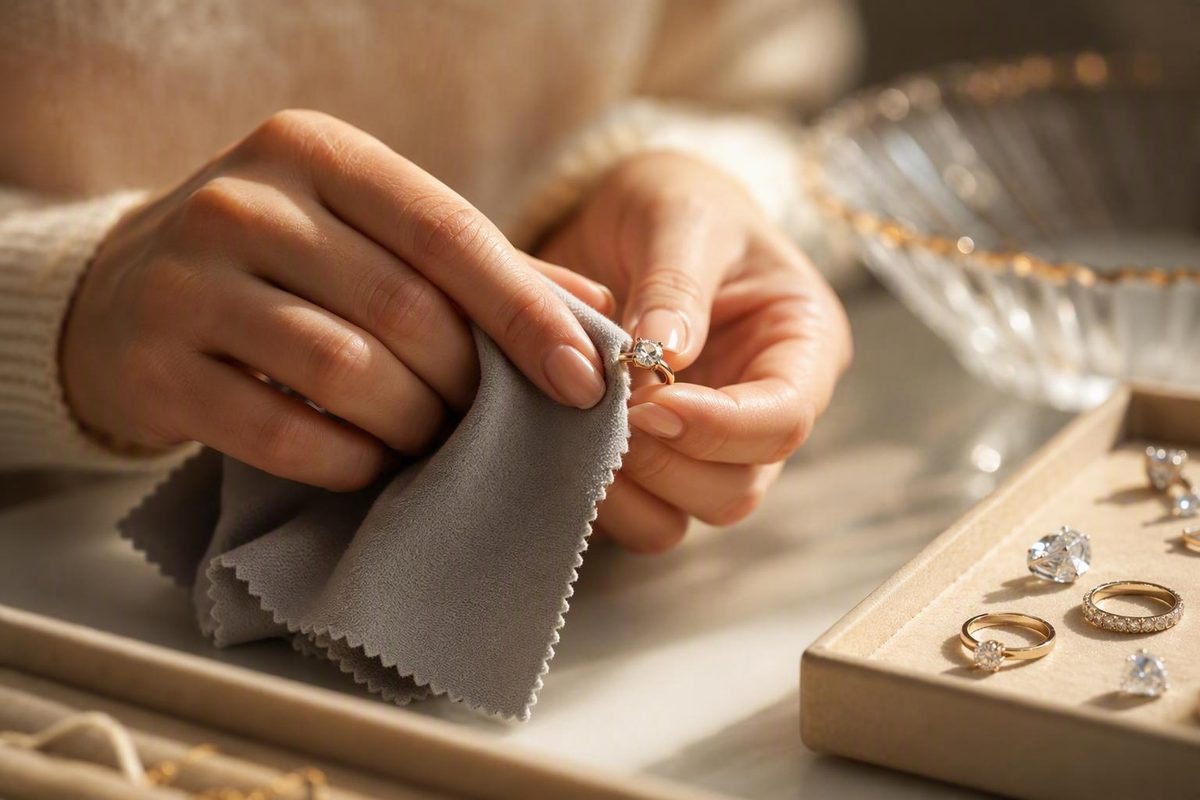
A jewelry cleaning cloth looks simple, but choosing one safely requires more than finding a package labeled “for jewelry.” The right option depends on what you need to remove, whether the cloth is treated, and how the jewelry is constructed.
For routine fingerprints and oils, clean untreated microfiber is usually the conservative starting point. For light tarnish on a compatible metal, a material-specific treated cloth may be appropriate. Plating, coatings, delicate gemstones, intentional oxidation, brushed finishes, adhesives, fragile settings, and unknown materials require greater caution.
Most available evidence comes from manufacturers, jewelry retailers, marketplace listings, and product demonstrations rather than independent material-specific testing. The guidance below therefore distinguishes documented product instructions from conservative editorial precautions.
Start With the Task: Wipe, Polish, or Get Professional Help?
Use this decision tree before comparing products:
- Fingerprints, oils, smudges, or loose surface grime? Use clean, untreated microfiber.
- Light tarnish on an identified, compatible metal? Consider a treated polishing cloth whose directions expressly include that metal and finish.
- Heavy tarnish, persistent discoloration, loose stones, damaged plating, unknown materials, or inaccessible buildup? Stop and seek professional assessment.
The important distinction is that cleaning, tarnish removal, gloss improvement, and scratch repair are separate outcomes:
- Cleaning removes surface residue such as oil, fingerprints, and loose grime.
- Tarnish removal uses a chemical polishing agent, fine abrasive, or another material-specific process.
- Gloss improvement can make a surface look brighter without eliminating scratches.
- Scratch repair may require controlled refinishing and is not a routine cloth-cleaning task.
Marketing often merges these outcomes under words such as “clean,” “polish,” “restore,” or “shine.” Read the description of the treatment and the directions instead of assuming those terms are interchangeable.
For example, CLEAN+CARE describes its untreated woven microfiber cloth as a tool for wiping fingerprints, oils, smudges, dirt, and grime, and explicitly says that it does not remove tarnish. That limitation identifies it as a surface-wiping product rather than a metal-polishing product (CLEAN+CARE microfiber cloth specifications).
Treated polishing cloths are instead marketed for tarnish removal and shine restoration. Retailer guidance commonly positions them for light-to-moderate tarnish rather than severe buildup, but that is commercial guidance rather than independent comparative evidence (Touch925 guide to silver polishing cloths).
| Visible problem | Most cautious next step | What not to expect |
|---|---|---|
| Fingerprints or oils | Wipe lightly with clean untreated microfiber | Tarnish removal |
| Loose dust or dirt | Remove loose debris carefully, then wipe if the piece is compatible | Cleaning of every recess |
| Light tarnish | Use a material-specific treated cloth only when the metal and finish are listed as compatible | Repair of plating or scratches |
| Heavy tarnish | Ask a jeweler to assess the metal, finish, stones, and construction | A universal cloth or household fix |
| Deep scratches | Seek professional refinishing advice | Reliable scratch removal through harder rubbing |
| Loose stone or setting | Stop handling the piece and obtain an inspection | Tightening or structural repair from cleaning |
Cleaning Cloth vs. Polishing Cloth: What the Labels Actually Mean
“Jewelry cleaning cloth” is an umbrella term. It may describe untreated microfiber, compound-treated polishing fabric, a dual-layer cloth, or a disposable pre-wetted wipe. These formats are not interchangeable.
Untreated microfiber is a fabric-based wiping tool. It relies primarily on contact between clean fibers and the jewelry surface rather than an embedded polishing compound. Its typical role is removing fingerprints, skin oils, smudges, and loose residue.
Because it acts on the surface rather than merely lifting oil, it warrants additional caution on plating, coatings, patina, intentional oxidation, and textured finishes.
A two-layer cloth combines treatment and buffing. The maker-designated treated layer is used first on compatible tarnished metal, followed by an untreated cotton or microfiber layer for the final buff. Hagerty, for example, identifies a white inner cloth for tarnish treatment and a gray outer cloth for buffing (Hagerty two-piece cloth directions).
Color is not a universal code. One demonstrated rouge cloth uses red for treatment and yellow for buffing, while other products use white and gray or simply distinguish between “inner” and “outer” layers. Always identify the layers from the package, sewn label, or manufacturer directions—not from color alone.
Products may also be specialized. Blitz separates its offerings into general jewelry cloths, silver cloths, a diamond-and-gem microfiber cloth, a fashion-jewelry cloth, and wipes. That range illustrates why “jewelry cloth” does not identify one treatment or use case (Blitz jewelry-care cloth collection).
Disposable wipes should not be treated as miniature reusable cloths. They may be pre-wetted, contain different ingredients, carry different material restrictions, and be intended for one or a few uses. Check their compatibility, storage, and disposal instructions separately.
| Cloth type | Typical task | Treatment | Common limitation | Washing approach | Surfaces warranting caution |
|---|---|---|---|---|---|
| Untreated microfiber | Fingerprints, oils, smudges, loose grime | None | Usually does not remove tarnish | Follow its care label | Fragile settings and dirty or gritty surfaces |
| Treated polishing cloth | Light tarnish and gloss improvement | Embedded compound or fine abrasive | May alter vulnerable surfaces and cannot reach every recess | Often should not be washed | Plating, coatings, patina, oxidation, texture, delicate stones |
| Two-layer cloth | Tarnish treatment followed by buffing | One treated layer and one untreated layer | Layer sequence varies by product | Follow product-specific directions | Same cautions as other treated cloths |
| Material-specific cloth | Care for a named metal or jewelry category | Varies | A metal name does not cover every finish or construction | Product-specific | Mixed materials, plating, coatings, treated stones |
| Disposable wipe | Portable wiping or polishing | Often pre-wetted or treated | Different formula and limited reuse | Usually not washable | Every material excluded by the label |
Compatibility Guide by Metal, Plating, Gemstone, and Finish
No compatibility chart can guarantee safety for every piece. Commercial sources disagree about plated metals, rhodium, vermeil, pearls, opals, and mixed-material jewelry, and the supplied evidence does not include independent material-specific testing.
The conservative approach is to evaluate three things separately:
- The named metal or gemstone
- The surface construction—solid, filled, plated, coated, oxidized, brushed, or patinated
- The complete piece—including settings, adhesives, treatments, repairs, and present condition
Plain sterling silver
Material-specific treated cloths are commonly marketed for removing light tarnish from sterling silver. Confirm that the item is plain sterling rather than silver-plated or coated, follow the cloth directions, and keep the treated surface away from intentionally blackened details.
A retailer guide specifically warns that polishing can remove intentional oxidation when the darkened area is rubbed too aggressively. Treat that as commercial care guidance rather than a universal test result.
Solid gold and platinum
Several commercial cloths expressly list gold and platinum, but that does not make every polishing cloth appropriate for every alloy, finish, or piece. A high-polish solid-gold band presents a different care problem from a matte gold ring, a coated white-gold ring, or an antique with stone settings.
Use a treated cloth only when its instructions expressly include the relevant metal and do not conflict with the jewelry maker’s care directions. For an unknown finish, untreated microfiber remains the less aggressive starting point.
Gold-filled jewelry
Grayling recommends polishing cloths for its own 14K gold-filled pieces while instructing users to rub gently; the same page strongly warns against compound-treated cloths on plated items (Grayling’s material-specific polishing guidance).
Treat that as guidance for the retailer’s products, not permission to polish every gold-filled item. If the maker’s instructions are unavailable or the surface already shows wear, avoid escalating from gentle wiping to compound polishing.
Rhodium, vermeil, silver plate, and other plating
Commercial advice conflicts sharply here. CLEAN+CARE lists plated metals, rhodium, and vermeil among the intended surfaces for one treated polishing cloth, but it does not provide independent material-specific test data for those broad claims (CLEAN+CARE treated polishing-cloth listing).
Other retailer guidance warns that mild abrasives or embedded polishing compounds may score or remove plating. The practical response is to distinguish untreated wiping from compound polishing:
- For fingerprints and oils, use clean untreated microfiber as the conservative starting point.
- Do not use a treated or abrasive cloth unless authoritative instructions for the exact piece, plating, and finish permit it.
- Stop if the color, reflectivity, or uniformity of the surface changes.
Diamonds and other gemstone-set jewelry
A secure diamond ring may permit gentle wiping on compatible accessible surfaces. That is different from assuming that a polishing compound belongs on every stone, prong, gallery, coating, or adjoining finish.
Before using any cloth, establish whether the stones are secure, whether surface treatments are present, and whether the piece includes adhesive.
Pearls, opals, turquoise, emeralds, and delicate stones
Some sellers broadly list pearls, opals, turquoise, or emeralds as compatible with particular treated products. Other retailer guidance recommends untreated microfiber for pearls and porous or delicate gemstones and discourages excessive rubbing of emeralds, opals, and pearls (Jewelry Factory cloth guide).
Without authoritative instructions for the exact piece, use clean untreated microfiber as the cautious starting point and apply minimal pressure. Do not turn a seller’s broad compatibility list into a guarantee for an unknown stone treatment, coating, adhesive, or mounting.
Special finishes
Polishing may change a surface that was not designed to be mirror-bright:
- Brushed and satin finishes: treated polishing may make the surface glossier or less uniform.
- Oxidized and antiqued areas: polishing can reduce the dark contrast.
- Patina: polishing can alter an intentionally aged appearance.
- Engraved details: changing the surrounding contrast may change how the engraving appears.
- Coatings: visible change is a reason to stop.
- Mixed finishes: a cloth suitable for one area may be unsuitable for the adjacent area.
Evidence for these effects is largely product guidance and anecdotal reporting rather than controlled testing. For example, a watch-repair forum post reported increased shine from a polishing cloth while warning readers to avoid brushed and thinly plated surfaces; it should be treated as an individual experience, not proof of universal performance (watch-polishing anecdote and cautions).
Unknown coatings, glued components, gemstone treatments, previous repairs, setting condition, and antique construction remain unresolved even when you know the named metal or gemstone.
| Material or finish | Untreated microfiber | Treated polishing cloth | Professional assessment |
|---|---|---|---|
| Plain sterling silver | Conservative for surface residue | Commonly marketed for light tarnish; avoid intentional oxidation | Heavy tarnish, damage, or uncertain coating |
| Solid gold | Conservative for routine wiping | Only when the alloy and finish are expressly included | Deep scratches, damaged settings, or uncertain finish |
| Gold fill | Conservative starting point | Only with explicit care approval and gentle use | Visible wear, discoloration, or uncertain construction |
| Platinum | Appropriate for surface wiping when the piece permits | Only when expressly listed and finish-compatible | Refinishing or deep scratches |
| Rhodium or vermeil | Conservative for fingerprints and oils | Avoid unless exact-piece instructions permit it | Wear-through, color change, or unknown coating |
| Other plating | Conservative for routine surface residue | High caution because commercial guidance conflicts | Persistent discoloration or worn plating |
| Diamonds | Useful on accessible surfaces of a secure piece | Do not assume compatibility with the metal, finish, or setting | Loose stones or inaccessible buildup |
| Delicate or porous stones | Conservative starting point when clean and used gently | Avoid unless specific authoritative instructions permit it | Unknown treatment, adhesive, crack, or unstable mounting |
| Oxidized details | Minimize rubbing over intended contrast | Generally unsuitable for the darkened area | Restoration of altered oxidation |
| Brushed finishes | Gentle wiping only | May change the intended texture | Texture restoration or uncertain finish |
| Antique or unknown pieces | Minimal wiping only when clearly safe | Do not experiment | Preferred when materials, patina, repairs, or adhesives are uncertain |
How to Use a Jewelry Cloth Without Overpolishing
The safest method is controlled, local, and easy to stop.
-
Identify the complete piece. Determine the metal, plating, gemstones, gemstone treatments, coatings, adhesives, finish, and cloth type. If an important variable is unknown, do not assume compatibility.
-
Inspect before rubbing. Look for loose or moving stones, lifted or snagging prongs, cracks, damaged links, peeling or worn plating, glued elements, and embedded debris. Stop if the piece appears structurally unsound.
-
Remove loose debris carefully. Do not drag visible dirt across the surface. This is not a universal instruction to soak or brush jewelry; those methods have separate compatibility requirements.
-
Read the cloth instructions. Determine whether it is untreated, treated, or dual-layer. Identify the treatment and buffing sides from the label rather than from color.
-
Follow dry-use directions. If the product calls for dry polishing, ensure that both the jewelry and cloth are completely dry and do not add water. In a retailer demonstration of a rouge cloth, the presenter uses light pressure on dry jewelry and expressly instructs users not to wet the cloth (Beadaholique rouge-cloth demonstration).
-
Test cautiously. When the construction permits, begin on a small, inconspicuous area. Use minimal pressure over a limited section and inspect it in good light.
-
Use the correct sequence. On a compatible dual-layer cloth, use the maker-identified treated layer only where treatment is permitted, then use the untreated layer for the final buff.
-
Protect vulnerable details. Avoid aggressive rubbing over stones, prongs, engraved or oxidized recesses, plated areas, glued elements, and brushed or satin textures.
-
Inspect frequently. Do not continue automatically because some tarnish remains. Reassess after every small section.
Stop immediately if:
- the metal color changes;
- plating looks thinner, patchy, or absent;
- a brushed area becomes glossy;
- new marks appear;
- intentional dark contrast or patina diminishes;
- the cloth transfers unwanted residue;
- a stone or component moves.
Pressure guidance varies by product. BERRICLE tells users of its cloth for sterling silver and rhodium-plated sterling silver to apply medium pressure, while other commercial guidance and demonstrations favor light or gentle rubbing. Starting gently and following the instructions for the specific cloth is more defensible than prescribing one force or duration for every piece (BERRICLE cloth instructions).
Four Practical Workflows for Common Jewelry
These four workflows cover the most common decisions while accounting for delicate stones, watches, and antique or mixed-material pieces.
1. Sterling-silver workflow
- Confirm that the piece is sterling silver rather than silver plate or an unknown coated alloy.
- Check for stones, adhesives, fragile construction, and intentionally oxidized details.
- Confirm that the treated cloth expressly includes sterling silver.
- Remove loose debris carefully.
- Follow any dry-use direction on the label.
- Work lightly on a small tarnished area with the maker-designated treated layer.
- Inspect the metal and stop if intended darkening or texture changes.
- Finish with the designated untreated buffing layer.
This workflow is for routine light tarnish, not structural damage, severe discoloration, or deposits in inaccessible areas.
2. Solid-gold workflow
- Verify that the piece is solid gold rather than gold plated or gold filled.
- Identify the alloy and finish as far as the maker’s documentation permits.
- Confirm that the cloth expressly lists gold.
- Inspect prongs, engraving, high-wear areas, and any matte or brushed sections.
- Begin on a small area with light pressure.
- Stop once surface residue or mild dullness improves.
Do not interpret visible scratches as an instruction to press harder. A brighter surface can make some fine marks less noticeable, but a cloth should not be expected to repair deep scratches.
3. Plated-jewelry workflow
- Treat preservation of the outer surface as the priority.
- Use clean untreated microfiber for fingerprints and oils.
- Wipe gently and inspect after a small area.
- Stop if the color or surface uniformity changes.
- Do not move to a compound-treated cloth unless authoritative care instructions for that exact item and finish permit it.
If plating is already worn, a cloth cannot replace it. Grayling’s retailer guidance is particularly restrictive, warning that embedded compounds can score or remove plating and advising against polishing cloths on its plated items (Grayling plated-jewelry warning).
4. Gemstone-set, delicate, brushed, and antique pieces
Different pieces in this category require different stopping points.
For a diamond ring:
- Check whether the stone moves and inspect the prongs or bezel.
- Identify the ring metal, plating, and finish.
- Use untreated microfiber for accessible fingerprints and surface oil.
- Use a treated cloth on the metal only when the complete ring construction and product instructions permit it.
- Remember that surface wiping cannot reach every recess or replace a setting inspection.
Retailer advice presents at-home cleaning as maintenance between professional cleanings and inspections rather than proof that a diamond remains secure (James & Sons diamond-ring care guidance).
For pearls, opals, turquoise, emeralds, or uncertain treated stones:
- Check for cracks, loose mounting, drill holes, stringing, and visible adhesive.
- Begin with a clean, soft, untreated microfiber cloth.
- Use minimal pressure.
- Avoid treated compounds unless authoritative instructions for the specific piece approve them.
- Stop if the surface appearance or luster changes.
For a watch or brushed surface:
Use untreated microfiber for routine surface residue. Avoid treated polishing on brushed watch cases, bracelets, and satin-finished jewelry unless the watch or jewelry manufacturer expressly approves it. If texture restoration is the objective, professional refinishing is more appropriate than progressively stronger home polishing.
For an antique or mixed-material piece:
Stop if you cannot identify the materials, coatings, adhesives, patina, previous repairs, or gemstone treatments. Do not test an antique by progressing from microfiber to increasingly aggressive compounds. A jeweler or conservator can help determine whether a darkened surface is unwanted tarnish, an intentional finish, or part of a more complex construction issue.
How to Compare Jewelry Cleaning Cloths Before Buying
Start with treatment type and intended task, not ratings:
- Choose untreated microfiber for fingerprints, oils, and routine surface residue.
- Consider a treated cloth for light tarnish on compatible metal.
- Choose a dual-layer cloth when you specifically want treatment followed by an untreated buff.
- Treat pre-wetted wipes as a separate product format.
Then read past the word “jewelry.” Check whether the directions address your exact metal, plating, gemstone, and finish. An explicit silver-only cloth may be a more rational choice for plain sterling than a broad product that claims compatibility with almost every metal and gemstone but gives few exclusions.
Look for observable specifications:
- treated, untreated, or pre-wetted construction;
- separate treatment and buffing layers;
- exact compatibility and exclusions;
- usable cloth dimensions;
- pack quantity;
- washing instructions;
- storage directions;
- disclosed ingredients or available safety documentation;
- return terms.
Be cautious with dimensions. A listing may report package measurements rather than usable cloth size. If the description is unclear, do not assume every dimension refers to the fabric itself.
Direct product listings illustrate the range. BERRICLE lists a cloth measuring 7.5 by 5 inches, while Hagerty lists a boxed two-piece cloth measuring 12 by 15 inches. These are product specifications, not evidence that either size performs better.
Marketplace results show even wider variation, including small individually wrapped multipacks and larger reusable cloths. They also mix sponsored placement, changing prices, customer ratings, delivery charges, and platform badges. Those details describe the offer but do not establish controlled cleaning performance or material safety (Amazon polishing-cloth search results).
Usable area and pack count can help compare convenience.
Separate facts from claims:
- Size, quantity, layer construction, listed exclusions, and care instructions are observable product information.
- “Scratch-free,” “non-toxic,” “maximum shine,” “finish preserving,” and extended tarnish-prevention statements remain performance or safety claims unless independently substantiated.
- Star ratings and reviews are customer opinions.
- Sponsored placement reflects advertising.
- Sale labels and shipping charges affect delivered cost, not material compatibility.
- An “Overall Pick” or similar marketplace badge describes platform behavior rather than laboratory performance.
Buyer checklist
Before ordering, answer each question:
- [ ] Is the cloth untreated, treated, pre-wetted, or dual-layer?
- [ ] Is it designed for wiping residue, removing tarnish, or both?
- [ ] Does it name my exact metal?
- [ ] Does it address plating, coatings, gemstone treatments, and finish?
- [ ] What surfaces are expressly excluded?
- [ ] Are the stated dimensions for the cloth rather than the package?
- [ ] How many cloths or wipes are included?
- [ ] Can it be washed, and how?
- [ ] Are ingredients or safety documents available for the treatment?
- [ ] How should it be stored?
- [ ] What is the delivered price after shipping?
- [ ] What are the return terms?
- [ ] Are the instructions narrow and specific enough for my piece?
For valuable, plated, antique, or mixed-material jewelry, narrow and explicit instructions are preferable to a vague “safe for everything” promise.
Washing, Reusing, Storing, and Replacing the Cloth
BERRICLE, for example, specifically instructs customers not to wash its treated cloth and says that it may be used until completely darkened. Those are product-specific directions, not a universal rule for every cloth (BERRICLE care and replacement directions).
Plain microfiber is different. When its care label permits, it may be hand-washed with mild soap and air-dried. Keep it away from lint-producing or heavily soiled fabrics and ensure that it is completely dry before storage or dry-use cleaning.
Dark residue can be normal during polishing, but color alone does not establish:
- how much tarnish was removed;
- what material transferred to the cloth;
- how much active treatment remains;
- whether the cloth is contaminated;
- whether continued use is appropriate.
There is no supported universal lifespan. One seller says its cloth may be used until completely darkened, while a promotional rouge-cloth demonstration describes use until physical wear destroys the fabric. Neither provides an objective measure of compound depletion, contamination, or safe replacement.
Follow the maker’s directions and replace the cloth when:
- it contains visible grit or hard particles;
- it transfers unwanted residue;
- continued use produces unwanted surface changes;
- it develops an objectionable odor;
- the fabric is frayed, torn, or otherwise deteriorating;
- the maker’s stated replacement condition is reached.
Store cloths clean, dry, and protected from dust and abrasive debris.
When a Cloth Is the Wrong Tool
Stop home cleaning and seek professional assessment when you find:
- a loose stone or moving setting;
- lifted, snagging, or visibly damaged prongs;
- cracks, broken links, or weakened components;
- glued elements;
- damaged or worn plating;
- valuable antique construction;
- an unknown metal, coating, gemstone treatment, or patina;
- intricate areas that a flat cloth cannot reach;
- heavy tarnish;
- persistent discoloration;
- a visible change in color, texture, or finish.
A flat cloth works only where it can make controlled contact. It cannot effectively reach every under-gallery space, chain interior, deep engraving, or crowded setting.
Heavy tarnish is also a different problem from routine maintenance. It may require material-specific professional cleaning or refinishing. The evidence does not support one universal liquid dip, household ingredient, or cleaning process for solid metals, plating, porous stones, adhesives, coatings, and antique finishes.
Nor does a clean-looking ring prove that its prongs and stone remain secure.
Stop-or-proceed checklist
Before each session, ask:
- Do I know the metal, plating, stones, treatments, coatings, and finish?
- Is the piece structurally sound?
- Is the cloth explicitly compatible with the task and construction?
- Is the cloth clean, dry if required, and free of debris?
- Can I avoid intentional oxidation, texture, plating, and fragile settings?
- Can I test gently and inspect frequently?
If every answer is yes, proceed conservatively. If any answer is no—or if the surface changes while you work—stop and obtain material-specific advice.
Frequently Asked Questions
Can a jewelry cleaning cloth remove tarnish?
An untreated microfiber cloth generally removes surface oils, fingerprints, smudges, and loose grime rather than tarnish. CLEAN+CARE’s untreated microfiber listing, for example, expressly says that the product does not remove tarnish (CLEAN+CARE microfiber directions).
A treated polishing cloth may remove light tarnish from a compatible metal because it contains a polishing compound or fine abrasive. Results and restrictions are product-specific. For heavy tarnish, unknown finishes, plated pieces, or intricate construction, professional assessment is safer than harder rubbing.
Can I use a polishing cloth on gold-plated, rhodium-plated, or vermeil jewelry?
Do not assume so. Seller guidance conflicts: some treated products list plated metals, rhodium, or vermeil, while other retailer guidance warns that compound-treated cloths can score or remove plating.
For routine fingerprints and oils, clean untreated microfiber is the conservative starting point. Use a treated cloth only if authoritative care instructions for the exact piece, plating, and finish expressly permit it. Stop immediately if the color or surface uniformity changes.
Is a jewelry cloth safe to use on diamonds, pearls, opals, or turquoise?
A clean untreated microfiber cloth can be a cautious starting point for gentle surface wiping when the setting is secure and the piece’s care instructions permit it. That does not make every treated polishing cloth safe.
Diamonds may be mounted in vulnerable plated or textured metal. Pearls, opals, turquoise, emeralds, and other delicate or porous materials may also have treatments, adhesives, or surfaces for which a compound-treated cloth is inappropriate. Retailer guidance recommends untreated microfiber for pearls and porous or delicate gemstones unless specific instructions say otherwise (Jewelry Factory gemstone guidance).
Should I wash a jewelry polishing cloth when it turns black?
Usually not when it is a treated cloth, because laundering may remove the polishing treatment. Follow the product’s instructions.
Darkening can be a normal result of use, but it does not objectively prove that the cloth is exhausted—or that it remains effective. Replace it according to the maker’s guidance, or sooner if it becomes gritty, damaged, odorous, transfers unwanted residue, or produces unwanted surface changes. Untreated microfiber may be washable when its care label allows.
Can a polishing cloth remove scratches from jewelry?
It may improve gloss or make very fine surface marks less noticeable, but it should not be expected to remove deep scratches reliably. Increasing pressure can alter plating, patina, texture, edges, or the geometry of a polished surface without resolving the scratch.
Do not use a scratch as a reason to keep rubbing after the surface begins to change.
Match the Cloth to the Task and the Entire Piece
The safest jewelry cleaning cloth is the one matched to both the job and the jewelry’s complete construction. Use clean untreated microfiber for routine fingerprints, oils, and surface residue. Reserve treated cloths for compatible materials with light tarnish, and follow the product label rather than generic color rules.
Stop before polishing changes plating, texture, patina, oxidation, or a delicate setting. When materials, treatments, construction, or damage are uncertain, professional assessment is safer than stronger pressure or a more aggressive product.