
CZ vs Diamond vs Moissanite: Which Should You Buy?
Compare cubic zirconia, diamond and moissanite by sparkle, scratch resistance and cost—and learn what to check before buying a ring.
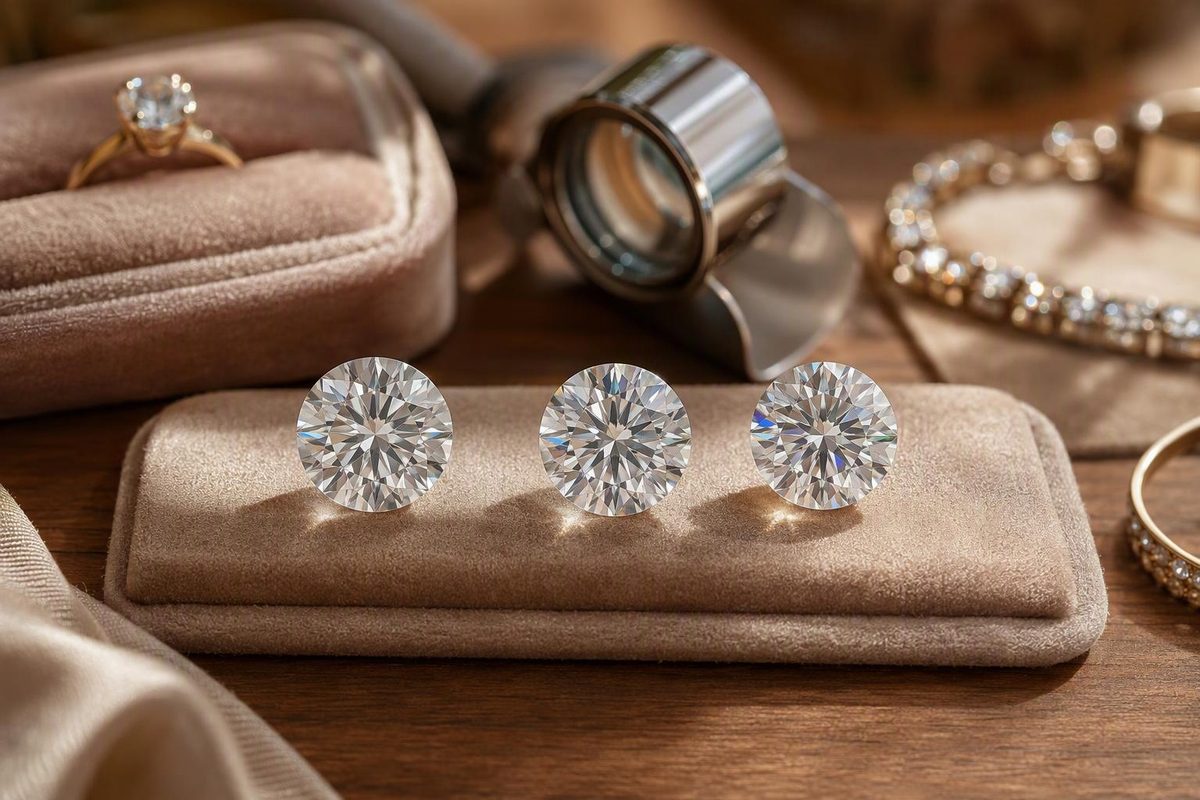
Choose cubic zirconia (CZ) for a low-cost placeholder or occasional-wear piece; moissanite for a scratch-resistant everyday stone if you like strong rainbow flashes; diamond if you specifically want diamond’s material and appearance. If diamond is the goal but natural origin is not, include lab-grown diamonds in your comparison.
These are not three grades of the same gemstone. CZ and moissanite are different materials that can imitate diamond. Lab-grown diamond, by contrast, has the same carbon crystal structure and nearly the same chemical, physical and optical properties as natural diamond. GIA explains the distinction.
The differences at a glance
| Factor | Cubic zirconia (CZ) | Diamond | Moissanite |
|---|---|---|---|
| Material | Manufactured zirconium oxide | Carbon; natural or laboratory-grown | Silicon carbide; jewelry material is commonly laboratory-grown |
| Mohs hardness | 8.5 | 10 | 9.25 |
| Appearance | Slightly more fire, but less brilliance, than diamond | Diamond’s characteristic light return; assess the individual cut | Much stronger rainbow fire; facet doubling can be visible in some directions |
| Wear trade-off | More susceptible to surface scratches and abrasion | Greatest scratch resistance of the three, but can still chip | High scratch resistance, though not as hard as diamond |
| Buying role | Economical decorative or temporary stone | For buyers who want diamond itself | Durable alternative with its own optical character |
The material, hardness and optical comparisons are described by GIA’s simulant guide, GIA’s introduction to gem imitations and GIA’s moissanite research. The buying roles are recommendations, not quality grades.
Which looks most like diamond?
Neither CZ nor moissanite duplicates diamond’s optics. If matching diamond’s appearance is the priority, a lab-grown diamond is the more direct comparison—not a higher-priced simulant.
CZ is often colorless and has very few visible imperfections. That does not mean it performs like a well-cut diamond: GIA describes it as having slightly greater fire but less brilliance than diamond.
Moissanite has substantially greater fire than diamond. Fire means the colored flashes produced when light separates into its component colors; brilliance refers to returned white light. More fire is not automatically more beautiful. Some buyers enjoy moissanite’s vivid flashes, while others find them distracting, particularly in larger stones. Moissanite is also doubly refractive, which can produce doubled back-facet images and a slightly fuzzy appearance in certain viewing directions. GIA describes both effects.
Compare clean stones of similar shape and millimeter dimensions, rather than relying on a promotional video. Look at them in diffuse daylight, ordinary room lighting and spot lighting. Tilt each stone and decide whether you like its pattern, colored flashes and any visible tint. You are choosing an appearance, not trying to identify a universal sparkle winner.
Which holds up best in a daily ring?
For resistance to scratches and abrasion, the order is diamond, moissanite, then CZ. Moissanite is a reasonable everyday-ring choice; CZ is more likely to show surface wear, particularly along facet junctions. That makes CZ easier to recommend for occasional wear or a temporary ring than for someone expecting an unchanged surface after years of daily use. GIA’s comparison supports this distinction.
Do not read the Mohs numbers as percentages. The scale is not evenly spaced, and hardness measures scratch resistance—not resistance to every kind of damage. Even diamond can chip or cleave after a hard blow. A secure setting and sensible wear habits still matter. GIA separates hardness, toughness and stability.
For cleaning, warm soapy water is a suitable starting point for CZ and moissanite. Check the entire piece before using stronger methods: the metal, other stones and condition of the mounting also need consideration. GIA lists warm soapy water for simulants and advises against harsh home-cleaning methods for diamonds. Simulant care · Diamond care.
Compare the finished-ring cost, not just the stone
CZ is generally the least expensive stone option, while moissanite generally costs more than CZ. Brilliant Earth’s guide, updated August 11, 2026, describes that price relationship. GIA notes that affordability is a common reason to choose simulants.
There is no useful universal price ratio. Compare current quotes, and do not assume that every moissanite ring will cost less than every lab-grown diamond ring.
Request comparable quotes that specify:
- The center stone’s material, shape and millimeter dimensions.
- Whether the size label is actual carat weight or a diamond-equivalent size.
- The mounting’s metal and fineness, plus the identity of any side stones.
- The complete price, including applicable taxes, sizing and delivery.
- Return terms and the scope of any repair or replacement warranty.
Millimeters matter because different materials have different densities: equal carat weights need not produce equal-looking sizes. GIA explains this sizing trap.
If you want diamond rather than a simulant, compare natural and lab-grown quotes separately using our 1-carat lab-grown versus natural price comparison. If future resale affects your budget, seek an actual buyback offer rather than treating the purchase price as recoverable value.
Verify the material before paying
A seller’s “passes a diamond tester” demonstration does not establish that a stone is diamond. Thermal-only testers can distinguish diamond from CZ when used correctly, but moissanite’s similar thermal conductivity can fool them. Electrical testing adds information but also has exceptions, including some diamonds. GCAL explains these limitations.
For a diamond purchase, check that the laboratory document identifies the stone and its natural or laboratory-grown origin, then have the stone matched to that document. For CZ or moissanite, require the material to be stated plainly on the invoice. A seller’s color or clarity label should not substitute for identification.
Our guide to what diamond testers can—and cannot—prove explains why a handheld result is not proof of natural origin. Buy the material you actually want, with its trade-offs disclosed, rather than paying for a claim that it is indistinguishable from something else.