Why Round Brilliants Usually Carry the Highest Price
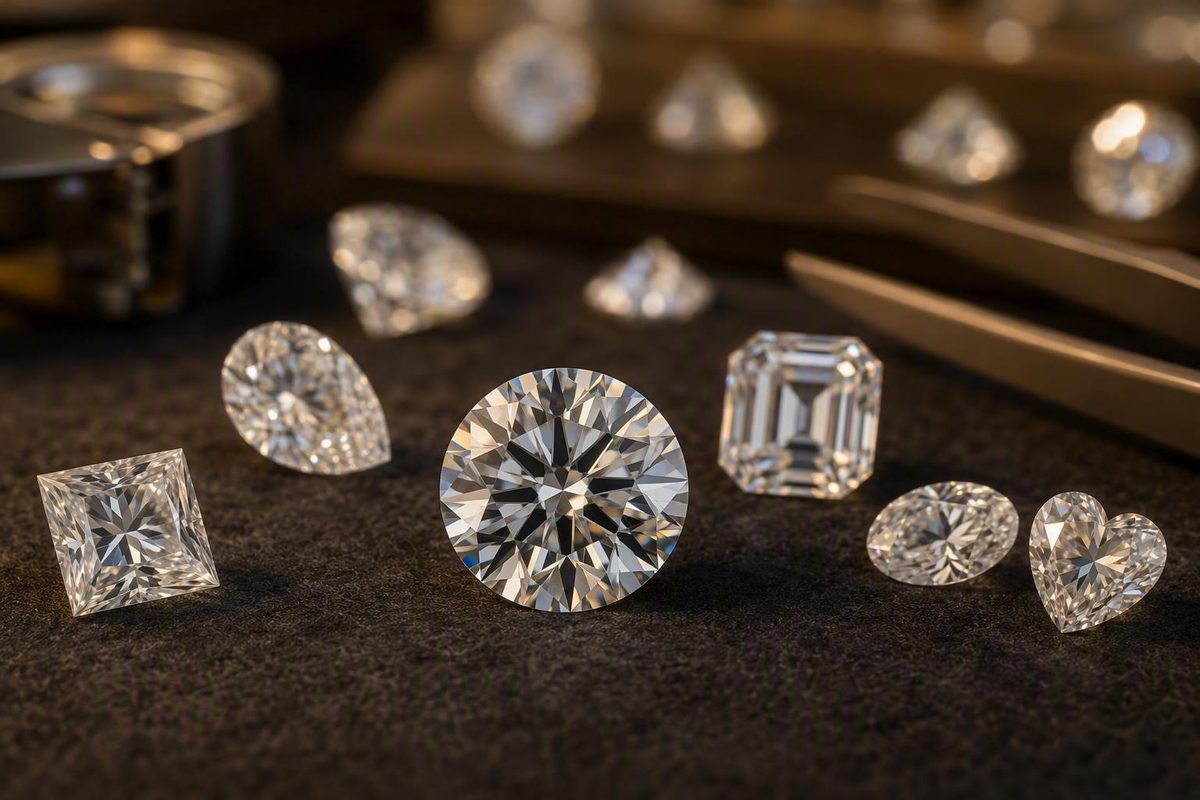
The short answer: round brilliant is usually the most expensive common shape
Among common diamond shapes, the round brilliant is usually the most expensive per carat when carat weight, color, clarity, cut quality, origin, grading documentation, and market timing are comparable. Commercial diamond sellers broadly agree on that ranking and commonly attribute the premium to rough-material loss, manufacturing precision, and demand (Whiteflash’s explanation of diamond shape and price).
“Usually” is essential. Shape alone does not determine the total price of an individual diamond. A larger oval, a higher-color emerald cut, an unusually rare pear, or a proprietary branded shape can cost more than a particular round brilliant. The ranking applies only when the other factors affecting value are held reasonably constant.
The conclusion also has a defined scope. It concerns ordinary comparisons among widely sold shapes such as round, oval, princess, cushion, pear, marquise, radiant, emerald, and Asscher. It is not a ranking of record-setting colored diamonds, historic gems with exceptional provenance, or limited-production branded designs.
There is an important evidence limitation: the direct pricing consensus comes primarily from diamond retailers and marketplaces rather than from a transparent, independent dataset covering the entire market. The available seller estimates do not consistently disclose sample sizes, observation dates, inventory-selection methods, or controls for every relevant specification. They support a broad commercial pattern, not a universal pricing law.
The useful buying conclusion is therefore narrower than “round diamonds cost the most”:
When two diamonds are genuinely comparable in their other value factors, the round brilliant will commonly carry the higher per-carat price.
That conclusion cannot predict which of two unmatched diamonds will cost more. Nor does it establish which diamond will look better, appear larger, or provide better value to a particular buyer.
Diamond shape and cut quality are not the same thing
People searching for the “most expensive diamond cut” often use cut to mean a diamond’s shape. In everyday shopping language, someone might ask whether a round, oval, pear, emerald, or princess “cut” costs more.
Technically, the question combines two different ideas:
- Shape is the diamond’s face-up outline: round, oval, square, rectangular, pear-shaped, and so forth.
- Cut quality concerns the diamond’s proportions, facet angles, symmetry, and relationships among its facets. These characteristics influence how light travels through and returns from the stone.
The distinction matters because there are two separate potential premiums. One is the shape-based premium commonly associated with a round brilliant. The other is the price difference between diamonds with different levels of cutting precision or optical performance.
A diamond does not become well cut merely because it is round. Two round brilliants with the same carat weight, color, and clarity can look noticeably different if their proportions, symmetry, or facet relationships differ. Likewise, two ovals with similar grading specifications can differ in brightness distribution, contrast, bow-tie visibility, outline, and apparent size.
Cut quality influences several parts of a diamond’s visual character:
- Brightness: white light returned toward the viewer
- Fire: flashes of spectral color
- Scintillation: flashes and contrast seen as the diamond, light, or observer moves
- Pattern: the arrangement of bright and dark areas across the face of the stone
- Overall appearance: whether the diamond looks lively, balanced, glassy, dark, or uneven
The Gemological Institute of America distinguishes diamonds being fashioned into different shapes from the optical quality of their cut. It also explains that a finished diamond’s value reflects the combined effects of color, clarity, cut, and carat weight—not shape alone (GIA’s overview of diamond quality factors). GIA does not use that guidance to identify a single most expensive shape.
This separation prevents a common comparison error. If a well-proportioned round costs more than a poorly performing cushion, the difference cannot automatically be attributed to shape. Some of the premium may reflect cut quality, color, clarity, documentation, or another unmatched characteristic.
The reverse is also true. Choosing a fancy shape does not require accepting weak visual performance. It means evaluating performance according to that shape’s own optical character rather than assuming that every diamond should display the pattern of a round brilliant.
Why round brilliant diamonds command a premium
The round brilliant’s usual premium is best understood through three recurring factors: yield from the rough crystal, manufacturing requirements, and consumer demand. These explanations come mainly from commercially interested sellers rather than disclosed production-cost studies, so they should be treated as well-established industry explanations rather than precise formulas.
Lower yield from the rough
A polished diamond begins as rough material with its own crystal form, dimensions, inclusions, and planning possibilities. To create a circular outline with the desired proportions, a cutter may need to remove material that could have remained in a shape following the rough more closely.
That lost yield has an economic consequence. The buyer purchases the finished polished diamond, but the manufacturer’s cost begins with a heavier piece of rough. If two possible designs retain different finished weights from otherwise comparable rough, the design retaining less saleable material generally carries a higher rough-material cost per polished carat.
The amount removed is not fixed. It depends on the original crystal, the location of inclusions, the manufacturer’s planning decisions, and the target proportions and finished weight. Claims that exactly the same percentage is discarded for every round brilliant are therefore too broad.
Fancy shapes may sometimes fit a particular rough crystal more efficiently. A square princess, rectangular radiant, elongated oval, or another outline can potentially preserve weight that would be removed to form a circle. This is a recurring manufacturing tendency, not a rule that every fancy diamond has high yield or every round has poor yield.
Controlled manufacturing
Commercial sources commonly describe the standard round brilliant as a 58-facet design.
What matters is how the facets work together.
For a round brilliant, the cutter must coordinate the table, crown, girdle, pavilion, culet, and individual facet relationships while preserving the intended symmetry and weight. Achieving a particular result therefore requires careful planning and controlled execution.
It would be misleading, however, to claim that rounds categorically require more skill than every fancy or proprietary design. Cutting an attractive heart outline, balancing the shoulders of a pear, managing central contrast in an oval, or producing a branded design can also be demanding. Precision and yield contribute to the cost of producing rounds; they do not make every fancy shape simple.
Strong and persistent demand
Price also reflects what buyers want. Round brilliants are widely sought for engagement rings and other diamond jewelry, so demand can support a premium alongside manufacturing economics.
Demand helps explain why the price difference cannot be calculated from rough yield alone. Production cost is only one component of a retail price.
Descriptions such as “timeless,” “the most beautiful,” or “guaranteed to sparkle the most” are preferences or promotional opinions, not objective reasons every buyer should pay the round premium. A well-cut round has a recognizable balanced brilliant-style appearance, but some buyers prefer the broad flashes of a step cut, the elongated outline of an oval, or the varied pattern of a cushion.
The defensible explanation is economic and technical: round brilliants commonly combine lower rough yield, controlled production targets, and strong demand. Beauty remains a personal judgment.
How much more can a round diamond cost?
Retailer estimates often place the round premium broadly around 15% to 35% over many comparable fancy shapes. That range combines estimates published under different assumptions; it is not a universal benchmark or a promised saving.
The estimates are not uniform:
- Clean Origin gives an approximate 20% difference but does not disclose a market-wide dataset or sampling method for that figure (Clean Origin’s discussion of round pricing).
- With Clarity says oval, pear, and marquise diamonds may cost up to 25% less than rounds of the same carat weight, while caution is still required because other specifications affect price (With Clarity’s shape-pricing overview).
- Whiteflash reports a 25% to 35% round premium over fancy shapes with the same carat, color, and clarity, although its article does not provide a disclosed market sample supporting the estimate.
- Little Treasury Jewelers presents the broader 15% to 35% estimate for comparable rounds versus many fancy shapes, again as retailer-provided guidance rather than a market-wide index (Little Treasury Jewelers’ shape-pricing overview).
These figures are best treated as indicative seller estimates. The actual spread may be smaller, larger, or absent in a particular search. It may also change across carat ranges, quality combinations, origin categories, and observation dates.
A meaningful comparison should control for:
- Carat weight
- Color grade
- Clarity grade
- Cut quality or the available cut information
- Natural or lab-grown origin
- Grading laboratory and report details
- Treatments, where relevant
- Seller
- Inventory or observation date
- Current market conditions
Documentation also matters when constructing a fair comparison. Check report numbers, measurements, comments, fluorescence where listed, and whether the seller’s description matches the report.
Consider two one-carat diamonds: a round with lower color and clarity but extensive cut information, and a cushion with higher color and clarity but uncertain visual performance. Their price difference does not isolate the effect of shape. The cushion’s higher grades may increase its price, while the round’s cutting, yield, or demand may add a separate premium. Calling the entire difference a “round markup” would oversimplify the comparison.
The most practical method is to create a small, dated sample from several sellers:
- Choose one origin category, such as natural diamonds.
- Set a narrow carat range instead of requiring an identical displayed weight.
- Hold color and clarity to the same grades.
- Match grading documentation as closely as possible.
- Exclude treated stones unless treatments are part of the intended search.
- Review cut information and visible performance.
- Record prices on the same date.
- Compare several examples of each shape rather than selecting only the cheapest listing.
This exercise will not produce a definitive market index, but it is more useful for an actual purchase than relying on one retailer’s average-price table. It also shows whether the theoretical shape discount remains after accounting for the grades, dimensions, documentation, and visual characteristics you want.
Lower-cost alternatives and what buyers trade off
There is no universally cheapest diamond shape. Prices depend on individual specifications, rough planning, demand, and the diamonds available at the time of purchase. Nevertheless, retailers commonly position princess, cushion, radiant, oval, pear, marquise, emerald, and Asscher diamonds as potentially less expensive alternatives to comparable rounds.
The goal is not simply to identify the lowest displayed price. It is to understand what changes in outline, face-up size, optical pattern, and selection risk may accompany the lower price.
Princess, cushion, and radiant
Princess, cushion, and radiant diamonds are often presented as value-oriented alternatives for buyers who still want a brilliant-style pattern. Little Treasury Jewelers identifies all three as comparatively economical options, while also emphasizing that pricing depends on the complete specification of the diamond.
- A princess usually provides a square or slightly rectangular outline with sharp corners.
- A cushion has softened corners and can range from square to noticeably rectangular.
- A radiant combines a square or rectangular outline with cropped corners and a brilliant-style facet arrangement.
These categories contain considerable variation. One cushion may show broad, distinct reflections, while another has a more fragmented pattern. Princess diamonds can differ in apparent spread, corner shape, and brightness distribution.
Do not assume that all three shapes cost alike or perform alike. Compare actual diamonds on their merits. Buyers specifically interested in old mine or period-style stones can also consult Carat Review’s guide to antique cushion-cut diamonds, which addresses a visual and historical category distinct from many modern cushions.
Oval, pear, and marquise
Elongated shapes can create a larger-looking face-up outline than a round of the same carat weight, depending on their proportions. Kravit Jewelers specifically identifies oval, pear, and marquise diamonds as shapes that can create an impression of greater size (Kravit Jewelers’ diamond-shape pricing guide).
Carat is a measure of weight, not visible diameter or surface area. Two diamonds with the same carat weight may distribute that weight differently.
Compare the actual millimeter dimensions:
- Length
- Width
- Depth
- Length-to-width ratio
- Face-up outline and symmetry
Also inspect how the diamond uses that area. A large outline is not automatically desirable if substantial portions look persistently dark, transparent, or inactive.
Apparent size should therefore be judged from dimensions and face-up observation, not inferred from shape or carat weight alone.
Emerald and Asscher
Emerald and Asscher diamonds are step cuts.
They may carry a lower shape-based price than a comparable round, but the tradeoff is not simply “less sparkle.” They offer a different optical style. Some buyers actively prefer their calmer, more architectural pattern.
Step facets can also make body color and inclusions easier to notice. A buyer comfortable with a particular color or clarity grade in a brilliant-style stone may prefer a higher grade in an emerald or Asscher. Paying for those higher grades can absorb part of the initial shape-based saving, a possibility specifically noted in retailer guidance for these step cuts.
That does not mean every step cut requires high color or clarity. Visibility depends on the diamond’s size, facet pattern, inclusion type and location, and the conditions in which it is viewed. Evaluate the actual stone rather than buying a grade by rule.
For every fancy shape, request or review:
- Clear face-up photographs
- Video under more than one lighting condition where possible
- Side views
- Exact millimeter dimensions
- The grading report
- Information about visible inclusions
- Return and inspection terms
Fancy shapes can vary considerably because their proportions and visible performance cannot be inferred from the shape name alone. The best value is an individual diamond whose appearance suits you at an acceptable price—not whichever category has the lowest advertised average.
When the round brilliant will not be the most expensive diamond
The round brilliant’s usual ranking applies only to matched or broadly comparable diamonds. Once the specifications diverge, another shape can easily have the higher total price.
A fancy-shaped diamond may cost more because it is:
- Heavier
- Higher in color or clarity
- Better cut or more visually appealing
- Untreated rather than treated
- Associated with a rarer characteristic
- Part of a proprietary design
- Sold under a brand carrying its own premium
- Unusually scarce in the required combination of specifications
For example, comparing a two-carat oval with a one-carat round does not test whether oval or round is the more expensive shape. The weight difference dominates the comparison. The same problem arises when comparing a high-color, high-clarity emerald cut with a lower-grade round.
Some retailers identify Asprey, Jubilee, Royal Asscher, Eighty-eight, and Ashoka as rare or specialized named cuts (Diamond Mansion’s discussion of rare diamond cuts). That establishes that these designs are less common or more specialized; it does not prove that every example costs more than every round brilliant. Brand positioning, licensing, availability, individual specifications, and seller pricing can all affect the final amount.
Heart-shaped diamonds are another possible exception. Commercial guidance identifies hearts as potentially costly because of the precision involved in creating the shape (Kravit Jewelers’ pricing guide). That should not be converted into a universal ranking: an individual heart may be priced above or below a broadly comparable round.
Even ordinary listings need not follow the general ranking in every search. The conclusion describes a recurring market pattern, not a guarantee that the lowest-priced round will always cost more than every available fancy shape. Current inventory, specifications, and market conditions still have to be examined.
A higher initial purchase price should not be confused with proven resale performance. The supplied evidence supports a general retail price pattern for comparable common shapes; it does not establish that paying a round premium reliably produces a better resale outcome.
A practical framework for spending the budget well
Begin by deciding what you want the budget to accomplish. Four common priorities are:
- A traditional round appearance
- Strong visible light performance
- The greatest appealing face-up size
- The lowest purchase price among reasonably comparable candidates
These priorities can overlap, but they are not identical. Establishing their order makes comparison easier and reduces the temptation to treat a higher price as proof of greater beauty.
If you are committed to a round brilliant
Compare several rounds slightly below major carat thresholds as well as diamonds at the threshold itself. Shopping just below a popular benchmark may reduce the price, but the amount varies with grades, inventory, and market conditions; no saving is guaranteed (Rare Carat’s round-diamond buying guidance).
Do not sacrifice visible performance merely to reach a stated weight. Compare dimensions as well as carat because a heavier but deeper diamond may not look appreciably larger face-up. Review the grading report, images, video, and any available proportion or performance information together.
A diamond just below a threshold is not automatically a bargain. It still needs to be compared with nearby weights and specifications available on the same date.
If apparent size is the priority
Place oval, pear, and marquise candidates beside rounds available at the same total budget. Compare length and width in millimeters, not just carat weight. Then examine whether the larger outline still has attractive brightness, contrast, symmetry, and bow-tie behavior.
An elongated shape can also change the visual proportions of a ring or finger. That aesthetic effect may matter more to the wearer than a small difference in measured face-up area.
If you want a brilliant-style alternative
Examine princess, cushion, and radiant candidates without treating them as interchangeable. Set a budget and minimum specifications, then compare their outlines and light patterns directly.
For cushions, decide whether you prefer rounded or more squared corners, a square or elongated outline, and broad or more fragmented reflections. With radiants and princesses, inspect the center and corners for balanced activity instead of relying on the category name.
A lower displayed price is valuable only if the individual diamond delivers the appearance you want.
If you prefer a step cut
Assess emerald and Asscher diamonds at closer magnification and at normal viewing distance. Pay particular attention to inclusions under the table, body color, symmetry, and the balance of light and dark bands.
Do not assume that you must buy a particular clarity or color grade solely because of the shape. Visibility depends on the type, location, contrast, and orientation of inclusions, along with the diamond’s size and facet pattern. Evaluate the actual stone.
Use the same checklist for every candidate
For each comparison, confirm:
- Natural or lab-grown origin
- Grading laboratory and report number
- Report comments and disclosed treatments
- Carat weight
- Length, width, and depth
- Color grade
- Clarity grade and inclusion location
- Shape
- Available cut, polish, symmetry, and proportion information
- Face-up light performance
- Price and the date observed
- Seller return, inspection, shipping, and upgrade policies
- Compatibility with the intended setting
The setting deserves attention because it can alter perceived size and overall presentation. Band width, side stones, and metal color can also affect perception.
A setting does not change the diamond’s underlying quality, weight, or grades. Nor does it make two otherwise unmatched stones directly comparable. Treat the loose diamond and the completed ring as related but separate buying decisions.
The central conclusion is simple: the round brilliant usually carries the highest per-carat price among comparable common shapes, but that premium is meaningful only in a controlled comparison. Separate shape from cut quality, examine dimensions and visible performance alongside the 4Cs, and choose the shape that best serves your priorities. The most expensive shape is not automatically the best value for you.
Frequently asked questions
Is the round brilliant always the most expensive diamond cut?
No. It is usually the most expensive common shape per carat when other specifications are comparable. A larger, higher-color, higher-clarity, rarer, branded, or proprietary fancy-shaped diamond can cost more than a particular round brilliant. Current inventory and market conditions can also produce exceptions.
How much more does a round diamond cost than an oval, princess, or cushion diamond?
There is no fixed difference. Retailer estimates vary substantially because they use different assumptions and do not disclose a consistent market-wide methodology. The actual spread depends on carat weight, color, clarity, origin, documentation, cut performance, seller, and observation date. Current, like-for-like listings are more useful than applying one percentage to every purchase.
What is the difference between diamond shape and cut grade?
Shape is the diamond’s face-up outline, such as round, oval, pear, princess, or emerald. Cut quality concerns proportions, facet angles, symmetry, and facet relationships that influence brightness, fire, scintillation, and overall appearance. A round-shape price premium is therefore separate from any premium associated with better cutting or optical performance.
Which less-expensive diamond shapes can look larger for their carat weight?
Oval, pear, and marquise diamonds may look larger face-up than rounds of the same weight because their elongated outlines can cover more visible area. Actual appearance depends on proportions and depth, so compare length and width in millimeters rather than relying on carat weight alone.
Can a rare or proprietary diamond cut cost more than a round brilliant?
Yes. Named cuts such as Asprey, Jubilee, Royal Asscher, Eighty-eight, and Ashoka are described by commercial sources as rare or specialized, but rarity alone does not prove that every such diamond costs more than every round brilliant.