
Why Are Diamonds Expensive? The Real Reasons Behind the Price
Why are diamonds expensive? For a natural diamond, the retail price reflects five broad contributors:
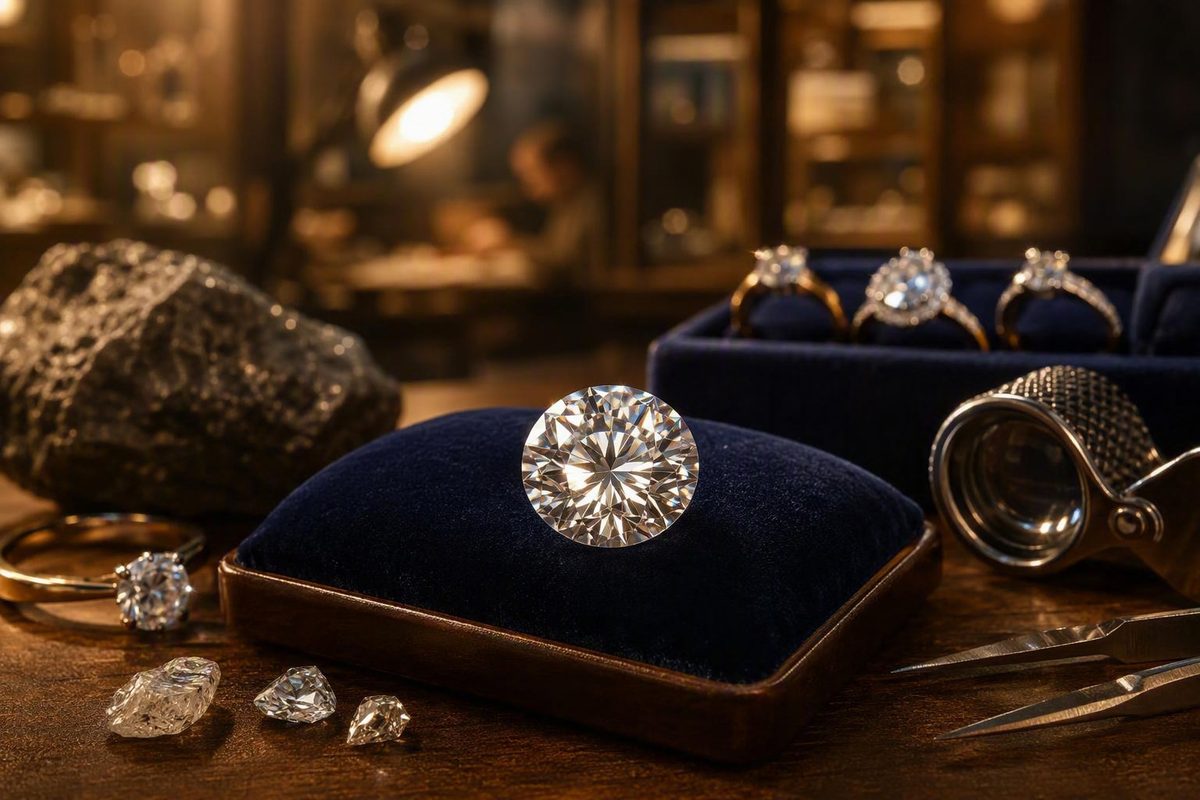
The short answer: diamond prices are built in layers
Why are diamonds expensive? For a natural diamond, the retail price reflects five broad contributors:
- Limited supplies of desirable natural stones. Diamond material varies widely. Rough capable of producing a large, clear, attractively colored jewelry stone is less common than small, included, poorly colored, or structurally unsuitable material.
- Recovery and processing costs. Exploration, mine development, extraction, recovery from ore, and sorting require equipment, labor, capital, and time.
- Cutting losses and skilled work. A polished carat is not equivalent to a rough carat. Material is removed during cutting and polishing, while planning and faceting require specialized skill.
- Consumer demand. Engagement traditions and associations with romance, luxury, and status support demand for particular origins, shapes, sizes, and quality grades.
- Seller-added costs. Grading, transport, security, insurance, financing, inventory, marketing, staffing, returns, service, branding, and profit can all enter the asking price.
Those factors explain why natural diamonds are expensive as a category. They do not fully explain why one diamond costs much more than another. Differences between individual stones are driven primarily by the 4Cs—cut, color, clarity, and carat weight—along with shape, proportions, fluorescence, visual performance, grading context, and seller strategy.
A useful way to picture the price is as a stack:
Exploration and mining → recovery and sorting → planning and cutting → polishing → grading → financing and inventory → distribution → retail
No reliable universal percentage can be assigned to each layer from the available evidence. The proportions vary by stone, mine, cutting outcome, route to market, seller, and economic conditions.
This article should therefore be read as a qualified consumer overview, not a definitive accounting of the diamond industry. Most of the available evidence comes from retailers, marketplaces, jewelry buyers, and commercial price tools. Those sources identify relevant costs and market patterns, but they have commercial interests and do not independently establish which factor contributes the largest share of the final price.
That limitation rules out two overly simple answers. Saying diamonds cost a lot only because they are rare ignores consumer demand, branding, and retail economics. Saying they cost a lot only because of marketing ignores differences in rough quality and the expense and material loss involved in producing a polished stone.
The supported answer is layered: desirable natural rough is limited relative to lower-grade diamond material; recovery and transformation cost money; grading helps classify the result; demand influences what buyers will pay; and distribution and retail add services, expenses, and margins.
Are diamonds actually rare?
“Rare” is not a useful yes-or-no label until you define which diamonds you mean and where in the supply chain you are looking.
Diamond material generally is not the same product as a large, clear, nearly colorless natural diamond suitable for a fine-jewelry center stone. Some recovered diamonds have undesirable color, heavy inclusions, or structural limitations. Others are too small or poorly shaped to produce the polished stone a particular buyer wants.
That is why two apparently conflicting statements can both contain part of the truth:
- Diamonds as a material need not be among the rarest gemstones or substances.
- Large, attractive, high-quality natural diamonds are less common than small or lower-quality stones.
Rare Carat, a commercial diamond marketplace, makes this distinction between relatively plentiful lower-grade material and the narrower supply of desirable jewelry-quality stones. It also connects price to the work required to locate, sort, and fashion rough, although its definitions of attractive or “gem-quality” material are not tied to a formal threshold (Rare Carat’s discussion of rarity and production).
It also helps to distinguish three forms of scarcity:
- Geological scarcity: how often nature produces diamond-bearing material with the desired combination of size, color, clarity, structure, and shape.
- Commercial recoverability: whether that material can be found, extracted, processed, and sold economically.
- Market availability: how many polished diamonds matching a specific set of requirements are offered at a particular time.
These concepts overlap, but they are not interchangeable. A deposit may exist without being economical to develop. A working mine may recover rough that cannot produce the size or clarity buyers want. A polished category may be readily available at one weight and much less available at another.
Rarity is therefore conditional. A small, heavily included natural diamond and a large, clear, nearly colorless one do not occupy the same commercial segment merely because both are diamonds. The latter combines several desirable characteristics in one stone and can consequently command a much higher price.
The role of marketing is harder to measure. Angara, a jewelry retailer, emphasizes advertising, cultural symbolism, and managed supply, while other commercial sellers give more weight to geological scarcity and production economics. None of the supplied sources independently measures the share of current prices caused by advertising or supply management (Angara’s explanation of marketing and diamond demand).
The defensible conclusion is narrower: limited availability of desirable natural quality is one supported price driver, while marketing and cultural associations help create demand for that quality. The evidence does not establish that diamonds as a whole are exceptionally rare, that geological scarcity explains the entire price, or that deliberate restriction of supply is the dominant cause.
From rough stone to polished diamond: where costs accumulate
A diamond in a jewelry case is the result of a long supply chain. At each stage, businesses can incur labor costs, capital requirements, material losses, security risks, or inventory expenses.
The process generally includes:
- Exploration. Potentially diamond-bearing areas are identified and assessed.
- Mine development and extraction. Infrastructure is built and material is removed if a project appears commercially viable.
- Recovery. Processing separates diamond material from the surrounding ore.
- Sorting. Rough is categorized by size, shape, color, quality, and likely cutting outcome.
- Planning. Cutters determine what polished stone or stones the rough can produce.
- Cutting and faceting. The crystal is divided and shaped.
- Polishing. Facets are finished to create the final surface and geometry.
- Grading. A laboratory may measure and assess the polished diamond.
- Transport and distribution. Rough and polished goods move among producers, cutters, dealers, manufacturers, and sellers.
- Financing and inventory. Capital remains committed while stones are processed, transported, stored, or displayed.
- Retail. The final seller supplies presentation, fulfillment, sales support, return terms, and other services while seeking a profit.
One easily overlooked point is that a carat of rough is not equivalent to a carat of polished diamond. Cutting and polishing can remove half or more of the original weight in some cases, although actual yield depends on the crystal’s shape, defects, and intended finished cut (Dana Rebecca Designs’ overview of cutting losses).
Suppose a piece of rough loses a substantial portion of its weight during sawing, shaping, and polishing. The remaining polished diamond must economically carry costs associated with obtaining and handling the starting rough as well as the labor used to transform it. That does not mean every stone loses the same percentage; it explains why rough and polished carats cannot be treated as interchangeable units.
Planning matters because a cutter is not simply trying to preserve the greatest possible weight. The objective is usually to find the most valuable balance among:
- finished carat weight;
- shape;
- proportions and cut quality;
- clarity after inclusions are removed or repositioned;
- color appearance;
- and likely market demand.
A planner may also choose between producing one larger stone and several smaller ones. Each option changes the likely yield, value, and risk.
Grading adds another cost, but it does not physically improve the diamond. A report records measured and assessed characteristics so buyers and sellers can identify and compare the stone more easily. Its value lies in documentation and market confidence, not in making the diamond brighter, cleaner, or larger.
Financing is another easily missed expense. Capital may be tied up while a mine is developed, rough awaits sale, a cutter plans and finishes a stone, a dealer holds it, or a jeweler waits for a retail buyer. Commercial retailer RockHer identifies extraction, cutting, manufacturing, and inventory as capital-intensive stages, although it does not provide an independently verified allocation of their contribution to retail price (RockHer’s supply-chain explanation).
The supply chain explains why the finished product costs more than the raw material alone. It does not reveal how much each stage contributes to a typical sale. That breakdown can vary substantially, and the supplied commercial evidence does not support a universal formula.
Why the 4Cs make diamond pricing nonlinear
The 4Cs are cut, color, clarity, and carat weight. They are often presented as four separate features, but pricing does not operate like a menu of independent surcharges. The factors interact.
A larger diamond with weak color, clarity, or cut may cost less than a smaller stone with exceptional grades. Two diamonds of equal weight can differ because one has more desirable proportions or visible performance.
Carat: weight, not visible size
One carat equals 0.20 gram, or 200 milligrams. It measures weight rather than diameter or face-up area (Info Diamond’s guide to carat weight and pricing).
Two one-carat diamonds can therefore look different in size. Shape and proportions determine how weight is distributed.
Carat also affects price nonlinearly. Larger rough capable of producing a large polished stone with desirable quality is less common, so buyers may pay for both more total weight and a higher price per carat. A comparable two-carat diamond can therefore cost more than twice as much as a one-carat diamond.
The calculation may be closer to:
twice the weight × a higher price per carat
rather than:
twice the weight × the same price per carat
Cut: what the cutter does with the rough
Cut describes the proportions and workmanship of the polished diamond. For round brilliants, it is closely associated with the way the stone handles light. Detailed geometry, symmetry, and polish influence appearance, while the cutting decision determines how much rough weight is retained.
A better cut does not create more diamond material. It can use the available material more effectively for light return and visual balance. Achieving preferred proportions may require sacrificing weight, which helps explain why a well-cut stone can cost more than a poorly proportioned stone with a similar listed weight and other grades.
There is no single numerical cut premium that applies to every diamond. Shape, grading terminology, proportions, inventory, demand, and the stone’s detailed appearance all matter.
Color: how much body color is present
For diamonds in the colorless-to-light-yellow or light-brown range, color is commonly described on a D-to-Z scale. D is at the colorless end, with progressively later grades indicating more observable body color. In this market, less color generally commands a higher price.
A market premium can therefore be genuine even if the face-up difference is difficult for a particular buyer to see.
Clarity: internal and surface characteristics
Clarity assesses inclusions within a diamond and blemishes on its surface. Grading commonly evaluates these characteristics under 10× magnification, considering their number, size, type, position, and visibility.
Higher clarity grades can command substantial premiums because cleaner stones are less common. Yet a higher grade may produce little visible benefit once a diamond appears clean to the unaided eye at normal viewing distance.
This is the difference between a documented grade and a visible benefit. The higher grade may be legitimate and marketable without being the best use of every buyer’s budget.
Milestone weights and price jumps
Prices can rise sharply around popular weights such as one carat. Demand concentrates at familiar round numbers, and commercial price-per-carat brackets can reinforce the difference between otherwise similar stones immediately below and at a threshold (Info Diamond’s discussion of weight thresholds and price-per-carat brackets).
Imagine two otherwise comparable diamonds weighing just under and exactly one carat. The one-carat stone may carry a higher total price because it contains slightly more material, falls into a more popular category, and may be assigned a higher price per carat. Depending on their dimensions and proportions, the visible size difference may be limited.
That does not make every sub-one-carat diamond a bargain. It simply makes the area below a milestone worth checking. Actual measurements and appearance matter more than the rounded label alone.
Shape, appearance, and the limits of a grading report
A grading report is a structured description, not a complete judgment of beauty or value. Headline grades compress or omit details that can affect both appearance and price.
Two diamonds with similar reports may differ because of:
- shape and outline;
- table, depth, crown, and pavilion proportions;
- symmetry and polish;
- fluorescence;
- haze or cloudiness;
- inclusion type and placement;
- facet pattern and contrast;
- bow-tie effects in some elongated shapes;
- and overall light performance.
Some of these characteristics appear on a report, but they still require interpretation. Two diamonds can receive the same clarity grade even though one has an inclusion near the edge and the other has a more distracting feature beneath the table.
Round brilliant diamonds often cost more than some fancy shapes because of a combination of strong consumer demand and differences in how efficiently shapes can be produced from rough (Dana Rebecca Designs’ explanation of round and fancy-shape pricing).
That is a market tendency, not a rule that every oval, cushion, pear, emerald, or princess cut will be cheaper than every round. Shape comparisons are meaningful only when origin, weight, color, clarity, cut information, grading context, and other important characteristics are reasonably similar.
This does not establish that one laboratory is always more accurate; it means the report issuer can affect how readily the market accepts the stated grades.
An independent grading report can document characteristics and make comparison easier. It does not guarantee:
- beauty;
- fair pricing;
- seller honesty;
- ethical sourcing;
- future value;
- or suitability for a particular buyer.
Whenever possible, review moving video, neutral-light images, and in-person appearance alongside the report.
Online calculators have similar limitations. They can establish a rough expectation or identify an asking price that deserves investigation, but they are not appraisals or binding offers. Washington Diamond, for example, describes its calculator as a guideline rather than an actual purchase or sale price and notes that laboratory, proportions, fluorescence, and in-person appearance may change value (Washington Diamond’s calculator limitations).
Demand, branding, and the retail price
Production cost alone does not determine retail price. Diamonds are consumer goods, so preferences and cultural meaning affect what buyers are willing to pay.
Natural diamonds are widely associated with engagement, romance, luxury, status, and permanence. Marketing has reinforced those associations, but the supplied commercial sources do not independently quantify advertising’s historical effect on modern prices.
Demand is also selective. Buyers may prefer:
- round shapes;
- one-carat or two-carat labels;
- high color and clarity grades;
- natural origin;
- a familiar grading report;
- a particular designer;
- or a prestige retail experience.
Those preferences can produce premiums even when visual differences are small. A one-carat label may be more marketable than a stone slightly below it. A very high clarity grade may appeal to buyers who value documented rarity. A luxury brand may attract someone who values design, presentation, reputation, and service.
Retail asking prices may include:
- advertising and customer acquisition;
- showroom and display expenses;
- sales and support staff;
- insured shipping and secure handling;
- returns and payment processing;
- warranties and after-sale service;
- inventory financing;
- packaging and presentation;
- and profit.
These costs are not automatically illegitimate. Some buyers value local inspection, custom design, convenient returns, or an established service relationship. Others prefer a leaner online transaction and would rather direct more of the budget toward the stone.
A brand premium can pay for design, curation, craftsmanship, reputation, service, and convenience. It should not automatically be treated as a measurable improvement in the loose center diamond. Conversely, branded and unbranded stones are not necessarily identical merely because a few headline grades match.
To estimate what you are paying for brand and service, compare independently graded diamonds with closely matched origin, shape, weight, color, clarity, proportions, fluorescence, dimensions, and report context. Then compare the transaction itself: return period, resizing, warranty, insured shipping, setting quality, and customer support.
The evidence does not support a universal retailer markup. Business models and operating costs differ, so it is not defensible to say margins are always excessive or always thin.
It is also important to separate the center diamond from the completed ring. The final ring price can include metal, setting complexity, side stones, design, labor, craftsmanship, condition, and brand in addition to the center stone (With Clarity’s overview of diamond and ring value).
A lower loose-diamond price does not necessarily produce a lower finished-ring price, and a more expensive ring does not necessarily contain a better center diamond.
Why lab-grown diamonds usually cost less
Natural and lab-grown diamonds operate in different supply systems.
Natural rough depends on geological occurrence, discovery, recoverability, mine economics, and the quality distribution of extracted material. Laboratory capacity is not unlimited, but it can generally be expanded more readily than recoverable natural rough.
That difference, together with consumer preferences and market positioning around origin, helps explain why comparable lab-grown diamonds generally list for less than natural diamonds. Commercial price data show a substantial market distinction between the two categories, although the size of the gap varies and any current estimate is time-sensitive (StoneAlgo’s diamond price methodology and market caveats).
The difference is not necessarily a judgment about visible appearance. A natural and a lab-grown diamond can look similar while carrying very different prices because buyers are purchasing more than appearance. One buyer may value natural origin, geological formation, tradition, or perceived scarcity. Another may prioritize size and visual performance at a lower initial cost.
No fixed percentage discount applies across the market. The gap varies by date, shape, size, quality, grading context, availability, and seller.
For a useful comparison, match:
- the same shopping date;
- carat weight;
- shape;
- cut quality and proportions;
- color;
- clarity;
- grading context;
- fluorescence where relevant;
- and seller terms.
Then compare the actual stones rather than broad category averages. A high-quality lab-grown diamond should not be compared with a lower-quality natural diamond if the goal is to isolate the price attached to origin.
Current differences should not be treated as permanent. Manufacturing capacity, technology, retailer competition, natural-diamond supply, and consumer preferences can change. Commercial calculators are snapshots of listed inventory, not universal valuations or guarantees of future prices.
How to avoid paying for a premium you cannot see
The goal is not necessarily to buy the cheapest diamond. It is to identify which premiums produce a benefit you can see or genuinely value.
1. Set a total ring budget
Start with what you are comfortable spending on the finished piece, not just the center stone. Leave room for the setting, metal, side stones, design work, shipping, taxes where applicable, resizing, and service features.
2. Choose natural or lab-grown
Origin has a major effect on price, so mixing natural and lab-grown listings can make comparisons misleading. Decide whether natural origin matters to you, whether lab-grown better fits your priorities, or whether you are open to either.
3. Prioritize visible cut performance
Look for an outline and light pattern you find attractive. Review proportions and moving video, preferably under more than one lighting condition. Do not preserve carat weight at the expense of an appearance you dislike.
4. Establish acceptable color and clarity ranges
Determine how much warmth you notice in your preferred shape and setting. For clarity, check whether the stone appears clean to your unaided eye and examine the location and character of inclusions.
A higher grade may provide documented rarity or reassurance without creating an obvious visual improvement. Whether that is worth paying for is a personal decision.
5. Compare closely matched stones
Hold the important variables as constant as possible:
- origin;
- shape;
- carat weight;
- color;
- clarity;
- cut and proportions;
- fluorescence;
- dimensions;
- and grading context.
Only then can you sensibly investigate whether a higher price reflects a better-looking stone, stronger service, or branding.
6. Check weights just below milestones
Compare diamonds immediately below one carat, one and a half carats, two carats, or another target threshold. Price-per-carat brackets and demand at round-number weights can produce a noticeable price difference, even when the change in face-up size is modest.
Do not compare weight alone. Check millimeter measurements and proportions because some additional weight may be carried in depth rather than visible spread.
7. Separate visible improvements from report upgrades
Ask what each premium buys:
- Can you see the color difference face-up?
- Is the lower-clarity stone already eye-clean?
- Does the better cut produce more balanced light performance?
- Is the extra weight visible?
- Are you paying for beauty, origin, documented rarity, or only a higher grade?
Side-by-side viewing is valuable. Some differences become obvious only in direct comparison; others remain difficult to see even then.
8. Review details beyond the 4Cs
Inspect proportions, symmetry, polish, fluorescence, inclusion placement, haze, photographs, and videos.
A report narrows the field. It does not complete the evaluation.
9. Compare the entire transaction
Compare finished-ring prices and account for the setting, craftsmanship, customization, shipping, return period, resizing, warranty, maintenance, and support.
Read the return policy before paying. A practical inspection period can be particularly valuable when buying remotely.
10. Use price per carat carefully
Price per carat is the diamond’s total price divided by its carat weight. It is useful only when the diamonds are sufficiently similar.
Comparing the price per carat of a natural round with that of a lab-grown oval reveals little. The same is true when color, clarity, cut, fluorescence, proportions, or grading context differ materially.
11. Keep different kinds of value separate
A diamond can have several different numbers attached to it:
- Retail price: what a consumer pays a seller.
- Insurance replacement appraisal: an estimate prepared to replace the item under the appraisal’s assumptions.
- Dealer buyback offer: what a business is prepared to pay while accounting for risk, operating expenses, holding time, and resale needs.
- Private-party resale value: what another consumer may pay in a market with different levels of trust, convenience, and liquidity.
These figures answer different questions. An insurance appraisal above the purchase price does not establish an immediate profit, and a dealer offer below retail does not by itself prove that the original price was improper.
12. Do not treat the purchase price as an investment guarantee
A high retail price does not guarantee appreciation or preservation of principal. Retail expenses and services do not necessarily transfer to a later owner, while secondhand buyers and dealers may account for condition, documentation, inspection risk, market changes, and the time required to resell.
Commercial marketplace guidance also identifies trust and liquidity constraints as reasons resale prices may fall below retail, while cautioning that automated estimates are not appraisals or offers (StoneAlgo’s explanation of retail and resale differences).
The practical decision rule is simple:
Pay more when the premium produces a visible benefit, a desired origin, trusted documentation, distinctive design, or service you value—not merely because the report carries a higher number.
Conclusion
Why are diamonds expensive? Buyers are paying for a combination of limited supplies of desirable natural rough, costly and sometimes highly lossy production, graded quality, consumer demand, and the services and margins added through distribution and retail.
The available commercial evidence supports those factors as contributors, but it does not establish a universal allocation or prove that any one factor dominates. Price is also not proof of beauty, fairness, ethical sourcing, or investment value.
The most defensible buying strategy is to compare like with like, examine appearance beyond the headline grades, test whether each upgrade changes what you see or care about, and keep retail price separate from appraisal and resale expectations.
Frequently asked questions
Are diamonds rare or is their price mostly marketing?
Neither explanation is sufficient by itself. Diamond material generally is different from the narrower supply of large, clear, attractively colored natural rough suitable for fine jewelry. That desirable subset is more limited, while marketing and cultural associations help create demand for it.
The supplied commercial evidence does not reliably quantify whether scarcity, production, advertising, or supply management contributes the largest share of the final price.
Why does a two-carat diamond cost more than twice as much as a one-carat diamond?
Larger high-quality diamonds generally command a higher price per carat, so a two-carat stone can combine twice the weight with a higher per-carat rate. Popular weight thresholds can add further pricing pressure. With Clarity describes this nonlinear relationship for otherwise comparable one- and two-carat stones (With Clarity’s explanation of carat and value).
The comparison assumes that color, clarity, cut, shape, origin, and other important variables are reasonably similar.
Why are round diamonds often more expensive than other shapes?
Round brilliants often carry a premium because buyer demand is strong and their production can retain less rough than some fancy-shape alternatives.
This is a general tendency, not a universal rule. A particularly fine oval, cushion, pear, emerald, or princess cut can cost more than a round with lower grades or weaker appearance.
Does a grading report mean a diamond is fairly priced?
No. A grading report documents assessed characteristics and supports comparison, but it does not set a mandatory retail price.
Proportions, fluorescence, haze, inclusion placement, visual performance, grading context, seller costs, branding, service, and inventory can still affect the asking price. A report also does not guarantee beauty, seller honesty, ethical sourcing, future value, or a fair transaction.
Why is a diamond’s resale value often lower than its retail price?
The retail price can include marketing, staffing, shipping, returns, financing, service, security, and seller profit. A later buyer does not necessarily reimburse those costs.
Dealers may also account for inspection risk, holding time, operating expenses, and the need for a resale margin. Private sellers face different trust and liquidity constraints from established retailers. As a result, resale proceeds can be substantially below the original retail price, but no fixed percentage applies to every diamond.