
1 Carat Diamond Earring Size: Total Weight vs Per Ear
A 1-carat-total pair has roughly 5 mm round diamonds per ear. One carat per earring is about 6.5 mm. Learn how to check the listing and fit.
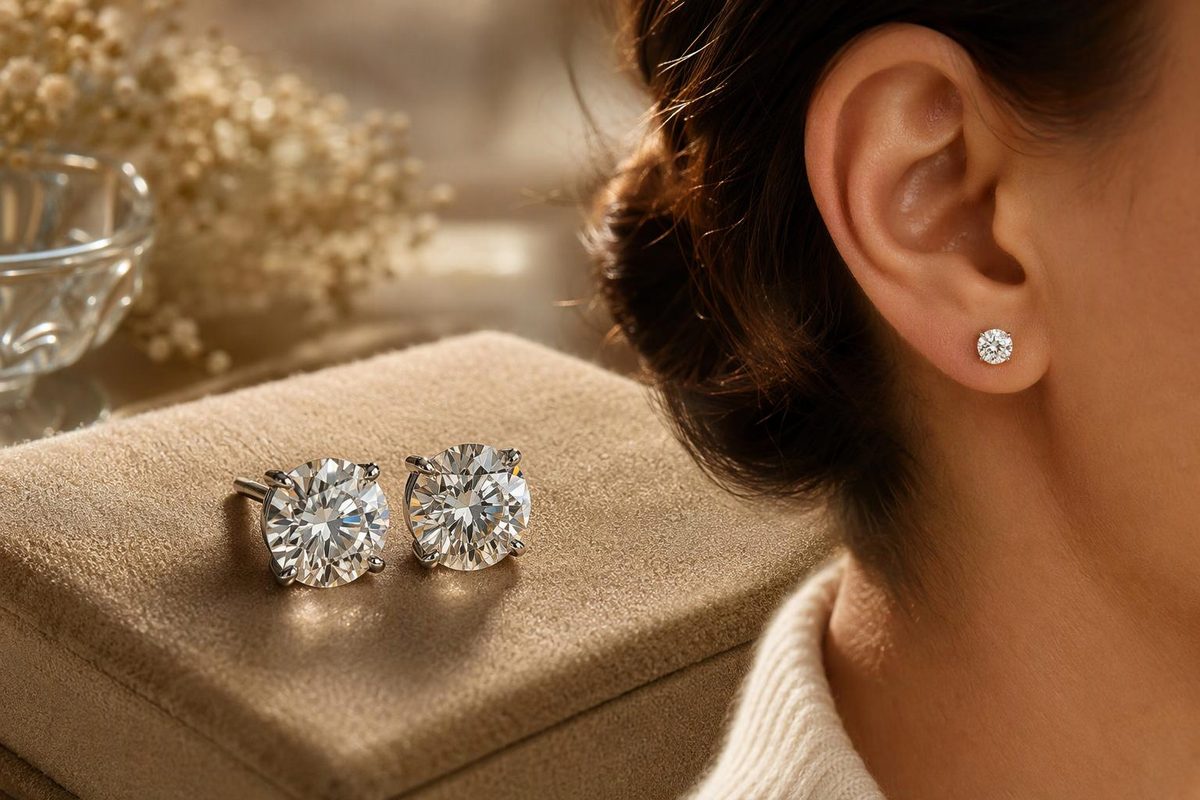
A 1-carat-total pair of round solitaire diamond studs usually has a 0.50-carat diamond in each ear, about 5 mm across. If you mean 1 carat per earring, each round diamond is about 6.5 mm across—and the pair totals 2 carats. These are approximate stone diameters, not the outside dimensions of the finished earrings. Frank Darling’s stud-size guide gives these benchmarks for the two sizes.
The important buying distinction is whether “1 carat” describes the pair or each stone. Do not choose from the headline weight alone.
Read the weight before judging the size
CTW, TCW and “ct. tw.” refer to total carat weight. For earrings sold as a pair, that includes all the diamonds across both earrings. Blue Nile explains that a 1-carat-total pair of solitaire studs contains two half-carat diamonds.
For matched solitaire studs—one diamond in each earring—the comparison is:
| Listing wording | Approximate weight per ear | Approximate round diamond diameter per ear |
|---|---|---|
| 1.00 carat total weight for the pair | 0.50 ct | 5.0–5.1 mm |
| 1.00 carat each / per earring | 1.00 ct | 6.5 mm |
| 2.00 carat total weight for the pair | 1.00 ct | 6.5 mm |
Diameter benchmarks: Frank Darling. Actual measurements vary with the individual diamonds.
This arithmetic does not tell you the center-stone size in halo or cluster earrings. A 1-carat-total pair could distribute its weight among several smaller diamonds. Ask for the center weight and finished width separately. Also confirm whether the item is sold as a pair or a single stud.
Carat is a weight measurement, not a width: GIA defines one metric carat as 200 milligrams. For broader shape comparisons, see our 1-carat diamond size guide; for the stones in a typical 1-carat-total solitaire pair, use the half-carat size guide.
What does the difference look like on the ear?
Using the rounded benchmarks of 5 and 6.5 mm, a 1-carat stone is about 30% wider than a half-carat stone—not twice as wide, despite weighing twice as much. That is a meaningful change in the amount of earlobe it covers.
Whether either size looks discreet or prominent depends on your lobe, piercing position and other earrings. “Everyday size” and “statement size” are style descriptions, not measurements.
To preview the scale before buying:
- Draw and cut out circles measuring 5 mm and 6.5 mm across. Hold each against the lobe at the piercing position. This approximates coverage, not sparkle or comfort.
- Try on studs with comparable finished millimeter dimensions, ideally in the same setting style.
- Check both a close view and a normal mirror view. A tightly cropped seller photograph is not a reliable scale reference.
Compare the finished stud, not just the diamond
A bezel adds a metal rim; a halo adds surrounding diamonds. Both change the outline you see on the ear, so a 5 mm center stone need not mean a 5 mm-wide earring. Whiteflash’s earring-size guide explains how these settings frame the visible design.
Before ordering, request four details in writing:
- Is the quoted carat weight for the pair or each earring?
- What is each center diamond’s actual weight and face-up measurement?
- What is the finished width of each stud, including metal and accents?
- Can you try the earrings on or return them after checking fit under the seller’s policy?
For a straightforward size comparison, start with two matched solitaire pairs: approximately 5 mm centers versus 6.5 mm centers. Keep the setting style similar so you are judging the size step rather than extra metal or a halo.