
1-Carat Diamond Size in mm: Round and Shape Benchmarks
A 1-carat round diamond is about 6.5 mm across. Compare shape benchmarks, read report measurements and check size without sacrificing cut quality.
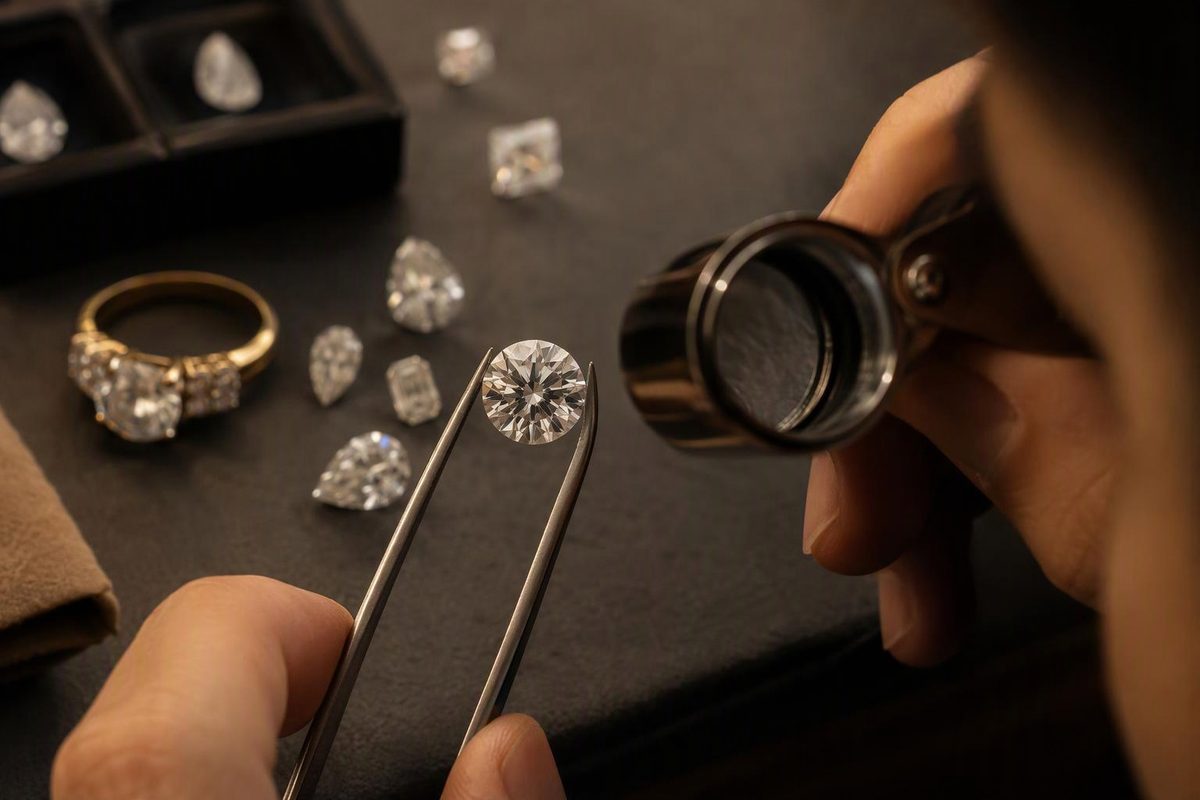
A 1-carat round brilliant diamond is approximately 6.5 mm in diameter. That is a useful shopping reference, not an exact conversion: the benchmark assumes well-proportioned cutting, and individual stones differ. Beyond 4Cs’ size guide uses 6.5 mm for a round cut to ideal proportions.
Carat measures weight, not size. One metric carat equals 200 milligrams, or 0.2 grams. Millimeter measurements tell you how wide, long and deep the finished diamond is. For a particular stone, use its grading-report measurements rather than substituting a chart estimate. GIA explains carat weight.
1-carat diamond size by shape
These are approximate face-up dimensions—the outline seen from above—not the diamond’s depth or the finished ring’s overall size.
| Diamond shape | Approximate 1-carat reference size | How to read it |
|---|---|---|
| Round brilliant | 6.5 mm | Diameter across the stone |
| Princess | 5.3–5.5 × 5.3–5.5 mm | Side-to-side dimensions, not the diagonal |
| Oval | 7.5 × 5.5 mm | Length × width |
| Emerald | 7 × 5 mm | Length × width |
| Pear | 8 × 5 mm | Length × maximum width |
| Marquise | 10 × 5 mm | Tip-to-tip length × maximum width |
| Heart | 6.5 × 6.5 mm | Length × width for a roughly equal-length-and-width outline |
The princess, oval, emerald and pear references follow Harriet Kelsall’s approximate conversion chart; its princess range covers stones weighing approximately 1.00–1.05 carats. The marquise and heart references appear in Rio Grande’s diamond size chart. These are visualization guides, not laboratory standards or required dimensions.
An elongated diamond can span more of the finger lengthwise without being wider. A 10 mm marquise is therefore not simply “bigger” in every direction than a 6.5 mm round. Compare both dimensions and the outline, not just the longest measurement.
Cushions need particular care because square and elongated outlines are different comparisons. If that is your shortlist, see our guide to evaluating elongated cushion-cut diamonds.
Read the measurements on the report
For rounds, the measurement format is minimum diameter–maximum diameter × depth. For fancy shapes, it is length × width × depth. This report walkthrough explains both formats.
For example, a round measurement of 6.50–6.53 × 3.92 mm means the stone is approximately 6.5 mm across and 3.92 mm deep. It does not mean its face-up outline is 6.50 × 3.92 mm.
For an oval, dividing length by width gives its length-to-width ratio. The chart’s 7.5 × 5.5 mm reference has a ratio of about 1.36. That describes its outline, not its quality: a longer, narrower oval may suit your taste better than a fuller one.
Why equal-weight diamonds differ in size
A deeper cut or thick girdle—the outer edge of the diamond—can leave a stone with smaller face-up dimensions for its weight. A shallower cut can produce a larger outline. Shiree Odiz’s carat guide describes these size differences.
But the largest millimeter measurement is not automatically the best purchase. Proportions also control how the diamond interacts with light. GIA evaluates a round brilliant’s weight relative to diameter alongside brightness, fire, scintillation and craftsmanship in its cut-grading system.
Before buying:
- Confirm the weight basis. Ask whether “1 carat” refers to the center diamond or the combined weight of several stones.
- Compare actual measurements. Shortlist stones of the same shape, then inspect their appearance rather than choosing by dimensions alone.
- Check scale on your hand. Draw the measured outline on paper with a millimeter ruler, or ask to try a similarly sized stone. Do not assume an enlarged listing photograph is life-size.
- Separate stone size from ring size. Ask for the setting’s overall dimensions too; the table describes only the diamond.
If you are deciding whether to move up in weight, compare the millimeter change in our 2-carat diamond size guide, rather than expecting twice the carat weight to mean twice the width.