
Oval Diamond Carat Size Chart: Millimeter Benchmarks
Compare oval diamond carat weights with millimeter benchmarks, calculate length-to-width ratio and check visible size without overlooking cut quality.
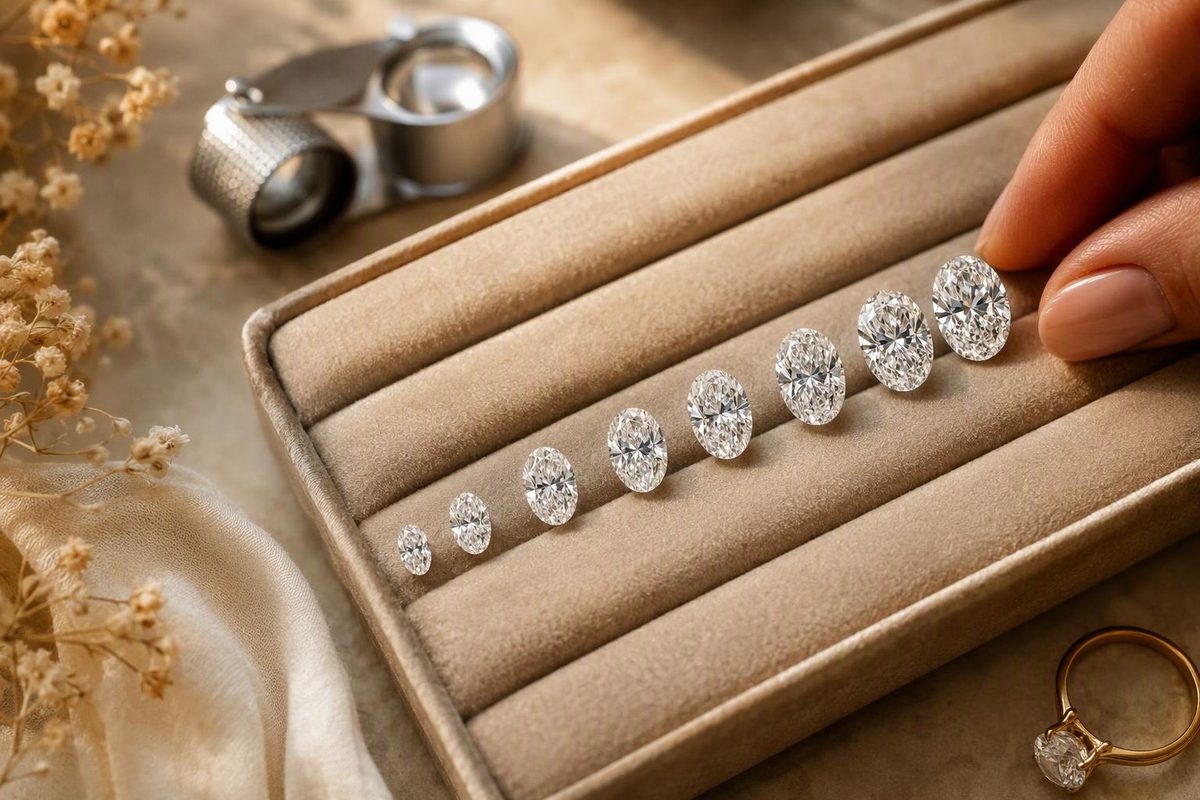
For an oval diamond, 1 carat at roughly 7.7 × 5.7 mm is a useful shopping reference—not a guaranteed size. An oval’s length and width tell you more about its visible footprint than carat weight alone.
Carat measures weight: one metric carat equals 200 milligrams. It does not specify a diamond’s dimensions. Two stones with the same weight can therefore look different from above. GIA explains the distinction between carat weight and size.
Oval diamond size chart: carats to millimeters
These are retailer-supplied reference dimensions from Brilliance’s oval diamond size chart, not standardized sizes. Several benchmarks, including 0.50, 1.00, 1.50 and 2.00 carats, also appear in With Clarity’s chart.
| Carat weight | Reference length × width |
|---|---|
| 0.50 ct | 6.0 × 4.0 mm |
| 0.75 ct | 7.0 × 5.0 mm |
| 1.00 ct | 7.7 × 5.7 mm |
| 1.25 ct | 8.0 × 6.0 mm |
| 1.50 ct | 8.5 × 6.5 mm |
| 1.75 ct | 9.0 × 6.5 mm |
| 2.00 ct | 9.0 × 7.0 mm |
| 2.50 ct | 10.0 × 8.0 mm |
| 3.00 ct | 12.0 × 8.0 mm |
| 4.00 ct | 12.5 × 8.5 mm |
| 5.00 ct | 12.0 × 10.0 mm |
This is a reference chart, not a precise conversion formula or a cut-quality standard. The rows describe different oval outlines: the 5-carat reference is wider but shorter than the 4-carat reference. That does not mean increasing weight makes an oval shorter; it means the chart does not hold proportions constant.
Use the table to establish a rough scale, then replace its figures with the measurements of each diamond you are considering. The weight should be for the individual oval, not the combined weight of every diamond in a ring. For comparisons beyond ovals, see our 1-carat size benchmarks by shape.
Read length, width and depth separately
Ask for the grading report, not just a listing’s carat label. GIA reports include weight, measurements and cutting style among the diamond’s identifying characteristics. GIA’s report guide explains what those records contain.
For an oval, a measurement written as 8.40 × 6.00 × 3.70 mm describes length, width and depth. In this hypothetical example:
- 8.40 mm is the end-to-end length.
- 6.00 mm is the width across the stone.
- 3.70 mm is its depth, not additional finger coverage.
Compare both length and width. A longer oval is not necessarily larger overall if it is also considerably narrower.
Calculate the length-to-width ratio
Length-to-width ratio = length ÷ width.
The example above has a ratio of 8.40 ÷ 6.00 = 1.40. GIA describes approximately 1.30–1.40 as a more rounded oval look and 1.40–1.50 as a more traditional elongated outline. These are appearance preferences, not quality grades. GIA’s oval buying guide also recommends viewing individual stones because appearance varies within the same ratio range.
If you prefer a broad oval, do not choose solely by the longest measurement. If you prefer a slender outline, compare stones with similar ratios before judging the size increase between carat weights.
Do not buy millimeters at the expense of appearance
A thick girdle can add weight without increasing visible size. Conversely, an extremely thin girdle can increase damage risk. GIA also explains that ovals can show a bow tie—a darkened band across the center whose prominence changes with viewing conditions. Dimensions alone cannot establish whether that contrast is attractive or distracting. GIA’s oval guide covers both trade-offs.
For a shortlist, check three things:
- Actual measurements: record carat weight, length, width and ratio side by side.
- Appearance in motion: request face-up video and, where possible, inspect the stone at normal viewing distance in more than one lighting environment.
- The meaning of the cut label: GIA does not assign an overall cut grade to ovals, although it reports polish and symmetry. A seller’s “Excellent” or “Ideal” oval label is not a GIA overall cut grade. GIA confirms this distinction.
Finally, try the footprint on your own hand. A ruler-drawn paper oval can help compare dimensions, but it cannot reproduce sparkle or the finished setting. Use an actual try-on to judge comfort and proportion; our guide to choosing an engagement-ring carat size takes that decision beyond the chart.