
Half a Carat Diamond Size: How Big Is 0.50 ct?
A half-carat round diamond is about 5 mm across. Compare shapes, visualize it on your hand and check the measurements before buying.
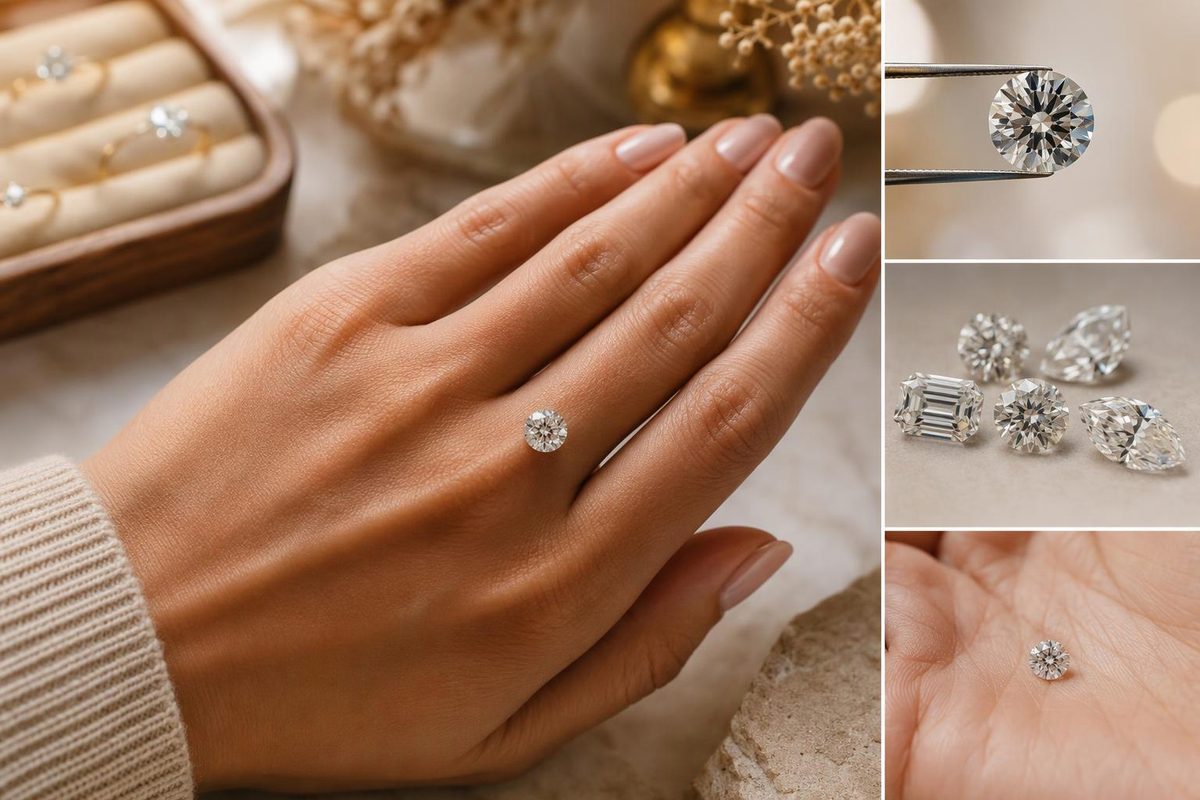
A half-carat round diamond is about 5 mm across, or roughly 0.20 inches, viewed from the top. That is a useful shopping benchmark, not an exact dimension for every stone: Brilliance’s round size chart lists 0.50 ct at 5.0 mm.
Half a carat means 0.50 ct, or 50 points, and weighs 0.10 grams. Carat measures weight; millimeters describe the size you can see. Two half-carat diamonds can have different dimensions because their shapes and proportions differ, as IGI explains.
Half-carat size by shape
For a round diamond, compare diameter. For other shapes, compare both length and width—not just the longest measurement.
These selected benchmarks come from Shiree Odiz’s diamond size chart. They are reference dimensions rather than required sizes or guarantees of cut quality.
| Diamond shape | Approximate face-up dimensions at 0.50 ct |
|---|---|
| Round | 5.0 mm diameter |
| Princess | 4.4 × 4.4 mm |
| Square cushion | 4.6 × 4.6 mm |
| Oval | 6.0 × 4.0 mm |
| Emerald | 5.5 × 3.7 mm |
| Pear | 6.7 × 4.2 mm |
An oval measuring 6 × 4 mm is longer than a 5 mm round, but narrower. “Longer” does not mean larger in every direction. Likewise, a square’s side length is not directly equivalent to a circle’s diameter: the outlines differ.
If an oval appeals to you, our oval diamond carat size chart explains how length-to-width ratio changes its outline.
Is half a carat half the size of one carat?
It is half the weight, not half the diameter. Using Brilliance’s benchmarks, a half-carat round is about 5 mm across and a one-carat round about 6.5 mm.
From those diameters, the half-carat stone has approximately:
- 77% of the diameter of the one-carat stone.
- 59% of its face-up circular area, calculated from the diameters.
Those calculations describe the outlines, not sparkle or perceived size. For a fuller comparison with the larger weight, see our 1-carat diamond size guide.
How to visualize it on your hand
Draw and cut out a 5 mm circle, checking it against a millimeter ruler, and place it where the center diamond would sit. For an oval, use a 6 × 4 mm outline instead. This gives you a scale reference, not a preview of brilliance or the finished setting.
Then try a ring with similar center-stone dimensions and your intended band width. Judge it from normal viewing distance as well as close up. “Too small” is a preference, not a grading defect; choose by how the ring looks on your hand rather than by a carat target alone.
What to check before buying
Ask for the actual millimeter measurements. IGI reports include length, width and depth. For a round, the average of the first two measurements is a useful diameter comparison; for an elongated shape, retain both numbers.
Do not chase diameter at the expense of cut. Excessive depth or a thick girdle can hide weight without adding visible width. GIA explains why carat weight alone cannot establish visible size. Compare measurements alongside the report and the stone’s appearance.
Confirm that “half a carat” means the center stone. A ring labeled 0.50 ct total weight may distribute that weight across several diamonds. Total carat weight is the combined weight of all its diamonds—not a promise of one roughly 5 mm round center.