
6-Carat Diamond Size: How Big Is It in Millimeters?
A 6-carat round diamond is roughly 11.75–12 mm across. Compare actual round and oval measurements, visualize the size and check ring fit.
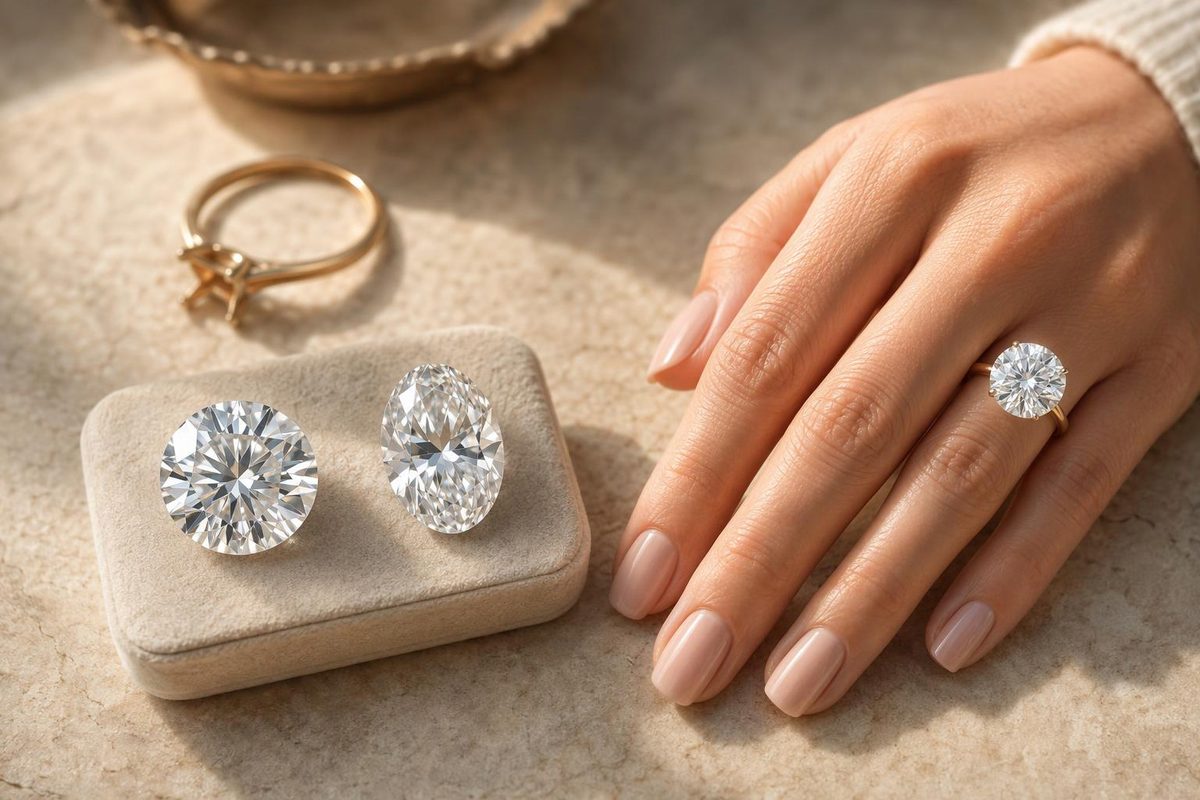
A 6-carat round diamond is roughly 11.75–12 mm across—just under half an inch. That is a useful shopping benchmark, not a fixed conversion: Whiteflash gives approximately 11.75–12 mm for a round brilliant cut to ideal proportions. The specific diamond’s measurements matter more than the chart.
Six carats describes weight, not diameter. Using GIA’s definition of one carat as 0.2 grams, a 6.00-carat diamond weighs 1.2 grams. Its shape and proportions determine how that weight translates into visible size.
Actual measurements near 6 carats
These seller-listed stones illustrate the difference between a round’s diameter and an oval’s length and width. They are individual examples, not average dimensions or buying recommendations. Listings were checked on November 5, 2026.
| Shape and origin | Weight | Face-up dimensions | Stone depth |
|---|---|---|---|
| Round, natural—With Clarity | 6.01 ct | 11.55–11.61 mm diameter | 7.30 mm |
| Oval, lab-grown—Hatch Brilliance, SKU OS006730 | 6.01 ct | 15.40 × 10.27 mm | 6.13 mm |
| Oval, lab-grown—Hatch Brilliance, SKU OS006661 | 6.01 ct | 14.83 × 10.09 mm | 6.41 mm |
The two ovals have identical weights, yet one is 0.57 mm longer and 0.18 mm wider. Neither measurement establishes which is more beautiful. It establishes that matching carat weights does not guarantee matching size.
The round example is slightly smaller across than the opening benchmark. That is why a chart should guide your expectations, not replace the actual measurements.
For elongated shapes, compare both axes. An oval around 15 mm long, set lengthwise along the finger, extends farther in that direction than a roughly 12 mm round, but it can also be narrower. “Longer” is not the same as “larger in every direction.” Our oval diamond size chart explains how to compare length-to-width ratios.
How much bigger does 6 carats look?
It does not look six times as wide as a 1-carat diamond. Lumera’s round benchmarks put a 1-carat round at about 6.5 mm across. Against an 11.75 mm round, that is approximately 81% more diameter and 3.3 times the face-up outline area, calculated as circles.
The step from 5 to 6 carats is much smaller visually. DiamDB’s illustrative comparison uses an 11 mm round at 5 carats and an 11.75 mm round at 6 carats. In that model, six carats adds 0.75 mm in diameter and about 14% in face-up area. Those figures describe the selected dimensions, not every pair of five- and six-carat stones.
Check the report, then the fit
On a GIA Diamond Grading Report, round measurements read minimum diameter–maximum diameter × depth. Fancy-shape measurements read length × width × depth. The final number is the diamond’s depth—not the finished ring’s height above your finger.
Before buying:
- Confirm the center-stone weight. Ask whether “6 carats” means one diamond or the ring’s combined diamond weight.
- Make a true-size outline. Draw an approximately 12 mm circle, or an outline of the candidate’s shape using its exact length and width. Place it on your finger rather than judging an enlarged product photo.
- Try a comparable mounting. Ask for the finished ring’s width and height, and check how it sits beside your wedding band.
- Inspect appearance separately from size. Request video in more than one lighting environment and compare brightness and dark areas as the diamond moves, not just millimeters.
A deeper cut can carry more weight below the visible outline and face up smaller, as Lumera explains. But chasing the widest stone is not a substitute for assessing cut: GIA notes that proportions also control how light returns to the eye. Choose the dimensions you enjoy wearing, then verify that the diamond looks good within them.