
10-Carat Diamond Size: How Big Is It in Millimeters?
A 10-carat round diamond is about 14 mm across. Compare smaller rounds, see an actual oval’s dimensions and check how the size will fit your hand.
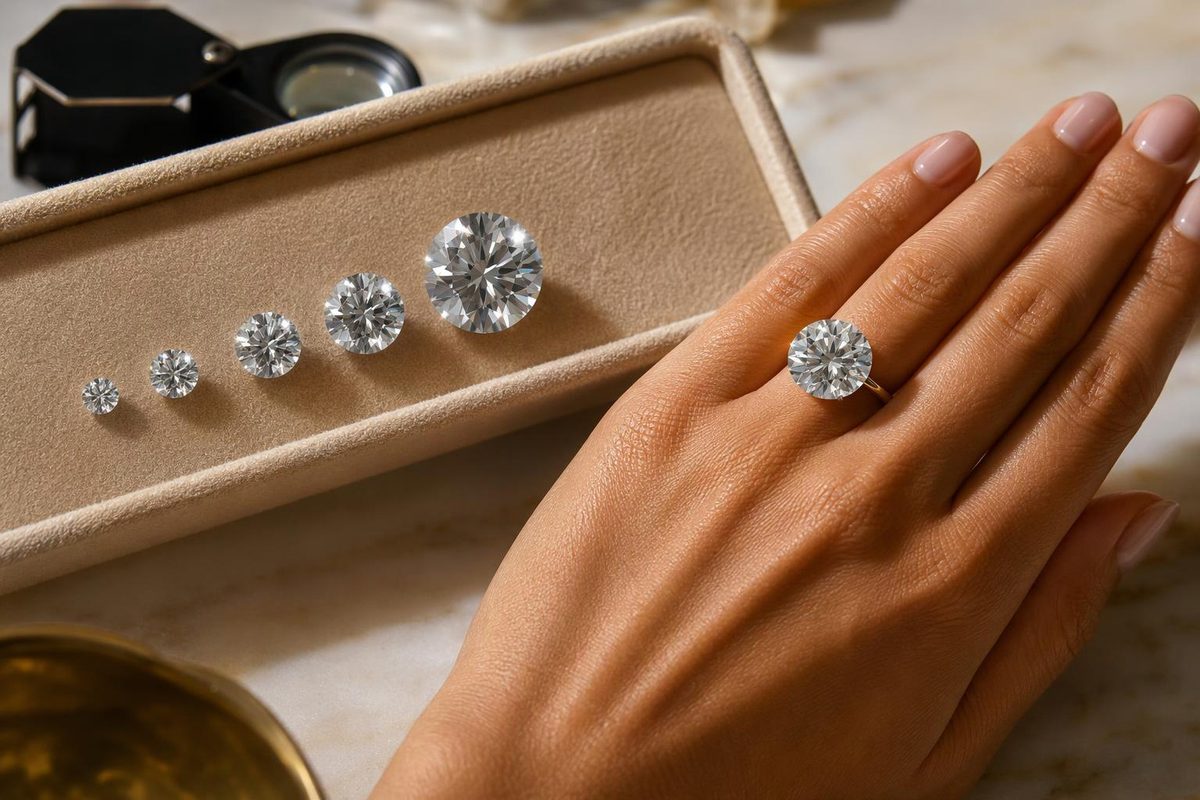
A 10-carat round diamond is approximately 14 mm across—1.4 cm, or about 0.55 inches. That is a face-up size benchmark, not an exact measurement for every stone. Gemsize’s round-diamond chart places 10 carats at 14 × 14 mm.
The diamond weighs 2 grams: GIA defines one metric carat as 200 milligrams. Carat measures weight, not diameter, so a 10-carat oval, cushion or emerald cut will not necessarily have the same outline as a 10-carat round. Source: GIA
How much bigger is 10 carats than 1, 2 or 5?
These approximate round-diamond diameters provide a useful comparison:
| Round diamond weight | Approximate diameter |
|---|---|
| 1 carat | 6.5 mm |
| 2 carats | 8.2 mm |
| 5 carats | 11.1 mm |
| 10 carats | 14.0 mm |
Benchmarks are rounded from Gemsize’s conversion chart; individual diamonds vary with their proportions.
Using those diameters, a 10-carat round is:
- About 2.15 times as wide as a 1-carat round, with roughly 4.6 times its face-up area.
- About 71% wider than a 2-carat round.
- About 26% wider than a 5-carat round, with roughly 59% more face-up area.
These are geometric comparisons, calculated by treating the outlines as circles—not measurements of perceived sparkle or beauty. Ten times the weight does not mean ten times the width. Even doubling from 5 to 10 carats adds only about 2.9 mm to the diameter in this comparison.
For a closer look at the smaller reference stone, see our 2-carat diamond size guide.
A 10-carat oval can be longer but narrower
An actual listing shows why shape matters. Adiamor lists a 10.00-carat lab-grown oval measuring 18.16 × 11.73 × 6.87 mm, with an IGI report number of 754564172. The listing was marked unavailable when checked on November 3, 2026; its dimensions remain a specific size example, not a shopping recommendation. Source: Adiamor
For that oval:
- 18.16 mm is the length along its long axis.
- 11.73 mm is the width across its short axis.
- 6.87 mm is the depth, not another face-up measurement.
Compared with the 14 mm round benchmark, this oval extends farther along the finger when set lengthwise, but is narrower across it. “Larger-looking” therefore needs a definition: longer outline, greater width and greater face-up area are different comparisons.
Do not use this one stone as a universal 10-carat oval specification. Our oval diamond size guide explains how length-to-width ratio changes the outline.
Check the actual size before choosing a ring
Start with the report’s measurements, not just “10 ct” in the product title. GIA records round diamonds as minimum diameter–maximum diameter × depth; fancy shapes use length × width × depth. Source: GIA’s report guide
Then make the size tangible:
- Cut out a 14 mm paper circle for a round benchmark, or sketch an approximate outline using the actual stone’s listed length and width. Place it where the ring will sit. This previews coverage, not sparkle or comfort.
- Ask to try a similarly sized mounted stone. Check the ring from above and from the side, and ask for the finished setting’s width and height. A loose diamond’s depth is not the ring’s total height.
- Confirm the center-stone weight separately. Ask whether “10 carats” refers to one diamond or the combined weight of the ring’s diamonds.
Finally, do not chase millimeters at the expense of cut. In its guide to round brilliant proportions, GIA explains that a thick girdle can add weight while making a diamond appear smaller, and that overly shallow or deep pavilion proportions can let light escape. A wider outline alone is not evidence of a better diamond. Source: GIA’s diamond anatomy guide