
Antique Bezel Set Engagement Rings: How to Buy
Verify age claims, gemstone identity, condition, alterations, fit, price and purchase terms before choosing an antique or antique-inspired ring.
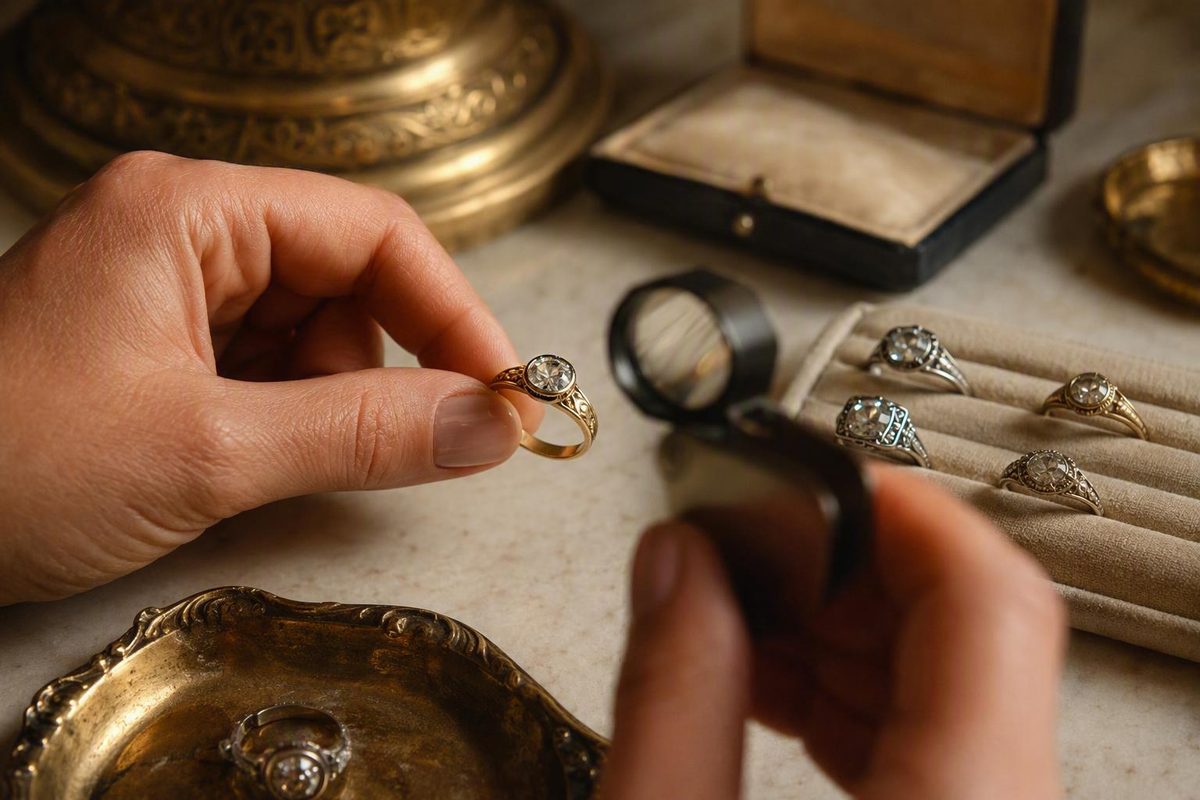
Buy an antique bezel-set engagement ring on evidence, not styling. GIA defines antique jewelry as more than 100 years old, vintage jewelry as noncontemporary but not yet antique, and estate jewelry as any preowned jewelry. Establish the ages of the mounting and stones, inspect condition and alterations, and only then judge design, fit, and price. GIA explains these definitions and the precautions for buying antique and vintage rings.
Start here: decide which kind of ring you actually want
“Antique” is an age claim. “Estate” describes ownership history. “Antique-inspired” describes an aesthetic. Retail collections may place genuine antiques, older preowned rings, reproductions, and new rings with old-looking stones beside one another, so the category label alone is not enough.
| Category and what it establishes | What it does not establish | Evidence to request | Why choose it |
|---|---|---|---|
| Genuine antique: The complete ring was made more than 100 years ago. That status should be supported, not merely asserted. | That every stone and component is original, the period attribution is correct, or the ring is structurally sound. | A specific date or period attribution, marks, provenance where available, repair history, condition report, and independent specialist assessment. | Period construction, historical character, collectibility, or the appeal of an old object. |
| Vintage: The ring is noncontemporary but not old enough to qualify as antique. | A universal age cutoff, a particular era, or original stones and metalwork. | Approximate production date, marks, invoices or ownership records, alteration history, and condition report. | Older design or workmanship without requiring a century-old ring. |
| Estate: The ring is preowned. | Any particular age; an estate ring may be antique, vintage, or contemporary. | Original records if available, current gemstone documentation, condition report, and service history. | Access to discontinued or unusual preowned designs. |
| Modern reproduction or antique-inspired: The ring was newly made to reproduce or reinterpret historical styling. | Antique age, period workmanship, or historical provenance. | Manufacturing date, maker, metal specifications, stone identity, customization details, warranty, and return terms. | Predictable condition, current sizing, broader stone choices, or customization. |
| Modern ring with an antique-style cut: The center has a cut described as Old Mine, Old European, rose, portrait, or “antique.” | That the stone is old, or that the mounting or assembled ring is antique. | Whether the stone is natural or lab-grown, cutting date if known, grading documentation where appropriate, and the mounting’s manufacturing date. | The appearance of an old-style cut with a new setting and contemporary purchase terms. |
Treat the center stone, mounting, and assembled ring as three potentially different objects. An old diamond may have been reset into a new bezel. A replacement stone may occupy an old mounting.
Terms such as antique-inspired, vintage design, Old Mine cut, Old European cut, rose cut, and antique cut therefore do not prove that the complete ring is antique. Ask the seller to state in writing what is being dated: the center stone, the mounting, or the ring in its current assembled form.
What a bezel setting is—and what a listing may leave unclear
A bezel is a precious-metal border that surrounds and secures a gemstone, much like a frame. Retail use is less precise: a “bezel ring” collection may include rings with bezel-set centers as well as designs using bezels only around side stones or halo elements. Jewelers of America defines the basic bezel construction.
Do not rely on the face-up hero image. Request:
- A straight-on face-up photograph
- A side profile showing the ring’s total height
- An underside view of the gallery and stone
- Magnified views of the metal rim
- A short video tilting the ring through diffuse and directional light
Ask whether the rim fully surrounds the center stone, whether openings interrupt it, how far the bezel projects beyond the shank, and how high the ring sits above the finger. Confirm whether the advertised price includes the center stone; some pages display a setting or starting price that changes after a stone and metal are selected.
Descriptions such as full, half, partial, open, low-profile, or halo bezel identify construction or appearance. They are not proof of a historical period.
Metal coverage may reduce the visible stone area or affect brightness in some designs. Ritani’s retail guidance, for example, notes that a bezel-set diamond may look slightly smaller or show less sparkle than it would in certain prong settings. Ritani describes this qualified design tradeoff.
Use period details as clues, not authentication
Historical design language can help you form a hypothesis, but it cannot authenticate a ring.
| Period | Common visual clues |
|---|---|
| Victorian | Romantic motifs such as flowers, hearts, and serpents; yellow gold is frequently associated with the period. |
| Art Nouveau | Flowing lines, natural forms, enamel, unusual colored gems, and asymmetry. |
| Edwardian | Platinum, diamonds, garlands, bows, scrolls, milgrain, and delicate openwork. |
| Art Deco | Geometry, abstraction, strong symmetry, architectural patterns, and contrasting colors. |
These are broad patterns, not a dating formula. Periods overlap, regional practices differ, and later makers have repeatedly revived earlier styles.
An Old Mine cut generally has a cushion-like or squarish outline, small table, high crown, relatively large culet, and noticeably variable proportions. An Old European cut is generally round, with a high crown, small table, and greater depth than a modern round brilliant.
Those characteristics may support a period hypothesis but do not settle it. A stone may be genuinely old, newly cut in an old style, lab-grown with antique-style facets, or transferred from an earlier ring into a later mounting.
The same caution applies to milgrain, filigree, hand engraving, floral ornament, geometric patterns, and platinum. Hera, for example, presents newly made, made-to-order designs using antique fluting, hand-carved milgrain, floral or Art Deco engraving, and old-style lab-grown cuts. Hera’s collection shows how modern rings can combine multiple period cues.
Instead of asking only, “Does this look Edwardian?” ask, “What evidence supports the Edwardian attribution, and which parts are believed to be original?”
Audit the ring before you judge the price
The following list is a set of questions for a qualified antique-jewelry specialist, not a consumer authentication method or a guarantee that hidden problems have been ruled out.
Printable specialist-inspection checklist
- [ ] Is the bezel rim continuous and securely seated?
- [ ] Are any areas of the rim lifted, split, excessively worn, or rebuilt?
- [ ] Is the center stone secure?
- [ ] Can the visible portion of the girdle be checked for chips or abrasion?
- [ ] Is the shank adequately thick, particularly at its narrowest point?
- [ ] Are there sizing seams, solder lines, patches, or color differences?
- [ ] Is the milgrain crisp, worn, missing, or restored?
- [ ] Is engraving intact or interrupted by resizing or repair?
- [ ] Are the gallery and underside distorted, cracked, or reinforced?
- [ ] Are accent stones secure and consistent with the originality claim?
- [ ] Has the bezel, shank, or another major component been replaced?
- [ ] Are exact dimensions and the current ring size documented?
- [ ] Are magnified face-up, profile, and underside images available?
- [ ] Does the written condition report distinguish old repairs from active concerns?
Ask whether the center and accent stones are original to the mounting. Require disclosure of replacement stones, later additions, synthetic gemstones, lab-grown diamonds, and simulants.
Do not pry back the rim, scrape the metal, or attempt another destructive test. Ask a specialist or qualified appraiser to inspect everything that can be assessed safely and to document what remains hidden.
Gemstone assessment and ring authentication are separate jobs. The 4Cs—carat, color, clarity, and cut—help describe diamond quality, and equal-weight diamonds may differ in value because the other quality factors differ. The 4Cs do not establish the mounting’s age, maker, provenance, originality, or structural condition. Jewelers of America outlines what the 4Cs evaluate.
Compare an original antique with a modern antique-inspired ring
Neither category is automatically better. A documented period ring offers historical material and accumulated character. A modern design offers greater control over specifications and generally begins without decades of age-related wear. A seller-described period ring occupies a third category until its attribution is supported.
| Factor | Documented or assessed period ring | Seller-described period listing | Modern antique-inspired ring |
|---|---|---|---|
| Provenance | May have marks, records, or specialist support. | Attribution may rest mainly on the seller’s description. | Manufacturing history should be comparatively direct. |
| Customization | Usually limited without changing original material. | Depends on the ring and whether alterations are appropriate. | Metal, stone, engraving, and dimensions may be configurable. |
| Stone choices | May contain original, replacement, or reset stones. | Stone history may be uncertain until examined. | May offer natural or lab-grown diamonds, moissanite, sapphires, or other gems. |
| Condition risk | Wear, thinning, repairs, and hidden damage may exist. | Condition and attribution both require verification. | Less age-related wear, though workmanship still needs assessment. |
| Sizing | Major changes may be difficult or undesirable. | Do not assume the listed size is safely alterable. | Often ordered in the intended size. |
| Production time | Existing pieces may be available after inspection or sizing. | Depends on inspection and alteration needs. | Made-to-order work may take weeks. |
| Returns | Depends on the written terms and any alterations. | Verify before arranging inspection or sizing. | Custom or made-to-order configurations may be nonreturnable. |
| Wedding-band fit | Irregular galleries may require a contour band. | Must be checked on the specific ring. | Some designs are engineered for flush stacking. |
Current modern listings include natural diamonds, lab-grown diamonds, moissanite, sapphires, and other colored gemstones.
Retail prices are useful only as attributed snapshots:
- Hera lists selected made-to-order antique-inspired bezel designs with lab-grown stones at starting prices from $1,575 to $2,750. These are starting prices, not valuations or evidence of antique status. See Hera’s listed designs and prices.
- June Rings lists a made-to-order open-bezel portrait-cut design starting at $3,350, with lab-grown diamond and moissanite choices. The page says made-to-order rings are nonreturnable and gives conflicting 1.90-carat and 2.90-carat center-stone descriptions, which should be resolved before purchase. See the June Rings product details.
- Kobelli displays a low-set, engraved 14-karat white-gold “vintage design” at $4,499 in one configuration, with selectable natural diamond, lab-grown diamond, sapphire, or moissanite centers. The page supports modern vintage styling, not antique status, and variant pricing may differ.
Older listings require the same restraint. Vintage Diamond Ring displayed a seller-described circa-1930s platinum Art Deco ring at $5,500 and an Edwardian old mine-cut ring at $7,550. These were seller attributions and asking-price snapshots, not independent authentication or proof of fair market value. See the retailer’s bezel collection.
EraGem separately displayed bezel-titled rings at $5,200 and $15,500, but the available listing text did not establish that either was antique. Its catalog combines antique, vintage, estate, and contemporary pieces, illustrating why a product title or category is not authentication. See EraGem’s mixed-period catalog.
Do not compare these figures as equivalent goods. A quoted figure may be a starting price, a selected configuration, a setting-only price, or the price of a complete ring. Stone identity and quality, metal, condition, documentation, repairs, customization, and seller services can all affect the amount.
Check resizing and wedding-band fit before committing
A listed size is not a promise that the ring can be altered safely.
Before purchase, obtain a written assessment from the specialist who would perform the work. Ask it to state:
- The current verified size
- The feasible sizing range
- Whether metal would be added or removed
- Which engraving, milgrain, stones, or marks could be affected
- Whether previous repair seams complicate the work
- Whether resizing could change symmetry or stone security
Wedding-band fit is also a profile question rather than a face-up question.
Request side-profile photographs beside a straight wedding band, measurements at the widest and lowest points, and written confirmation of whether a straight band will sit flush. If it will not, ask whether a contour or negative-space band is required.
Seller filters can provide a starting point, but the claims remain model-specific. Hera filters its collection according to whether individual designs stack flush. June Rings says its portrait-cut design can pair with straight, contour, or negative-space bands. Neither statement applies automatically to another bezel ring.
The paperwork and purchase terms worth insisting on
Before paying, assemble a file that allows someone other than the seller to understand what the ring is, what has been done to it, and what you are entitled to receive.
Final pre-purchase checklist
- [ ] Precise age or period claim identifying whether it applies to the mounting, stones, or assembled ring
- [ ] Clear photographs of hallmarks, assay marks, maker marks, and inscriptions
- [ ] Provenance or ownership records where available
- [ ] Gemstone report for the center stone where appropriate
- [ ] Written identity of every significant gemstone
- [ ] Condition report and disclosure of restoration, resizing, replacement stones, and later additions
- [ ] Exact ring, shank, head, and stone dimensions
- [ ] Current verified size and written resizing assessment
- [ ] Confirmation that the center stone is included in the price
- [ ] Itemized final price for the selected configuration
- [ ] Production or alteration timeline
- [ ] Written return, exchange, warranty, and restocking terms
A diamond grading report describes the diamond within the report’s scope. It does not ordinarily authenticate the complete ring’s age, maker, provenance, originality, or structural condition.
Consider an independent appraisal addressing gemstone identity, condition, estimated historical period, and estimated value.
GIA recommends seeking a return period of at least seven days, but that is consumer guidance rather than a universal legal entitlement. Confirm the actual policy for the transaction in writing, especially before authorizing sizing or customization. GIA provides the seven-day recommendation in its antique-ring buying guide.
Resolve every discrepancy before sending payment. Conflicting carat weights, changing variant prices, ambiguous stone descriptions, setting-only prices, and return exclusions should be corrected or clarified on the invoice.
Finally, consider insurance needs and maintenance. Store the ring separately, remove it for rough work, and arrange periodic professional inspections. Diamond ranks highly for hardness but can still chip or abrade, and worn metalwork may compromise the setting.
The safest choice is not automatically the oldest ring or the heaviest bezel. It is the ring whose age claim, gemstone identity, condition, alterations, fit, price, and purchase terms withstand scrutiny. Treat old-world styling as an invitation to investigate, not as proof, and obtain independent inspection and written disclosures before choosing between a genuine antique and a modern antique-inspired design.