
Elongated Cushion Rings: Choosing the Setting and Fit
Compare elongated cushion ring settings by protection, height, comfort and wedding-band fit—and know what to confirm before custom work begins.
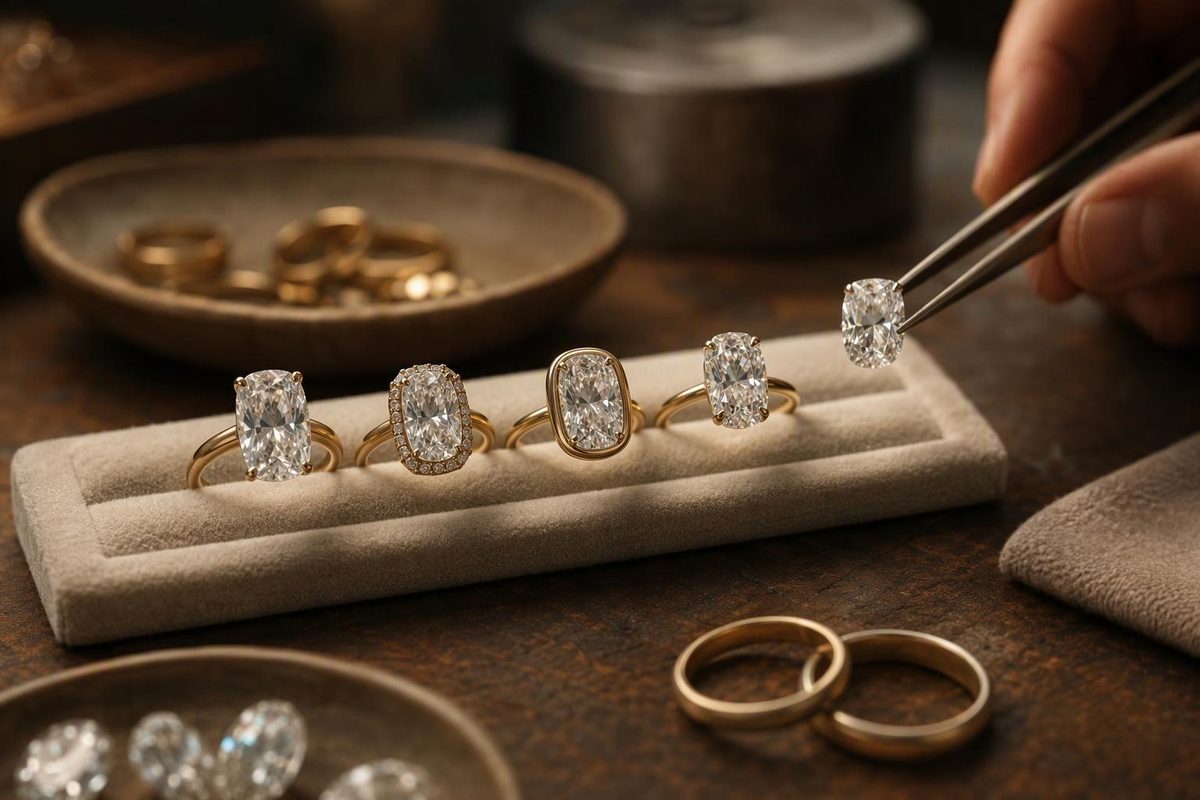
For elongated cushion rings, the mounting decision is more than solitaire versus halo. Choose the look from above, then check protection, height and wedding-band clearance from the side. A ring can frame the diamond beautifully yet feel awkward on the hand or leave an unwanted gap beside a straight band.
If you are still choosing the center stone, our elongated cushion diamond guide covers proportions, facet patterns and grading. Here, the task is choosing the finished ring.
Choose how the setting frames the cushion
Separate the ring’s overall design from the method holding the diamond. A solitaire can use prongs or a bezel; pavé describes small stones along the band, not how the center is secured. Brilliant Earth’s setting guide explains the main design elements summarized below.
| Design | Why choose it | What to inspect on an elongated cushion ring |
|---|---|---|
| Prong solitaire | Keeps attention on the center stone | Whether the prongs frame the rounded corners evenly without visually squaring off the outline |
| Bezel solitaire | Adds a metal rim around all or part of the stone | Whether the rim follows the cushion’s curves cleanly, and which edges remain exposed in a partial bezel |
| Halo | Adds a visible border of small stones | Whether you like the complete outer outline—not just the center diamond—and its size on your hand |
| Hidden halo | Adds small diamonds beneath the center, mainly visible from the side | Whether the detail is visible enough to justify its cost and leaves room for your wedding band |
| Three-stone | Frames the center with two side stones | Whether the side stones preserve the elongated center as the focal point and feel comfortable between adjacent fingers |
For edge protection, a well-made full bezel is worth shortlisting. GIA’s cushion guide specifically recommends considering a bezel when the girdle—the stone’s outer edge—is extremely thin between the corners and vulnerable to chipping. Ask the jeweler to assess those areas on your diamond. The visual trade-off is that more metal becomes part of the cushion’s outline. Compare finished rings rather than assuming you will like a bezel because you like the loose diamond.
Also compare orientation. Place the long axis along the finger for a vertical arrangement, or across it for an east–west design. Ask to see both on a hand; orientation changes the ring’s footprint, not the diamond’s proportions.
Check the mounting, not just the prong count
Ask the jeweler to confirm that the head—the structure holding the center—fits your diamond’s exact dimensions and outline, rather than relying only on a carat-weight range or a generic “cushion compatible” label.
Request close-up top and side views of the finished ring. Look for:
- Prongs that appear consistent and sit against the stone without visible gaps or lifted tips.
- A center stone that sits straight and is not visibly tilted in the mounting.
- A clean, even bezel rim if that is your chosen design.
- An explanation of how the head connects to the band and where it receives support.
These are screening checks, not a substitute for a jeweler’s security inspection. GIA’s platinum-prong workmanship benchmarks, illustrated with a round diamond, emphasize consistent prongs and show how impact can loosen a poorly set stone. They are useful inspection prompts, not cushion-specific specifications.
Rounded corners do not make the diamond impact-proof. GIA’s diamond-care guidance distinguishes scratch resistance from resistance to breaking or chipping. Remove the ring for activities likely to subject it to hard blows; stop wearing it and have it checked if the stone moves or a prong catches unexpectedly.
Decide height and wedding-band fit together
A lower setting generally reduces snagging and keeps the center closer to the finger. A higher setting can offer more clearance for a straight wedding band, but also more exposure to knocks and clothing. These are the practical trade-offs described in Brilliant Earth’s high-versus-low setting guide.
“Bezel” does not automatically mean low-profile. For example, EthicStone describes its Florence elongated cushion bezel ring as having a cathedral high setting. Ask for the actual finished height in millimeters, with the measurement endpoints explained.
If a straight, gap-free wedding band matters, make it a requirement before approving the engagement ring. Height alone does not guarantee clearance: check the intended pair together from above and from the side.
- Does the band clear the basket beneath the center stone, the prongs and any hidden halo?
- Do the rings sit together without one being pushed out of position?
- Could exposed diamonds rub against the other ring’s metal or stones?
That last question is functional, not merely cosmetic: GIA notes that diamond can scratch precious setting metals.
If the mounting blocks a straight band, consider a contoured or open band, accept a deliberate gap, or change the engagement-ring design. Low settings can require these alternatives; do not assume that raising the stone is the only solution.
Confirm comfort and the complete order
Try the ring with the intended wedding band, close your hand and check contact with neighboring fingers. Notice whether the center stays upright or rotates freely. Ask for both band width and thickness, and have the jeweler explain whether that construction suits the chosen head.
Get fitted for the actual design and stack. GIA’s sizing guidance says bridal sets wider than 4–5 mm together need special consideration; a narrow sizing sample alone may not represent the finished pair.
Before paying, obtain written confirmation of the center stone’s identity and report number, metal and alloy, finished dimensions, resizing limits, inspection service, and return terms after customization. Request an itemized quote for the center, mounting, accent stones and wedding band. For a custom ring, approve side-view clearance as carefully as the top-view design.