
Split Shank Engagement Rings: What to Check Before Buying
Compare split shank engagement rings by shoulder width, center-stone balance, construction, wedding-band fit, resizing options and the complete price.
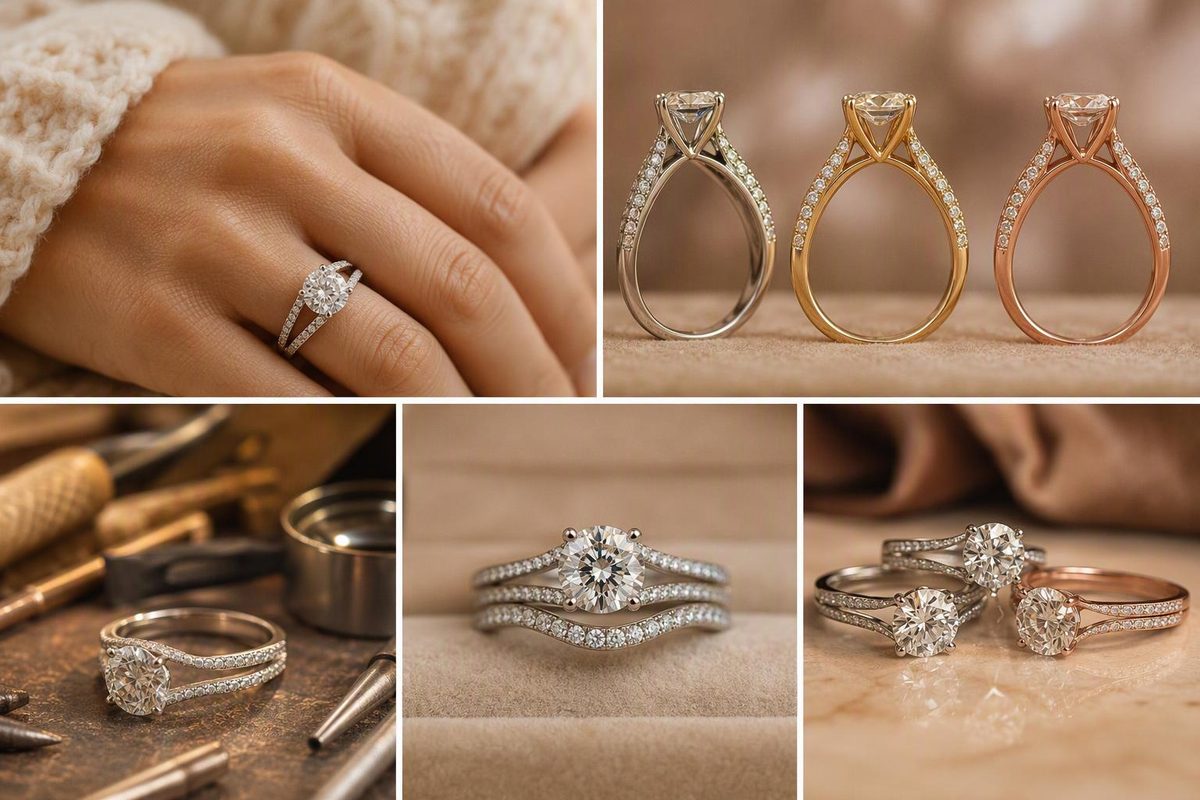
Split shank engagement rings have a band that divides into two or more arms as it approaches the center stone, leaving an opening between them. The split can be a subtle detail or a broad frame around the diamond. Angara’s style guide illustrates that range.
Choose this style if you like visible space and a more substantial ring outline—not because two arms automatically mean better security or a bigger-looking diamond. The useful comparison is between the finished rings: their proportions, construction, comfort and fit beside a wedding band.
Choose the split’s proportions first
The shank is the band around your finger; the shoulders are the areas where it transitions toward the center setting. The split describes this part of the ring, not how the diamond is held. Prongs or a bezel perform that separate job, as GIA’s setting guide explains.
Lauren B distinguishes tight, medium and wide splits: a tight opening can be subtle from above, while a wide opening makes the design more expansive on the hand.
| Design choice | What to compare |
|---|---|
| Narrow split | Can you see the opening when the ring is worn, or does the center setting hide it? |
| Wide split | Do you like the extra finger coverage, and can you close your fingers comfortably? |
| Plain-metal arms | Do the contours and finish look even on both sides? |
| Pavé diamond arms | Do the small diamonds look consistent, and are the edges comfortable? |
| Split shank with a halo | Does the center remain distinct, or do you prefer the combined diamond-covered outline? |
Ask for photographs or video with your intended center-stone dimensions. A mounting shown with a large display diamond may look quite different with your stone.
Separate the mounting’s footprint from diamond size. A broad split adds to the mounting’s footprint; it does not increase the diamond’s face-up dimensions. Compare the center’s outline against the shoulders at normal viewing distance. If judging size is your priority, use diamond dimensions in millimeters, not carat weight alone.
There is no universally best diamond shape for a split shank. Compare the actual combination rather than assuming an oval, cushion or round will always work better.
Inspect the arms and the center setting separately
A wide opening does not tell you how much metal is present in each arm. Before ordering, request:
- The width and thickness of each arm, including its narrowest section.
- The total shoulder span, measured across both arms and the opening.
- The width and thickness of the lower, unsplit band.
- The setting height and a clear side view of the head’s connections to the shoulders.
A single advertised “band width” cannot answer all four questions. Ask where it was measured rather than treating it as the width of the whole design.
Have the jeweler assess the construction for your intended wear. GIA notes that durability depends on workmanship as well as setting style; delicate prong and pavé designs benefit from periodic inspection. Pavé also introduces small stones and their retaining beads or prongs, which may need maintenance.
For a pear, marquise, heart or princess diamond, check point or corner protection independently of the split. GIA recommends protective settings for these vulnerable areas. Extra shoulder arms are not a substitute.
Test wedding-band fit before committing
Do not assume either that every split shank needs a curved band or that every raised center allows a straight band to sit flush.
Try the engagement ring with the band you actually intend to wear. Look from above and from the side, checking:
- Whether the band hits the basket, halo or shoulders.
- Whether you like any gap between the rings.
- Whether either ring’s exposed diamonds contact the other ring.
- Whether the combined width feels comfortable when you bend and close your fingers.
A contoured band is one option, not an obligation. Whiteflash’s wedding-band guide distinguishes straight bands that may leave a gap from contours shaped around a particular head or gallery. If ordering remotely, request a side-view pairing photograph rather than accepting “matching band available” as proof of fit.
Confirm resizing, upkeep and the complete price
Ask the seller to state the permitted resizing range for the exact design. Pavé-set bands can be harder to resize because adjustment may disturb the small stones, according to GIA. A plain section underneath is worth asking about, but it is not a guarantee that any size change is possible.
For upkeep, use warm water, mild soap and a soft brush where appropriate for the ring’s materials. Have loose stones or damaged settings assessed before cleaning; GIA warns that ultrasonic cleaning can dislodge already-loose stones.
Finally, get an itemized quote separating the center diamond, mounting, accent stones, setting labor and any applicable sizing, shipping and taxes. Confirm whether the accents are natural or lab-grown rather than assuming they match the center’s origin. Some split-shank listings are mountings for a separately selected center—for example, Blue Nile describes this design as accommodating the center stone of your choice.
Compare complete quotes with the same center stone and metal. Buy only once the seller has also confirmed wedding-band fit, resizing limits, return eligibility and what maintenance or lost-stone coverage actually includes.