
Ring Setting Types: A Practical Guide to Choosing One
Ring setting types are easier to compare once you separate several ideas that jewelry sellers often group under the word setting. The term may describe the…
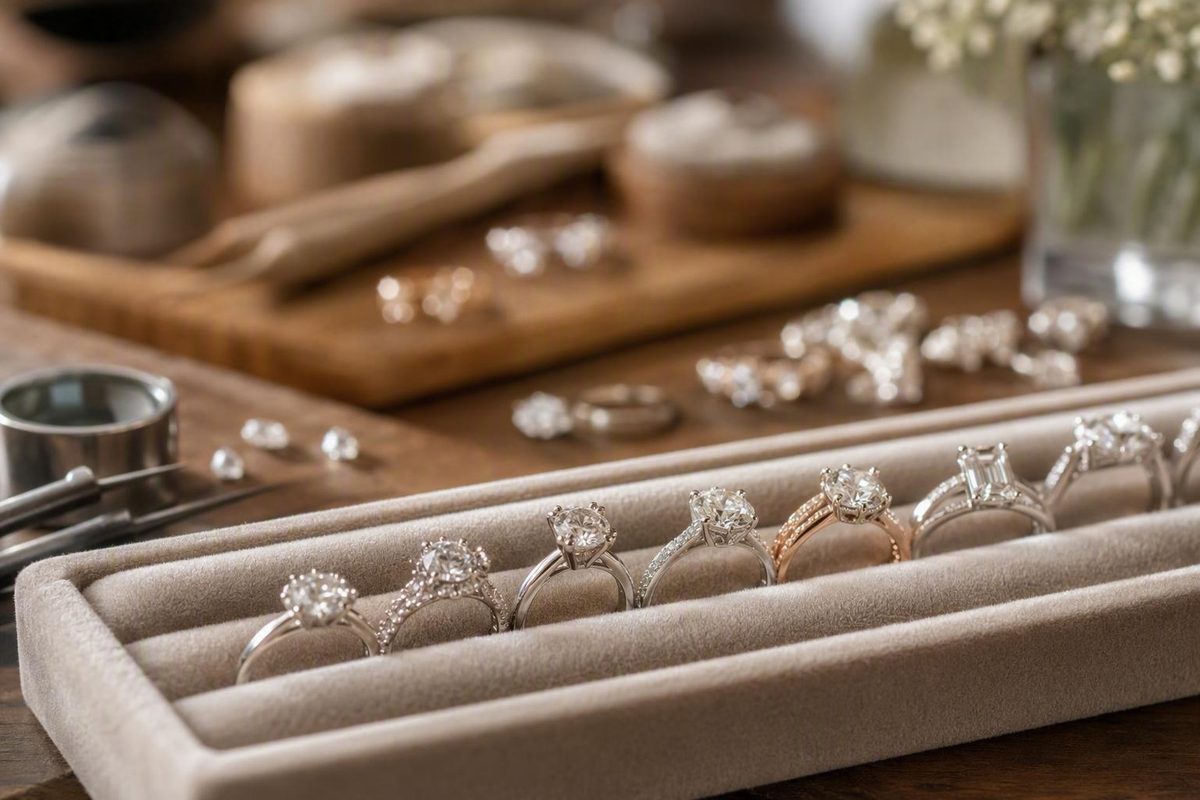
Ring setting types are easier to compare once you separate several ideas that jewelry sellers often group under the word setting. The term may describe the pieces of metal touching a gemstone, the arrangement of stones across a ring, the structure supporting the center stone, or the ring’s overall design.
Begin with one mechanical question: What physically keeps each stone in place? Then evaluate the ring’s profile, exposed edges, accent layout, cleaning access, snag potential, gemstone fit, and compatibility with a wedding band.
No setting name guarantees security, brilliance, or suitability for daily wear. Performance also depends on the gemstone, metal dimensions, setting height, stone fit, workmanship, condition, impacts, and how the ring is worn.
First, separate setting methods from ring styles
A ring setting is the structure or technique used to mount and secure a gemstone to a ring. In the narrow mechanical sense, names such as prong, bezel, channel, and tension explain how metal retains a stone. In shopping language, however, solitaires, halos, three-stone rings, and cathedral designs are also marketed as “settings.” Tiffany’s guide distinguishes the mounting method from the ring’s overall style, although the jewelry trade does not apply that distinction consistently (Tiffany’s explanation of ring settings and styles).
A useful taxonomy divides the vocabulary into six groups:
- Retention method: What touches or overlaps the gemstone to hold it?
- Stone arrangement: How many stones are present, and where are they placed?
- Shank or support structure: How does the band approach and support the setting?
- Profile: How high or low does the gemstone sit?
- Orientation: Which direction does the gemstone or prong pattern face?
- Decorative treatment: What surface details contribute to the appearance?
Taxonomy graphic: how ring-setting terms fit together
RING DESIGN
│
├── 1. RETENTION METHOD — how the stone is physically held
│      ├── Prong / claw
│      ├── Bezel
│      ├── Bead / pavé / castelle
│      ├── Channel
│      ├── Flush / gypsy / burnish
│      ├── Bar
│      └── Tension
│
├── 2. STONE ARRANGEMENT — number and placement of stones
│      ├── Solitaire
│      ├── Halo / hidden halo
│      ├── Three-stone
│      ├── Cluster
│      └── Side-stone
│
├── 3. SHANK OR SUPPORT STRUCTURE
│      ├── Cathedral shoulders
│      ├── Basket
│      ├── Trellis
│      ├── Split shank
│      ├── Bypass
│      └── Tulip form
│
├── 4. PROFILE
│      ├── Low
│      ├── Medium
│      └── High
│
├── 5. ORIENTATION
│      ├── Conventional
│      ├── Compass prongs
│      └── East–west stone orientation
│
└── 6. DECORATIVE TREATMENT
       ├── Milgrain
       ├── Engraving
       ├── Filigree
       └── Vintage-inspired detailing
This is a conceptual taxonomy, not a manufacturing diagram.
The categories are cumulative. One ring could be:
- a solitaire because it has one principal stone;
- prong-set because claws retain that stone;
- cathedral because raised shoulders approach the center;
- basket-built because horizontal supports connect the prongs;
- pavé-set along the shank;
- and finished with a hidden halo beneath the center.
Calling that design only a “cathedral setting” or “hidden-halo setting” leaves the essential mechanical question unanswered: how is the center stone held?
Prong, bezel, bead, channel, flush, bar, and tension primarily describe retention. Solitaire, halo, hidden halo, three-stone, and cluster primarily describe arrangements. Cathedral, basket, split-shank, bypass, trellis, and tulip identify supporting structures or design forms.
Ring setting types compared at a glance
The table describes broad tendencies rather than universal rankings. Two rings sold under the same name may perform differently because of stone shape, metal thickness, setting height, workmanship, damage, and wear.
| Retention method | How the metal retains the stone | Common application | Stone exposure | Perimeter coverage | Typical profile | Snag tendency | Cleaning complexity | What to inspect |
|---|---|---|---|---|---|---|---|---|
| Prong or claw | Separate metal tips grip the stone around or just above its girdle | Center stones; some side stones | High | Limited to contact points | Low, medium, or high | Often greater if the prongs or stone project | Open undersides can aid access, but debris collects around prongs | Bent, lifted, uneven, or worn prongs; movement |
| Bezel | A metal rim overlaps all or part of the perimeter | Center stones and individual accents | Moderate to low | Extensive in a full bezel; interrupted in a partial bezel | Often low to medium, but not inherently so | Usually lower when smooth and low | Top edges are accessible; the underside may be enclosed | Gaps, lifted rim sections, distortion, or movement |
| Tension | Engineered pressure from opposing parts of the ring grips the stone | Usually a center stone | High | Concentrated at opposing contacts | Design-dependent | Depends on the projecting stone and shoulders | Open areas may be accessible; contact zones create recesses | Movement or deformation; obtain specialist assessment |
| Pavé or bead | Raised beads or small prong-like elements retain closely spaced stones | Accent stones across a shank or surface | High face-up visibility | Minimal around each stone | Usually low at the accent surface | Smooth when well finished; damaged beads or exposed edges may catch | Many small recesses can collect residue | Missing stones, damaged beads, uneven rows, rough edges |
| Channel | Stones sit between two parallel metal walls | Accent rows; wedding or anniversary bands | Face-up surfaces visible; sides enclosed | Two sides covered | Usually low to medium | Generally low when walls are smooth and intact | Residue can collect beneath and between stones | Deformed walls, loose stones, uneven spacing |
| Flush or gypsy | A stone is recessed and surrounding metal is worked over its edge | Individual small accents in substantial metal | Low side exposure | Metal covers much of the edge | Usually low | Generally low | Face is accessible; recessed edges can collect residue | Movement, damaged edges, or displaced metal |
| Bar | Stones are secured between metal bars, commonly with open sides | Rows of accent stones | More side exposure than a channel | Coverage at opposing bar contacts | Usually low to medium | Depends on bar height and exposed edges | Open sides aid access but add crevices | Bent bars, movement, worn contact areas |
The broad trade-off is that open constructions generally reveal more of a gemstone, while enclosing or recessed constructions cover more of its edge and tend to present a smoother profile. More exposure does not guarantee greater brilliance: cut quality and the complete mounting also influence optical performance (overview of open, enclosed, and low-profile setting types).
Quick pathways
- Prioritize center-stone visibility: Begin with prongs, partial bezels, or a professionally assessed tension design.
- Prioritize perimeter coverage: Examine full bezels and other constructions that cover exposed edges or points.
- Prefer a smooth band surface: Compare flush-set and channel-set accents.
- Want extensive accent coverage: Compare pavé, castelle, channel, halo, and cluster designs, then identify how each small stone is retained.
- Prefer a low profile: Ask for the actual height and side view. Do not assume a bezel, basket, or channel is low from its name.
- Want a straight wedding band to sit flush: Check the gallery and shank with the intended band.
Center-stone methods: prong, bezel, and tension
Prong, bezel, and tension constructions differ in where metal contacts the stone, how much of the perimeter remains exposed, and how the mounting works as a complete structure.
Prong or claw settings
Prongs are narrow metal elements that rise from the mounting and bend over a gemstone near its girdle. “Claw” and “prong” commonly refer to the same general method. Because contact is concentrated at several points, much of the gemstone remains visible.
Four-prong designs generally obstruct less of the outline than six-prong designs. Six prongs add two contact points, but prong count alone cannot establish security. Stone fit, prong dimensions, metal condition, symmetry, impacts, and wear remain consequential (comparison of four- and six-prong settings).
Several terms refine rather than replace the prong method:
- Rounded prong: Has a rounded or bead-like visible tip.
- Pointed or talon prong: Tapers to a sharper visual point.
- V-tip prong: Wraps around a pointed end or corner in a V-shaped form.
- Compass prongs: Places four prongs at north, south, east, and west instead of on the diagonals.
- Basket: Connects vertical prongs with horizontal rails beneath the stone.
- Trellis: Uses crossing or interwoven supports.
- Tulip: Shapes the supports or prongs like overlapping petals.
Compass describes orientation. Rounded, talon, and V-tip describe prong shape. Basket, trellis, and tulip primarily describe the supporting structure or form.
A basket’s horizontal rails join the vertical prongs and can allow a lower profile than a tall, open mounting. Actual height still depends on basket depth, stone proportions, and gallery design.
SIMPLIFIED PRONG CROSS-SECTION

                 crown
/────────\
___/ \___
/ \
/____________________ ← girdle
             ↑            ↑
          prong          prong
/
pavilion /
/
▼ / ← culet needs clearance
\____/
                    |
                  gallery
Conceptual diagram: prongs overlap the stone near its girdle rather than covering the entire perimeter.
Full and partial bezel settings
A bezel places the gemstone into a seat and uses a metal rim that overlaps its edge. A full bezel continues around most or all of the perimeter. A partial bezel leaves intentional openings, often on opposing sides.
A full bezel generally supplies more continuous edge coverage than a partial bezel or open prong setting. In exchange, more metal is visible around the stone. A partial bezel preserves more side exposure but leaves its openings uncovered.
SIMPLIFIED BEZEL CROSS-SECTION

             metal rim
            ↘        ↙
          __|────────|__
/ \
/________________ ← edge beneath overlapping rim
/
/
\____/
             prepared seat
Conceptual diagram: the rim overlaps the perimeter instead of contacting it only at separated points.
| Question | Prong tendency | Bezel tendency |
|---|---|---|
| How much of the outline remains visible? | Usually more | Usually less in a full bezel |
| How much edge coverage is provided? | Localized at prong contacts | More continuous |
| Can the design be low profile? | Yes, especially with a basket, but not always | Often, although tall bezels also exist |
| What may catch? | Projecting prongs and a high stone | Usually fewer projecting edges if smoothly finished |
| How accessible is the underside? | Often relatively open | May be more enclosed |
| How visually prominent is the metal? | Concentrated at contact points | Forms a visible frame |
Neither method is automatically best. A substantial, well-fitted prong construction can perform better than a thin, damaged, or poorly fitted bezel.
Tension settings
A tension setting uses engineered pressure from the ring structure to hold the gemstone between opposing contact areas. Its open appearance can make the stone seem suspended between the sides of the ring. It is a specialist construction, not simply a conventional setting with its prongs removed (operating principle of tension settings).
SIMPLIFIED TENSION CROSS-SECTION

        ring side →  )  ◇  (  ← ring side
                       ↑ ↑
                 opposing pressure
                  at contact areas
Conceptual diagram: the surrounding structure supplies the holding force; actual geometry requires specialist design.
Because the whole ring participates in retention, ask the maker how that particular design is assessed and serviced, and whether the intended gemstone suits its contact geometry. Broad promises about resizing, repair, or long-term performance should not be inferred from the name alone.
Accent-stone techniques: pavé, bead, castelle, channel, flush, and bar
Small accent stones can be retained in several mechanically distinct ways. Pavé and channel are often confused because both can create a continuous line of stones along a band.
Bead and pavé setting
In bead setting, a setter raises or forms small pieces of surrounding metal and works them over individual gemstones. The beads act like miniature retaining prongs.
Pavé is a closely spaced application of bead setting in which many small stones cover a surface or section of a band. Construction varies: stones may share beads, use dedicated beads, or be combined with bright-cut borders.
SIMPLIFIED BEAD / PAVÉ TOP VIEW

       • ◇ • ◇ • ◇ •
       • ◇ • ◇ • ◇ •
       ↑   ↑   ↑
     raised metal beads

◇ = gemstone
• = bead or small retaining element
Pavé provides broad face-up accent coverage but introduces many stones, contact points, and recesses. Its suitability for regular wear depends on construction, finish, exposure, and the wearer’s routine—not on the pavé label alone.
Castelle setting
Castelle resembles pavé but omits the continuous outside metal border. Stones sit at the edge of the surface, producing a scalloped profile. McCaul distinguishes castelle from bordered pavé by this absence of outside metal edges (illustrated explanation of castelle, pavé, gypsy, and channel setting).
SIMPLIFIED EDGE VIEWS

Bordered pavé:        Castelle:
 ┌─◇─◇─◇─┐            ◇)◇)◇)
 │       │             scalloped edge
 └───────┘             no continuous outer border
The exposed scalloped edge changes both appearance and the surface presented to clothing or an adjacent ring. Check whether the edge feels smooth and whether stones or beads project beyond the intended outline.
Channel setting
A channel holds a row of stones between two parallel metal walls, without individual prongs separating them. The stones sit in prepared seats while the walls retain the outer edges of the row.
SIMPLIFIED CHANNEL CROSS-SECTION

        channel wall       channel wall
             ↓                  ↓
┌── ◇ ◇ ◇ /──┐
│ \__________/ │
           └──────────────────┘
                 ring body
The terms full channel, half channel, and quarter channel describe approximately how far the stone-set section extends around the band—not different retention principles.
Channel-set stones may appear to meet, but they should be fitted so their edges do not continually rub against one another, since continued rubbing can damage them. Even spacing and accurate seat preparation therefore matter (channel-setting fit guidance).
Smooth outer walls can reduce projecting edges, but they do not guarantee retention. A thin, worn, or deformed wall can compromise the row.
Flush, gypsy, and burnish setting
In a flush or gypsy construction, an individual stone is recessed into a prepared seat. Surrounding metal is worked over part of the stone’s edge, leaving its face at or near the surface.
SIMPLIFIED FLUSH / GYPSY CROSS-SECTION

ring surface ─────\____/─────
\◇/
                         V
                    recessed seat
The terms flush, gypsy, and burnish overlap across jewelry sources. The shared shopping concept is a recessed gemstone retained by surrounding metal rather than elevated on separate prongs.
This technique is commonly used for individual small accents in a band with enough depth to contain the stone and its seat. The actual gemstone and setting process still require professional evaluation.
Bar setting
A bar setting places stones between metal bars, often in a repeating sequence. Unlike a channel’s continuous side walls, the bar construction leaves more of each stone’s sides exposed.
SIMPLIFIED BAR TOP VIEW

       | ◇ | ◇ | ◇ |
       ↑   ↑   ↑   ↑
          metal bars
The additional side exposure can create a more open appearance. Inspect the exposed edges and confirm that each bar is substantial, correctly positioned, and smoothly finished.
Practical accent-setting comparison
- Choose bordered pavé for closely spaced stones framed by defined metal edges.
- Investigate castelle for a scalloped, stone-set edge without a continuous outside border.
- Consider channel for a smooth row without individual prongs between stones.
- Consider flush setting for isolated accents recessed into a broad metal surface.
- Consider bar setting for a repeated row with more side exposure than a channel.
Every method depends on intact retaining metal. A damaged bead, displaced channel wall, worn flush-set edge, or bent bar can affect an accent stone’s retention.
Layouts and structures that can be combined with those settings
Arrangement and support terms explain what a ring looks like, but they do not necessarily reveal how its gemstones are held.
A solitaire has one principal gemstone. It may use four prongs, six prongs, a full bezel, a partial bezel, or another compatible retention method. Solitaire answers how many focal stones?, not necessarily what retains the stone?
A halo places small accent stones around the center stone. A hidden halo positions the accent row beneath the center, where it is more visible from side angles than directly above. Halos can increase apparent spread and visual impact, but they do not change the center stone’s carat weight.
A three-stone ring has a central gemstone flanked by two others. The side stones may match the center or differ in size, shape, or color. The idea that the three stones represent the past, present, and future is a customary interpretation, not a mechanical characteristic.
A cluster groups several stones closely. Some clusters clearly appear to be collections of separate gemstones; others suggest the outline or visual mass of one larger stone. That visual effect does not increase the weight of any individual stone.
Structural terms add another layer:
- Cathedral shoulders: Raised arches rise from the shank toward the center setting.
- Basket: Horizontal supports connect vertical prongs beneath the center stone.
- Split shank: The band divides into two or more visible branches near the center.
- Bypass: Opposing sides curve past or around the center instead of meeting symmetrically.
- Trellis: Supports cross or interweave, sometimes beneath several stones.
- Tulip: The supports resemble overlapping petals.
- Compass: Four prongs occupy north, south, east, and west positions.
These forms can change profile, side appearance, cleaning access, and stacking clearance without creating a new fundamental retention method (illustrated guide to compass, basket, bypass, trellis, split-shank, cathedral, and tulip variations).
             ◇ ◇ ◇                ← hidden halo beneath center
/ ◆ ← one center stone: solitaire
/ ↗ ↖ ← four compass-oriented prongs
         |-----------|            ← basket rail
/ / \
/◇◇ / ◇◇ ← pavé-set split shank
/ \_____/ \
           cathedral
            arches
This could be described as a compass-prong solitaire with a basket, hidden halo, cathedral shoulders, and pavé split shank. Each label describes a different aspect of the same ring.
Match the construction to the gemstone, not just the look
A setting must fit a gemstone in three dimensions. Outline alone is insufficient. Relevant factors include width, length, depth, girdle proportions, pavilion, culet, durability, and position within the ring. The mounting must also provide enough depth to keep the culet or pavilion from protruding dangerously or contacting the wearer.
It is useful to distinguish three properties:
A gemstone that resists scratching is not necessarily immune to chips or breakage. Ask a qualified jeweler or gemologist how the actual material, cut, and condition affect the proposed setting.
Shape can create vulnerable areas. Pear, marquise, and heart shapes have pointed ends; princess and other angular cuts have corners. V-tip prongs, bezels, corner-covering prongs, or other fitted structures may help cover those areas, but the appropriate solution depends on the individual stone. Pointed shapes are commonly identified as candidates for tip protection rather than for one universally required setting (guidance on setting profile and protection for pointed shapes).
The same setting category can behave differently with different proportions:
- A deep stone may require greater gallery depth or setting height.
- A shallow stone may not fit a mounting intended for a deeper pavilion.
- A thin or irregular girdle requires the setter to evaluate the proposed contact areas.
- A large culet or deep pavilion may need additional clearance.
- An asymmetrical or individually cut stone may need a seat fitted to its actual contour.
This matters when the mounting and gemstone are purchased separately. A setting advertised for an oval, cushion, or marquise is not necessarily suitable for every stone with that outline. Millimeter dimensions, depth, girdle position, and contour also matter.
Open prongs may reveal more of the side and perimeter, while a full bezel covers more edge. That comparison does not establish which finished ring will appear more brilliant. Cut quality and the complete mounting remain important.
Questions to ask about stone-to-setting fit
- Where does the metal contact the girdle?
- Are the contact points even and suitable for this stone?
- How are pointed ends or corners covered?
- Is any vulnerable girdle area exposed?
- Does the pavilion clear the gallery and the wearer’s finger?
- Is there enough depth for the culet without making the ring unnecessarily tall?
- Was the mounting made or adjusted for the stone’s actual dimensions?
- Does the stone sit level from the front and side?
- Is the proposed retention method appropriate for the gemstone’s durability?
- Will an adjacent wedding band contact the stone, prongs, or gallery?
The goal is not to assign every shape one approved setting. It is to identify vulnerable areas and confirm that the complete construction accommodates them.
Choose by daily wear, profile, and wedding-band fit
“Active lifestyle” is too broad to determine a setting. Translate routine into specific contact conditions:
- Do you work with tools, equipment, boxes, or machinery?
- Do you frequently put on fitted gloves?
- Does the ring contact pockets, knitwear, towels, or bedding?
- Are your hands exposed to repeated knocks?
- How often will you wear the ring?
- Do you remove jewelry for exercise or manual work?
- Are you willing to clean intricate surfaces and monitor accent stones?
- Do projecting edges cause discomfort?
- Must the ring stack flush with another band?
Lower-profile, smooth-edged constructions—such as many bezels, flush settings, and channels—generally tend to snag less than tall designs with exposed prongs or projecting stones. Exact construction still controls the result: a rough bezel can catch, while a well-finished low basket may be unobtrusive (profile and snagging considerations for ring settings).
It can also place the stone and retaining elements farther from the finger, increasing their exposure to fabric contact and impacts.
Prong and pavé rings contain exposed retaining elements and, in pavé, numerous small stones. This does not make them unsuitable for daily wear, but it makes changes such as a lifted prong, rough spot, rattling center, or missing accent stone especially important to notice.
Wedding-band compatibility should be treated as a design requirement before purchase. Check:
- Gallery clearance: Can a band pass beneath the center setting?
- Shank shape: Does the ring remain straight, or does it flare, divide, or curve?
- Projecting features: Does a halo, basket, bezel, or prong extend beyond the shank?
- Contact points: Will the rings rub against gemstones or delicate setting elements?
- Desired appearance: Is a deliberate gap acceptable?
Split-shank, bypass, low-basket, and projecting-halo designs may prevent a straight band from sitting flush. Depending on the geometry, the pairing may require a gap, contoured band, or differently shaped companion ring.
Non-ranked decision tree
START
  │
  ├── Frequent hands-on wear, glove contact, or low snag tolerance?
  │      ├── Yes → Examine low bezels, flush settings, smooth channels,
  │      │         and other low-profile designs.
  │      │         Then inspect the actual edges and height.
  │      └── No  → Open or higher designs remain options.
  │
  ├── Is center-stone visibility a priority?
  │      ├── Yes → Compare prongs, partial bezels, and specialist
  │      │         open constructions.
  │      └── No  → Full bezels and more enclosing designs remain options.
  │
  ├── Do you want extensive accent coverage?
  │      ├── Yes → Compare pavé, castelle, channel, halo, and cluster.
  │      └── No  → Consider plain shanks or isolated flush-set accents.
  │
  ├── Must a straight wedding band sit flush?
  │      ├── Yes → Test gallery clearance and side profile with the band.
  │      └── No  → A gap or contoured band may be acceptable.
  │
  └── How much detailed cleaning and observation will you accept?
         ├── Less → Favor simpler surfaces and fewer small components.
         └── More → Intricate pavé, trellis, halos, and clusters remain viable.
No named category is universally secure or suitable for every active wearer. Choose by the actual construction rather than a lifestyle label attached to it.
Evaluate workmanship and plan for ownership
Setting quality cannot be judged from the category name. Workmanship, stone fit, metal dimensions and condition, setting height, prior damage, and wear all affect performance.
Examine a prospective ring from the top, side, and underside, using magnification if available.
Pre-purchase inspection checklist
- Prongs: Are they evenly placed, correctly seated, and in contact with the stone? Do any look lifted, thin, or asymmetrical?
- Bezel rim: Is the intended overlap closely fitted? Are there visible gaps or lifted sections?
- Center-stone alignment: Does the gemstone sit level relative to the shank?
- Accent stones: Are rows even? Do any stones appear tilted or unusually spaced?
- Channel walls: Are they straight, smooth, and substantial for the design?
- Channel fit: Are stones evenly seated without continual edge-to-edge rubbing?
- Flush-set stones: Is the surrounding metal smooth and evenly worked?
- Bars and beads: Are they complete and free of sharp projections?
- Clearance: Does the pavilion or culet clear the gallery, ring body, and finger?
- Wear surface: Are edges that contact skin or clothing smooth?
- Movement: Does any stone rattle or visibly shift when the ring is gently handled?
- Stacking: Does the intended band fit without pressing against stones or delicate components?
Confirm cleaning instructions for every gemstone and material in the finished ring rather than assuming that one method is universally suitable.
Seek professional inspection if a stone rattles or shifts; a prong becomes bent, lifted, or visibly worn; a bezel rim lifts or breaks; a channel wall deforms; an accent stone disappears or tilts; or the shank or setting changes shape. These conditions can indicate that retaining metal or stone fit has changed (ring-setting maintenance and inspection considerations).
Inspection frequency should reflect actual exposure rather than a single calendar rule. Daily hands-on wear, known impacts, prior repairs, construction complexity, and observed changes are more useful considerations than the setting name alone.
Ask the seller or bench jeweler:
- Can this particular ring be resized, and within what limits?
- How could resizing affect its accent stones or channel?
- Can the underside be accessed for cleaning and repair?
- How are lost accent stones matched and replaced?
- Who is qualified to service this tension design?
- Are there manufacturer-specific servicing requirements?
- What damage or wear is excluded from the warranty?
- Does the warranty require particular inspections or maintenance?
- Will the intended wedding band sit flush?
- Could the two rings abrade one another?
- What should prompt immediate removal of the ring?
Final buying checklist
Before committing, record:
- the center stone’s actual retention method;
- the number and position of its contact points;
- the ring’s measured or observed profile;
- how points, corners, girdle areas, and the culet are accommodated;
- the method used to retain accent stones;
- whether exposed edges feel smooth;
- whether the mounting fits the stone’s actual dimensions;
- whether the intended wedding band fits without harmful contact;
- approved cleaning instructions for every gemstone and material;
- resizing, repair, warranty, and specialist-service limitations.
The most useful setting name is the one that explains how the stone is actually held. Identify that method first, then examine profile, edge coverage, exposed points, workmanship, accent construction, cleaning access, and wedding-band clearance. A familiar label cannot guarantee security or wearability, but a construction-specific comparison can show whether the ring suits both the gemstone and the wearer’s routine.
Frequently asked questions
What is the difference between a ring setting and a ring style?
A ring setting, in the narrow technical sense, is the structure or technique used to mount and retain a gemstone. A ring style describes the broader design or arrangement.
Prong, bezel, channel, and tension primarily identify retention methods. Solitaire, halo, three-stone, cluster, and vintage-inspired primarily describe arrangements or aesthetics. Cathedral, basket, trellis, split-shank, and bypass describe supporting forms. Retail vocabulary frequently mixes these categories, so one ring may legitimately carry several labels.
Is a bezel setting more secure than a prong setting?
A full bezel generally provides more continuous perimeter and edge coverage than an open prong setting. That may be advantageous when exposed edges or projecting prongs are concerns, but it does not mean every bezel is more secure than every prong design.
A thin, damaged, lifted, or poorly fitted bezel can fail. A substantial prong mounting with correctly fitted and intact prongs can perform well. Security depends on the complete construction, stone fit, metal condition, setting height, impacts, and wear.
What is the difference between pavé and channel setting?
Pavé normally uses tiny beads or prong-like elements to retain closely spaced accent stones across a surface. Channel setting places a row of stones between two continuous parallel metal walls without individual prongs between them.
Pavé introduces many small beads and recesses. Both depend on accurately fitted stones and intact retaining metal.
Which ring settings tend to snag less during everyday wear?
Low-profile designs with smooth outer surfaces generally tend to snag less than tall settings with projecting prongs, corners, or stones. Many full bezels, flush settings, and well-finished channels have these characteristics.
The actual ring matters more than the category. A tall bezel can still project, a damaged channel wall can catch, and a low basket with smooth prongs may be unobtrusive. Evaluate the side profile and finish rather than relying on the sales label.
Can a halo, bezel, or cluster make a diamond look larger?
These designs can create an impression of greater visual spread, but they do not change the diamond’s carat weight.
A halo or cluster extends the area occupied by gemstones. A bezel adds a visible metal frame that may broaden or emphasize the outline. The effect depends on proportions, contrast, border thickness, spacing, and viewing angle; it is a design effect, not an increase in the center stone’s weight.