
Diamond Color and Clarity Chart: D–Z and FL–I3
Use the GIA D–Z color and FL–I3 clarity scales to compare diamond grades, then see how cut, setting, inclusions, and origin affect the choice.
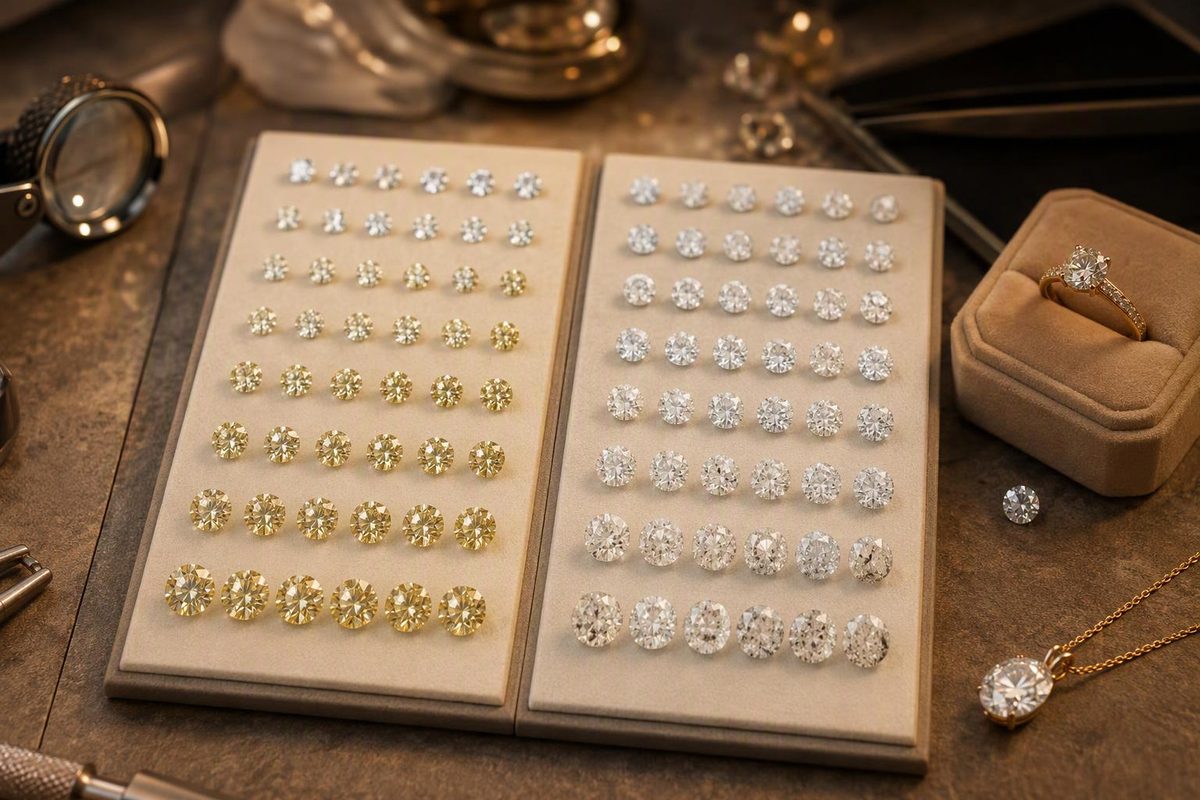
Color and clarity are separate grades: color describes the relative absence of body color, while clarity describes inclusions and surface blemishes. A D/IF diamond sits near the rare end of both GIA scales, but it is not automatically more attractive—or a better purchase—than a well-cut G/VS2. There is no official combined color-and-clarity score.
Select a color and clarity grade to see what each one means.
Color And Clarity Grade Lookup
The default G/VS2 combination is shown. Change either grade to compare another pairing.
Your Selected Pair
This pairing has no official combined score. Inspect the individual diamond and prioritize cut performance.
Please select a valid color and clarity grade.
Source: GIA D–Z color scale and GIA FL–I3 clarity scale. Appearance still varies by the individual diamond.
Diamond Color Runs From D To Z
The GIA D-to-Z color scale contains 23 grades, from D colorless through Z light yellow, brown or gray. GIA divides the scale into five ranges (GIA).
| Color grade | GIA category | Buying implication |
|---|---|---|
| D–F | Colorless | The rarest range; compare it with G–H before paying a premium if appearance matters more than the grade itself |
| G–J | Near colorless | Subtle warmth varies with grade, size, cut style and setting; useful for side-by-side comparison |
| K–M | Faint | Increasingly visible warmth; can complement yellow or rose gold and antique-style designs |
| N–R | Very light | Readily apparent body color; choose it for its warm appearance, not as a colorless substitute |
| S–Z | Light | Stronger body color within the D-to-Z range; compare it in the intended setting and lighting |
Adjacent color grades can be difficult for an untrained viewer to distinguish even when the price changes. GIA grades color under controlled conditions by comparing a diamond with master stones of known color—not by deciding whether a finished ring looks “white enough” (GIA).
The setting changes how color is perceived. Larger diamonds tend to reveal body color more clearly, while brilliant and step-cut facet patterns display warmth differently. Yellow gold can reduce the contrast with faint yellow warmth; white gold and platinum can make it more apparent (GIA).
That makes a letter grade a comparison point rather than a guarantee of face-up appearance. Compare neighboring grades in the same shape and approximate size, preferably against the intended setting metal.
Diamond Clarity Runs From FL To I3
The GIA clarity scale has 11 grades. A skilled grader assigns the grade at 10× magnification after considering the size, number, position, nature and relief of the clarity characteristics (GIA).
| Clarity grade | Meaning at 10× | Buying implication |
|---|---|---|
| FL — Flawless | No inclusions or blemishes visible | Exceptional rarity; the premium generally buys rarity rather than an obvious improvement in normal wear |
| IF — Internally Flawless | No inclusions and only blemishes visible | Extremely high clarity, but not the same grade as Flawless |
| VVS1–VVS2 | Inclusions are difficult for a skilled grader to see | Usually much cleaner than required for an unaided-eye clean appearance |
| VS1–VS2 | Minor inclusions range from difficult to somewhat easy to see | Compare price and appearance; inclusion location still matters |
| SI1–SI2 | Inclusions are noticeable to a skilled grader | May or may not appear clean without magnification; inspect each diamond |
| I1–I3 | Inclusions are obvious and may affect transparency and brilliance | Visible appearance and possible durability concerns require close review |
An inclusion beneath the table generally affects clarity more than the same inclusion near the side. A dark or otherwise high-contrast characteristic is also easier to see. Two diamonds carrying the same clarity grade can therefore look different (GIA). For all 11 grades in more detail, see our diamond clarity scale chart.
“Eye-clean” is not a GIA grade. GIA describes it as an industry term for a diamond whose inclusions cannot be seen with the naked eye. The term does not establish a universal viewing distance, angle or lighting setup, so ask the seller how it was assessed.
Inspect the diamond face-up and from the side at normal viewing size. A highly enlarged video is useful for locating an inclusion, but it does not reliably predict whether that inclusion will be visible during wear.
Choose Color And Clarity Separately
An H/VS2 is not an official quality equivalent of an F/SI1. Treat the grades as two independent filters.
- Set the color target. Decide whether you want an icy, neutral or visibly warm diamond. D color has little practical value if you prefer warmth.
- Compare neighboring color grades. View them in the same shape and approximate size, with the intended metal color in mind.
- Find the lowest clarity that meets your requirements. Read the report’s plot and comments, then inspect the actual diamond rather than buying the abbreviation alone.
- Account for shape and size. Emerald cuts and other step cuts have broad, open facets that tend to reveal inclusions more readily than brilliant cuts. Larger stones may make body color easier to see (GIA; GIA).
- Separate visibility from durability. A harmless visible crystal and a vulnerable surface-reaching feature are different concerns. GIA notes that inclusions near the girdle can increase vulnerability. Very deep feathers extending from crown to pavilion, or roughly one-third or more into the diamond, can also present durability concerns. Ask a qualified jeweler or independent appraiser to assess anything uncertain.
- Prioritize cut before upgrading paper grades. Brightness, fire and scintillation depend on how a diamond’s facets and proportions interact with light. Higher color or clarity cannot correct weak light performance (GIA).
For a shopper seeking a neutral-looking modern diamond rather than rarity, G–J color and VS–SI clarity are reasonable comparison bands, not automatic winners. Move higher in color if warmth is visible and unwanted. Move higher in clarity if an inclusion is distracting, affects transparency or creates a durability concern.
A carefully inspected SI1 may be a better purchase than VVS if both appear equally clean without magnification. A large step cut may justify starting the clarity comparison higher.
The Charts Cannot Judge The Individual Diamond
A color-and-clarity combination does not disclose cut quality, carat weight, face-up size, light performance, transparency, treatments or overall beauty. Before buying, verify the laboratory and report number; a seller’s “G/VS2” description is not equivalent to a grading-laboratory report.
Confirm whether the diamond is natural or laboratory-grown. Matching grades do not imply matching rarity or market value. Check for disclosed color or clarity treatments because they can materially change the comparison.
Review the stone at a realistic scale and in more than one lighting environment when possible. Look for persistent dark areas, weak light return or haziness that the color and clarity abbreviations do not summarize.
Price comparisons also need to be like for like. Compare diamonds of the same origin, shape, weight range, grading laboratory and cut quality, as well as comparable sales and return terms.
GIA Uses A Different System For Eligible Lab-Grown Diamonds
Since October 1, 2025, GIA has used an overall Premium or Standard Quality Assessment for eligible loose, colorless-to-near-colorless laboratory-grown diamonds instead of reporting them with its natural-diamond color and clarity nomenclature (GIA announcement; current GIA service description).
Listings may still show letter and clarity grades from other laboratories or earlier reports. Check the laboratory, report date and grading system before comparing them. Our guide to whether lab-grown diamond grades matter explains when paying for higher grades changes the visible result.
Use the report to narrow the search rather than make the final choice. If two diamonds meet your color target, appear clean enough, show no concerning inclusions and have comparable documentation, let cut performance, face-up appearance, price and return terms decide between them.