
Diamond Clarity Scale Chart: FL to I3 Explained
Compare FL through I3, understand “eye-clean” diamonds, and learn what to inspect on a clarity plot before buying.
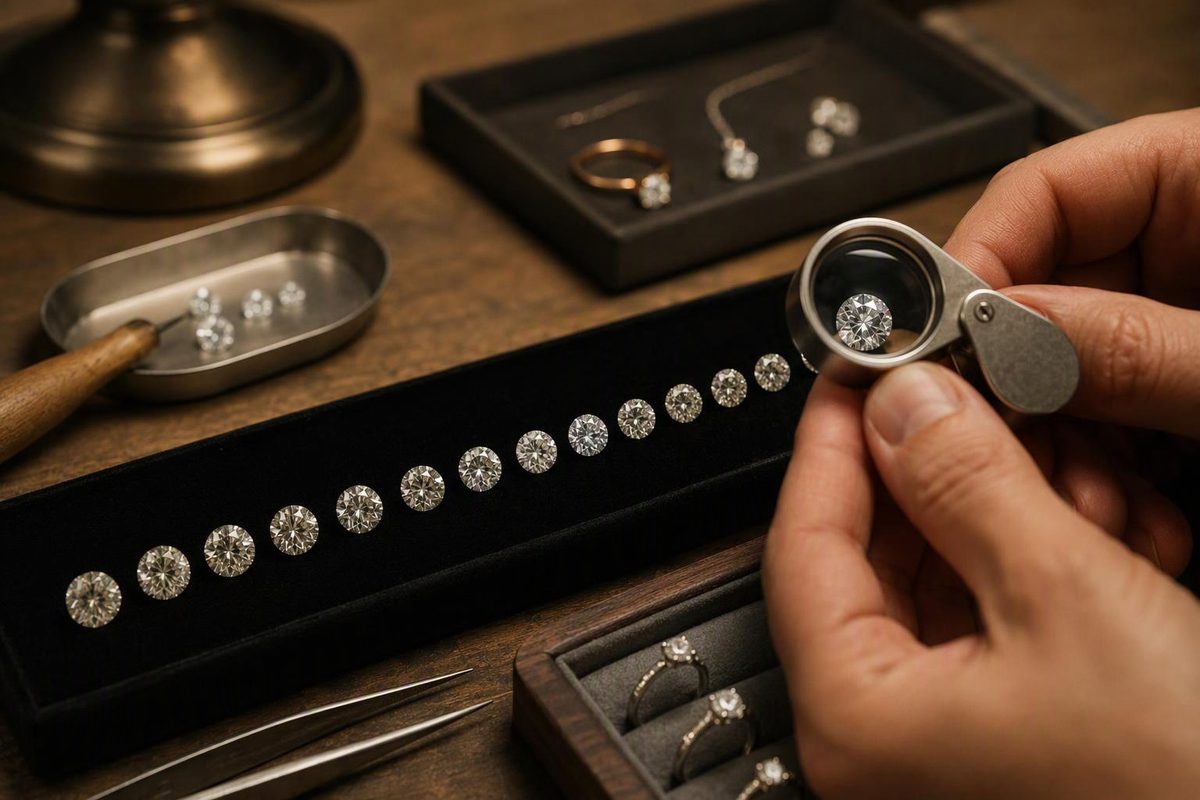
GIA’s natural-diamond clarity scale runs from Flawless (FL) to Included 3 (I3). A higher grade means fewer or less noticeable inclusions and blemishes under standardized examination—not automatically a prettier diamond to the unaided eye.
The scale has six categories divided into 11 grades. Graders assess characteristics at 10× magnification, considering their size, nature, position, relief and number. “Relief” means how strongly a characteristic contrasts with the surrounding diamond. GIA defines the scale and grading factors here.
Diamond clarity scale chart
| Grade | Full name | GIA meaning under 10× magnification | Practical buying interpretation |
|---|---|---|---|
| FL | Flawless | No inclusions or blemishes visible to a skilled grader | Exceptionally rare. The premium buys rarity, not a guaranteed visible improvement over a lower eye-clean grade. |
| IF | Internally Flawless | No inclusions visible; only blemishes are visible | Also rarity-driven. An unaided observer generally cannot use the FL–IF distinction to judge beauty. |
| VVS1 | Very, Very Slightly Included 1 | Minute inclusions are extremely difficult for a skilled grader to see | Very high clarity and usually more than necessary for an eye-clean appearance. |
| VVS2 | Very, Very Slightly Included 2 | Minute inclusions are very difficult to see | Below VVS1 in grading terms, but not necessarily visibly different without magnification. |
| VS1 | Very Slightly Included 1 | Minor inclusions are difficult to see | A useful range to consider when high clarity matters but FL, IF or VVS rarity does not. |
| VS2 | Very Slightly Included 2 | Minor inclusions are somewhat easy for a skilled grader to see | Often worth considering, but do not assume every VS2 is eye-clean. |
| SI1 | Slightly Included 1 | Noticeable inclusions are easy for a skilled grader to see | Can be eye-clean, but that is stone-specific. Check visibility, location and any durability implications. |
| SI2 | Slightly Included 2 | Noticeable inclusions are very easy for a skilled grader to see | A visible inclusion is more likely. Inspect the actual stone and report carefully. |
| I1 | Included 1 | Obvious inclusions; the highest of the three Included grades | Unaided-eye characteristics become more likely. Examine transparency, brilliance and structural concerns. |
| I2 | Included 2 | Obvious inclusions; below I1 and above I3 | Appearance or durability may be compromised. A low price alone does not resolve those risks. |
| I3 | Included 3 | Obvious inclusions; the lowest clarity grade | Usually an appearance- and condition-led purchase rather than a conventional clarity-value choice. |
GIA groups I1, I2 and I3 under the same broad definition: inclusions are obvious at 10× and may affect transparency and brilliance. The number distinguishes relative grade within that category. In every split category, 1 is higher than 2, and I2 is higher than I3. The full category definitions appear in GIA’s published 11-grade clarity system.
A clarity grade is not an eye-clean guarantee
“Eye-clean” is an industry description, not a GIA grade. GIA defines the term as a diamond whose inclusions cannot be seen with the naked eye, but does not use it in its grading system. The clarity grade is determined at 10× magnification; normal viewing also depends on the observer, distance, lighting, angle and cleanliness of the stone.
Two VS2 diamonds can therefore look different. Clarity is not determined by simply counting inclusions. A dark crystal beneath the center of the table can be more distracting than several faint characteristics near the edge. GIA’s five factors—size, number, location, relief and nature—explain why the grade alone cannot tell you exactly what you will see.
Facet pattern matters as well. GIA notes that inclusions are typically easier to see through the broad, open facets of an emerald cut than among the smaller facets of a round brilliant. Consequently, “always buy SI1” or “always buy VS2” is not a reliable rule.
Reasonable starting points are:
- Round and other brilliant-style cuts: compare VS2 and SI1 candidates, retaining only stones that meet your own viewing standard.
- Emerald and Asscher cuts: consider beginning at VS2 or VS1, while still inspecting every stone. The grade creates a shortlist; it does not make the decision.
- Collectors seeking rarity: FL, IF and VVS grades can be valid preferences, but understand the premium as payment for rarity and documentation rather than assumed naked-eye beauty. VVS is high clarity, not flawless.
How to compare diamonds with the same grade
Inspect each stone face-up without magnification first, because that is how it will normally be seen. Then examine it from the side and at close range. A single spotlighted seller video is not enough: ask for footage in neutral, diffused lighting with the stone moving slowly through different angles. If a seller promises that a diamond is eye-clean, ask what viewing distance and conditions the promise assumes and get the answer in writing.
Next, read beyond the report’s headline grade:
- Identify the grade-setting characteristic. On a GIA plot, characteristics are listed in order of importance to the clarity grade, except that a laser drill-hole is listed first for disclosure.
- Check its location. A central, high-relief inclusion may be conspicuous. A surface-reaching feather near the girdle warrants attention because the girdle is also the setting edge.
- Read the Comments section. Widespread, faint or otherwise unplotted characteristics may be disclosed there instead of on the diagram.
- Do not treat the plot as a photograph. It maps approximate type, shape, size and location; it does not reproduce exactly how dark, reflective or visible a characteristic looks.
GIA explains that its clarity plotting diagram is both a map and an identification aid. A report without a full plot may instead list significant characteristics, so the absence of a diagram does not mean the diamond has no inclusions.
Clarity and durability are related—but not interchangeable
A lower clarity grade does not automatically mean a diamond will break, and a higher grade is not a wear guarantee. Type and position matter. GIA identifies surface-reaching inclusions near the girdle, deep feathers extending from crown to pavilion, and feathers penetrating roughly one-third or more into a stone as possible durability concerns. If a report shows a questionable feature, have a qualified independent appraiser or jeweler assess it before the return period expires.
Also check for treatments. Laser drilling is permanent, and GIA records drill holes as clarity characteristics. Fracture filling masks a fracture with a glass-like material but is not considered permanent or stable; GIA does not grade fracture-filled diamonds. A seller’s clarity description is not a substitute for treatment disclosure.
Does the chart apply to lab-grown diamonds?
FL-to-I3 terminology still appears on reports from some laboratories and on older GIA laboratory-grown diamond reports. It is not the format GIA now uses for newly assessed D-to-Z lab-grown diamonds.
Since October 1, 2025, GIA has assigned qualifying stones an overall Premium or Standard assessment based on clarity, color and finish, with cut criteria also applied to round brilliants. A stone must meet every minimum Standard criterion to receive the assessment. GIA’s announcement provides the detailed thresholds. For what high grades mean in practice, see whether lab-grown diamond grades matter.
Finally, make exact grade comparisons between loose stones assessed by a recognized laboratory. GIA grades diamonds loose because a mounting can obscure or influence color and clarity, impede treatment detection and prevent an exact carat-weight determination, as its grading FAQ explains. For a mounted estate ring without a prior report, treat a seller’s clarity range as an estimate rather than the equivalent of a loose-stone laboratory grade.