
Diamond Stone Clarity Chart: FL to I3
Use this diamond stone clarity chart to compare all 11 GIA grades, understand 10× grading, and choose by shape, size, appearance, and risk.
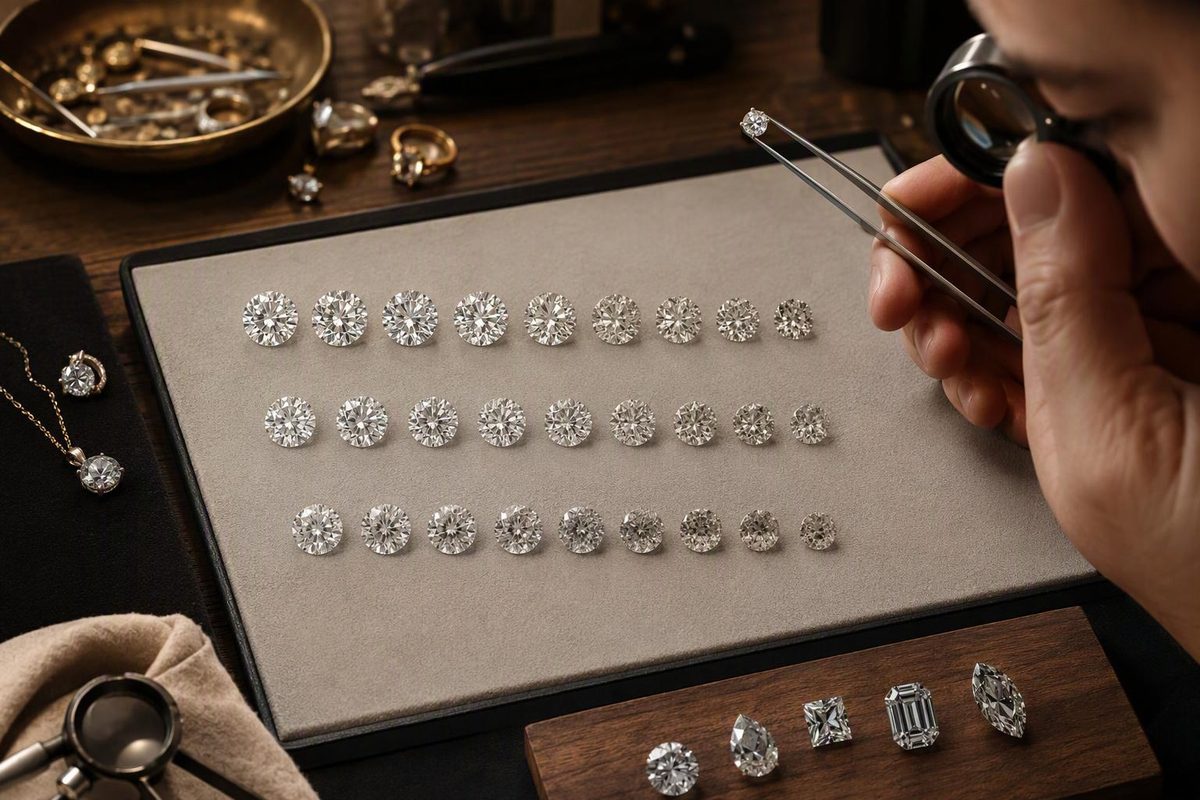
On the GIA diamond clarity scale, Flawless (FL) is the highest grade and Included 3 (I3) is the lowest. A higher grade means fewer, smaller or less noticeable clarity characteristics under standardized 10× examination—not necessarily a prettier diamond to the naked eye. For many buyers, VS2 or a carefully selected SI1 is a sensible starting point, while emerald and Asscher cuts often merit looking around VS1 or VS2.
Choose the shape, size and buying priority; the finder shows a practical clarity starting point.
Clarity Starting-Point Finder
This narrows the grade range; it does not grade an individual diamond.
For a round brilliant of 3 carats or less, compare both grades before paying for VVS rarity.
Confirm that the individual diamond is eye-clean under agreed viewing conditions and has no unacceptable durability issue.
See all 11 GIA clarity grades
| Grade | Observation at 10× |
|---|---|
| FL | No inclusions or blemishes |
| IF | No inclusions; only blemishes |
| VVS1 | Inclusions extremely difficult to see |
| VVS2 | Inclusions very difficult to see |
| VS1 | Minor inclusions difficult to see |
| VS2 | Minor inclusions somewhat easy to see |
| SI1 | Noticeable inclusions easy to see |
| SI2 | Noticeable inclusions very easy to see |
| I1 | Obvious inclusions |
| I2 | Obvious inclusions |
| I3 | Obvious inclusions |
Sources: GIA clarity scale and IGI eye-clean guidance. Recommendations are screening ranges, not guarantees.
Diamond Stone Clarity Chart
GIA’s scale has 11 grades across six categories. Graders assess internal and surface-reaching characteristics called inclusions and external features called blemishes. The grade reflects their size, number, position, nature and relief—how strongly they contrast with the diamond—as seen at 10× magnification (GIA).
| Grade | Full Name | What a Grader Sees at 10× | Practical Buying Interpretation |
|---|---|---|---|
| FL | Flawless | No inclusions or blemishes | Exceptionally rare; the premium buys rarity, not a visible advantage over every lower grade |
| IF | Internally Flawless | No inclusions; only blemishes | Nearly the top of the scale, but not free of every characteristic |
| VVS1 | Very, Very Slightly Included 1 | Inclusions are extremely difficult to see | Normally clean without magnification; primarily a rarity or specification purchase |
| VVS2 | Very, Very Slightly Included 2 | Inclusions are very difficult to see | Normally clean without magnification; still carries a high-paper-grade premium |
| VS1 | Very Slightly Included 1 | Minor inclusions are difficult to see | A strong place to look when ample clarity margin matters |
| VS2 | Very Slightly Included 2 | Minor inclusions are somewhat easy for a grader to see | Often eye-clean, but large stones and step cuts need individual inspection |
| SI1 | Slightly Included 1 | Noticeable inclusions are easy to see | Can offer value if the diamond is eye-clean and no characteristic creates a durability concern |
| SI2 | Slightly Included 2 | Noticeable inclusions are very easy to see | Visibility varies substantially; video and in-person inspection matter |
| I1 | Included 1 | Obvious inclusions | Inclusions may be visible unaided and may affect transparency or brilliance; check durability separately |
| I2 | Included 2 | Obvious inclusions | Assess appearance, transparency and condition rather than relying on the label alone |
| I3 | Included 3 | Obvious inclusions | The lowest GIA clarity grade; close inspection of appearance and durability is essential |
The grader-observation wording follows GIA’s published definitions. GIA groups I1 through I3 as grades whose inclusions are obvious at 10× and may affect transparency and brilliance (GIA). The buying interpretation is less absolute because two diamonds with the same grade can have very different inclusion patterns.
A Clarity Grade Does Not Guarantee an Eye-Clean Diamond
“Eye-clean” generally means that inclusions cannot be seen without magnification, but it is not a GIA grade. Viewing distance, lighting, direction and eyesight can all change the result. GIA explicitly does not use the term.
That distinction matters most around VS2, SI1 and SI2. One SI1 might have a small, pale inclusion near the girdle that is difficult to notice face-up. Another might have a dark crystal under the table. Both can receive SI1 because graders consider five factors together rather than simply counting marks.
IGI’s consumer guidance says round brilliants graded VS2 and above are reliably eye-clean under its stated viewing definition. It recommends checking VS2 emerald and Asscher cuts—and VS2 round brilliants over 3 carats—individually (IGI). That is a useful screening rule, not a promise about a particular stone or viewer.
A seller’s eye-clean guarantee also needs a definition. A diamond may look clean face-up at a normal distance while showing an inclusion from the side or under close inspection. Confirm the viewing conditions before treating the claim as part of the purchase decision.
Shape And Size Change Inclusion Visibility
Step cuts such as emerald and Asscher cuts have broad, open facets that can reveal inclusions more readily than the smaller, busier facets of a round brilliant. GIA likewise notes that inclusions are easier to see in an emerald cut than in brilliant cuts, although large or multiply reflected inclusions may be apparent in any shape.
Larger diamonds also deserve closer inspection. IGI’s recommendation to check VS2 round brilliants over 3 carats case by case is a specific reminder that the grade alone does not settle visible appearance.
Practical starting ranges are:
- Round, oval, cushion, pear, princess or marquise: Compare VS2 with carefully selected SI1 diamonds before paying for VVS clarity.
- Emerald and Asscher: Begin around VS1 or VS2, then judge each diamond face-up and from the side.
- Large center stones: Inspect at normal viewing distance as well as under magnification, regardless of the stated grade.
- Collectors or grade-sensitive buyers: FL, IF and VVS can be rational choices when rarity or the report specification is part of the appeal.
These are shopping ranges, not substitute grades. Cut quality and the face-up pattern can contribute more to visible beauty than moving from VS1 to VVS1.
Five Factors Determine The Clarity Grade
A grader does not assign clarity by counting inclusions. The five considerations work together:
- Size: A larger characteristic generally has more influence than a tiny one.
- Number: Several characteristics may affect the grade, but their mere count does not determine it.
- Position: A centrally located inclusion under the table may be more conspicuous than one near the girdle.
- Nature: The type of characteristic and whether it is internal, external or surface-reaching matter.
- Relief: A dark or strongly contrasting inclusion is usually easier to see than a pale one.
This explains why the same grade can produce different buying outcomes. A plotted report identifies types and locations, but it cannot fully convey contrast, reflections, transparency or how distracting an inclusion appears when the diamond moves.
How To Read The Report And Inspect The Diamond
Start with the laboratory name and report number, not a seller’s standalone “VS” description. Then evaluate the report and the physical diamond together.
- Confirm the exact grade. “VS clarity” leaves a meaningful distinction between VS1 and VS2.
- Read the clarity-characteristics list and plot, if provided. Note what is present and where, but do not estimate the grade by counting symbols. One centrally located, dark inclusion may matter more visually than several tiny peripheral ones.
- Review face-up video at realistic scale. Magnified media helps locate inclusions; it does not show how conspicuous they will be on a hand.
- Ask for the eye-clean definition in writing. Specify face-up viewing, daylight-equivalent or fluorescent lighting, normal vision and a distance such as 6–12 inches—the conditions used in the definition quoted by IGI.
- Check durability separately. A low grade is not automatically fragile, but GIA says an inclusion’s potential to cause damage can sometimes affect the grade, usually in Included diamonds (GIA). Have an independent gemologist or appraiser assess surface-reaching feathers, cavities or chips when their position or extent raises concern.
- Compare price after matching the other variables. Clarity affects rarity and price, but carat, color, cut, shape, origin and report also matter.
For more detail on the upper grades, see why VVS is high clarity rather than flawless.
FL And IF Do Not Mean The Same Thing
A Flawless diamond has no inclusions or blemishes visible to a skilled grader at 10×. An Internally Flawless diamond has no inclusions visible at 10× but may have blemishes. Neither description promises that a diamond is literally perfect at unlimited magnification.
The practical difference between FL, IF and VVS grades is usually rarity and report status rather than an unaided visual improvement. Buyers who value rarity may reasonably pay for it. Buyers focused on face-up appearance can often direct more of the budget toward cut, carat or another visible characteristic.
For VVS specifically, the defining distinction is that inclusions are extremely difficult or very difficult for a skilled grader to find at 10×. It is a high clarity range, but it is below FL and IF.
GIA Lab-Grown Assessments Now Use Different Terms
The FL-to-I3 chart remains relevant to natural diamonds and to reports from laboratories that use the scale for lab-grown diamonds. It should not be assumed, however, that every new GIA lab-grown document shows an individual clarity grade.
Since October 1, 2025, GIA has used Premium or Standard overall assessments for qualifying colorless-to-near-colorless lab-grown diamonds. Premium requires VVS clarity or higher along with D color and specified finish criteria. Standard allows VS clarity and lower minimums for color and finish; a stone that misses the minimum Standard criteria receives no quality assessment (GIA). GIA lists a separate full-quality report for laboratory-grown colored diamonds (GIA).
Older GIA lab-grown reports remain valid (GIA). Other laboratories may still print familiar grades such as VS1 or VVS2, so compare the actual report format and issuer rather than assuming the terminology is interchangeable. The guide to whether lab-grown diamond grades justify an upgrade covers that buying decision.
The Best Grade Is The Lowest Acceptable Individual Stone
For most jewelry buyers, the useful target is the lowest clarity grade that looks clean under the agreed viewing conditions, performs well in its cut and presents no unacceptable durability issue. VS2 and selected SI1 diamonds often deserve comparison in brilliant-style shapes. Step cuts, large diamonds and stones with central or high-relief inclusions require closer individual review.
A chart narrows the search. The report, magnified inspection and normal-distance appearance determine whether a particular diamond is worth buying.