
Different Types of Earring Backs: Uses, Pros and Cons
The best earring back depends on more than the earring’s value or appearance. Post construction, earring weight, rear profile, fastening effort, piercing…
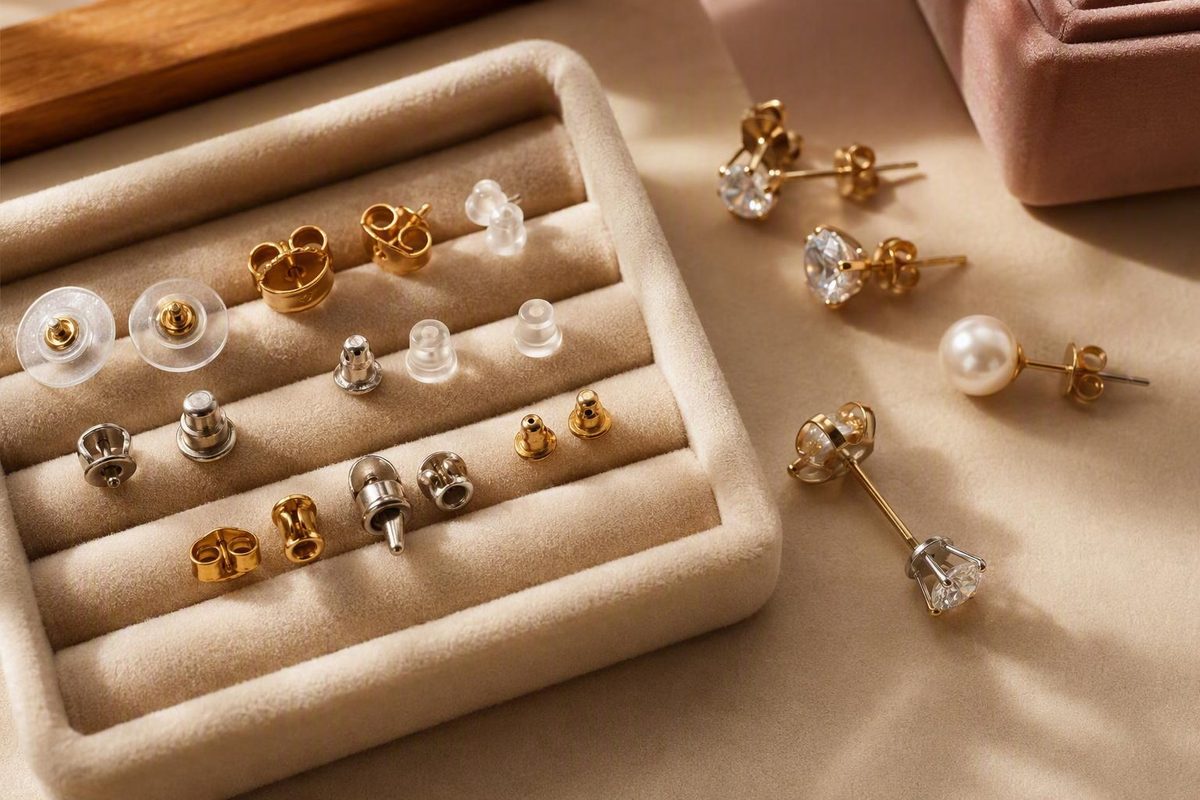
The best earring back depends on more than the earring’s value or appearance. Post construction, earring weight, rear profile, fastening effort, piercing location, dexterity, and the availability of compatible replacement parts all matter.
It is also important to distinguish a detachable back—a separate component fitted to a post—from an integrated closure built into the earring. Leverbacks, French wires, hinged hoops, and similar designs are often called “backs,” but replacing them is generally a repair or component-matching question rather than a matter of buying a loose backing.
Earring backs at a glance: a mechanism-first comparison
| Common name | Alternate names | Construction | Attachment mechanism | Typical pairing | Required post or design | Rear profile | Fastening effort | Principal tradeoff |
|---|---|---|---|---|---|---|---|---|
| Butterfly back | Push, friction, scroll | Detachable | Friction or tension | Studs | Compatible smooth or notched straight post | Small to moderate | Fast | Convenient, but grip can weaken |
| Screw back | Threaded back | Detachable | Threading | Studs | Matching threaded post | Small to moderate | Slower | Deliberate threaded attachment, but exact compatibility is essential |
| Guardian back | La Pousette; sometimes marketed generically as a locking back | Detachable | Mechanical click lock with release tabs | Studs, including wider support designs | Compatible locking post | Moderate | Moderate precision | Positive lock action, but specialized parts may be harder to replace |
| Silicone back | Rubber stopper | Detachable | Compression | Studs, wires, threaders | Compatible post or wire | Usually small | Fast | Soft and inexpensive, but can stretch or crack |
| Bell back | Closed back | Detachable | Usually friction | Studs | Compatible post | Moderate | Fast | Covers the post end, but fit and bulk vary |
| Ball back | Spherical component | Detachable back, coordinated end, or decorative component | Friction, threading, or another system | Studs and body jewelry | Depends on the complete construction | Rounded | Varies | The shape alone does not reveal the fastening method |
| Flat-back system | Labret-style post | Coordinated post system | Threadless tension or internal threading | Cartilage jewelry and low-profile studs | Hollow threadless post or internally threaded post | Low, flat disc | Moderate | Less projection behind the ear, but components are system-specific |
| Oversized back | Monster back, large-disc back | Detachable support back | Usually friction or locking | Heavy or forward-tilting studs | Compatible post | Wide | Fast to moderate | More support area, but greater bulk |
| Omega closure | Sometimes called a French clip | Usually integrated or semi-integrated | Hinged pressure support, often combined with a post | Heavy or structured earrings | Purpose-built earring | Wide and curved | Moderate | Supports the lobe, but pressure and alignment must be appropriate |
| Leverback | Hinged lever | Integrated | Hinged wire closes into a loop | Drops and dangles | Purpose-built earring | Curved loop | Moderate | Enclosed form, but not a detachable replacement |
| French wire | Fish hook, French hook | Integrated | Curved wire passes through the piercing | Drops and dangles | Purpose-built wire | Open wire | Fast | Simple and light, but does not fully lock |
| Latch or hinged hoop | Saddleback, snap, clicker | Integrated | Post clicks into a gate, groove, or earring body | Hoops and huggies | Purpose-built earring | Low to moderate | Fast | Streamlined, but a worn latch usually requires adjustment or repair |
| Clip-on | Hinged clip | Integrated | Pressure | Non-pierced ears | Purpose-built clip | Moderate to large | Fast | No piercing required, but pressure and stability vary |
| Magnetic design | Magnetic earring | Usually a matched pair or complete design | Magnetic attraction | Primarily non-pierced styles | Matched magnetic components | Small to moderate | Fast | Easy attachment, but may detach when bumped |
These options fall into five practical groups:
- Removable stud backs: Butterfly, screw, mechanical locking, silicone, bell, and some ball backs.
- Flat-back post systems: Threadless or internally threaded jewelry with a disc behind the ear.
- Heavy-earring supports: Oversized backs, discs, pads, and Omega supports.
- Integrated closures: Leverbacks, French wires, latches, hinged hoops, clickers, segment rings, and threaders.
- Non-pierced options: Clip-ons and magnetic earrings.
Across those groups, the main mechanism families are friction, threading, tension fit, mechanical locking, hinged or latched closure, wire suspension, magnetic attachment, and pressure.
The commercial guides reviewed for this article generally describe these mechanisms in similar terms, but they do not provide independent comparative failure-rate or comfort testing. Their security and comfort rankings should therefore be treated as shopping guidance—not proof that one design is universally best. A commercial overview of removable backs and integrated closures illustrates the usual categories as well as the subjective ratings often attached to them.
Synonym key:
- Push, friction, butterfly, and scroll usually describe the same basic detachable back.
- Guardian and La Pousette describe a mechanical locking style.
- French wire, French hook, and fish hook overlap in everyday product descriptions.
- Flat-back describes the shape behind the ear, not whether the jewelry is threaded or threadless.
- Hinge, saddleback, latch, snap, and clicker are not used consistently across all sellers. Inspect the actual mechanism rather than relying on the label alone.
Removable backs for stud earrings
Butterfly, push, friction, or scroll backs. This familiar separate component slides onto a compatible straight post and holds through friction or tension. Some posts include a notch near the end, but the presence of a notch does not make every butterfly back compatible with every post. These backs are quick to attach, widely available, and generally easier to replace than specialized systems. Their principal weakness is that the grip can diminish as the back flexes or wears; a back that has started sliding too easily should not be relied upon.
- Speed and handling: Fast, familiar, and available in sizes that are relatively easy to grasp.
- Profile: Usually compact, although the post end may remain exposed.
- Compatibility: Post thickness, notch position, and the back’s tension must correspond.
- Availability: Common and usually easier to source than proprietary locks.
- Main drawback: Friction can weaken with use.
Commercial descriptions consistently identify butterfly, push, and friction backs as the same basic mechanism and acknowledge that their grip can loosen over time (Dana Rebecca Designs’ comparison of common stud backs).
Screw backs. A screw back twists onto a threaded post. It normally takes longer to attach than a friction back because the component must be aligned and turned through several rotations. The intentionally operated connection appeals to shoppers who want a more deliberate fastening process, but it is not fail-safe.
- Speed and handling: Slower than a push back; fine threads and small components can demand careful manipulation.
- Profile: Usually small to moderate, depending on the design.
- Compatibility: Requires matching threads. An ordinary smooth post cannot be assumed to accept a screw back.
- Availability: Common as part of complete stud systems, but a random replacement may not match the existing thread.
- Main drawback: Damaged, contaminated, or mismatched threads can bind or fail to engage correctly.
Guardian or La Pousette-style locking backs. These use a mechanical lock that clicks into place and releases when tabs or buttons are pressed. Some have a wider body that also supplies more support behind the lobe. They usually require a post designed for the locking system rather than an arbitrary straight post.
- Speed and handling: Faster than fine threading for some wearers, but the release tabs require precise handling.
- Profile: Moderate and sometimes broad.
- Compatibility: Often requires a specialized post with the features the lock is designed to engage.
- Availability: Less standardized and potentially harder to replace than a butterfly back.
- Main drawback: Bulk, proprietary parts, and the need to operate the release correctly.
A jewelry-brand explanation of Guardian or La Pousette-style backs describes the click-on mechanism and side-tab release.
Lox and other branded locking systems. These are specialized mechanical products, not a generic category guaranteed to fit every stud.
- Speed and handling: Some have larger gripping surfaces, but operation varies.
- Profile: Often bulkier than a conventional friction back.
- Compatibility: Check the manufacturer’s specified post requirements.
- Availability: Replacement parts may be less readily available than standard backs.
- Main drawback: Cost, unfamiliar operation, and possible dependence on proprietary components.
Silicone or rubber backs and stoppers. Soft backs grip through compression around a compatible post or wire. They are sold both as stud replacements and as stoppers for some French wires or threaders.
- Speed and handling: Quick to fit; larger versions may be easier to grasp.
- Profile: Usually low, although support-disc versions are available.
- Compatibility: Fit must be tested on the intended post or wire.
- Availability: Generally easy to find.
- Main drawback: The material can stretch, split, crack, or lose its grip.
“Universal” in a product description should not be interpreted as proof that the component will grip every post or wire securely.
Bell backs. A bell back has a closed form that covers the end of the post instead of leaving the point exposed.
- Speed and handling: Straightforward where the design uses a push-on friction fit.
- Profile: More enclosed and usually more voluminous than a small butterfly back.
- Compatibility: Depends on the post for which the back was designed.
- Availability: Less standardized than ordinary butterfly backs.
- Main drawback: The closed shape does not by itself establish comfort, correct spacing, or suitability for a particular piercing.
One retailer says its own bell backs prevent the post from poking and help avoid an overly tight fit, but those are product-specific claims rather than independent findings applicable to every bell back (Rowan’s guide to flat, bell, and butterfly backs).
For a healing piercing, use the jewelry and fitting guidance provided by the professional responsible for the piercing rather than substituting an unverified back based on a generic product description.
Ball backs. “
- Speed and handling: Varies by mechanism; small threaded balls can be difficult to turn.
- Profile: Rounded and potentially easier to locate by touch than a thin disc.
- Compatibility: Verify the post, thread, material, and whether the ball is intended to be removable.
- Availability: Common in some jewelry categories but not necessarily interchangeable with ordinary stud backs.
- Main drawback: The name does not establish how securely the component attaches, and a loose ball can roll away when dropped.
Magnetic designs. Magnetic earrings rely on attraction between matched components and are commonly sold as complete non-pierced earrings. A magnetic component should not automatically be treated as a replacement back for an ordinary stud.
- Speed and handling: Fast, with no threading or release tabs.
- Profile: Usually small to moderate.
- Compatibility: Use matched components only as the design specifies.
- Availability: Available as complete magnetic earrings and in some specialty systems.
- Main drawback: The components can shift or detach when bumped.
Magnetic attachment should not be presented as a secure substitute for every valuable, heavy, or pierced earring.
Flat-back jewelry: profile and fastening system are not the same thing
A flat back places a smooth, low-profile disc behind the ear. The term is commonly associated with labret-style jewelry and cartilage placements. Its defining feature is the rear shape: compared with a projecting butterfly, screw, or ball component, the disc presents a flatter surface.
That description does not explain how the decorative end is attached. Flat-back jewelry commonly appears in two coordinated forms:
- Threadless: A slightly bent pin on the decorative end enters a hollow post. Tension between the pin and post holds the end in place.
- Internally threaded: The decorative end has a threaded section that screws into threads inside the post.
These systems are not interchangeable simply because both can have a flat disc behind the ear. The pin dimensions and tension of a threadless system must correspond to the hollow post; threaded components likewise require matching threads.
Insertion can also differ from an ordinary stud. With many flat-back systems, the post enters the piercing from behind and the decorative end is attached at the front. Changing a small front end is therefore a different task from sliding a butterfly back onto a post that already projects behind the ear.
The low rear profile is why flat backs are commonly considered when someone wants less projection behind the lobe or cartilage. It may reduce contact compared with a long exposed post, but it does not guarantee comfortable sleeping or continuous wear. Post length, disc size, anatomy, jewelry weight, fastening tension, and the condition of the piercing still matter.
When shopping for replacement parts, do not use these terms interchangeably:
- Flat-back identifies the rear profile.
- Labret generally identifies a post-and-disc jewelry format.
- Threadless identifies a tension-held pin system.
- Threaded identifies a screw connection.
- Internally threaded means the receiving threads are inside the post.
If a cartilage piercing is healing, difficult to access, or otherwise concerning, obtain in-person guidance from a qualified piercer rather than relying on universal fitting instructions or forcing a component into place.
Backs and supports for heavy or forward-tilting earrings
A heavy stud can tilt because the decorative front pulls forward while a small back supplies limited support behind the lobe. Increasing the back’s contact area can distribute the load across a broader area and may help the earring sit more upright. It does not reduce the earring’s actual weight.
Oversized butterfly or monster backs use a larger structure behind the ear while retaining the familiar friction mechanism. They can be a practical option when the post is compatible but an ordinary back does not stabilize the front adequately.
Large-disc backs add a broad disc around or behind the gripping component. The disc provides support while the central mechanism—such as friction or mechanical locking—retains the post. The disc is not useful if the center fails to grip the post correctly.
Guardian-style wide backs combine a mechanical lock with a broader rear surface in some designs. This may address retention and positioning together, but it also adds bulk and requires the correct post and release operation.
Plastic support pads sit behind the lobe and spread pressure across a larger area. Plastic pads should be replaced if they split, distort, or degrade.
Omega backs combine a post with a hinged support that presses behind the ear. Sources classify them inconsistently: some call them backs, while others treat them as integrated closures. Mechanically, they are usually engineered as part of the earring rather than sold as a generic loose replacement. Commercial guides group monster backs, pads, and Omega mechanisms among options for heavier earrings, while also noting tradeoffs such as bulk and deterioration of plastic supports (Daniel Wellington’s overview of earring backs).
Use this troubleshooting sequence:
- Confirm retention. Check whether the back grips, threads, locks, or latches consistently.
- Assess balance. Try an appropriately compatible wider support and observe whether the front sits more upright.
- Check pressure. Do not force a support into position or continue using one that pinches.
- Inspect the post. A bent, unusually long, or poorly positioned post can contribute to instability.
- Consult a jeweler. If the earring still tips, the post, setting, or overall construction may need professional adjustment.
A supportive back may improve positioning, but it cannot make every excessively heavy or poorly balanced earring comfortable. If a larger support merely transfers uncomfortable pressure across a wider area, the practical answer may be shorter wear, redesign, or professional modification rather than an even larger back.
Integrated closures for hoops, drops, dangles, and non-pierced ears
Many entries in lists of “earring backs” are actually closures built into the earring.
Leverbacks use a curved wire that passes through the piercing and a hinged lever that closes behind it, forming a loop. They are commonly paired with drop and dangle earrings. The enclosed form differs from an open hook, but the hinge and latch still need to align and close consistently.
French wires or fish hooks are curved wires that pass through the piercing and hang behind the lobe without forming a complete lock. Some accept a small silicone or rubber stopper. That stopper must fit the wire rather than sliding freely or distorting it.
Latch backs use a gate or post that snaps into a catch. They are common on hoops, huggies, and structured earrings, although terminology varies between sellers.
Hinge, saddleback, clicker, and snap closures describe related but not identical constructions. A hinged post may click into a groove, a movable clicker section may close into the opposite side, or a straight post may snap into the earring body.
Instead of relying solely on the product name, inspect three points:
- Where does the post meet the catch or earring body?
- Does it seat fully in its groove or opening?
- Does the hinge close with consistent alignment and resistance?
A retailer’s guide to hinge, lever, Omega, French-wire, and threader designs demonstrates how these labels can overlap across earring categories.
Segment rings use a removable curved segment to complete the ring. This is a specialized coordinated system, not a conventional stud with a detachable back.
Threaders pass a fine chain or thin section through the piercing so part of the earring hangs on each side. They generally have no traditional back, although some designs can accept a compatible stopper.
Omega closures combine a post with a hinged support behind the ear. Their broad rear surface makes them relevant to heavier or structured earrings, but they are usually engineered as part of the piece.
Clip-ons hold an earring on an unpierced lobe using pressure, often from a hinged clip. Their main tradeoff is between enough pressure to resist movement and a fit the wearer can tolerate.
Magnetic designs also serve non-pierced ears, but they differ from clip-ons. A clip applies mechanical pressure through a hinge or spring; a magnetic earring relies on attraction between matched components. Either can feel uncomfortable if poorly fitted, while magnetic pieces can detach when bumped.
A simple pairing guide is:
- Studs: Detachable friction, screw, or locking backs, or coordinated flat-back systems.
- Drops and dangles: Leverbacks or French wires, sometimes with a compatible stopper.
- Hoops and huggies: Purpose-built latch, hinge, saddleback, clicker, snap, or segment mechanisms.
- Heavy structured earrings: Wider detachable supports or integrated Omega closures.
- Non-pierced ears: Clip-on or magnetic designs.
Choosing by priority: retention, comfort, speed, weight, and dexterity
There is no single best earring back. Start with the problem you need to solve.
| Priority | Options to consider | Main caution |
|---|---|---|
| Fast, frequent stud changes | Properly fitting butterfly or friction back | Check for weakened grip |
| More deliberate fastening for valuable studs | Compatible screw or mechanical locking system | No system is fail-safe; posts and components must match |
| Low profile behind the ear | Properly fitted threaded or threadless flat back | Correct post length and system compatibility still matter |
| Support for forward-tilting studs | Oversized back, support disc, wide locking back, pad, or Omega support | More support cannot correct every overweight or poorly balanced design |
| Enclosed closure for drops | Leverback | Inspect the hinge and latch |
| Simple closure for drops | French wire with an optional compatible stopper | The wire does not fully lock |
| Hoops or huggies | Original engineered latch, hinge, clicker, or snap closure | Avoid improvised generic replacements |
| Non-pierced wear | Clip-on or magnetic earring | Compare pressure with detachment risk |
| Easier handling | Larger friction back or a system with larger gripping surfaces | Usability depends on individual hand strength and coordination |
For frequently changed everyday studs, a snug friction back remains a familiar and fast option. It should resist a gentle pull rather than moving freely along the post.
When loss is a concern with valuable diamond or gemstone studs, a compatible screw or mechanical locking system offers a more deliberate fastening process. Retailers commonly recommend these systems for valuable jewelry, but those recommendations are not backed by independent failure testing. Treat them as options with distinct mechanisms and compatibility requirements—not as impossible-to-lose solutions.
For a low rear profile, consider a properly fitted threaded or threadless flat-back system. Confirm the post length, attachment method, and compatibility of the decorative end rather than choosing by rear shape alone.
For a heavy stud, compare wider butterfly backs, support discs, wide locking backs, pads, and Omega mechanisms. The suitable choice is one that fits the earring and improves its balance without pinching.
For drops and dangles, the main choice is often between the enclosed loop of a leverback and the simpler open form of a French wire. A compatible stopper can add resistance behind a French wire, but it does not convert the hook into an engineered locking closure.
For hoops and huggies, use the closure designed for the piece. A weak latch, misaligned post, or damaged hinge generally calls for adjustment or repair rather than an improvised butterfly back.
Dexterity deserves explicit consideration. A large friction back may be easier for some people to grasp than a tiny screw back. Someone else may prefer a lock that produces a distinct click. Fine threads, short posts, polished surfaces, and small release tabs can all require precise manipulation. This is an individual practical test, not a validated accessibility ranking.
Finally, separate physical comfort from material sensitivity. Rear profile, pressure, post length, earring weight, composition, finish, cleanliness, fit, and individual response can all affect wear. A butterfly, bell, ball, or flat-disc shape does not by itself make a component hypoallergenic.
Compatibility: how to match a replacement back to the post
Earring backs are not universally interchangeable. Before buying a replacement, identify the post or closure already on the earring.
Compatibility checklist:
- Smooth post: Often intended for a friction or compression back.
- Notched post: May help locate a friction back, but post thickness and notch position still vary.
- Threaded post: Requires a back with matching threads.
- Hollow post: May belong to a threadless tension system or accept an internally threaded end.
- Grooved or shaped post: May be intended for a particular mechanical lock.
- Proprietary post: Requires the manufacturer-specified or otherwise confirmed compatible component.
- Integrated closure: May need adjustment or repair rather than a detachable replacement.
For a friction back, test the replacement on the actual post. It should move intentionally but resist sliding off. Do not assume that every straight post has the same diameter or that every notch will align with every back.
For a screw back, start the threads gently and keep the back aligned. Stop if it binds, tilts, or fails to turn smoothly.
For Guardian, La Pousette, Lox, and other mechanical locks, check the release method and the post features the lock is intended to engage. Similar-looking systems may not be interchangeable.
For a threadless flat back, the bent pin and hollow post form a coordinated tension system. Pin dimensions, bend, and post construction affect retention, so a random decorative end may not fit or may produce inappropriate tension.
For integrated hoops, latches, clickers, and leverbacks, the closure is generally part of the earring. If a post misses its groove or a latch no longer stays shut, a jeweler may be able to realign or repair the mechanism. Commercial compatibility guidance likewise distinguishes smooth, threaded, locking, and integrated constructions rather than treating replacement backs as universal (Gabriel & Co.’s guide to earring styles and backs).
Have a jeweler inspect valuable earrings, uncertain threads, bent posts, failed locks, or proposed structural conversions. Do not bend or modify a valuable post merely to make an incompatible back fit.
Care, inspection, and signs a back should be replaced
For suitable components, restrained routine care is generally sufficient: use mild soap and warm water, rinse as appropriate, and dry thoroughly before storage or wear. When uncertain, clean the removable back separately or ask a jeweler about the complete piece. Commercial care guidance supports mild cleaning, thorough drying, and checking for reduced grip or loosened tension (Sylvie Jewelry’s earring-back care guidance).
Store backs with their matching earrings, particularly when they are threaded, locking, or proprietary. A labeled pouch, small compartment, or closed stud organizer can prevent a visually similar but incompatible component from being mixed into the pair.
Inspect for:
- A friction back that slides more easily than it previously did
- Silicone or rubber that is stretched, split, or cracked
- Threads that are flattened, dirty, rough, or binding
- A bent stud post or threadless pin
- A latch that no longer closes firmly
- A hinge with inconsistent movement or poor alignment
- A lock that fails to engage or release normally
- A support pad that is split, distorted, or degraded
- An Omega mechanism that pinches or no longer holds its intended position
Do not rely on a back that slips, binds, pinches, cracks, or closes inconsistently. The reviewed evidence does not establish a universal replacement schedule; condition, fit, use, and actual performance are more useful than an arbitrary calendar interval.
The closure mechanism also does not determine whether jewelry will suit sensitive skin. Composition, finish, cleanliness, fit, and individual response all matter.
This article does not provide piercing-care or medical instructions. If a piercing is healing or develops concerning symptoms, stop experimenting with replacement components and obtain guidance from a qualified piercer or clinician.
Before wearing valuable earrings away from home:
- Test each fastening mechanism.
- Confirm that each back belongs with its post.
- Check that threads turn smoothly and locks engage normally.
- Inspect the post, hinge, and support components.
- Make sure the earring sits without pinching or obvious instability.
This inspection cannot guarantee against loss, but it can identify visible problems before the earrings are worn.
The final selection process is straightforward: determine whether the earring uses a detachable back or an integrated closure; inspect the post or mechanism; identify whether your priority is quick changes, deliberate fastening, a lower profile, weight support, or non-pierced wear; and confirm compatibility before buying. Secure fit and good condition matter more than marketing labels. Seek professional assessment for valuable jewelry, structural conversions, healing piercings, or persistent discomfort.
Frequently asked questions
Are butterfly, push, friction, and scroll earring backs the same?
Usually, yes. These names generally describe a separate back that slides onto a compatible straight post and holds through friction or tension.
Shape, size, and grip can vary, however, so two butterfly backs are not necessarily interchangeable even though they use the same basic mechanism. Test the replacement on the actual post.
Which earring back is most suitable when I am worried about losing valuable studs?
Consider a compatible screw back or a mechanical locking system such as a Guardian or La Pousette-style back. Both require more deliberate operation than an ordinary friction back, but neither is fail-safe.
Confirm compatibility, learn how the mechanism is supposed to engage, and inspect it before wear. For particularly valuable earrings, have a jeweler assess the posts and backs as a matched system.
Can I put a screw or locking back on an ordinary earring post?
Not automatically. A screw back requires matching threads, while many locking backs require grooves or other specialized post features.
A smooth friction post may need professional replacement or modification before it can accept another system. Never force a back that binds, turns unevenly, or fails to engage as designed.
What type of earring back can help heavy studs stop drooping?
An oversized butterfly or monster back, large-disc back, wide Guardian-style back, support pad, or Omega support may spread the load across more of the lobe and reduce forward tilt.
The component must still fit correctly and should not pinch. If a wider support does not stabilize the earring comfortably, ask a jeweler to inspect the post position, setting, and overall balance.
Are flat-back earrings the same as threadless earrings?
No. Flat-back describes the smooth disc behind the ear. Threadless describes a fastening system in which a slightly bent pin is held by tension inside a hollow post.
Flat-back jewelry can be threadless or internally threaded. Check the complete construction before ordering replacement posts or decorative ends.