
Does Brass Turn Your Skin Green? Yes—Here’s Why
Brass can leave a green mark because it contains copper. Learn why it happens, how to reduce staining and when irritation may indicate a metal allergy.
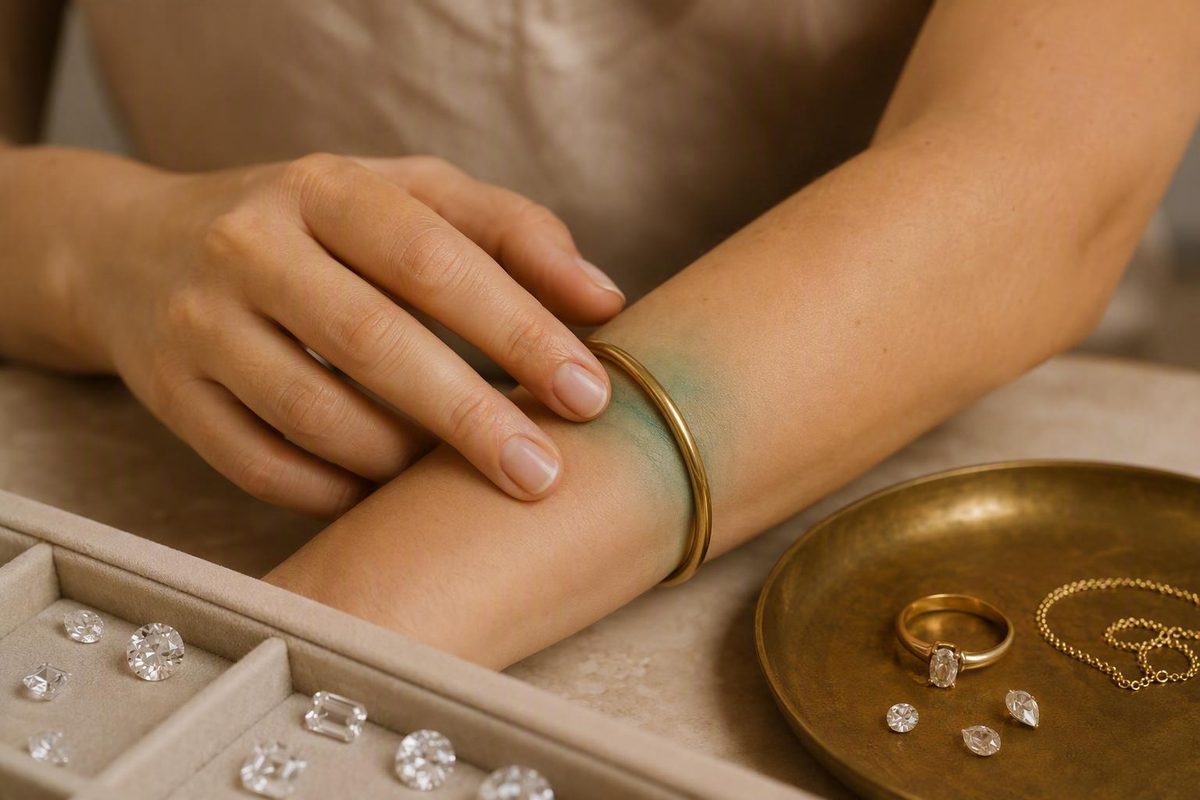
Yes. Brass can leave a green or blue-green mark on your skin because it is mainly an alloy of copper and zinc. The copper can react with sweat, air, skin oils, soap or other substances, producing colored copper compounds that transfer from the jewelry to your skin.
This is usually a removable surface stain—not proof that the jewelry is fake and not, by itself, an allergic reaction.
Why brass causes a green mark
Brass contains primarily copper and zinc, although its exact composition can vary. The Canadian Conservation Institute identifies brasses as alloys made mainly from those two metals and notes that perspiration contains salts and acids that can affect brass (Canadian Conservation Institute).
Copper is the source of the familiar green color. It reacts with substances in its surroundings to form compounds ranging from blue to green. The Royal Society of Chemistry explains that copper can react with sweat to form chelates and with salt water to form chlorides; the resulting thin layer can rub off onto skin (Royal Society of Chemistry). A published dermatology case report likewise attributes a green skin stain to copper salts formed when acidic sweat leached copper from a pendant (Indian Dermatology Online Journal).
A mark may therefore be more noticeable when:
- the jewelry remains wet or sweaty;
- a ring fits closely enough to trap moisture, soap or lotion;
- the protective lacquer or plating has worn through; or
- the piece receives frequent, prolonged skin contact.
Not every person—or every brass piece—will produce the same amount of discoloration. Alloy composition, surface coating, wear and the conditions under the jewelry all differ.
Does green skin mean the brass is low quality?
Not necessarily. Even correctly described brass can stain because copper is an expected part of the alloy. Conversely, a green mark does not establish that an item is solid brass. The same dermatology report notes that silver, gold and brass ornaments can all leave green stains when they contain copper.
For buying purposes, ask the seller to distinguish among:
- solid brass, where the metal remains brass below the surface;
- brass-plated jewelry, where a thin brass layer covers another material;
- gold-plated brass, where wear can eventually expose the brass beneath; and
- “brass tone” or “gold tone,” which describes appearance rather than confirming composition.
A material disclosure is more useful than judging the metal from a skin mark.
How to reduce green staining
The most reliable approach is to reduce moisture and chemical contact:
- Remove the piece before bathing, swimming or strenuous exercise. Dry your skin before putting it back on.
- Keep lotion, perfume and cleaning products off the contact surface. Let skin products dry before wearing the jewelry.
- Wipe the jewelry after wear. Use a clean, soft cloth, then store the piece dry. Choose a jewelry cleaning cloth only after confirming that it suits the finish.
- Preserve any existing coating. Abrasive polishing removes surface metal, while repeated polishing can erase detail (Canadian Conservation Institute). Avoid aggressive polishing on plated, antiqued or deliberately patinated jewelry.
- Do not automatically use vinegar-and-salt remedies. The Canadian Conservation Institute reports that this mixture can cause dezincification, a corrosion process that removes zinc and leaves a copper-rich surface. It also notes that residues from some polishes can produce green-blue copper compounds (Canadian Conservation Institute).
A clear coating can create a barrier between metal and skin, but it eventually wears and needs maintenance. For valuable, plated, stone-set or antique jewelry, ask a jeweler whether recoating is appropriate rather than applying an improvised product. If considering a commercial jewelry protectant spray, verify that its maker supports every metal, stone, adhesive and finish in the complete piece.
Green stain or skin reaction?
Color alone and an irritated rash are different signals. A transferable green mark is consistent with copper compounds. Redness, itching, tenderness, scaling or blisters suggest irritation or contact dermatitis instead. MedlinePlus lists nickel and other jewelry metals among common contact allergens and advises avoiding further exposure to the suspected substance (MedlinePlus).
Nickel is a particularly common cause of allergic contact dermatitis, and rings, bracelets, necklaces and other jewelry containing it can trigger symptoms (American Academy of Dermatology). Brass composition and finishes vary, so a “brass” description alone does not confirm whether a finished piece is nickel-free.
Stop wearing the jewelry if the skin becomes sore, itchy or inflamed. Seek medical advice for a severe, blistering, infected or recurring rash. For future purchases, request a specific nickel-free material disclosure rather than relying only on broad terms such as “hypoallergenic.”