
How Should a Ring Fit? A One-Minute Fit Test
Check knuckle resistance, comfort at the finger base, rotation, movement and removal—plus signs the ring is too tight or loose.
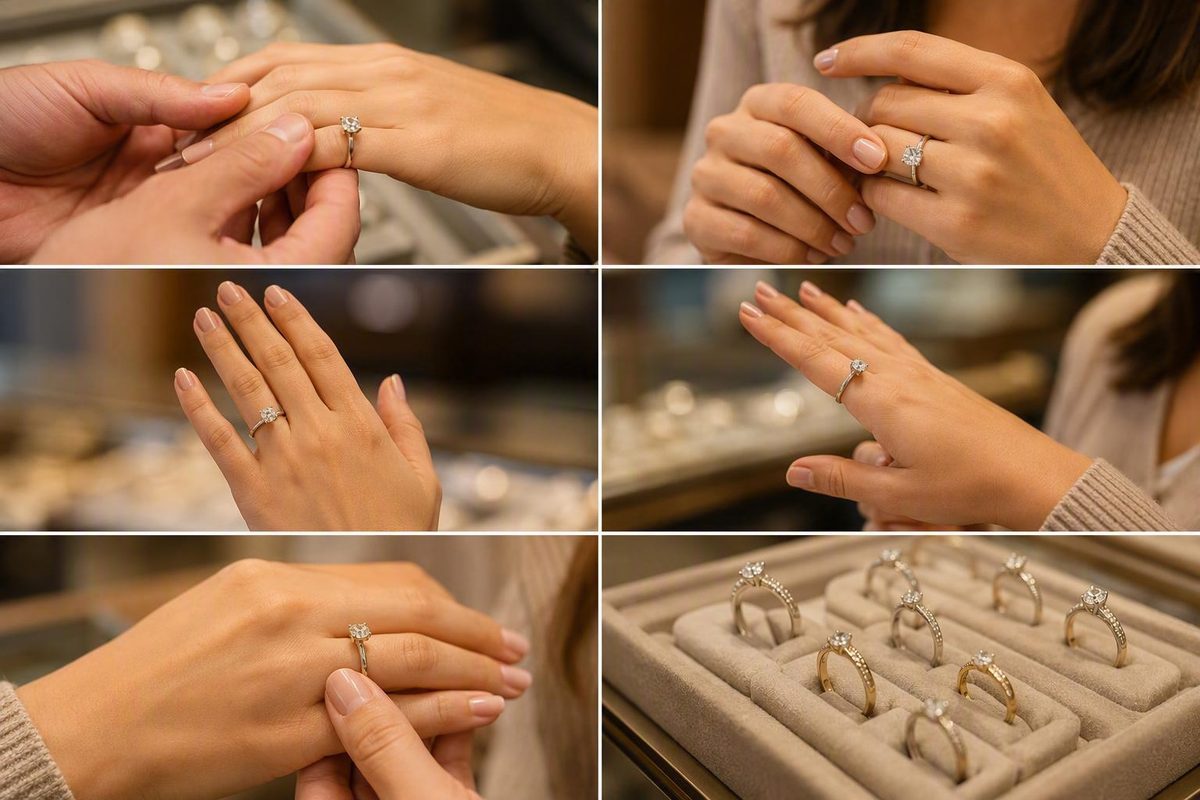
The quick answer: what a properly fitted ring feels like
A properly fitted ring should pass over your knuckle with mild resistance, sit snugly at the base of your finger without pinching, and come off with a gentle tug rather than force. Jewelers Mutual describes the same sequence: relatively easy placement, a little extra push over the knuckle, a snug resting position, and slight resistance during removal.
“Secure” does not mean painfully tight. The ring should not squeeze your finger, create persistent pressure, or become a daily struggle to remove. Equally, “comfortable” does not mean so loose that the ring spins constantly, moves toward the knuckle during normal activity, or could slip off unnoticed.
This standard applies broadly to engagement rings, wedding bands, heirlooms, signet rings, and fashion rings. The exact sensation will vary with your finger and knuckle shape, the ring’s width and interior profile, and the weight and balance of its setting.
A useful distinction is deliberate movement versus uncontrolled movement. You should generally be able to turn the ring intentionally without discomfort, but it should not rotate freely whenever you move your hand. Mild resistance at the knuckle is desirable; needing soap, force, or a prolonged struggle for routine removal is not.
Ring fit is therefore best judged through several qualitative checks:
- How the ring crosses the knuckle
- How it feels at the finger base
- Whether it stays in place during ordinary movement
- Whether you can turn it deliberately
- Whether removal takes a gentle tug or a struggle
- Whether it causes pain, tingling, unusual color, or a deep, persistent mark
A ring can pass one check and fail another. It might clear a prominent knuckle correctly but rotate at a much narrower finger base. A heavy engagement-ring setting may tilt even when the band is reasonably secure. Judge the overall pattern rather than relying on one sensation.
A one-minute ring-fit test
Test the ring with clean, dry hands in a safe indoor place. Stand away from sinks, floor vents, open windows, and other places where a dropped ring could disappear. Do not use soap to test looseness, and do not perform the test over a drain or in open water.
Then complete these five checks.
1. Placement check
Put the ring on normally. It should travel down the finger relatively easily, followed by a small push or mild resistance as it passes the knuckle.
If it drops into place without resistance, that may indicate looseness. If pushing it over the knuckle hurts or takes significant force, it may be too tight.
2. Base check
Let your hand relax. The ring should feel secure at the finger base without pinching, persistent pressure, pain, or obvious skin bulging. Flex and straighten your fingers to confirm that ordinary hand movement remains comfortable.
A small amount of soft-tissue compression is not automatically a problem. Fingers are not rigid cylinders, so a band may make light contact all the way around. What matters is whether that contact hurts or produces a deep, persistent groove.
3. Rotation check
Use your other hand to turn the ring gently. Deliberate rotation should usually be possible and comfortable. Constant free spinning during ordinary gestures is different and may indicate instability.
For a ring with a center stone, distinguish occasional tilting from a setting that repeatedly flips toward the palm. A top-heavy design can rotate because of its weight distribution even when the band is not clearly oversized.
4. Movement check
Open and close your hand, pick up a light everyday object, and let your arm hang naturally. The ring should remain near the finger base rather than repeatedly migrating toward the knuckle.
Do not use violent hand shaking as a stress test.
5. Removal check
Remove the ring slowly. It should move up the finger and meet slight resistance at the knuckle. A gentle tug or small back-and-forth motion should be enough.
It should not fall off effortlessly, but routine removal should not require soap, substantial force, or a prolonged struggle.
Use the combined results to classify the fit:
| Result | What you observe |
|---|---|
| Proper fit | Mild resistance at the knuckle; secure and comfortable at the base; deliberate rotation possible; stable during normal movement; removable with a gentle tug |
| Probably too tight | Painful placement or removal; pinching; skin bulging; persistent pressure; deep marks; restricted rotation; or recurring difficulty taking it off |
| Probably too loose | Little or no knuckle resistance; constant spinning; repeated movement toward the knuckle; effortless removal; or a credible risk of slipping off |
| Temporarily changed by conditions | Normally secure and comfortable, but noticeably tighter after heat or activity or looser in cold conditions |
If the result is ambiguous, do not rush into resizing. Repeat the check under ordinary conditions on several days and look for a consistent pattern.
Signs your ring is too tight
A snug ring stays in place without hurting. A ring is probably too tight when it repeatedly causes discomfort, visible constriction, difficulty moving or removing the band, or altered sensation.
Warning signs include:
- Pain or pinching
- Tingling or numbness
- A cold feeling in the finger
- Blue, purple, pale, or otherwise unusual discoloration
- Marked swelling or skin bulging around the band
- Deep, painful, or persistent grooves
- Inability to rotate the ring slightly
- Recurring difficulty removing it
- A ring that becomes trapped
These signs are described in jewelry-fitting guidance as indications that a ring needs attention rather than evidence of a desirable snug fit. Jewelers Mutual, for example, identifies pain, tingling, discoloration, bulging, deep marks, and inability to rotate or remove a ring as excessive-tightness indicators. Its guidance also recommends professional attention when fit is consistently wrong.
A faint temporary impression after extended wear can occur, particularly with a broad band. Consider the character of the mark rather than treating every line as proof that the ring is too small. A light impression that fades and is not painful is different from a deep groove associated with discomfort or unusual color.
Context matters as well. A ring that feels briefly snug after exercise or during unusually hot weather may reflect a temporary change. If it returns to a comfortable, secure fit when conditions normalize, observation may be more appropriate than immediate resizing. If the same problems recur during ordinary days, the underlying fit probably needs attention.
This article provides general jewelry-fitting information, not individualized medical advice. It cannot determine the cause or urgency of numbness, coldness, marked swelling, unusual color, or a trapped ring. Do not continue treating those symptoms as a routine sizing test; obtain appropriate medical advice. A jeweler can assess an otherwise asymptomatic sizing or repair problem, but jewelry evaluation is not a substitute for medical assessment of physical symptoms.
This guide therefore does not provide a countdown or a do-it-yourself removal procedure.
Signs your ring is too loose—and why spinning is not conclusive
A ring is probably too loose when it does not remain predictably secure during normal wear. Common signs include:
- Constant or frequent uncontrolled rotation
- Easy sliding up and down the finger
- Repeated movement toward the knuckle during ordinary activity
- Little resistance as the ring crosses the knuckle
- Effortless removal
- A center setting that regularly turns under the finger
- Reluctance to wear the ring because it feels likely to slip off
The key is recurrence. A ring that shifts once is not necessarily too large. Hands move, fingers taper, and settings have uneven weight. Occasional rotation can be normal when the band remains secure at the base and still meets meaningful resistance at the knuckle.
Spinning alone is not conclusive because the ring may be mechanically unbalanced. A large center stone, elevated setting, halo, or other top-heavy design places more weight above the finger. Gravity can pull that setting sideways even when the ring’s circumference is not clearly oversized. Commercial fitting guidance also notes that a top-heavy design can spin because of its weight distribution rather than band size alone.
Finger anatomy can produce a similar effect. A tapered finger becomes narrower toward the base, giving the band less of a ledge to rest against. Someone with a prominent knuckle and slim finger base may need a ring large enough to cross the knuckle, only to find that it rotates once seated. Simply reducing the size could improve base stability while making the ring painful or impractical to pass over the knuckle.
Assess spinning alongside three other factors:
- Knuckle security: Does the ring still meet resistance before coming off?
- Base stability: Does it slide freely up the finger, or does the setting mainly tilt in place?
- Frequency: Does it move occasionally or almost every time you use your hand?
If the ring constantly rotates, slides toward the knuckle, and comes off with almost no resistance, looseness is the likely explanation. If the stone occasionally leans but the band stays secure, consider setting weight and finger shape before changing size.
Cold conditions can make an already loose ring feel less secure, while water or soap can reduce grip. Do not deliberately recreate those conditions as a fit test. Remove or otherwise secure a loose-feeling ring before entering situations in which its loss would be difficult to notice or reverse.
Why the same ring fits differently throughout the day and year
Your finger is living tissue, not a fixed-size mandrel. Its circumference can vary, so the same ring may feel snug at one time and loose at another.
Potential influences include:
- Heat and cold
- Exercise and other activity
- Fluid retention
- Diet and hydration
- Pregnancy
- Weight change
- Time of day
- Individual health and anatomical factors
The general pattern described in fitting guidance is that heat may make a ring feel tighter and cold may make it feel looser, although there is no fixed size change that applies to everyone. Temperature, activity, and diet can all contribute to fluctuations, which is why measurement immediately after exercise or during extreme temperatures may be misleading. The Knot discusses these fit variables and recommends checking size under more typical conditions.
For example, a ring may feel temporarily snug after a workout or on a hot day, then return to its usual fit later. In cold weather, the same ring may rotate more or become easier to remove. Neither isolated event proves that permanent resizing is necessary.
Judge fit across several ordinary days—not during a heat wave, immediately after strenuous exercise, when your hands are unusually cold, or during an episode of pronounced swelling. This reduces the chance of solving a temporary condition with a permanent alteration.
A simple fit log can make the pattern easier to see:
| Observation | What to note |
|---|---|
| Comfort | Comfortable, pressured, pinching, or painful |
| Movement | Stable, occasional tilt, frequent spin, or sliding |
| Removal | Gentle tug, effortless, difficult, or not attempted |
| Conditions | Normal, hot, cold, or unusually humid |
| Recent activity | Resting, exercising, or just finished activity |
| Configuration | Ring alone or worn in a stack |
You do not need an elaborate diary. A few short entries may show whether the ring is consistently wrong or changes only under particular conditions.
Do not use ring fit to diagnose persistent or unexplained physical changes. If pain, swelling, unusual color, or altered sensation is unexplained or concerning, obtain appropriate medical advice rather than assuming resizing is the complete answer.
How to measure ring size without trusting one reading
Measure the exact finger on which the ring will be worn. Do not assume that the corresponding finger on the other hand is identical; left and right ring fingers can differ.
Take repeated measurements on multiple days under moderate conditions. Avoid measuring when your hands are unusually cold, immediately after exercise, or noticeably swollen from heat. The goal is to estimate your ordinary fit range rather than capture the finger at its absolute smallest or largest.
Paper or string method
- Cut a narrow strip of paper or choose a non-bulky piece of string.
- Wrap it around the base of the intended finger.
- Keep it snug against the skin without digging in.
- Mark where the ends overlap.
- Lay it flat and measure the length in millimeters.
- Compare that circumference with the specific seller’s size chart.
- Repeat the process instead of relying on the first result.
Whichever material you use, the measured loop must also be able to pass over the knuckle. A base-only measurement can underestimate the practical size when the knuckle is prominent.
Existing-ring method
If you own a ring that fits correctly, make sure it fits the same intended finger and is reasonably similar in width. Measure straight across the inside of the band at its widest point to obtain the inner diameter, excluding the metal itself. Compare that measurement with the seller’s chart.
Alternatively, place the ring over the circles on a correctly scaled printable guide. The printed circle should align with the inside edge of the ring, not the outside.
For any printable tool:
- Print at 100% or actual size
- Disable “fit to page” or automatic scaling
- Check the printed reference line with a physical ruler
- Reprint the guide if that reference does not match
Those scale checks are essential because printer settings can enlarge or reduce the chart. Gabriel & Co.’s at-home sizing instructions specifically call for 100% printing and verification against a ruler.
Common sources of error include:
- Pulling string too tightly
- Allowing stretchy string to lengthen
- Wrapping paper at an angle
- Measuring a different position each time
- Misaligning the ruler’s zero point
- Measuring the outside rather than the inside diameter
- Printing a chart at reduced or enlarged scale
- Using a ring that fits another finger
- Measuring only once
- Ignoring the finished band’s width
Treat home sizing as an estimate, not a guarantee. If measurements disagree, try a physical sizing set or visit a professional jeweler. Professional fitting is especially worthwhile for a valuable ring, wide band, unusual shape, stone-set band, heirloom, or design that may be difficult to alter.
If possible, try the proposed size and its neighboring sizes. Wear the sizer long enough to evaluate knuckle passage, comfort at the base, movement, and removal—not merely whether it can be pushed onto the finger once.
Fit factors a basic ring-size chart cannot capture
A size chart converts circumference or diameter into a nominal size. It cannot fully predict how a finished ring will interact with your anatomy, its design, or other jewelry.
Band width
There is no universal quarter- or half-size adjustment that works for every wearer and design. Test with a sizing band that approximates the finished ring’s width.
The interior profile matters too. A rounded comfort-fit interior may pass over and rest on the finger differently from a flatter standard interior. Two rings carrying the same stated size can therefore feel different.
Ring stacks
Test the rings in their intended order and configuration. Check comfort while making a fist, typing, gripping a light object, and relaxing your hand. Do not choose the engagement-ring size in isolation if it will normally be worn as part of a stack.
Prominent knuckles
When the knuckle is much larger than the finger base, sizing becomes a compromise. The ring must be large enough to cross the knuckle without pain but stable enough not to spin once seated. A generic chart cannot determine that balance.
Reducing the band size may not be the right solution, even when the ring rotates at the base. A jeweler may instead consider a stabilization method that preserves passage over the knuckle.
Tapered fingers
A finger that narrows steadily toward the base gives the ring less resistance against upward movement. The band may drift or rotate even when its nominal size is plausible. Stability must therefore be assessed during movement rather than only while the hand rests flat.
Heavy or top-heavy settings
A prominent center stone or elevated setting shifts the ring’s center of gravity. This can produce tilt or rotation independently of band size. A smaller band might reduce movement but make the knuckle fit too tight, so consider the ring’s balance before resizing.
Interior construction
Even if two rings have matching inner diameters at one point, their overall feel may differ.
For wide rings, stacks, substantial knuckle-to-base differences, or heavy settings, use a sizer that resembles the finished piece and seek individualized fitting rather than relying only on a conversion chart.
When to wait, use a temporary adjustment, or resize
The right response depends on whether the poor fit is occasional, condition-dependent, mechanically caused, or persistent.
Monitor the fit when the change is occasional
Monitoring is reasonable when the ring is secure and comfortable most of the time but becomes temporarily snug after heat or activity or slightly loose in cold weather. Use a short fit log over several ordinary days and look for a stable pattern.
Do not authorize permanent work based on one unusual afternoon. Conversely, do not continue testing through pain, altered sensation, marked swelling, unusual color, or an inability to remove the ring; those issues fall outside routine sizing assessment.
Consider a temporary or stabilizing adjustment for minor looseness
Temporary or stabilizing options may make sense when looseness is modest or fluctuates. Possibilities described in fitting guidance include:
- Removable ring adjusters
- Ring guards
- Inserts
- Jeweler-installed sizing beads
Whether one is appropriate depends on the ring and the wearer. Ask a jeweler to inspect the band and setting rather than assuming a generic product will suit every design.
Sizing beads or another stabilization method may be more useful than simple downsizing when the knuckle is prominent, the finger base is narrow, or the setting is top-heavy. The goal is to reduce unwanted movement while preserving reasonable passage over the knuckle.
Avoid improvised alterations involving pliers, adhesives, tied materials, or heat-shrink tubing. The supplied evidence does not establish those methods as safe for the wearer, gemstones, plating, finish, or setting.
Consult a jeweler when poor fit is persistent
Professional assessment is appropriate when the ring repeatedly causes discomfort, consistently slides toward the knuckle, remains difficult to remove under ordinary conditions, or feels insecure enough that you avoid wearing it.
Resizing is not simply a matter of selecting a new number. Feasibility can depend on:
- The metal or material
- Band construction
- Setting style
- Gemstone type and placement
- Stone coverage around the band
- Engraving or surface detail
- Existing repairs or alterations
- The amount and direction of the proposed change
Some eternity bands and rings made from tungsten, titanium, or ceramic can be difficult or impossible to resize conventionally. This is not an absolute rule for every ring carrying those labels: manufacturing method, alloy, inlays, stone layout, and repair-shop capabilities also matter. Gabriel & Co.’s sizing guide likewise identifies these materials and eternity-style settings as potentially difficult or impossible to alter conventionally.
Do not rely on generic promises about cost, turnaround time, allowable size change, or the number of times a ring can be resized. Those variables depend on the individual piece. A jeweler should inspect a valuable, antique, intricate, engraved, or stone-set ring before recommending permanent work.
Use this decision framework:
- Occasional and condition-dependent: monitor the pattern.
- Minor or fluctuating looseness: ask about a suitable temporary adjustment.
- Persistent poor fit: obtain professional sizing and inspection.
- Large knuckle or top-heavy setting: investigate stabilization as well as resizing.
- Physical symptoms or a trapped ring: stop treating the problem as routine sizing and obtain appropriate medical advice.
Frequently asked questions
Should a properly fitting ring leave a mark?
A faint, temporary impression after extended wear can occur and does not by itself prove that a ring is too tight. Consider the mark’s depth, duration, comfort, and color. A deep, painful, persistent, or discolored groove indicates that the fit needs attention.
Interpret the mark alongside the other checks. If the ring crosses the knuckle with mild resistance, feels comfortable, turns deliberately, and comes off with a gentle tug, a light fading impression is less concerning than a mark accompanied by bulging, pain, altered sensation, or difficult removal.
How much should a ring spin on the finger?
There is no validated universal amount of acceptable rotation. You should generally be able to turn the ring deliberately, but it should not spin constantly or move unpredictably during ordinary activity.
Check whether the ring also slides toward the knuckle or comes off too easily. Occasional tilting may result from a top-heavy setting, tapered finger, or narrow finger base rather than an oversized band. Spinning alone does not determine the correct size.
Should a ring fit tighter in summer than in winter?
It can. Heat may make a ring feel tighter, while cold may make it feel looser. The degree varies by person, so do not assume a fixed seasonal size difference.
If the change is modest and predictable, monitoring or a temporary adjustment may be preferable to immediate resizing. Judge the fit across ordinary conditions and focus on whether the ring remains secure and comfortable rather than expecting it to feel identical in every season.
Should I size up for a wide band or a ring stack?
Possibly, but not by a universal amount. Wide bands and stacked rings often feel tighter because they cover more of the finger than a narrow sizing sample.
Try a sizer close to the finished band’s width and interior profile. For a stack, test all rings together in their intended order. Compare neighboring sizes and choose the one that remains secure at the base, passes the knuckle with mild resistance, and stays comfortable during ordinary movement.
What should I do if my ring causes numbness, discoloration, or will not come off?
Do not treat numbness, coldness, marked swelling, unusual color, or a trapped ring as an ordinary fit test. This general jewelry guide cannot determine the medical cause or urgency of those symptoms, so obtain appropriate medical advice rather than relying on a sizing article or treating a jeweler as a substitute for healthcare assessment.
For a persistent but asymptomatic fit problem, a qualified jeweler can inspect the ring and discuss sizing or repair options. This article does not provide a fixed time threshold or a do-it-yourself trapped-ring removal method.
A good ring fit is secure at the base, mildly resistant at the knuckle, comfortable during ordinary wear, deliberately rotatable, and removable with a gentle tug. Assess the actual ring on the intended finger across several normal days, then choose among monitoring, a jeweler-approved temporary adjustment, or professional resizing. Routine fit problems allow time for observation; physical symptoms and a trapped ring should not be handled as ordinary sizing questions.