
I3 Clarity Diamond: What It Means and When to Buy
Learn what I3 diamond clarity means, how inclusions affect appearance and durability, and what to check before accepting a lower price.
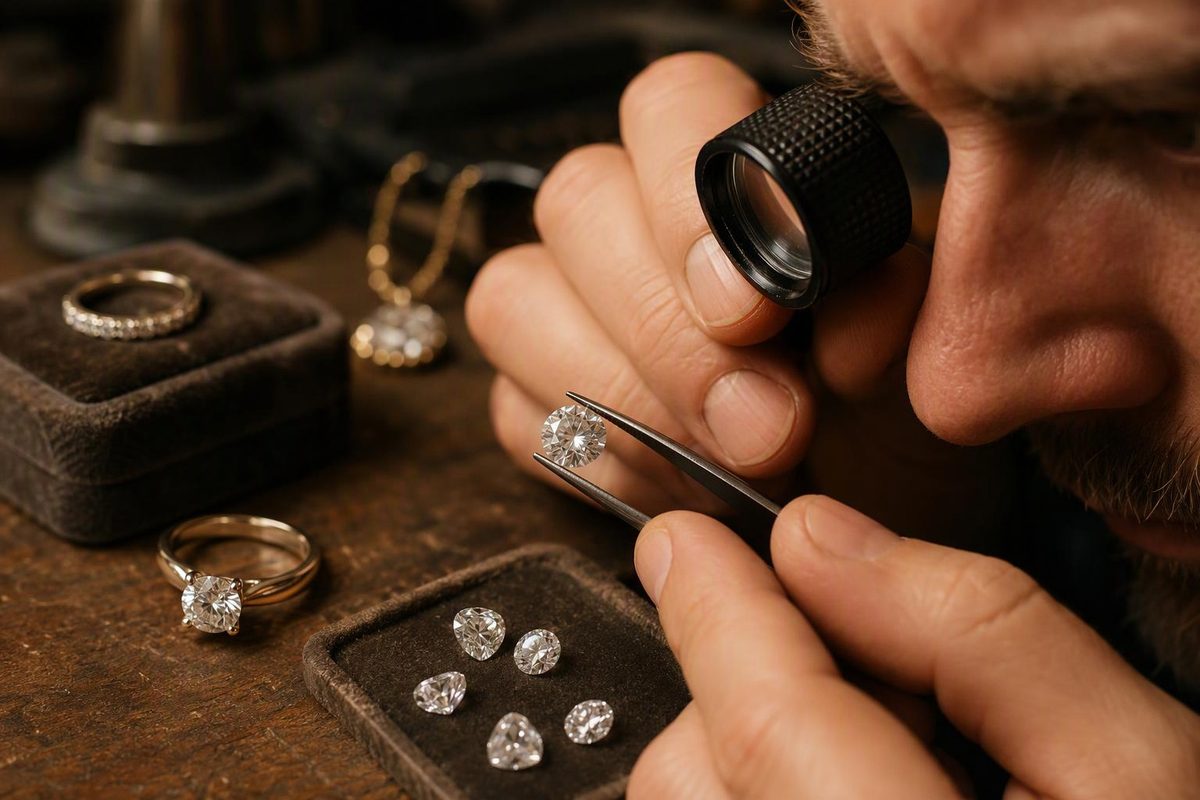
An I3 clarity diamond is in the lowest grade on GIA’s 11-grade clarity scale. The “I” stands for Included, and I3 sits below I1 and I2. Inclusions in this category are obvious under 10× magnification and may affect transparency and brilliance. GIA’s clarity scale explains the grading framework.
For a buyer seeking a bright, visibly clean engagement-ring center stone, I3 would not be our starting point. It can be worth considering if you deliberately like a heavily included appearance—but only after checking the individual stone’s condition, treatment status and price.
What will an I3 diamond look like?
Expect visible inclusions rather than assuming the diamond will be “eye-clean.” GIA describes inclusions in the Included category as often visible without magnification; it does not use eye-clean as a laboratory grade. Its clarity guidance also shows an I3 example whose appearance is affected by numerous clarity characteristics.
The practical trade-offs are separate:
- Visible marks: Do dark spots, pale fractures or other features draw your attention away from the facet pattern?
- Transparency: Does the diamond look clear through its body, or hazy and cloudy?
- Sparkle: Does it show crisp flashes as it moves, or does part of the stone remain dull?
Two diamonds labeled I3 need not look identical. Clarity grading considers the size, number, position, nature and contrast of the characteristics—not simply a count of inclusions. An inclusion under the table, the large top facet, can have more impact than a similar feature off to one side. GIA explains these grading factors.
A brilliant cutting style may make some inclusions less conspicuous than a step cut, but it is not a reliable way to hide extensive inclusions. GIA notes that large or numerous clarity features can be easy to see regardless of cutting style. Do not treat a seller’s high cut grade as evidence that the diamond has good transparency; inspect both separately.
For the broader grade comparison, see our diamond clarity scale chart.
Does I3 mean the diamond will break?
No—but durability deserves a separate inspection. A clarity grade is not a prediction of when a stone will chip.
GIA identifies certain surface-reaching inclusions, particularly near the girdle—the edge where a diamond is set—as potential vulnerabilities. Deep feathers, a gemological term for fractures, can also raise durability concerns. Not every feather is dangerous; its depth and position matter. GIA’s durability discussion explains why these features need individual assessment.
Before buying an I3 diamond for daily wear, ask an independent gemologist to examine the stone and a qualified setter to assess the proposed mounting. Ask specifically whether fractures reach the edge, whether chips are already present, and whether setting or resetting introduces concerns. Do not assume a prong placed over an inclusion makes it structurally safe.
What to request before paying
Identify who assigned the grade. A seller’s “I3” description is not the same evidence as a laboratory report. Request the report, if one exists, and compare its weight, measurements and identifying details with the offered stone. If there is no report, make the purchase conditional on an independent examination.
Inspect the actual diamond in ordinary lighting. Request a face-up view and a rotating video in diffuse daylight and normal indoor light, not only under jewelry-store spotlights. Inspect without magnification first, then use magnification to locate the features that bother you. A return period should allow an in-person check.
Get treatment status in writing. “Clarity enhanced” needs an explanation. Laser drilling and fracture filling are different treatments. GIA grades laser-drilled diamonds unless they also contain fracture filling, but does not issue grading reports for fracture-filled diamonds because the filling is not stable or permanent. Steam, ultrasonic cleaning and common repair procedures can damage the filling. GIA’s treatment guidance sets out those distinctions.
Is the lower price worth it?
All else equal, lower clarity generally means a lower price, as GIA’s clarity guidance explains. But I3 alone cannot establish a fair dollar value. GIA describes diamond value as a combination of color, clarity, cut and carat weight, rather than any single grade. Its quality-factor guide explains that relationship.
Compare actual alternatives within your total budget: a smaller natural diamond with a cleaner appearance, an individually inspected higher-clarity stone, or a lab-grown diamond if origin is flexible. For a closer comparison, our SI2 buying guide explains what still needs checking above the Included grades.
Buy I3 because you accept and enjoy the particular diamond’s appearance—not because the carat weight looks impressive or the seller calls it a bargain. If transparency, condition or treatment status remains unresolved, the lower price is not enough reason to proceed.