
Is Your Ring Size Your Shoe Size? No—Measure It
There is no dependable conversion formula; measure the exact finger with a gauge or use a round ring that already fits that finger.
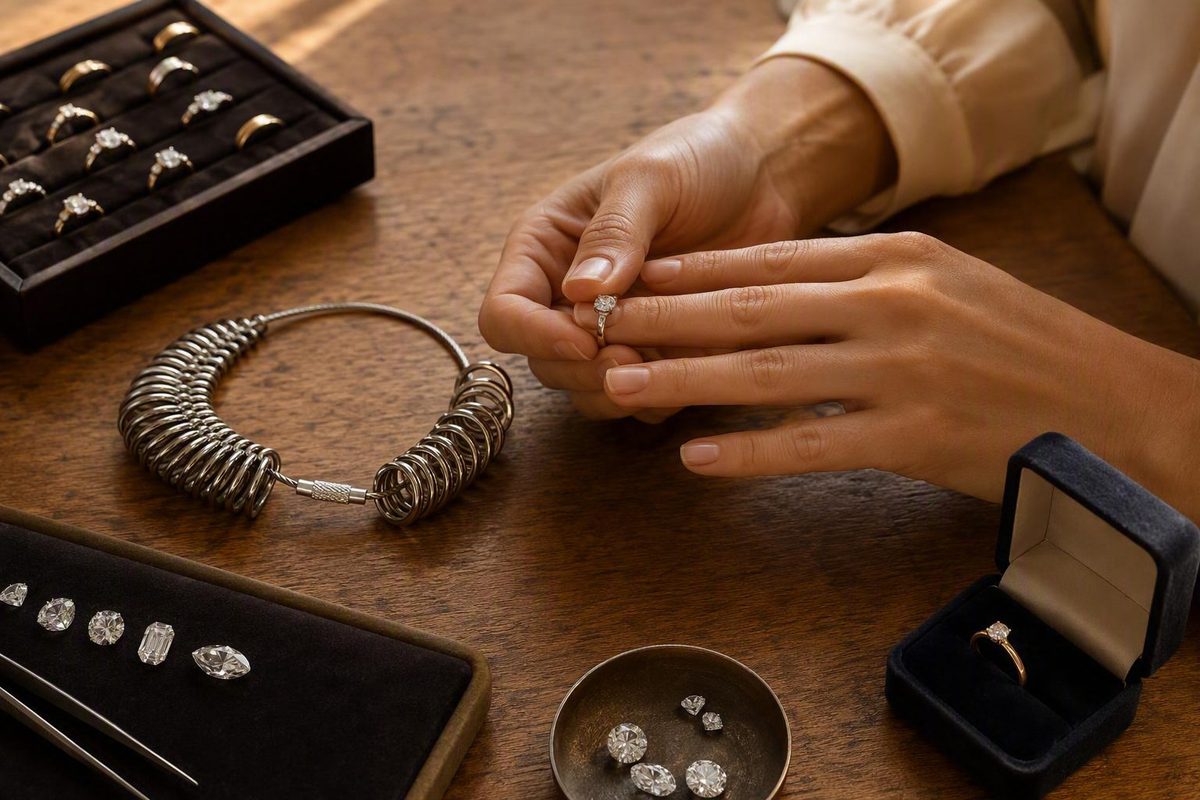
No—your ring size is not reliably the same as your shoe size, and there is no dependable formula for converting one into the other. Matching numbers are a coincidence. For a low-risk purchase, measure the exact finger with an appropriate ring gauge or measure a round ring that already fits that finger.
No, your ring size is not your shoe size
Shoe and ring sizes describe different measurements. Shoe sizing is tied to foot dimensions, while ring sizing describes the opening required to fit one particular finger. Using numbers in both systems does not make those numbers interchangeable.
A comparison of the separate footwear and ring-measurement standards supports the practical conclusion that a shoe-size label does not provide the finger measurement needed to order a ring. This is an inference from how the two systems are defined, not evidence that the standards directly tested a shoe-to-ring correlation (Ring Sizer’s comparison of shoe and ring sizing).
If someone wears a size 7 shoe and a size 7 ring, that match cannot predict another person’s ring size. It cannot even predict the size of a different finger on the same person. It is not evidence of a conversion rule.
Height, weight, build and hand size are also unsuitable for choosing a precise order size. Body dimensions may show broad relationships across a population, but those averages cannot reveal an individual finger’s circumference, knuckle clearance or fit inside a particular band. For a purchase, direct measurement is the evidence that matters.
Choose a sizing method based on the purchase risk
The strongest method is professional fitting by a jeweller using finger gauges appropriate for the intended band. That becomes especially important when the ring is expensive, custom-made, final sale or difficult to resize.
The confidence labels below are practical rankings, not measured accuracy grades; the evidence does not provide comparative error rates for every method.
| Method | Practical confidence | Best use |
|---|---|---|
| Professional finger-gauge fitting | Highest | Custom, expensive, final-sale or hard-to-resize rings |
| Fixed physical sizing rings | High when used correctly | At-home fitting before a standard jewellery order |
| Well-fitting ring measured by a jeweller | High if it fits the correct finger and is round | Confirming a known fit or planning a surprise |
| Adjustable belt sizer or printable tool | Rougher; technique can affect the result | Preliminary estimate before confirmation |
| String or paper | Low; material can stretch or distort | Rough estimate only |
| Shoe size, height, weight, build or hand-size guess | Unsuitable | Never for selecting a precise order size |
Fixed sizing rings are generally preferable to an adjustable belt-style sizer. A belt sizer can be pulled too tightly or left too loose, while a fixed ring provides a rigid opening that must pass over the knuckle. String can stretch, and paper can bend or become damaged; neither reliably reproduces how a rigid ring moves over the finger joint.
Match the method to the consequences of getting it wrong. A rough home estimate may be sufficient before ordering an inexpensive ring with straightforward exchanges. It is a poor basis for approving a non-returnable engagement ring or custom wedding band.
Measure the exact finger—and check how the ring passes the knuckle
Measure the finger and hand on which the ring will actually be worn. Do not assume that the corresponding finger on the opposite hand—or a neighbouring finger—takes the same size.
A suitable sizing sample should pass over the knuckle comfortably and then sit securely at the finger’s base. It should not turn freely or feel likely to slip off, but it should come back over the knuckle without painful force. Finger shape matters: a tapered finger can require a different balance between security and knuckle clearance than a finger with a prominent joint.
The sizing sample should also resemble the intended ring. Band width and interior profile can change how a ring feels even when its nominal size is unchanged. GIA distinguishes narrow finger gauges for rings up to 4 mm wide from wide-finger gauges for wider rings and identifies several profiles that can require special sizing treatment (GIA’s professional finger- and ring-measurement guidance).
If you are buying a broad wedding band, do not confirm the order using only a thin, wire-like sample. Whenever possible, try a gauge or sample with a similar width and inside profile. If an exact match is unavailable, tell the jeweller what type of ring you intend to order so the measurement can be interpreted appropriately.
How to find the size from a ring that already fits
An existing ring can provide strong sizing evidence—but only if it fits the intended finger on the intended hand. A ring worn on another finger is not a reliable substitute.
The best approach is to take the ring to a jeweller, who can measure it using a calibrated ring stick or mandrel. This avoids many of the reading and chart-matching errors that can occur at home.
For an at-home estimate:
- Confirm that the ring fits the correct finger and hand.
- Place it flat against a millimetre ruler or use a caliper.
- Measure straight across the opening from one inside edge to the opposite inside edge.
- Record the inner diameter in millimetres.
- Compare the result with the selected seller’s clearly labelled size chart.
- Check that the chart uses diameter—not circumference—and the intended national sizing system.
Use diameter matching only when the ring is round. A bent, oval or otherwise distorted ring can produce a misleading reading and should be assessed by a jeweller instead.
International systems use different labels. Inner diameter or circumference in millimetres gives you a clearer reference for conversion, but the final order should still be checked against the seller’s chart because brands and manufacturing tolerances may differ.
For a surprise ring, prioritize evidence and reversibility
The strongest discreet option is to borrow a ring known to fit the correct finger and take it to a jeweller. If borrowing it is impractical, ask a trusted friend or family member to help arrange a professional measurement without revealing the plan.
A jeweller may also be able to estimate size from a careful tracing of the ring’s inner circle or another physical reference. These methods are approximations, so first confirm that the borrowed ring is genuinely worn on the intended finger and hand.
Do not fill an evidence gap with a shoe-size formula, body-build range or supposed “average” ring size. If direct measurement is impossible, treat the selected size as provisional. Before paying, verify the seller’s return, exchange and resizing terms—including whether those terms apply to the exact setting, metal and customisation you have chosen.
That flexibility matters because pavé, channel-set and eternity rings, as well as some intricate or gemstone-set designs, can be difficult to resize (GIA’s ring-size and resizing guidance). Professional sizing is therefore particularly important for these designs and for custom or final-sale pieces.
Treat shoe size as irrelevant to the buying decision. Measure the intended finger with an appropriate gauge, or measure a round ring that already fits it, and confirm the result for the intended band. If the purchase must remain a surprise, use the best physical evidence available and choose terms that allow the fit to be corrected.
Do men’s and women’s rings use the same US sizing scale?
Yes. Men’s and women’s jewellery rings use the same numerical US sizing scale, so the same number represents the same nominal ring size. Retailers may stock or market different size ranges, but that does not create separate sizing systems (Modern Gents’ explanation of US ring sizing).
Can I use a standard jewelry ring size for a smart ring?
Not safely. Smart-ring brands may use proprietary sizing systems that do not match standard jewellery sizes. Use the manufacturer’s sizing kit, follow its trial instructions and order the size specified for that exact model (smart-ring sizing guidance).