
How to Choose an Angular Ring Without Overlooking the Practical Details
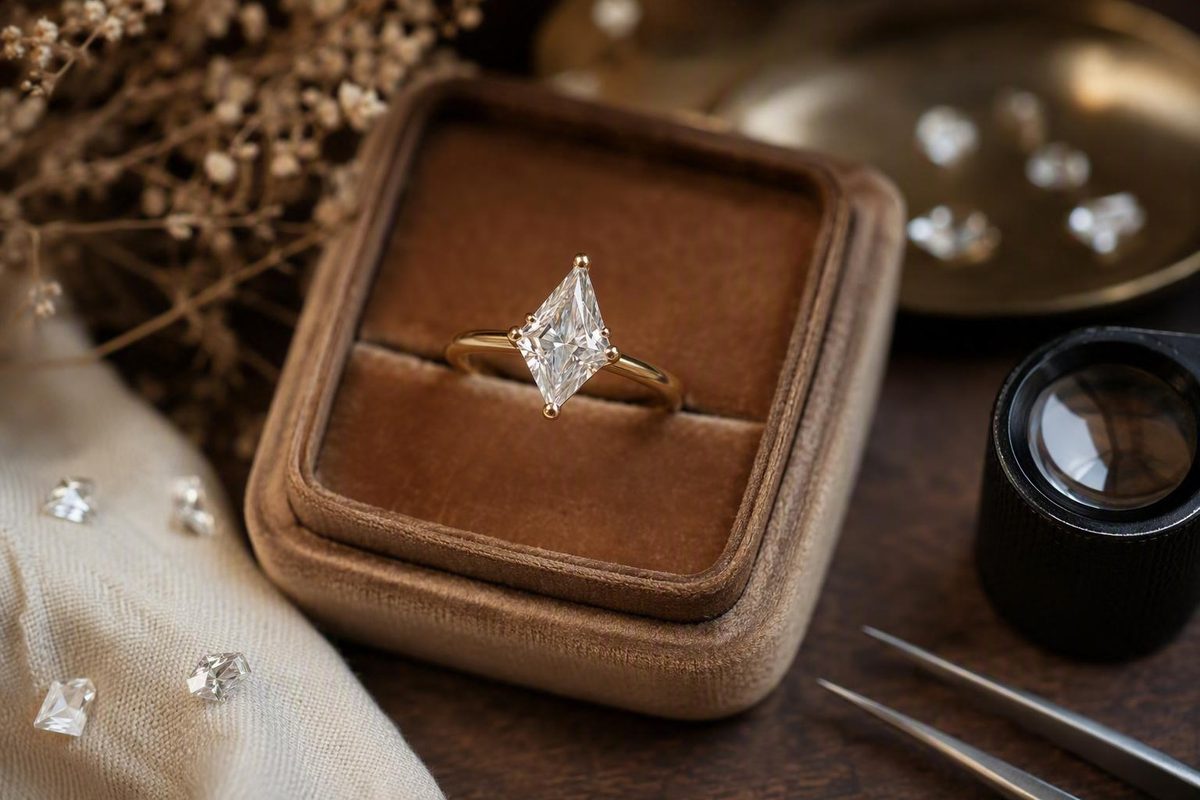
A kite cut engagement ring can be visually arresting: angular, elongated, and far removed from a standard round solitaire. It can also be unusually difficult to compare online. Sellers use “kite cut,” “kite shaped,” and “kite set” inconsistently; stones with similar outlines may have different facet patterns; and pointed ends introduce setting and wedding-band questions that product photographs often conceal.
The safest approach is to treat every kite-shaped center stone as an individual fancy shape. First establish what kite means in the listing. Then examine the actual outline, faceting, dimensions, point condition, setting construction, and band fit. Compare prices only after accounting for the center stone, metal, accents, matching bands, customization, and after-sale terms.
This guide uses GIA material for general diamond-shape and point-protection principles. Kite-specific terminology, product availability, and price examples come largely from retailer pages and should be treated as seller-derived market evidence rather than independent testing or endorsements. Where the available evidence does not establish a universal rule, the guidance below is framed as something to inspect or verify on the individual ring.
What a “kite cut” engagement ring can actually mean
The first buying risk is not color, clarity, or carat weight. It is terminology.
Retail catalogs may use kite cut, kite shaped, and kite set as though they mean the same thing. They do not always describe the same object. “Kite” may refer to the center stone’s physical outline, the orientation of a square stone, a pair of side stones, or merely an angular design motif.
A useful starting distinction is:
- Shape is the stone’s face-up outline.
- Cut style is the arrangement and angles of its facets.
These are separate decisions. GIA distinguishes diamond shape from cut style and identifies brilliant and step cuts as the two most common facet-style categories in its guide to diamond shapes and cut styles.
In retailer terminology, a true kite-shaped stone is physically fashioned into an elongated, angular outline, generally with a wider end tapering toward a narrower point. The stone remains kite shaped when removed from its mounting.
A kite-set stone is different. It is usually a square princess or Asscher diamond rotated 45 degrees so that the corners point north, south, east, and west. The result resembles a kite on the hand, but the stone itself remains square. Frank Darling’s explanation of kite-set diamonds makes this distinction and notes that rotating the stone does not change its underlying cut or inherent light performance.
Do not confuse either construction with compass-point prongs. A jeweler can move the prongs to north, south, east, and west without rotating the stone.
There is another source of confusion: some collection pages include rings with kite-shaped side stones but a center stone of another shape. Others place wedding bands, ring sets, lozenges, shields, daggers, coffin shapes, or elongated hexagons under broad filters. That does not make those outlines interchangeable. The available evidence does not establish authoritative boundaries among every retailer-used geometric label, so the actual outline and measurements matter more than the category name.
Before comparing prices, send the seller a verification request such as:
Please confirm whether “kite” refers to the center stone’s physical shape, the orientation of a square stone, the accent stones, or the overall design. Please provide the exact shape description shown on any laboratory report, the stone’s length, width, and depth in millimeters, and a straight-on face-up image or outline diagram.
Also ask whether the pictured stone is the exact stone for sale. If the ring is made to order, the image may show a sample, generic render, or previously sold stone rather than the center stone you will receive.
How outline and faceting determine the look
A kite outline does not dictate one type of sparkle. Retailer guidance describes kite-shaped stones with brilliant-style, step-style, and rose-style faceting, so two stones sold under the same shape label can look substantially different in motion.
Broadly:
- Brilliant-style patterns use numerous smaller facets and can produce a busier field of flashes.
- Step-style patterns use more linear, geometric rows of facets and can create a more orderly visual structure.
- Rose-style patterns have a shallow, faceted-dome appearance and should not be judged as though they were modern brilliant cuts.
These are visual categories, not performance guarantees. A brilliant-style kite is not automatically lively, and a step-style kite is not necessarily subdued. Proportions, facet angles, optical symmetry, obstruction, and lighting all affect the observed result. Retailer descriptions confirm that these different facet approaches appear in kite-shaped stones, but they do not establish a single performance hierarchy among them.
Shape and cut style must therefore be assessed independently. The outline determines the silhouette; the facets determine how light and dark areas organize within it. One kite may show fine scintillation, another broad directional flashes, and another persistent transparent or dark areas.
Do not expect a grading report to settle the matter. According to GIA’s general shape guidance, only the standard round brilliant receives an official GIA cut grade. A kite-shaped diamond should not be presumed attractive merely because it has reputable paperwork, nor should the absence of an overall cut grade be mistaken for a defect.
Avoid assumptions at either extreme. Not every kite will reproduce the balanced, uniform display associated with a well-cut round brilliant. It is equally unreliable to assume that every kite will show slow or muted flashes. The individual stone must be observed.
Ask for videos in at least three environments:
- Diffuse daylight, which can make broad transparency, windowing, and overall brightness easier to assess.
- Ordinary indoor light, which more closely resembles routine wear.
- Spot lighting, which reveals isolated flashes but can flatter almost any faceted stone.
A useful video should include a slow tilt from face-up through modest viewing angles. Look for:
- A transparent area through which the background remains persistently visible
- Large regions that stay dark as the stone moves
- One half that activates while the other remains dull
- An off-center pattern that makes the stone look visually crooked
- A tip or corner that seems disconnected from the rest of the facet activity
- A lifeless area that persists in more than one lighting environment
Some contrast is normal and necessary. The concern is not darkness in a single frame, but a large static zone that fails to participate as the stone moves.
Carat weight alone is a poor basis for comparison. Two stones of equal weight can distribute that weight differently above and below the girdle. Request:
- Length
- Width
- Depth
- Face-up photographs at a known scale
- A side profile
- Carat weight
Do not assume a kite will always look larger than another shape of the same weight. No reliable conclusion can be drawn without the stone’s actual dimensions, depth, and face-up outline.
A practical quality checklist when there is no universal kite standard
The supplied evidence establishes no universal ideal length-to-width ratio, depth, point thickness, or facet arrangement for kite-shaped stones. A seller’s “ideal” ratio may reflect an in-house aesthetic preference rather than an industry standard.
That makes direct observation especially important.
Start with the face-up outline. Place the image upright and compare corresponding sides. If the design is intended to be symmetrical, ask:
- Do the two long edges mirror each other?
- Do corresponding shoulders or corners sit at comparable heights?
- Are the upper and lower points aligned with the visual center?
- Does the widest part appear centered?
- Does the internal facet pattern reinforce the outline or make it look skewed?
Perfect mathematical symmetry is not mandatory. Some stones are deliberately asymmetric, especially in free-form, rustic, or portrait-style designs. The seller should identify which irregularities are intentional. “One of a kind” should not substitute for an explanation of an off-center point, uneven girdle, or mismatched side lengths.
Inspect both pointed ends at high magnification. Look for:
- Existing chips or abrasions
- Cavities
- Surface-reaching inclusions
- Feathers or fractures reaching a tip
- Extremely thin-looking terminal points
- Damage or inclusions concealed beneath a prong in photographs
There is no supported numerical minimum tip thickness for kite-shaped stones in the available evidence. The practical question is whether each point has adequate material and suitable metal coverage for the intended setting and wear.
Assess facet balance under several lighting conditions. A still image can capture a flattering moment that disappears when the stone moves. Look for persistent windows, large dead zones, distracting extinction, or a visual pattern that remains markedly off center.
For a diamond, request an independent grading report where one is available. Compare the report with the actual stone and listing:
- Measurements
- Carat weight
- Color
- Clarity
- Natural or laboratory-grown origin declaration
- Shape description
- Facet arrangement, where documented
- Laser inscription, if applicable
A report can describe a diamond, but it does not prove attractive proportions, sufficient point protection, a fair selling price, or the accuracy of every marketing phrase. It also cannot determine whether you personally like the light pattern.
For any gemstone—not only diamond—request exact dimensions, magnified imagery, treatment disclosures, and supporting information if the seller makes an origin claim. Ask specifically whether an inclusion, cavity, or fracture reaches either pointed end.
Finally, insist on a meaningful return or inspection period for a stock ring or loose stone. Still photography cannot establish optical performance, point condition, balance, or comfort. If a custom order is final sale, require correspondingly stronger documentation and approval steps before production begins.
Settings that protect the points—and what each design trades away
Pointed stones need settings designed around their vulnerable areas. GIA recommends protective settings, including V-prongs, for pointed diamond shapes and notes that such tips and corners require protection. Diamond hardness does not make an exposed point immune to impact damage, so the relevant issue is the construction of the individual mounting, not hardness alone. See GIA’s setting guidance for pointed diamond shapes.
No setting makes a kite-shaped stone damage-proof. The goal is to reduce exposure while preserving the appearance and wear characteristics you want. The following table is a design-review framework, not a ranking based on comparative damage or snagging tests:
| Setting type | What to verify about coverage | Visibility and profile | Cleaning and maintenance questions |
|---|---|---|---|
| Full bezel | Confirm that the rim contains both points and does not leave a tip projecting beyond the metal | More perimeter metal is visible; some side view may be concealed | Ask how debris can be removed beneath or around the setting and how a damaged rim would be repaired |
| Partial bezel | Confirm exactly which tips or edges are contained and which remain exposed | More of the outline may remain visible than with a full bezel | Ask whether the open sections are accessible for cleaning and whether either point remains vulnerable |
| V-tip prongs | Confirm that each vulnerable point sits inside the V rather than beyond or beside it | Most of the long edges can remain visible | Ask how wear, lifting, or distortion at each V-prong will be inspected |
| Conventional or double-claw prongs | Examine the placement around every point and corner; do not assume prong count alone establishes protection | Can preserve high stone visibility | Ask whether each prong is accessible for inspection and whether any projection catches during wear |
| Halo | Check whether the halo actually surrounds the terminal points or leaves one extending beyond it | Adds visual width and additional accent settings | Ask how the center and accent settings will be cleaned, checked, and repaired |
A full bezel can provide extensive perimeter coverage, but it is not an invulnerability shield. Severe impact may still damage the stone or deform the surrounding metal.
A partial bezel may protect selected ends while leaving the long sides visible. Its effectiveness depends on whether the metal truly contains each vulnerable point rather than stopping beside it.
V-tip prongs are intended to cradle pointed ends. For a kite, verify whether both terminal points need V-shaped protection or whether one end is broad enough to require a different construction. The mere presence of a V-shaped element does not prove that the stone is seated correctly.
Conventional or double-claw prongs can create a delicate appearance, but their geometry needs careful review. A point should not project beyond its protective metal. Exposed prongs should also be checked after an impact, if the stone begins to move, or if a prong looks or feels different.
A halo may create a surrounding boundary, but its practical effect depends on the exact layout. If the center point extends beyond the halo, the surrounding stones have not contained that point. Halos also add accent stones and settings that must be cleaned and monitored.
Height matters as well:
- A lower-profile setting may expose less of the ring to incidental contact, but the actual result depends on how far the points and decorative elements project.
- A higher setting may provide room for a straight or contoured wedding band to pass underneath and can make the center more visually prominent.
- Greater elevation also places the stone farther from the finger, so the wearer should test how the ring interacts with clothing, gloves, and everyday movement.
Retail catalogs show kite-related rings in solitaire, bezel, halo, cluster, three-stone, toi-et-moi, asymmetrical, geometric, botanical, vintage-inspired, and bridal-set configurations. These labels describe appearance, not protection. A botanical ring, for example, may be practical or awkward depending on its prongs, height, leaves, and other projections.
For an active wearer, take this design brief to the jeweler:
- Protect both terminal points.
- Use the lowest practical height consistent with the intended wedding band.
- Do not allow a stone point to extend beyond its protective metal.
- Leave accessible areas for cleaning.
- Avoid decorative projections in places likely to catch.
- Explain how the prongs or bezel can be inspected and repaired.
- Show the engagement ring and wedding band together before production.
The available evidence does not support a universal inspection interval. Instead, ask the maker what is appropriate for the specific construction, and arrange an inspection whenever a prong looks different, the stone moves, the ring sustains a significant blow, or the setting begins to catch unexpectedly.
Choosing a center stone: diamond and the alternatives visible in the market
Retail collections offer kite-shaped rings with natural diamonds, laboratory-grown diamonds, moissanite, sapphire, alexandrite, moss agate, opal, moonstone, and other colored gemstones. For example, the Felicegals kite collection lists options ranging from lab-grown diamond and moissanite to moss agate, sapphire, alexandrite, opal, and moonstone.
Lab-grown diamond rough can be fashioned into a kite outline just as mined diamond rough can. Request grading documentation where available, and verify measurements, origin declaration, and stone identity rather than assuming an unconventional outline will be undocumented.
Do not choose among materials by name alone. Use a buyer-facing framework.
Color and transparency. Decide whether you want a transparent, colorless appearance, saturated color, optical color change, cloudy translucency, or visible internal patterning.
Facet appearance. A transparent faceted stone may emphasize reflections and contrast. Patterned or heavily included material may derive much of its appeal from internal features rather than conventional brilliance.
Treatments. Ask whether color or clarity has been altered and whether the treatment changes cleaning, repair, or wear requirements.
Budget. Compare the complete ring, not only the center stone. Metal, accents, custom work, and a matching band can account for a substantial part of the total.
Documentation. Determine which report, treatment disclosure, invoice description, measurements, and origin information will accompany the ring.
Care requirements. Cleaning methods suitable for one stone or treatment may be inappropriate for another. Obtain material- and treatment-specific instructions from a qualified gemologist or jeweler.
Replacement availability. Ask whether an unusually proportioned or custom-faceted kite could be matched without remaking the setting. Do not assume that a future replacement will be readily available or impossible to source; obtain an answer for the specific dimensions and material.
Mounting protection. Every material fashioned into a thin point presents a setting challenge, but gemstones do not share identical material properties, inclusions, treatments, or care requirements.
Included and patterned stones deserve especially close inspection at the tips. A visually attractive inclusion in the center may present a different concern from a fracture or cavity reaching a narrow end. Ask a qualified gemologist or jeweler to evaluate the individual stone rather than relying on a generic hardness number.
Do not assume that moss agate, opal, moonstone, or another alternative is automatically appropriate for uninterrupted daily wear. Suitability depends on the material, individual specimen, treatments, inclusions, mounting, activities, and the wearer’s willingness to modify care and wear habits.
Aesthetically, there is no universal winner. One buyer may want transparent brilliance; another may prefer salt-and-pepper inclusions, botanical-looking patterns, or saturated color. Those preferences are not objective quality rankings.
Claims such as “ethically sourced,” “conflict-free,” “recycled,” or “environmentally superior” require evidence. Ask:
- What chain-of-custody documents support the origin claim?
- Which parts of the ring does the claim cover?
- Is the recycled-metal claim supported by supplier documentation?
- Does “conflict-free” rely on a named standard or only the seller’s assurance?
- What evidence supports an environmental comparison?
- Does the warranty cover damage to the center stone, or only manufacturing defects in the mounting?
Treat a sustainability label as a claim to investigate, not proof by itself.
Orientation, comfort, and wedding-band fit
North-south, east-west, and asymmetrical orientations are design choices, not quality grades. Each changes where the stone occupies space and which points are most exposed.
North-south orientation places the long axis along the finger. It creates visual coverage in that direction, but the lower point may approach the wedding band and the upper point may extend toward the knuckle. Check the clearance at both ends and confirm that neither point sits beyond its protective metal.
East-west orientation places the long axis across the finger. It creates more horizontal coverage, but the side points may approach adjacent fingers. Comfort depends on the stone’s width, mounting height, ring size, and how far the setting projects.
Asymmetrical orientation can integrate a kite into a cluster, toi-et-moi, or free-form design. It may shift points away from the center line, but visual and physical balance should be tested. Ask whether the ring rotates and whether a protruding corner contacts an adjacent finger.
Changing orientation does not itself alter a diamond’s inherent light performance. It can, however, change the direction from which you view the facet pattern and how the setting obstructs or shadows parts of the stone.
Wedding-band fit should be planned before ordering. Evidence of interference is strongest for square princess or Asscher stones rotated into a kite-set orientation: the lower corner can project toward the band and prevent a straight band from sitting flush. True elongated kite outlines vary widely, so inspect each design rather than generalizing.
Possible solutions include:
- Accepting a deliberate gap
- Raising the center setting so a band can pass beneath it
- Choosing a curved or contoured band
- Using a chevron or V-shaped band
- Selecting an open band
- Commissioning a tracer or nesting band
- Designing both rings as a coordinated bridal set
Each solution has a tradeoff. Raising the setting may improve clearance while increasing projection from the finger. A deeply curved band may fit the engagement ring precisely but look unusual when worn alone. An open band can avoid the center setting but introduces exposed ends that should be assessed for comfort and stability. A custom tracer can provide a close fit but may be difficult to pair with a different engagement ring later.
Before approving a custom set, request top, side, and profile CAD views showing both rings together. Ask the maker to document:
- Engagement-ring height
- Clearance beneath the lowest point
- Whether the band contacts the center setting
- The intended gap, if any
- Resizing limits for both rings
- Whether the wedding band can be worn comfortably on its own
- Whether the rings should be connected or worn separately
A full-scale mock-up or millimeter-accurate rendering is especially useful. Enlarged product images can make a dramatic outline look manageable even when the actual dimensions may feel very different beside adjacent fingers or a wedding band.
What kite-cut engagement rings cost
There is no defensible single average price for a kite cut engagement ring from the available listings. Market pages mix loose stones and finished rings, natural and laboratory-grown diamonds, moissanite and colored gemstones, silver and gold, single rings and sets, and stock pieces with custom configurations.
The examples below are retailer-page snapshots reviewed for this guide on August 23, 2026. They are not appraisals, market averages, or promises of current availability. Recheck the linked page and obtain a dated written quote before purchasing.
Build a budget from the following components:
- Center-stone material and dimensions
- Natural or laboratory-grown origin
- Color, clarity, faceting, treatments, and documentation
- Metal type and fineness
- Accent-stone type, number, and total weight
- Setting complexity
- Matching wedding band or tracer
- Custom CAD, stone sourcing, and fabrication
- Taxes, shipping, insurance, resizing, and service terms
Alexis Russell displayed customizable finished kite-diamond rings from about $4,495 to $6,495, while listed loose kite-shaped diamonds ran from $795 to $2,295. The seller also warns that the actual selected stone may be larger or smaller than the rendered example, reinforcing why dimensions must be checked in its kite-shaped ring builder.
Point No Point Studio showed a kite lab-diamond ring in the Lark setting starting at $4,682 Kite Shaped Diamonds & Stones | Point No Point Studio. Because both were starting prices, changes to the stone, metal, size, or configuration could alter the total; confirm the current specifications on the Point No Point Studio kite collection.
Staghead Designs displayed a collection range of $1,275 to $7,575, spanning moss-agate designs through a one-of-a-kind sapphire ring. Its kite-cut engagement-ring collection also shows why collection filters should not be treated as a clean market sample: adjacent cuts can appear alongside kite designs.
At a much lower entry point, Aquamarise displayed a $135 sterling-silver moss-agate ring. This illustrates how radically the gemstone and metal can alter the entry price; it is not a benchmark for diamond, gold, or custom engagement rings. Verify the current price and specifications on the Aquamarise kite-ring collection.
Giliarto listed a moissanite halo set starting at $1,350 and a laboratory-grown diamond set at $3,912.98. Its catalog contains inconsistencies among some titles, image text, and carat descriptions, so specifications should be confirmed in writing before relying on a listed price. The Giliarto kite collection also mixes single rings and sets.
The practical lesson is not that one seller is inexpensive or costly. Advertised totals are incomparable until normalized. For every quote, record:
- Exact center-stone dimensions and weight
- Stone material and origin
- Treatments and report details
- Metal and fineness
- Accent-stone specifications
- Whether the price includes one ring or a set
- Customization and engraving
- Taxes and insured shipping
- Resizing and after-sale service
- Return and warranty terms
Ask for an itemized quote, record its date, and disregard the claimed discount until you understand the underlying specifications. Prices, inventory, promotions, and available configurations can change.
The online and custom-order due-diligence checklist
Use this checklist before paying a deposit or approving production.
Stone
- [ ] Confirm whether “kite” describes the center-stone shape, orientation, side stones, or motif.
- [ ] Record exact length, width, and depth in millimeters.
- [ ] Record carat weight.
- [ ] Obtain straight-on face-up images.
- [ ] Obtain side and profile images.
- [ ] Request slow-tilt videos in diffuse daylight, ordinary indoor light, and spot lighting.
- [ ] Request magnified imagery of both points, edges, and inclusions.
- [ ] Obtain an independent grading report where applicable.
- [ ] Verify report measurements and origin declaration against the stone.
- [ ] Obtain treatment and origin disclosures in writing.
- [ ] Check intended symmetry, point alignment, windows, extinction, and dead zones.
- [ ] Confirm whether any inclusion, cavity, or fracture reaches a tip.
- [ ] Confirm that the photographed or filmed stone is the exact stone being sold.
Setting
- [ ] Specify the metal and fineness.
- [ ] Record ring height from the finger to the top of the setting.
- [ ] Record band width and thickness.
- [ ] Identify how each point is protected.
- [ ] Confirm prong count, type, and placement.
- [ ] Make sure no point extends beyond its protective metal.
- [ ] Ask how the underside can be cleaned.
- [ ] Record accent-stone type, quantity, dimensions, and total weight where available.
- [ ] Check for projections that may catch.
- [ ] Confirm compatibility with the intended wedding band.
Custom order
- [ ] Approve CAD views from the top, side, end, and perspective.
- [ ] Review a CAD showing the engagement ring and wedding band together.
- [ ] Confirm that the exact selected stone’s dimensions are used in the final CAD.
- [ ] Do not rely on a generic render.
- [ ] Document acceptable manufacturing tolerances.
- [ ] Confirm north-south, east-west, or asymmetrical orientation in writing.
- [ ] Approve prong or bezel geometry around each point.
- [ ] Obtain a production timeline.
- [ ] Specify what happens if the finished ring differs from the approved CAD.
Generic imagery deserves particular caution. Alexis Russell explicitly notes that the selected stone may be larger or smaller than the rendered stone in its customization process. A render can communicate style, but millimeter measurements determine scale, point position, and band clearance.
Order terms
- [ ] Confirm whether the price covers a loose stone, one finished ring, or a set.
- [ ] Obtain an itemized total.
- [ ] Confirm taxes, insured shipping, duties, and signature requirements.
- [ ] Read the return and inspection terms.
- [ ] Determine whether custom or resized work is final sale.
- [ ] Confirm resizing options, costs, and limits.
- [ ] Read warranty exclusions, especially for center-stone damage.
- [ ] Ask what routine maintenance is included.
- [ ] Put every verbal promise in writing.
Many catalog pieces are made to order, and an unusual kite may require specialty sourcing. That does not establish a universal production time or replacement cost. Obtain dates and costs for your specific order.
Long-term ownership
- [ ] Ask who can repair the setting without voiding the warranty.
- [ ] Determine whether future resizing is feasible.
- [ ] Ask how a matching replacement stone would be sourced.
- [ ] Record the center stone’s exact dimensions and facet style.
- [ ] Confirm which invoice, report, photographs, and valuation records are supplied for insurance.
- [ ] Ask whether the maker retains the CAD and stone measurements.
- [ ] Keep copies of all specifications outside the seller’s account portal.
- [ ] Arrange an independent inspection during any applicable return window.
Proceed only when you can answer five questions clearly:
- What exactly is the stone?
- Do you like its observed light pattern—not only its still photograph?
- How are its points protected?
- How will it fit with the intended wedding band?
- What does the complete delivered price include?
The best kite engagement ring is not the one with the boldest shape label or the largest claimed discount. It is the ring whose exact outline and faceting you have seen in motion, whose points are deliberately protected, whose dimensions and documentation match the listing, whose wedding-band fit has been planned, and whose complete price and ownership terms are clear in writing.
Is a kite-cut diamond the same as a princess or Asscher diamond turned sideways?
No. A true kite-cut diamond is physically fashioned into a kite-like outline. A kite-set diamond is generally a square princess or Asscher rotated 45 degrees in its setting. Rotation changes its orientation and face-up presentation on the hand, not the stone’s underlying cut or inherent light performance.
Do kite-cut diamonds receive a GIA cut grade?
Buyers should not expect an overall GIA cut grade for a kite-shaped diamond. GIA’s published guidance states that only the standard round brilliant receives an official GIA cut grade. A report may still document measurements, weight, color, clarity, origin, shape, and facet information without judging the kite’s overall visual quality.
Are kite-shaped stones more likely to chip?
Their pointed ends require deliberate protection. Pointed diamond shapes need settings designed to protect vulnerable tips, and hardness does not eliminate the possibility of impact damage at an exposed point. A suitably constructed bezel or V-tip prong may reduce exposure, but no setting guarantees against damage; retailer guidance likewise emphasizes inspecting the tips and protecting them in the mounting.
Can a straight wedding band sit flush with a kite engagement ring?
Sometimes. It depends on the center stone’s outline, orientation, setting height, and how far the lower point projects toward the band. Interference is particularly plausible with a square stone rotated into a kite-set position. Alternatives include accepting a gap, raising the setting, or using a curved, chevron, V-shaped, open, tracer, or custom nesting band.
How much does a kite-cut engagement ring cost?
There is no reliable single average. Seller snapshots range from low-cost silver-and-gemstone rings to gold diamond or sapphire designs costing several thousand dollars, while some pages mix loose stones, finished rings, and bridal sets. Compare the exact center stone, dimensions, origin, treatments, metal, accents, setting, matching band, customization, taxes, shipping, and service terms—and obtain a dated itemized quote before deciding whether a price is competitive.