
Heart Cut Diamond Engagement Ring: A Buying Checklist
Check a heart diamond’s silhouette, bow tie, report and point protection before buying. Compare dimensions and settings without relying on a cut label.
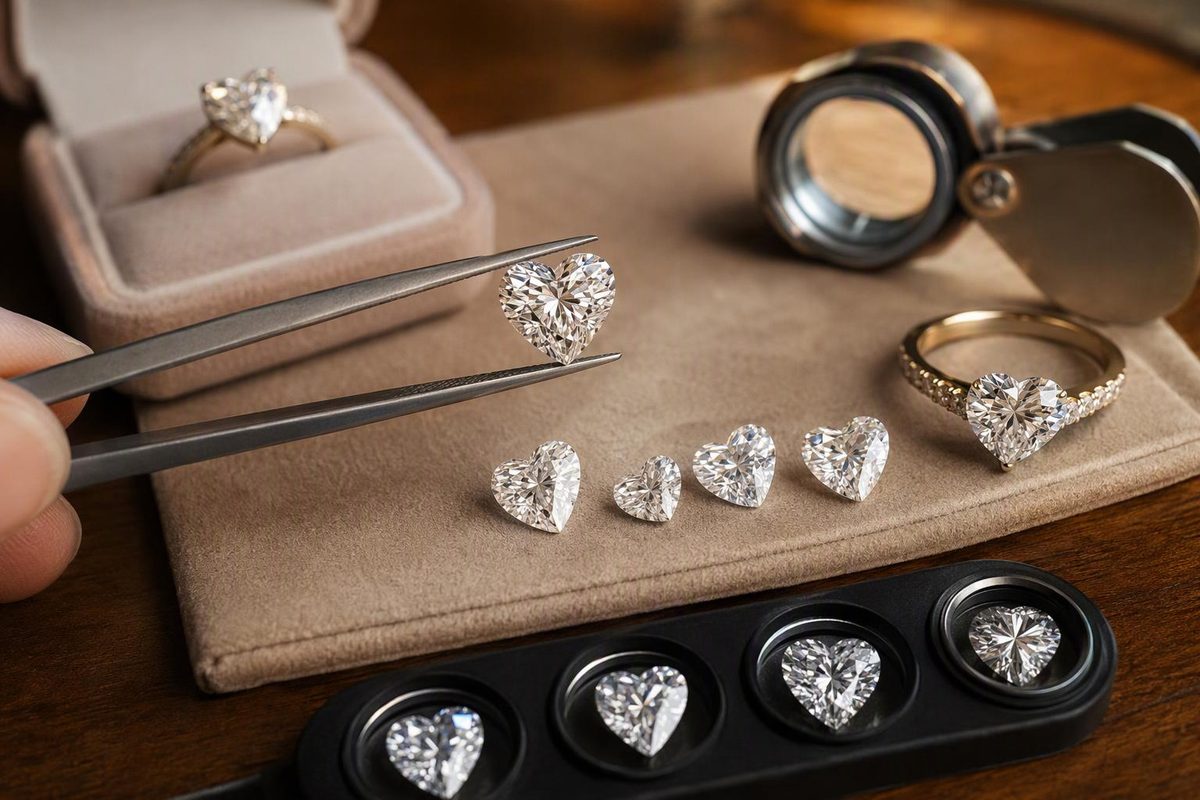
A heart cut diamond engagement ring is a good choice when the center stone reads clearly as a heart and the setting protects its point without hiding the outline. Prioritize matching lobes, a distinct cleft and appealing sparkle in motion—not simply the highest color or clarity grade you can afford.
Enter the diamond’s reported length and width to check whether its outline is broader or longer.
Heart Outline Ratio
Enter both dimensions to compare the outline.
Below 1.00: broader
1.00: equal length and width
Above 1.00: longer
Ratio = length ÷ width. Use positive dimensions in millimeters from the stone’s report. This is not a cut-quality score; inspect the lobes, cleft and point separately.
Source: Whiteflash’s heart-cut shape guide. ~ indicates a rounded ratio; — means unknown.
The report helps screen candidates, but it cannot settle the purchase. GIA does not give heart-shaped diamonds an overall cut grade; its overall cut grade applies to round brilliants. If a heart listing says “Excellent” or “Ideal” cut, ask whose grading system that label represents and what it measures. Excellent polish and symmetry are not an overall light-performance grade. GIA explains the distinction.
A Clear, Balanced Outline Comes First
Look straight down at the actual diamond, ideally loose or in an unobstructed face-up photograph. Draw an imaginary line from the notch at the top—the cleft—to the bottom point.
Check four features:
- The two rounded upper sections, or lobes, match in height, fullness and shape.
- The cleft is a distinct V, rather than a shallow indentation that makes the diamond resemble a broad pear.
- Both sides curve smoothly toward the point, without conspicuous flat spots or bulges.
- The point aligns with the cleft rather than leaning to one side.
GIA’s heart-shaped gemstone guide emphasizes matching lobes, smooth curves and a well-defined cleft and point. A high symmetry grade is useful screening information, but you still need to inspect the silhouette.
Broad versus elongated is a preference; mismatched halves are a separate issue. Length-to-width ratio equals the reported length divided by the width. A ratio of 1.00 means equal length and width; below 1.00 is broader, and above 1.00 is longer.
The ratio does not describe the fullness of the lobes or depth of the cleft, so it cannot select an attractive heart by itself. Whiteflash’s shape guide explains these distinctions, including how an insufficiently defined cleft can make a heart resemble a wide pear.
Small Hearts Need a Legible Outline
GIA suggests approximately 0.50 carat or larger to showcase the heart shape. Treat that as a shopping guide, not a minimum quality requirement. A smaller heart may suit a delicate ring, but check that its outline remains legible at normal viewing size, not just under magnification.
GIA’s diamond-shape guide also stresses that small hearts need prongs that emphasize rather than hide their shape. Compare length and width in millimeters alongside carat weight, and ask for a hand photograph or view the ring in person before deciding whether the center looks large enough.
Movement Reveals Bow Ties and Dull Areas
Heart-shaped brilliant cuts can show a bow tie, a dark area across the width of the stone. GIA notes that larger or darker bow ties detract more from face-up appearance. It also warns that a knife-edge girdle—the thin perimeter of the diamond—can increase damage risk. GIA’s heart-shaped gemstone buying guidance covers both concerns.
Request video of the actual stone moving face-up and through gentle tilts, preferably in more than one lighting environment. Look for a broad dark band that dominates the center through much of the movement, or large areas in the lobes and lower half that remain dull. Check whether the diamond still looks appealing outside spotlight-heavy jewelry lighting.
Do not reject every dark facet: compare the overall pattern and movement. A favorable table or depth percentage should not replace visual inspection either.
For clarity, check actual inclusion locations and visibility rather than choosing a universal grade cutoff. Ask to see the stone without magnification at your usual viewing distance, then have potentially significant inclusions near the point or edge assessed by a qualified gemologist. Our diamond clarity guide explains what the grades do—and do not—tell you.
For color, compare candidates in the intended metal and lighting instead of assuming that a particular grade will satisfy everyone.
The Setting Must Protect the Point Without Hiding the Heart
The point is the heart diamond’s most vulnerable area, so protection should be part of the design. GIA recommends protecting it and placing prongs on the lobes rather than in the cleft to emphasize the shape. See GIA’s setting guidance.
| Setting | What It Emphasizes | What to Inspect |
|---|---|---|
| Solitaire | The diamond’s own outline | Point coverage; prongs obscuring lobes |
| Bezel | A metal-framed silhouette | A distinct cleft and visible point shape |
| Heart-shaped halo | The surrounding heart outline | The center stone’s shape separately |
A solitaire lets the diamond’s outline carry the design. A bezel may suit a preference for a metal-framed silhouette, but its finished rim should not blur the cleft or visually round away the point.
With a heart-shaped halo, judge the center separately: a heart-shaped surround does not prove that the center stone itself is heart-cut.
For any design, request top and side views, the finished setting height, and a demonstration of wedding-band fit. A face-up photograph alone cannot answer those fit questions.
Confirm the Exact Stone and Finished-Ring Terms
Obtain the report for the exact center stone and written confirmation of whether it is natural or laboratory-grown, its carat weight, dimensions, and any disclosed treatments. Keep center weight separate from the ring’s total diamond weight.
Ask for an itemized finished-ring quote, including the setting, accents, sizing and applicable charges. Confirm return terms before approving custom work, and ask who is responsible if the stone is damaged during setting.
Choose the ring only when the paperwork, actual-stone images and finished design agree. Better grades cannot compensate for a silhouette you dislike or a point the setting leaves exposed.