
Asscher Cut Diamond Ring: How to Choose the Setting
Compare Asscher ring settings, inspect the mounted diamond, check wedding-band fit and separate center-stone weight from total carat weight.
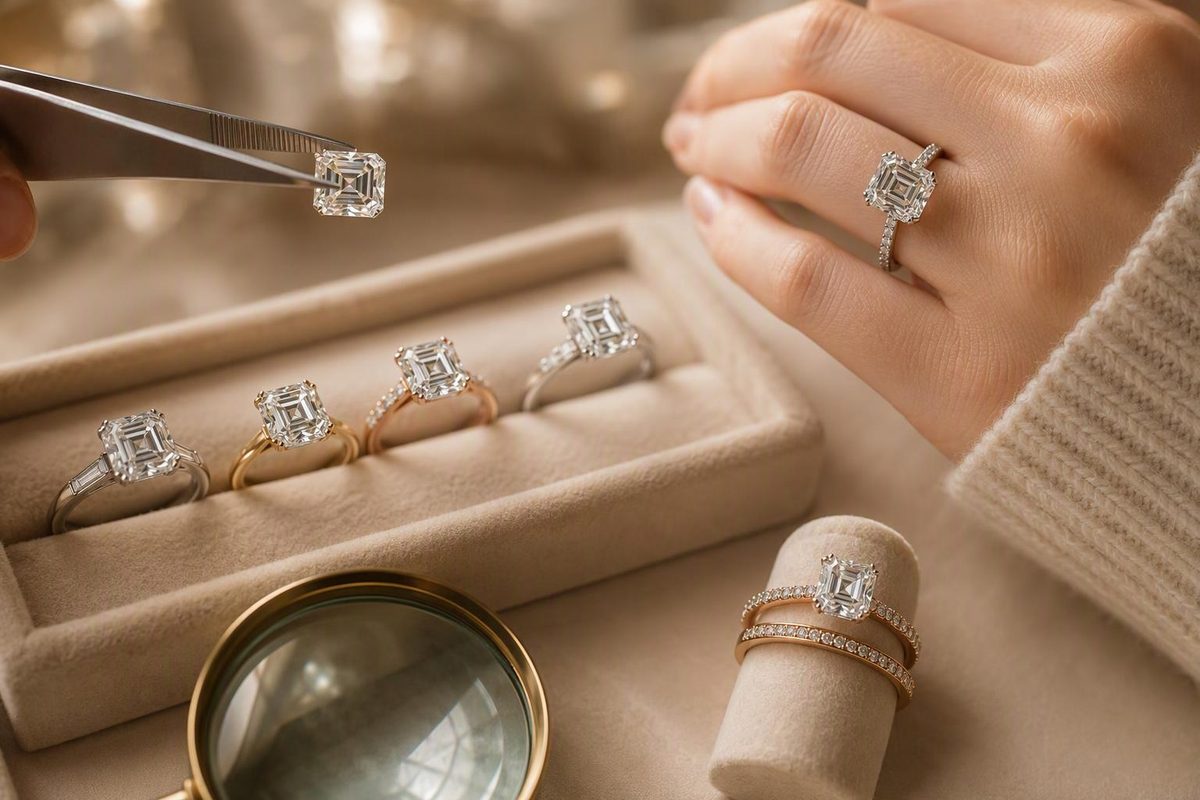
An Asscher cut diamond ring is a good candidate if you prefer geometric reflections to the busy sparkle of a brilliant cut. But choose the diamond and the finished ring separately: an attractive center stone still needs a well-made setting that suits your hand, daily wear and wedding band.
The Asscher’s square outline, cropped corners and step-cut facets create the layered “hall of mirrors” appearance. Its open facets also reveal color and inclusions more readily than brilliant cuts. That is an appearance trade-off, not a reason to buy the highest grades automatically. GIA’s shape guide explains these distinctions.
Choose the look—and how the stone is held
“Solitaire,” “halo” and “three-stone” describe the arrangement of stones. “Prong” and “bezel” describe how a stone is secured. An Asscher solitaire can use either, so a style name alone tells you little about protection. GIA distinguishes setting types from setting styles.
| Ring design | Why consider it | What to inspect |
|---|---|---|
| Prong-set solitaire | Keeps the Asscher’s outline and reflections prominent | Prong placement, secure contact and how much metal covers each cropped corner |
| Bezel-set solitaire | Adds a smooth metal border and perimeter protection | Whether the bezel follows the outline neatly or visually overwhelms it |
| Halo | Adds a sparkling frame and a larger overall footprint | Whether you still like the center’s shape, plus the condition and security of the small stones |
| Three-stone | Adds width across the finger | Side-stone balance, visible color differences and comfort between adjacent fingers |
A full bezel protects the girdle—the edge around the diamond—and is less likely to catch on clothing than exposed prongs. It also covers more of the stone’s perimeter. Halo and pavé designs introduce more small stones to inspect and maintain. Those are practical differences, not universal rankings of beauty. GIA’s setting guide covers these trade-offs.
For an open setting, ask how the head is supported. A basket connects the prongs with horizontal supports beneath the diamond. Double claws may suit the Asscher’s geometry, but do not buy by prong count alone: construction and finishing matter. GIA emphasizes both structural support and workmanship. Ask a jeweler to examine the actual setting, not just approve the design name.
Inspect the center after setting
Request photographs and video of the actual ring from above and from the side. For a custom order, inspect the loose diamond before approving the mounting, then inspect it again after setting.
Look straight down to check whether the metal preserves the outline and the balance of the steps. Rock the ring gently and view it at normal wearing distance: do you still like its reflections, and does an inclusion distract you without magnification?
In a three-stone ring, compare the center against both side stones. Significantly more colorless accents can make a warmer center look more yellow by comparison. GIA discusses side-stone color matching.
For detailed checks of the loose diamond’s light pattern, proportions, clarity and grading report, use our Asscher cut diamond guide. A seller’s “Ideal” label is not an overall GIA cut grade for an Asscher; GIA’s overall cut-grading system applies to round brilliants, while fancy shapes receive separate polish and symmetry assessments. GIA explains its cut-grading scope.
Check fit, documentation and the complete price
Try the ring with the wedding band you intend to wear. Do not assume “low profile” means flush-fitting: inspect whether the band clears the head, leaves an acceptable gap or rubs against the setting.
Confirm natural or laboratory-grown origin in writing and obtain the laboratory document for the actual center. For GIA documents, Report Check confirms that the report information matches the laboratory’s database; it does not, by itself, establish that the mounted diamond is the same stone. Ask the jeweler to match its identifying details and inscription where present and accessible.
An Art Deco look is not evidence of age. If an antique claim affects the price, request supporting documentation and a condition assessment rather than relying on the silhouette.
Ask for an itemized quote showing:
- Center-stone carat weight and millimeter dimensions—not just total carat weight.
- Accent-stone specifications and origin.
- Metal, mounting, setting labor and any customization charges.
- Sizing, tax, shipping and applicable fees.
- Return terms, especially for custom work, and the permitted resizing range.
Pavé bands can be harder to resize because adjustments may disturb the small stones. Confirm that limitation before choosing a stone-covered shank. GIA’s setting guide explains the issue.