
How to Choose a Three Stone Oval Engagement Ring
Inspect the center oval in motion, choose side stones for harmony or contrast, compare all three face-up, and confirm costs with an itemized quote.
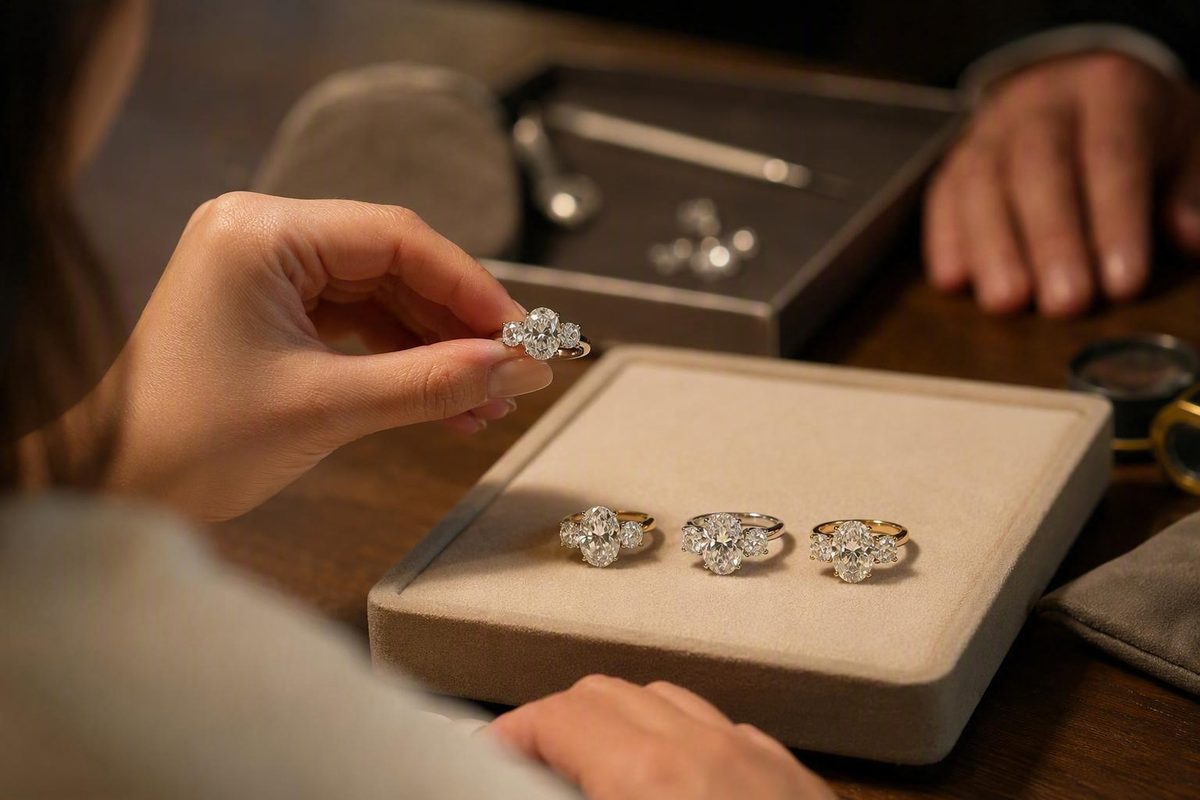
A three stone oval engagement ring has an oval center stone flanked by two side stones. Choose the center oval first by inspecting it in moving video or in person. Then decide whether the side stones should harmonize with its curves or create contrast, compare all three stones face-up, and obtain an itemized quote covering the stones, mounting, metal, reports, customization, taxes, and other fees.
The short answer: choose the center oval before comparing complete rings
Whatever meaning you give the design, its visual success begins with the center oval.
Use this buying sequence:
- Evaluate the center oval individually. Review its 4Cs, dimensions, outline, symmetry, polish, girdle, and bow tie.
- Choose a side-stone effect. Similar curves create harmony; contrasting shapes emphasize the center.
- Compare all three stones face-up. Check apparent color, visible size, outlines, and how the stones interact as the viewing angle changes.
- Confirm the complete quote. Establish which stones, setting, metal, reports, services, taxes, and fees are included.
This order matters because GIA does not assign an overall cut grade to oval diamonds, although its reports include polish and symmetry. A grading report can help narrow the field, but it cannot show whether you will like a particular stone’s outline, shoulders, contrast pattern, or bow-tie visibility.
Use this oval-center inspection checklist
An attractive oval is not defined by one measurement or grade. Assess the stone as a complete visual object rather than treating any single specification as decisive.
- Carat: Treat carat as weight, not visible size. Record the face-up length and width in millimeters when comparing candidates.
- Color: Decide whether the diamond’s apparent warmth suits the intended metal and side stones.
- Clarity: Locate the inclusions and determine whether their visibility is acceptable in the individual diamond.
- Cut-related appearance: Because an oval receives no overall GIA cut grade, inspect its brightness, contrast, outline, and bow tie directly.
- Polish: Consider the report grade alongside the stone’s overall appearance.
- Symmetry: Excellent or Very Good symmetry can support a balanced appearance, but it does not guarantee graceful shoulders, an appealing outline, or an unobtrusive bow tie.
- Outline: Look for balanced curves and a silhouette that appeals to you.
- Girdle: Review the report description and available imagery. An extremely thin girdle may increase vulnerability to damage, while an overly thick girdle can add weight without increasing visible size.
- Length-to-width ratio: Use the ratio to describe whether the stone is rounder or more elongated, not to assign quality.
- Bow tie: Watch the dark region crossing the center while the stone, camera, or viewer moves.
These factors form part of GIA’s recommended framework for evaluating an oval diamond, including the safety implications of girdle thickness.
Pay particular attention to the shoulders—the curved areas between the ends and sides of the oval. Flat shoulders can pull the silhouette toward a marquise-like appearance, while strongly bulging shoulders can make it appear pill-shaped. These descriptions do not make either outline automatically unacceptable; they help you identify whether the shape reflects your preference.
Some bow-tie effect is present in oval diamonds. The practical question is whether the dark area becomes broad, persistent, or distracting as the stone moves. Do not judge it from one favorable still image. Ask for continuously moving video or inspect the diamond in person, watching whether the darkness flashes on and off or remains prominent through much of the movement.
Viewing conditions also matter. Compare finalists under the same lighting and, when using video, at comparable magnification. The aim is not to find one angle that makes the diamond look its best, but to understand how its appearance changes. Two ovals with similar measurements and report grades can display markedly different outlines and contrast patterns.
Choose a rounded or elongated oval by ratio and outline
Calculate an oval diamond’s length-to-width ratio by dividing its length by its width:
Length-to-width ratio = length ÷ width
For example, an oval measuring 10.0 mm long and 7.0 mm wide has a ratio of approximately 1.43:1.
| Approximate ratio | General appearance | May suit buyers who prefer |
|---|---|---|
| 1.30:1–1.40:1 | Rounder oval | A fuller, broader silhouette |
| 1.40:1–1.50:1 | Traditionally elongated oval | A longer, narrower silhouette |
These are descriptive ranges from GIA’s oval ratio guidance, not quality grades or guarantees of beauty.
A ratio expresses only the relationship between length and width. It does not tell you whether the shoulders are graceful, the outline is balanced, the symmetry looks pleasing, or the bow tie is distracting. Two stones can share a 1.43:1 ratio while having visibly different silhouettes and contrast patterns.
Compare the actual face-up measurements as well as the ratio. Carat weight alone does not establish how large an oval will look from above, and stones of equal weight can have different dimensions. If possible, compare loose candidates side by side before judging how they will work in a completed ring.
The side stones may also change how the center’s proportions are perceived. Broad, curved sides can make the overall composition feel fuller, while narrower geometric sides can reinforce the center oval’s length. Evaluate the loose center first, then review a clear face-up image, rendering, or physical arrangement of all three stones.
Match the side stones to the look you want
There is no objectively best side-stone shape. Choose according to whether you want the ring to read as one coordinated composition or as a dominant oval framed by contrasting accents.
| Side-stone direction | Visual effect | What to compare |
|---|---|---|
| Smaller ovals or half-moons | Harmony and a continuous curved silhouette | Curvature, outline, apparent color, and transition into the center |
| Tapered baguettes | Geometric contrast and stronger center emphasis | Taper, length, step pattern, and angle toward the center |
| Colored gemstones | Deliberate color contrast and distinction | Hue, tone, dimensions, treatment or origin description, and balance |
Smaller ovals repeat the center’s outline, while half-moons can visually embrace it. Tapered baguettes use straight lines and a contrasting facet pattern to make the oval appear more distinct. Colored side stones add another focal element, so assess their color beside the center rather than independently.
For diamond side stones, GIA suggests staying within one or two color grades of the center to support a cohesive appearance. This is a starting point rather than a guarantee: the stones still need to be compared together face-up. GIA discusses these harmonious and contrasting combinations in its oval engagement-ring setting guidance.
Request the following information for all three stones:
- Face-up length and width in millimeters
- Individual carat weight
- Color and clarity grades, where applicable
- Shape and outline
- Treatment or origin description, when relevant
- Grading laboratory and report number, if a report exists
- A photograph or moving video showing the three stones together
Do not use a universal center-to-side carat ratio as a substitute for seeing the composition. Carat measures weight, and different shapes distribute that weight differently. Face-up dimensions and direct comparison are more useful for deciding whether the sides support, balance, or overpower the center.
Balance color and clarity without treating grades as guarantees
For a diamond center, G–H color is a commonly suggested starting range for balancing appearance and price, while D–F offers a more colorless appearance. Some buyers may also like J color in yellow or rose gold, but the metal does not guarantee that the diamond will appear colorless. These ranges are guidance, not fixed buying rules, and the individual stone should be judged in the intended metal and beside its side stones.
VS2 or SI1 clarity can likewise be value-oriented starting points, subject to inspection of the individual diamond. Neither grade guarantees that a stone will look eye-clean to a particular buyer. The practical issue is whether you accept the inclusions and their visibility in the actual stone, not whether its grade matches a predetermined target.
Use magnified images to identify inclusions, but also assess the diamond as it will ordinarily be viewed. If an inclusion is visible in video, ask how readily it can be seen without magnification and whether its visibility changes with the viewing angle.
Most importantly, do not purchase the three specifications independently. A center and side stones with slightly different grades may appear cohesive, while stones with nominally closer grades may not produce the look you want. Compare the assembled group or view all three loose stones together face-up against the same background.
The sensible endpoint is not a universal grade combination. It is a center diamond whose color, inclusions, outline, and bow tie you accept, paired with side stones that look intentional beside it at the quoted total price.
Treat advertised prices as leads, not market benchmarks
Undated retailer collection evidence listed Sarah O.’s Lara at $3,066, Vivien at $3,453, Hannah at $3,765, and Toula at $6,003. It also listed an elongated oval yellow Sri Lanka sapphire example at $14,430 and an elongated oval diamond example at $14,436. These are examples from one seller, not a market-wide range or proof that similarly named rings are comparable. The figures should be treated as historical listing examples rather than current quotes. The retailer’s engagement-ring collection is available here.
The dollar currency is not identified in the supplied listing text, and prices and availability may change. The collection evidence also does not establish what each displayed price includes or provide enough specifications to compare stone quality or value.
Before comparing advertised rings, request an itemized written quote confirming whether the price includes:
- The specific center stone
- Both specific side stones
- The mounting
- The stated metal and any metal upgrade
- Grading reports or other documentation
- Design changes and customization charges
- Setting labor
- Taxes, shipping, insurance, duties, and other seller fees
For each stone, ask for:
- Exact face-up measurements
- Individual carat weight
- Color and clarity grades, where applicable
- Treatment disclosure and any origin description
- The grading laboratory, report type, and report number
- Confirmation that the report corresponds to that stone
- Current photographs or video, preferably showing all three stones together
The retailer also advertises custom design and work involving heirloom stones. If you are considering either route, verify eligibility, terms, fees, timing, and the suitability of the particular heirloom stone for the proposed mounting. Obtain an assessment of the stone’s condition before proceeding.
Use one final purchase rule: approve the individual oval in moving video or in person first; choose side stones for harmony or contrast second; compare all three stones together face-up; then obtain an itemized quote listing dimensions, grades, reports, metal, included components, customization, taxes, and every other fee before committing.