
Princess Cut Carat Size Chart: Millimeter Benchmarks
Compare princess-cut diamond weights from 0.25 to 5 carats with millimeter benchmarks, then check actual measurements and face-up appearance.
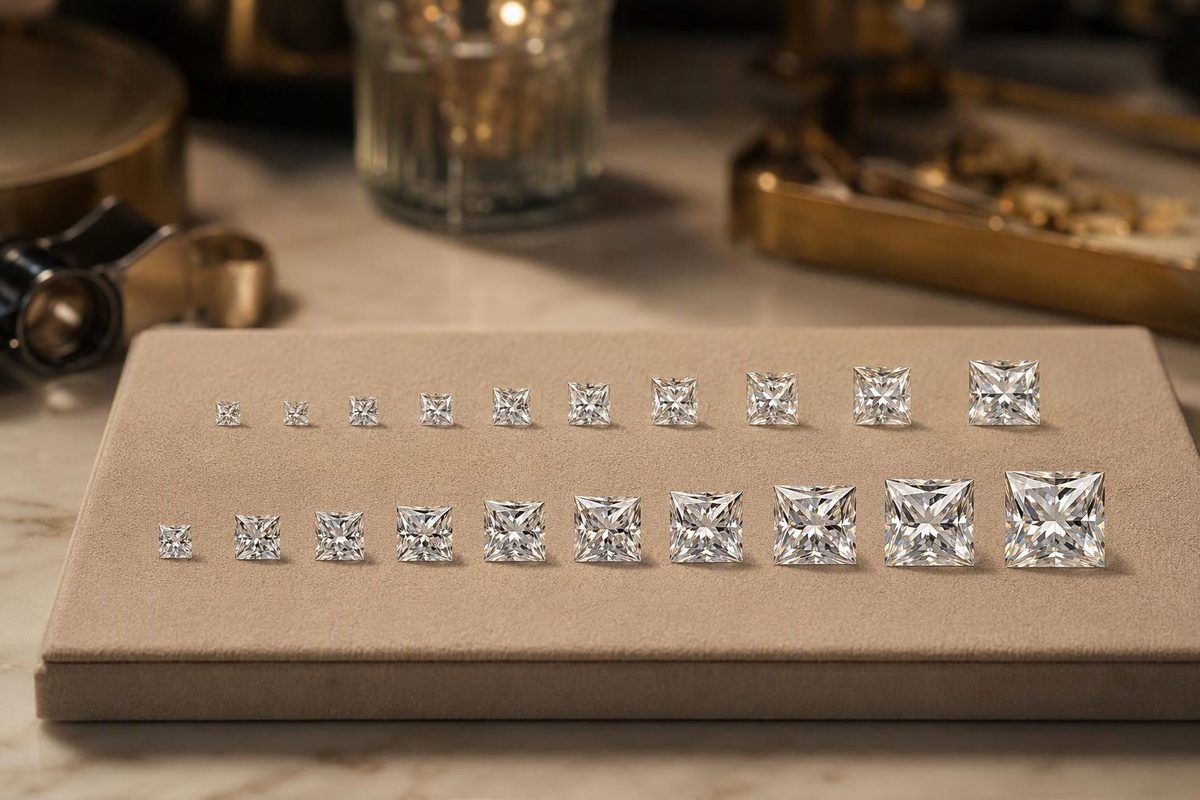
A 1-carat princess-cut diamond is roughly 5.5 × 5.5 mm face-up. At 2 carats, think about 7 × 7 mm; at 3 carats, about 8 × 8 mm. These are useful shopping references, not guaranteed dimensions for every diamond. Kobelli’s princess-cut conversion chart gives those approximate benchmarks.
Princess-cut size chart: 0.25–5 carats
The chart below assumes a square outline. Measurements describe length × width across the face, not corner-to-corner diagonal distance or the diamond’s depth.
| Diamond weight | Approximate face-up dimensions |
|---|---|
| 0.25 ct | 3.5 × 3.5 mm |
| 0.50 ct | 4.4 × 4.4 mm |
| 0.75 ct | 5.0 × 5.0 mm |
| 1.00 ct | 5.5 × 5.5 mm |
| 1.25 ct | 5.9 × 5.9 mm |
| 1.50 ct | 6.3 × 6.3 mm |
| 1.75 ct | 6.6 × 6.6 mm |
| 2.00 ct | 6.9 × 6.9 mm |
| 2.50 ct | 7.5 × 7.5 mm |
| 3.00 ct | 8.0 × 8.0 mm |
| 3.50 ct | 8.4 × 8.4 mm |
| 4.00 ct | 8.8 × 8.8 mm |
| 4.50 ct | 9.1 × 9.1 mm |
| 5.00 ct | 9.4 × 9.4 mm |
Source: GemSize’s princess-cut diamond chart, rounded to the nearest 0.1 mm. These are reference dimensions, not laboratory cut standards or required minimum sizes.
Carat is weight, not visible size. One metric carat equals 200 milligrams, so a 2-carat diamond weighs twice as much as a 1-carat diamond—but it is not twice as wide. GIA explains the distinction.
Using the chart, moving from 1 to 1.5 carats adds about 0.8 mm to each side. Moving from 1 to 2 carats makes the square roughly a quarter wider. Those differences are more useful for visualizing a purchase than the carat number alone.
Replace the benchmark with the report measurements
Once you shortlist a diamond, use its actual dimensions. For fancy shapes, the measurements line is read as length × width × depth, as explained in Anueva Jewelry’s report guide.
For example, a hypothetical measurement of 6.40 × 6.20 × 4.50 mm means:
- 6.40 mm: length across the face.
- 6.20 mm: width across the face.
- 4.50 mm: depth from top to bottom—not another visible side.
Divide length by width to check the outline: 6.40 ÷ 6.20 is approximately 1.03. GIA describes a square princess cut as having a length-to-width ratio no greater than 1.05:1. Rectangular princess cuts also exist, so the equal-sided chart should not be applied to them as an exact target. GIA’s princess-cut guide explains that distinction.
A larger measurement is not automatically a better cut
Princess cuts carry much of their weight in the pavilion, the lower portion of the diamond. GIA also warns that pavilion bulge can add weight and make a stone look dark. This is why weight alone cannot establish face-up size or attractive light performance. GIA’s selection guidance recommends checking facet symmetry and a pleasing balance of light and dark patterns.
Use the chart to choose a size range, then compare shortlisted stones by both length and width, alongside their appearance in motion. A stone below the benchmark deserves a closer look; it is not automatically poorly cut. Equally, extra spread is not a reason to accept an unattractive light pattern.
To judge scale on your hand, draw or cut out a square using the shortlisted stone’s actual dimensions, then try a similarly sized mounted diamond. The paper outline shows footprint, not sparkle or setting height. If you are still comparing shapes, see our 1-carat diamond size benchmarks.