
How to Compare a 3-Carat Princess Ring Without Paying for the Wrong Thing
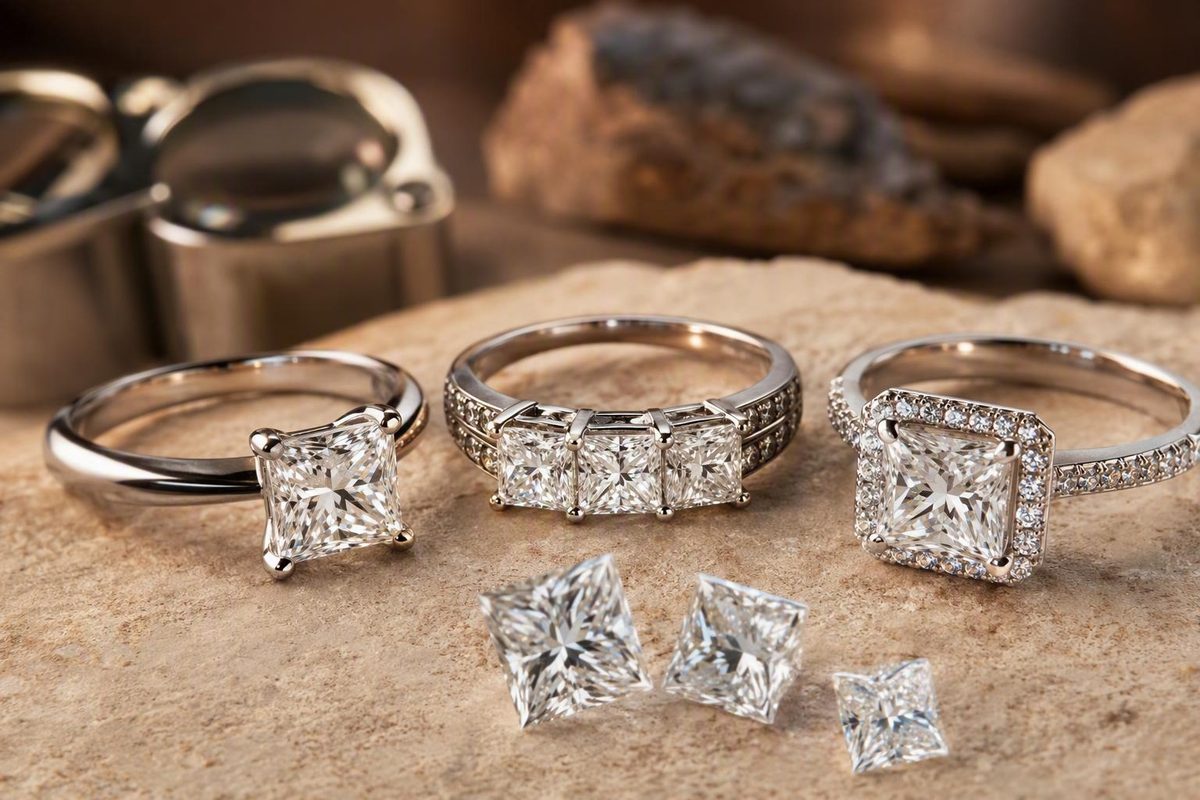
“Three carat princess cut diamond ring” can describe fundamentally different products: a ring with one three-carat center diamond, a multi-stone ring containing three carats in total, a loose diamond without a setting, or an empty setting designed to accept a center weighing up to three carats.
Those products may appear beside one another in search results, but their prices are not directly comparable. First establish exactly what the seller includes. Then assess the center diamond’s dimensions and visible performance, choose a setting that protects its pointed corners, match the stone to an independent grading report, and confirm the final price and sales terms in writing.
First, determine what “three carat” actually describes
Carat measures weight, not diameter or visible surface area. One carat equals 200 milligrams, so a three-carat diamond weighs 600 milligrams. Cutting proportions determine how that weight is distributed and how large the stone looks from above.
A listing can use “three carat” in at least five ways:
- Three-carat center: One center diamond weighs approximately three carats. Accent diamonds may increase the ring’s total diamond weight.
- Three carats total weight: All diamonds combined weigh approximately three carats. Look for ct. t.w., ctw, or total diamond weight.
- Loose three-carat diamond: The price buys an unmounted stone. The setting, sizing, assembly, and any side stones cost extra.
- Setting or semi-mount: The ring may accept a center diamond of up to three carats without including that center.
- Completed ring: The price includes the center and setting, but the listing should still separate center weight from total diamond weight.
A Zales ring advertised at three carats demonstrates the total-weight problem. Four princess diamonds form a center cluster, petite round diamonds frame them, and baguette and round diamonds decorate the shank. The approximately three-carat figure is the combined weight—not the weight of one princess center. The seller listed the natural-diamond ring at $7,999 in 14K white gold, with stated I color and I2 clarity.Zales identifies the ring as a three-carat-total-weight multi-stone design
A completed ring can instead separate the center from its accents. One David’s House of Diamonds design identifies a 3.00–3.05-carat princess center and approximately 1.00–1.05 carats of additional diamonds. Its total diamond weight is therefore roughly four carats or more, even though the center itself is approximately three carats.
Category pages can make the distinction harder. Most of the relevant Helzberg results use three carats total weight, including three-stone, composite, and engagement-set designs. One rose-gold solitaire, however, is explicitly described as having a single three-carat lab-grown diamond.Helzberg’s category page distinguishes the single-diamond solitaire from total-weight designs
A setting advertised as accommodating centers from 0.7 to three carats is not necessarily priced with a three-carat center installed. Collection-wide price ranges may span numerous center sizes, metals, and configurations. Unless the product summary explicitly identifies the included center diamond, treat the item as a setting or configurable ring rather than a completed three-carat-center ring.
Use this one-line test before comparing any two listings:
Identify the center weight, total diamond weight, product type, diamond origin, and whether the center stone is included.
If any field is missing, obtain the answer in writing. A low price is not meaningful until the object being sold is clear.
What current listings reveal about price
There is no useful single answer to “What does a three-carat princess ring cost?” without specifying origin, treatment, grades, dimensions, setting, and whether three carats refers to the center or the whole ring.
The merchant pages summarized below were reviewed for this guide on August 21, 2026. The figures are observed asking prices, not appraisals, market averages, or guarantees of fair value. Promotions, inventory, options, and prices can change.
| Product category | Observed examples | What the price appears to include | Main comparison caution |
|---|---|---|---|
| Lab-grown completed rings | From $3,040 in 14K gold and $3,455 in platinum | Center, setting, and completed ring as displayed | Detailed center grades and dimensions were not shown for every collection item.The collection shows the quoted starting prices |
| Lab-grown completed solitaire | $3,999 | One explicitly described three-carat lab-grown diamond in 14K rose gold | The supplied category text does not provide detailed color, clarity, dimensions, or report information.Helzberg lists the rose-gold solitaire separately from its total-weight designs |
| Lab-grown completed ring with accents | $6,599 | A 3.00–3.05-carat F/VS1 center plus approximately 1.00–1.05 carats of F–G/SI additional diamonds | The elaborate three-dimensional band and extra diamonds make this unlike a plain solitaire.David’s House of Diamonds separates the center and accent weights |
| Verified natural loose diamonds | $14,534 to $17,541 among selected examples | Diamond only | Setting, assembly, sizing, and taxes cost extra; individual grades and specifications differ.Ritani lists these as loose natural diamonds |
| Loose diamonds of unspecified origin in the supplied excerpt | $10,270 to $11,260 among selected near-three-carat examples | Diamond only | The excerpt does not establish natural or laboratory-grown origin for each listing, and seller cut labels are not GIA princess-cut grades.Rare Carat displays the selected loose-diamond examples |
| Clarity-enhanced natural completed ring | $17,795 | Completed ring as displayed | A treated natural diamond belongs in a separate comparison category from an untreated natural diamond. |
| Natural completed rings | $36,375 and $42,745 | Completed rings | Specifications differ; treatment status is not established for the $42,745 example. The $36,375 ring includes a stated 3.00-carat H/SI1 center and 1.90 carats of side diamonds.Liori provides the $36,375 ring specifications |
| Three-carat-total-weight multi-stone rings | $1,999.85 lab-grown composite; $7,999 natural multi-stone ring | Multiple diamonds and setting | Neither amount establishes the cost of one three-carat princess center.Zales describes its $7,999 ring as three carats total weight |
The price spread does not form a controlled comparison. The products are not matched for dimensions, color, clarity, grading laboratory, treatment, side-diamond weight, metal, or construction. A collection page may also omit specifications needed to decide whether two products are genuinely comparable.
The $6,599 lab-grown ring, for example, includes substantially more accent weight and a more complex band than the $3,999 solitaire. That difference is a price component; it does not show that one otherwise identical three-carat center costs $2,600 more.
For verified natural loose diamonds, the selected Ritani examples begin with a 3.01-carat K/SI1 stone at $14,534 and extend to a displayed $17,541 for a 3.01-carat J/SI2 stone. The grades, seller-assigned cut descriptions, and other specifications differ, so the higher price does not by itself establish higher visible quality.
Rare Carat displayed lower-priced loose examples, including a 3.01-carat K/IF stone at $10,270 and a 3.03-carat K/VS1 stone at $10,355. The supplied marketplace excerpt does not establish the origin of each diamond, however. Those figures should not be folded into a “natural-diamond range” without verifying the individual listing.
Clarity-enhanced natural diamonds also require a separate row. Ask what treatment was performed and ensure it appears consistently in the listing, grading documentation, and invoice.
The major price variables supported by these listings include:
- Natural, laboratory-grown, or clarity-enhanced natural origin
- Treatment status
- Center color, clarity, dimensions, and visible performance
- Grading laboratory and completeness of documentation
- Center weight versus total diamond weight
- Quantity and stated grade of side diamonds
- Gold versus platinum
- Solitaire, halo, pavé, three-stone, or ornate construction
- Craftsmanship and custom work
- Ring size and possible metal surcharges
- Loose stone, setting-only product, or completed ring
Do not calculate a blended average or a fixed natural-versus-lab-grown discount from these examples. A meaningful comparison begins by placing products with reasonably equivalent contents, specifications, documentation, and all-in costs in the same row.
How large a three-carat princess cut looks face up
GIA describes the princess cut as a square modified brilliant: a generally square outline with brilliant-style faceting and four pointed corners. Shape describes the outline, while cut style describes the facet arrangement and resulting light behavior.GIA explains the princess cut’s shape, faceting, and deep pavilion
Although a three-carat diamond weighs 600 milligrams, it has no fixed face-up measurement. Two diamonds of equal weight can distribute their mass differently. A deep pavilion can hold more material below the visible surface, allowing one three-carat princess diamond to look smaller from above than another.
The supplied evidence does not establish a universal millimeter range for a well-spread three-carat princess cut. One retailer calls approximately 8.5 mm typical, but that is a merchant estimate—not an independent benchmark, a guaranteed diameter, or a substitute for the individual diamond’s measurements. A princess cut is measured in two directions, so one “diameter” can also conceal a rectangular outline.
Use dimensions, not the carat label, to compare spread
Record the report’s length, width, and total depth in millimeters. Then calculate:
- Length-to-width ratio: length ÷ width
- Simple face-up outline area: length × width
The outline-area calculation does not precisely measure the visible polygon, account for corner shape, or grade cut quality. It is simply a consistent way to compare nominal footprint.
For example, a stone measuring 8.00 × 7.90 mm has a simple outline area of 63.2 mm². A same-weight stone measuring 7.70 × 7.65 mm has an area of approximately 58.9 mm². The first has the larger nominal footprint, but that does not prove it is brighter, more symmetrical, or better cut.
A ratio of 1.00 is mathematically square. Commercial guidance commonly uses approximately 1.00–1.05 as a screening range for a square-looking princess, with roughly 1.00–1.03 often preferred for a classic square appearance. These are retailer guidelines, not an official GIA standard.Fascinating Diamonds explains the ratio calculation and commercial screening ranges
Ratio does not establish sparkle or spread by itself. Two diamonds can share a 1.02 ratio while differing substantially in total depth, table, pavilion geometry, symmetry, corner shape, and light return.
Use a worksheet like this for each shortlisted stone:
| Comparison field | Stone A | Stone B | Stone C |
|---|---|---|---|
| Carat weight | |||
| Length (mm) | |||
| Width (mm) | |||
| Depth (mm) | |||
| Length ÷ width | |||
| Length × width (mm²) | |||
| Table percentage | |||
| Depth percentage | |||
| Girdle description | |||
| Seller cut assessment | |||
| Video observations |
This worksheet exposes hidden-weight and outline differences that a carat-only comparison misses. It is a comparison aid, not a cut grade.
Judge cut quality without a GIA princess-cut grade
GIA does not assign an official overall cut grade to princess-cut diamonds; among the shapes discussed in its guide, the round brilliant receives GIA’s overall cut grade.GIA distinguishes its round-brilliant cut grade from the treatment of fancy shapes
That matters when a retailer calls a princess diamond “Ideal,” “Excellent,” or “Rare Carat Ideal,” or assigns an AI quality score or comparison value. Those labels may be useful seller assessments, but they should not be recorded as GIA princess-cut grades.
Treat proportions as screening inputs
Useful report fields include:
- Length, width, and depth in millimeters
- Table percentage
- Depth percentage
- Length-to-width ratio
- Polish
- Symmetry
- Girdle description
- Culet, if reported
- Clarity characteristics and plotted locations
- Fluorescence, if reported
Commercial recommendations conflict. The supplied retailer guides span roughly 64%–75% for depth and approximately 62%–75% for table, with inconsistencies even within some guides. No range in that material is an official or universal standard.Do Amore explains that no industry standard defines an “Ideal” princess cut and presents conflicting commercial ranges
Proportions are still useful. They can help identify unusually deep stones, organize a shortlist, and flag candidates that may carry excess weight below the face-up surface. They should not become a rigid pass-fail formula. A diamond inside a favored table range can still perform weakly, while one just outside it may be visually attractive.
Facet count is not proof of quality either. Princess-cutting styles vary, and counting facets does not reveal whether their angles and alignment return light effectively. A proprietary score cannot answer that question alone.
Inspect motion, not just a still photograph
Request a rotating video of the exact diamond. Compare candidates under similar lighting and at similar magnification where possible. As each stone turns, look for:
- Balanced light and dark contrast across the face
- Lively changes rather than a static, glassy appearance
- Persistent dark zones in the center or corners
- Broad washed-out areas
- A visually dead center
- Corners that repeatedly appear dull
- Uneven facet activity from one side to the other
- Outline asymmetry or mismatched corners
- Visible inclusions and their positions relative to the points
Some darkness provides necessary contrast. The concern is persistent, uneven darkness that overwhelms part of the diamond, or a washed-out appearance with little changing contrast.
A practical sequence is:
- Shortlist by report data. Remove candidates missing essential dimensions, origin, treatment, or documentation.
- Compare actual measurements. Look for unnecessary depth and weak face-up spread.
- Review videos side by side. Use comparable lighting and viewing angles where possible.
- Eliminate weak or uneven performers. Do not let a favorable seller label override visible behavior.
- Inspect the finalist independently. For a consequential purchase, arrange review by an independent jeweler or gemologist while the return right remains active.
A grading report describes measurable characteristics. It cannot show exactly how appealing the diamond’s pattern, contrast, and movement will look to you. Report review and visual inspection perform different jobs.
Balance color, clarity, origin, and treatment
Commercial recommendations vary substantially. Some sellers suggest value-oriented ranges such as G–I color and VS2–SI1 clarity, while another recommends D–F color and VS1 or higher for a stone of this size. These are commercial judgments, not universal minimums.
Organize the decision around visible outcomes:
- Does the diamond show tint face up?
- Is that tint distracting in the intended metal and lighting?
- Are inclusions visible at a normal viewing distance?
- Where are those inclusions located?
- Is a feature close to a vulnerable corner?
- Are you paying for a paper-grade improvement you cannot see?
- Does the more expensive option improve appearance enough to matter to you?
Princess cuts use brilliant-style faceting, which can help conceal some color and inclusions compared with more open step-cut patterns. At the same time, a three-carat stone provides a large viewing area, so visible characteristics may be easier to notice than in a smaller diamond.
Evaluate color in the intended metal
The result still depends on the individual diamond, its cutting, its side view, and the lighting.
View the candidate:
- Face up against a neutral background
- From the side, where body color may be more apparent
- Beside the intended metal
- In diffuse indoor light, spot lighting, and daylight-equivalent light
- Next to a candidate differing by one or two color grades
Do not assume that one grade will appear colorless in every ring.
“Eye-clean” is not a laboratory grade
Eye-clean describes appearance under specified viewing conditions. A VS2 or SI1 princess diamond may be eye-clean, but neither grade guarantees that result.
Ask what the seller means by eye-clean: face up or from all directions, at what distance, and under what lighting. Inspect the diamond first at normal viewing distance and then under magnification to understand the report’s clarity description.
Pay particular attention to the four points. Because princess-cut corners are mechanically vulnerable, a feather or other concerning feature near a point warrants professional review. That does not mean every corner inclusion is unsafe, and a report image alone cannot establish that one is harmless. Ask an independent professional to inspect the actual diamond before the return period ends.
Keep origin and treatment in separate categories
Use three distinct comparison groups:
- Natural diamonds with no disclosed treatment
- Natural, clarity-enhanced diamonds
- Laboratory-grown diamonds
The seller should state origin and treatment consistently in the listing, grading report, and invoice. If treatment status is not documented, record it as unresolved rather than assuming the stone is untreated.
The observed lab-grown completed rings were listed for substantially less than several natural completed-ring examples. Those are not controlled comparisons: dimensions, grades, reports, side-diamond weights, metals, and setting complexity differ. The examples establish that origin is a major price variable, not a guaranteed percentage difference.
For a clarity-enhanced natural stone, ask what treatment was performed and whether it is identified in the grading documentation. Also obtain the seller’s applicable return, warranty, and service terms in writing.
Choose a setting that protects all four corners
The princess cut’s four sharp points can chip if inadequately protected. Suitable approaches include prongs that cover the actual corners—ideally V-shaped prongs—or a bezel that surrounds the edge.With Clarity identifies corner vulnerability and protective princess-cut setting options
Common options include:
- V-prongs: Wrap around each pointed corner and provide conspicuous coverage.
- Princess-specific corner prongs: Designed to seat and cover the square stone’s points.
- Double prongs: Use paired prongs at each corner, potentially adding security while preserving an open appearance.
- Claw or round prongs: Can be suitable when positioned and shaped to cover the actual points fully; the name alone does not guarantee protection.
- Bezel: Surrounds most or all of the edge with metal, providing extensive edge coverage and a smooth profile.
A bezel offers more continuous protection, while corner prongs leave more of the diamond visible. Neither is universally best. The choice depends on appearance, setting height, wearer habits, cleaning, and construction quality.
Inspect the completed ring rather than accepting a setting label. All four points should be:
- Properly seated
- Covered by metal
- Aligned consistently
- Free from obvious gaps
- Secure when examined by a professional
A “four-prong princess setting” can still be poorly executed. Conversely, carefully positioned claw prongs may protect the points effectively.
Compare design complexity separately from center quality
A solitaire emphasizes the center and simplifies comparison because fewer decorative components contribute to cost.
A halo creates additional coverage and detail around the center. It does not turn a smaller diamond into a three-carat center. Ask for center weight and halo weight separately.
Milgrain, intricate galleries, and multiple rows of accents add craftsmanship without improving the center diamond itself.
A three-stone design divides visual emphasis among three diamonds.
A channel-set band places accent diamonds between metal walls. Baguette-accent designs create geometric side detail and may add substantial side-diamond weight. Compare ornate rings by both center specifications and accent package.
A large center may also prompt practical questions about balance and wear. Ask about head construction, gallery height, band stability, spinning, snagging, and inspection intervals. The supplied evidence does not establish an authoritative minimum band width, so do not treat one millimeter recommendation as universal.
Obtain written confirmation of:
- Prong or bezel style
- Metal and alloy
- Compatibility with the exact center’s dimensions
- Side-diamond weight and stated grades
- Finished-ring dimensions where available
- Resizing limits
- Maintenance obligations
- Whether setting the selected center creates a custom, nonreturnable order
The setting is not merely decoration. For a princess cut, it is part of the stone’s risk management.
Match the diamond to its report and the listing
Require an independent grading report for the exact center diamond and identify the issuing laboratory. The word “certified” is too broad: it does not reveal which laboratory examined the stone, what document was issued, or whether that document belongs to the diamond being delivered.
Build a report-to-listing audit:
| Field | Listing | Grading report | Invoice or written confirmation |
|---|---|---|---|
| Report number | |||
| Laboratory | |||
| Natural or laboratory-grown origin | |||
| Treatment status | |||
| Carat weight | |||
| Length × width × depth | |||
| Color | |||
| Clarity | |||
| Polish | |||
| Symmetry | |||
| Fluorescence, if reported | |||
| Laser inscription, if present | |||
| Seller’s cut assessment | Not a GIA princess-cut grade |
Keep the seller’s cut assessment separate. If a GIA-graded princess diamond is advertised as Ideal or Excellent, do not copy that label into the report column as though GIA assigned it.
Resolve every inconsistency before payment. One Liori product description calls its center GIA-certified, while the specifications table says AGI-certified. The same page advertises a 30-day money-back guarantee, but its detailed terms describe a 14-day center-stone return window and say semi-mount settings generally cannot be returned. Its advertised lifetime warranty also contains exclusions involving the center diamond, stones above 0.10 carat, damage, loss, and theft; repair or shipping fees may apply.Liori’s page contains the certification and policy conflicts
Do not guess which statement is correct. Ask for a legible copy of the exact report and written confirmation of the issuing laboratory, report number, and applicable transaction terms. A broad claim that a retailer sells GIA-graded diamonds does not establish the laboratory for every individual stone.
When the ring arrives, compare the report measurements with the stone and inspect the laser inscription if one is present. Complete the check before the return period expires.
The final invoice should state:
- Center-stone carat weight
- Total diamond weight
- Natural or laboratory-grown origin
- Treatment status
- Grading laboratory
- Report number
- Center color and clarity
- Setting metal and purity
- Side-diamond weight
- Custom work or sizing performed
For a significant purchase, an independent appraisal can help confirm that the delivered ring matches its documentation and describe the finished piece for insurance. The supplied evidence does not establish a standard appraisal fee.
Audit the all-in price and retailer terms before paying
The displayed price may be only one part of the transaction. Build an all-in cost sheet covering:
- Center diamond
- Setting or semi-mount
- Side stones
- Custom design work
- Ring-size surcharge
- Engraving
- Assembly or setting labor
- Sales tax or import charges
- Shipping
- Independent inspection or appraisal
- Insurance
- Future prong inspections
- Resizing, repair, and refinishing
Reliable universal figures are not available here for appraisal, insurance, or long-term maintenance. Obtain quotes for the exact ring and location rather than inserting a generic percentage.
A broad collection range is not an exact quote. Diamond Mansion, for example, displayed princess-compatible designs spanning centers from 0.7 to three carats, with broad product ranges running from thousands of dollars to more than $100,000. Those ranges cover different center sizes and configurations, so they cannot establish the delivered price of one finished three-carat ring.Diamond Mansion’s ranges span multiple center sizes and designs
Ask explicitly whether the displayed amount buys a:
- Loose diamond
- Empty setting
- Semi-mount with side stones but no center
- Complete ring
- Replica preview
- Made-to-order ring
- Final customized product
Review return eligibility separately for the center stone, setting, resized ring, custom order, and made-to-order piece. A headline promise such as “30-day returns” does not establish that every configuration qualifies. The Liori conflicts documented above show why component-specific terms must be obtained in writing.
The actual contract may exclude:
- The center diamond
- Stones above a specified size
- Chipping or accidental damage
- Loss or theft
- Labor
- Replacement stones
- Shipping
- Repairs performed by another jeweler
- Damage attributed to missed inspections
Ask what inspections or other actions are required to keep coverage active.
Production and cancellation terms deserve the same scrutiny. David’s House of Diamonds states that made-to-order products may require two to three weeks, while custom or out-of-stock pieces may require six to eight weeks. Its page also restricts returns for custom or personalized orders and contains inconsistent cancellation language: one section refers to cancellation within 24 hours, while another says cancellations are not accepted.The David’s House of Diamonds page states the production and order restrictions
Ask when the return clock begins: order date, shipment date, delivery date, or signature date. If timing matters, establish whether a production estimate is a target or a contractual commitment.
Before paying, save copies or screenshots of:
- The product listing
- Diamond video and photographs
- Grading report
- Final invoice or order summary
- Return policy
- Warranty contract
- Resizing policy
- Shipping and production terms
- Written seller answers
Complete this prepayment check:
- [ ] Product type is identified
- [ ] Center weight is separate from total weight
- [ ] Origin is stated
- [ ] Treatment is stated
- [ ] Length, width, and depth are recorded
- [ ] Color and clarity are confirmed
- [ ] Laboratory and report number are verified
- [ ] Seller cut label is separated from laboratory facts
- [ ] All four corners will be protected
- [ ] Side-diamond weight is stated
- [ ] Delivered price includes known charges
- [ ] Production or delivery date is documented
- [ ] Return rights cover the exact configuration
- [ ] Resizing limitations are understood
- [ ] Warranty exclusions are documented
- [ ] Report identity will be checked before the return window closes
The best three-carat princess-cut ring cannot be identified from carat weight or a seller’s cut label alone. Separate single-center rings from total-weight designs, compare products with equivalent contents and specifications, inspect the exact diamond’s dimensions and video, protect all four corners, match the stone to its report, and confirm the final price and policies in writing.
Frequently asked questions
How much is a three-carat princess-cut diamond ring?
Observed completed lab-grown listings began at approximately $3,040, while selected natural completed rings exceeded $40,000. These are merchant-specific asking prices rather than a standardized market range.Shiree Odiz shows the observed lab-grown and natural completed-ring examples
Among verified natural loose-diamond examples, selected prices ran from $14,534 to $17,541 before adding a setting. Lower-priced marketplace examples were also displayed, but their individual origin was not established in the supplied excerpt.Ritani identifies its selected listings as loose natural diamonds
Compare laboratory-grown, natural, and clarity-enhanced natural products separately, and hold center weight, grades, dimensions, documentation, setting contents, and retailer terms reasonably constant.
Does a three-carat ring always have one three-carat center diamond?
No. “Three carats” may mean one three-carat center or approximately three carats distributed across every diamond in the ring. Terms such as 3 ct. t.w. or 3 ctw usually refer to total diamond weight.
Ask for center weight and total weight as separate figures. A cluster, composite, halo, or three-stone ring can contain three carats in total while having a much smaller center.
Does GIA give princess-cut diamonds an overall cut grade?
No. GIA does not assign its official overall cut grade to princess-cut diamonds. A GIA report can still provide dimensions, polish, symmetry, girdle information, color, clarity, and other characteristics.
Labels such as Ideal, Excellent, Rare Carat Ideal, or AI quality scores may be seller assessments. Use them as screening opinions, not substitutes for report data, comparable video, and inspection of the individual diamond.
Is VS2 clarity sufficient for a three-carat princess cut?
It can be, but VS2 does not guarantee an eye-clean or structurally suitable diamond. Inclusion type, size, relief, number, and location all affect what is visible.
Inspect the exact stone face up and from the side, review its report and video, and pay particular attention to features near a pointed corner. Any concerning corner characteristic should be evaluated by an independent professional rather than declared safe or unsafe from the clarity abbreviation alone.
Which setting best protects a princess-cut diamond?
A bezel provides extensive edge coverage. V-prongs, princess-specific prongs, double prongs, and properly positioned claw or round prongs can also protect the corners while leaving more of the diamond visible.
No setting name guarantees competent execution. Inspect the completed ring and confirm that all four points are seated, covered, aligned, and free from obvious gaps. The best option balances corner protection, profile, appearance, wear habits, cleaning, and maintenance.