
Heart Cut Diamond Ring: What to Check Before Buying
Compare heart cut diamond rings by symmetry, bow tie, millimeter size, grading report and setting—and check that the diamond’s point is protected.
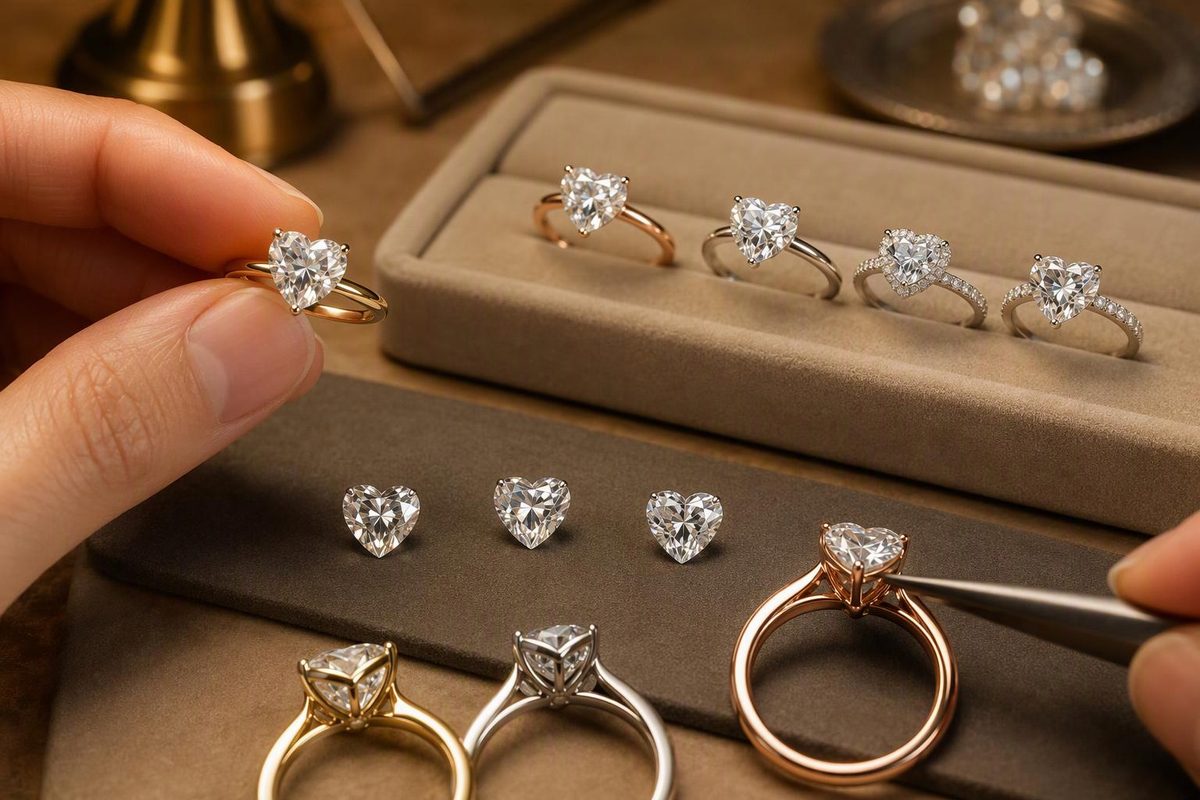
A good heart cut diamond ring needs three things: a clearly recognizable heart, attractive light performance and a setting that protects the pointed tip. High color and clarity grades cannot compensate for an uneven outline or a dark center that dominates the stone.
First, confirm what the listing describes. A heart-shaped diamond is not the same purchase as round diamonds arranged in a heart-shaped mounting. Ask for the center stone’s shape, individual carat weight and measurements—not just the ring’s total diamond weight.
Start with the outline, not the grades
Look at the actual diamond straight on, rather than relying on a stock photograph. Draw an imaginary line from the notch at the top—the cleft—to the bottom point. The two halves should look balanced.
Check four features:
- Lobes: The two rounded top sections should match in size and height.
- Cleft: The notch should be distinct enough to read as a heart.
- Wings: The sides tapering toward the point should have matching curves, without an obvious flat patch or bulge.
- Point: The tip should look defined and centered beneath the cleft.
These are the outline features emphasized in GIA’s heart-shaped diamond guide. A preference for a broader or taller heart is separate from whether its left and right sides match.
Length-to-width ratio helps describe that preference. Divide the length—from the point to an imaginary line across the tops of the lobes—by the widest side-to-side measurement. These measurement definitions come from GIA’s heart-shaped gemstone guide. A ratio near 1.00 describes a heart about as tall as it is wide; below 1.00 describes a broader heart. Treat this as a comparison tool, not a beauty grade. Two stones with the same ratio can have very different lobes and clefts.
Also compare millimeter dimensions. GIA’s fancy-shape buying guide notes that the heart outline can be difficult to perceive below approximately 0.50 carat, and that a bezel or three-prong setting can help preserve the shape of smaller stones. That is a visibility guideline, not a minimum purchase requirement. View the finished ring at realistic scale before deciding whether its outline is clear enough for you.
Watch the center as the diamond moves
Heart-shaped brilliant diamonds can show a bow tie: a dark area across the stone resembling two triangles joined at their tips. GIA explains that a larger or darker bow tie detracts more from the face-up appearance.
Ask for a face-up video of the actual diamond, gently tilted in diffuse daylight as well as under indoor lighting. Compare:
- Whether the center brightens as the stone moves.
- Whether a broad dark band remains visually dominant.
- Whether both halves show a pleasing, balanced pattern of bright and dark facets.
Do not judge from one frozen frame: a single lighting angle is not enough to establish how the stone will look in use. If buying remotely, make acceptable return terms part of the decision rather than treating video as a substitute for inspection.
Read the report without inventing a cut grade
For a natural heart-shaped diamond, a GIA report does not provide the overall cut grade used for standard round brilliants. GIA’s current report description limits that cut grade to standard round brilliant diamonds in the D–Z color range.
Consequently, a seller’s “Excellent cut” label for a GIA-graded heart needs clarification. It may be the seller’s assessment; excellent polish and symmetry are not the same as an overall GIA cut grade.
Use the report to check weight, dimensions, color, clarity, finish and any comments. GIA’s natural diamond report service includes polish, symmetry and fluorescence. Confirm natural or laboratory-grown origin in writing and make sure the report applies to the center stone being offered. GIA Report Check confirms whether report information matches GIA’s archived record; it does not, by itself, establish that the physical diamond is the reported stone.
For color and clarity, inspect the actual diamond rather than buying a universal grade target. Ask whether inclusions are visible without magnification and have a jeweler assess any potentially concerning features near the point. GIA’s heart-shaped engagement ring guide recommends checking for eye-visible inclusions and choosing a setting that shields the vulnerable tip. Our color and clarity chart explains what those grades measure.
Choose a setting that keeps the heart legible
The point is the heart’s most damage-prone area, and an excessively thin girdle can increase chipping risk. Ask the jeweler to assess both before mounting. GIA’s heart-shaped gemstone guide explains these durability concerns.
Compare settings by inspecting the finished design:
| Setting | What to check |
|---|---|
| Prong solitaire | Does the mounting shield the tip while leaving the cleft and lobes recognizable? |
| Bezel | Does the metal follow the heart cleanly, without visually filling the notch? |
| Heart-shaped halo | Does the halo complement the actual center outline, and is the tip protected by the mounting? |
Do not assume a halo automatically makes every tip safe. Ask for close-up top and side views showing the protection actually provided.
Compare the whole purchase
Request an itemized quote separating the center diamond, mounting and accent stones. Compare natural diamonds with natural diamonds, or lab-grown with lab-grown, using similar weights and grades—but keep outline, millimeter size and visible light performance in the comparison.
Before paying, obtain the report, actual-stone images, metal specification, resizing terms and return deadline. The better purchase is the heart you prefer in ordinary lighting, securely mounted, at an acceptable finished-ring price—not simply the listing with the highest grades.