
What the Types of Bezel Settings Mean
Full and partial are the two most consistently recognized structural categories. Other labels may instead describe rim width, decoration, geometry or arrangement.
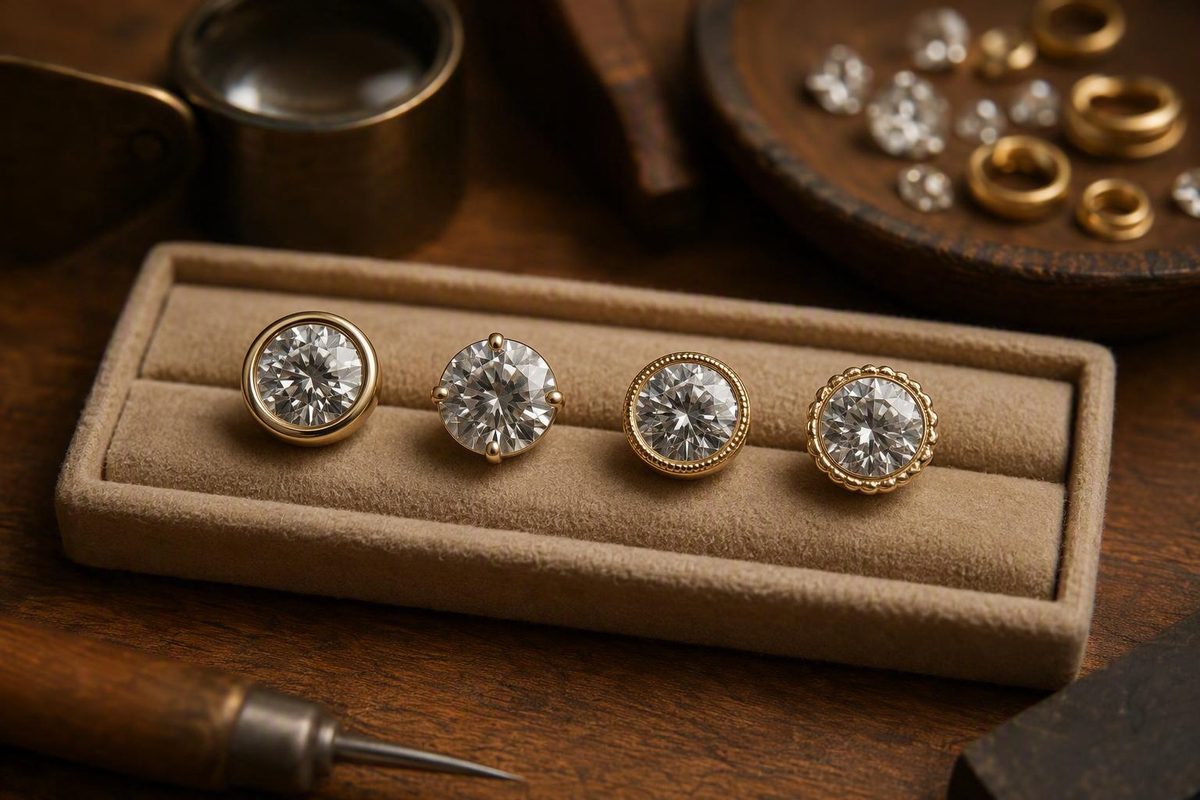
The many advertised types of bezel settings become easier to understand once their names are separated into distinct design variables. Across the commercial jewelry guides reviewed for this article, full and partial bezels are the two most consistently recognized structural categories. Other terms—such as thin, milgrain, scalloped, chevron, three-stone, or flush—may instead describe rim width, decoration, geometry, arrangement, or a related setting method.
That distinction matters when buying bezel-set jewelry. A product name may sound precise while revealing little about where the metal actually touches the gemstone. The practical approach is to examine coverage, exposed edges, profile, metal thickness, and workmanship rather than assuming a label guarantees a particular appearance, level of protection, or light performance.
What a bezel setting is—and why the terminology gets confusing
A bezel is a fitted metal rim or collar formed over some or all of a gemstone’s perimeter to hold it in place. Unlike a prong setting, which uses separate claws or points, a bezel relies on sections of a shaped rim. Commercial manufacturing guidance describes the construction as a collar fitted to the gemstone’s shape and size and pressed over its girdle or edge (Fascinating Diamonds’ bezel-setting guide).
The clearest structural division is:
- Full bezel: The retaining rim continues around the gemstone’s complete perimeter.
- Partial bezel: The retaining rim covers selected portions while intentionally leaving other portions open.
This is best understood as a practical taxonomy for comparing products, not as proof of a universally enforced industry vocabulary. The reviewed guides frequently mix several design dimensions in the same list. One might place “full,” “thin,” “milgrain,” and “three-stone” side by side even though those terms answer different questions.
A more useful taxonomy has five axes:
- Coverage: Is perimeter coverage full or partial?
- Rim width: Is the visible border thin, moderate, or thick?
- Decoration: Is the rim plain, milgrained, engraved, scalloped, textured, patterned, or set with accents?
- Geometry: Is the metal rounded, angular, spaced, V-shaped, recessed, or otherwise specially formed?
- Arrangement: Is the piece a solitaire, three-stone ring, toi-et-moi design, or another multi-stone layout?
These axes can overlap. A ring could have a full bezel structure, a thin rim, milgrain decoration, and a three-stone arrangement simultaneously. Calling it only a “milgrain bezel” or “three-stone bezel” leaves the underlying coverage unclear.
Here is a simplified coverage map:
FULL BEZEL — continuous retaining rim

        METAL RIM
      ╭──────────╮
     ╱  GEMSTONE  ╲
    │              │
     ╲            ╱
      ╰──────────╯
       No planned
     perimeter gaps


PARTIAL BEZEL — interrupted retaining rim

        METAL
      ╭──────╮
     ╱ GEMSTONE ╲
       open edge
     ╲          ╱
      ╰──────╯
        METAL
The drawing is conceptual rather than a manufacturing specification. A real design may have support below the stone even where its top view appears open.
Terminology is inconsistent among sellers. Half bezel, semi-bezel, and partial bezel are often used for related constructions, but some jewelers reserve “half bezel” for a specific two-sided layout. Open, spaced, and floating may be proprietary or loosely applied descriptions. Flush may be grouped with bezel styles by one manufacturer and treated as a separate setting method elsewhere.
For that reason, interpret a listing by examining the setting rather than relying on its title. Ask for a sharp top-view photograph or a simple coverage diagram. Trace the gemstone’s outline and mark every place where metal folds over or contacts its perimeter. That visual map usually communicates more than the style name.
A side view is useful as well. It can show whether the stone is raised, recessed, or seated close to the surrounding metal. It may also reveal that a visually open design has substantial structural support beneath the top rim.
Full bezel settings: continuous coverage around the stone
A full bezel uses a continuous retaining rim around the gemstone’s complete perimeter. From the top, the stone appears enclosed by an uninterrupted metal outline, with no section of the outer edge intentionally left open.
Imagine drawing a line around the visible stone without lifting the pencil. If that line represents the retaining rim and remains continuous, the structure is a full bezel. Openwork beneath the gemstone does not necessarily change that classification; the defining feature is continuity around the perimeter where the rim holds the stone.
This construction produces a more enclosed, strongly framed appearance than a partial bezel. Because the rim has no planned perimeter gaps, it places metal around more of the edge than a comparable partial design. Commercial guides accordingly distinguish full and partial bezels primarily by complete versus interrupted coverage (Frank Darling’s bezel-setting guide).
That physical difference should not be converted into a promise that a full bezel is damage-proof or that its stone can never loosen. Coverage is only one part of the finished setting. Fit, workmanship, condition, and later damage to the metal can all affect performance.
Rim thickness substantially changes the result:
- A slim full bezel can closely trace the outline and keep the visible border restrained.
- A thicker full bezel generally covers more of the stone’s face and makes the metal frame more prominent.
- A rim with intentional width changes can create a sculptural or asymmetrical effect.
- Unplanned variation may instead indicate inconsistent finishing or fit.
Complete coverage alone does not establish quality. The rim must be formed for the particular gemstone and meet it evenly along the intended contact area. A poorly executed full bezel should not be assumed to outperform a well-made partial design merely because it surrounds more of the perimeter.
A continuous rim may conceal a blemish or inclusion beneath a covered edge, as some retailer guides note. Covered areas can also be difficult for a buyer to inspect in a finished piece, so the condition of an important gemstone is best understood before it is set.
Consider a full bezel when your priorities include:
- Continuous perimeter coverage
- An uninterrupted metal outline
- A visually enclosed or framed appearance
- Less exposed outer edge than in a comparable partial design
- A smooth visual transition between the gemstone and rim
Do not choose one solely because of absolute claims about security, apparent size, or brilliance. Those outcomes depend on the actual gemstone and setting, including cut, rim thickness, proportions, fit, and finishing.
Partial, half, and semi-bezels: open sections with variable geometry
A partial bezel covers selected sections of the gemstone’s perimeter while leaving other sections exposed. Its defining feature is interrupted coverage: viewed from above, the retaining rim stops and starts rather than forming an unbroken border.
Half bezel and semi-bezel are commonly used for designs within this broad category. The words do not, however, guarantee one universal layout. Some jewelers define a half bezel specifically as metal covering two sides while leaving the others open (Dana Rebecca Designs’ bezel guide). That definition should not be generalized to every product sold as a partial or semi-bezel.
Possible layouts include:
- Metal along two opposing sides
- Covered ends with open sides
- Covered sides with open ends
- Several separated arcs around the perimeter
- Metal concentrated around corners or points
- Asymmetrical coverage used as a deliberate design feature
This variability is why a top-view image matters. “Partial” tells you that some part of the perimeter is open, but not which part, how much is exposed, or what support may exist beneath the stone.
Compared with a full bezel, a partial bezel usually creates a lighter, more open appearance. More of the gemstone’s outer edge remains visible, and the breaks in the metal make the setting feel less enclosed. The corresponding physical tradeoff is straightforward: open portions have less metal immediately surrounding them.
Half bezels may also be described by the form of their metal:
- Angled half bezel: The covered sections use angular planes, sharper transitions, or a geometric silhouette.
- Rounded half bezel: The covered sections curve around the gemstone and create a softer outline.
These are stylistic or geometric differences within partial construction, not separate retention principles. Angled and rounded versions can expose similar portions of the gemstone while looking markedly different.
Open sides are sometimes marketed as a way to increase light and brilliance. Greater exposure may change how a finished ring looks, but the supplied commercial evidence does not establish that open sides alone produce a measurable improvement in light performance. Cut, facet pattern, setting geometry, rim thickness, cleanliness, workmanship, lighting, and viewing angle can all affect the observed result.
A partial bezel is worth considering when you want visible breaks in the metal frame and accept that more of the perimeter will remain uncovered. Before buying, ask:
- Which sides are held by the rim?
- Are corners or pointed ends covered?
- Are the apparent gaps part of the retaining structure or decorative cutouts?
- Does support exist beneath areas that look open from above?
- Does the photograph show the actual gemstone shape and setting size?
Verify the answers against a straight top view. If the description and photographs seem inconsistent, request a marked image showing every intended contact area.
Milgrain, scalloped, engraved, and other decorative bezels
Many advertised bezel “types” are decorative treatments rather than different ways of retaining a gemstone. Their underlying structure may still be full or partial.
Common decorative descriptions include:
- Milgrain
- Double milgrain
- Scalloping
- Engraving
- Piercing or openwork
- Hammered or other textured finishes
- Repeating patterns
- Applied metal beads
- Small accent stones incorporated into the rim
Milgrain is a border of tiny metal beads. Double milgrain uses two rows of that beaded texture. The detail may run around a full bezel or appear only on the covered sections of a partial bezel. It changes the rim’s finish and visual character, not the basic distinction between continuous and interrupted coverage.
A scalloped bezel has a wave-like edge. The waves may face outward, inward, or form a repeating contour around the gemstone. The structural question remains whether the scalloped metal collectively forms a continuous retaining rim or appears only in selected sections.
A vintage-inspired bezel may combine milgrain, engraving, piercings, patterned metal, or applied bead details. “Vintage-inspired” is an aesthetic description, not a standardized method of construction. It does not establish the age of the piece or tell you whether the gemstone has full or partial perimeter coverage.
Commercial design examples show milgrain, double milgrain, scalloping, engraving, piercings, and metal beads overlapping with full, partial, and multi-stone bezel layouts (Green Lake Jewelry Works’ bezel examples). Decorative bezels may also incorporate contrasting textures or small accent stones, making the rim visually prominent even when its underlying border is narrow.
The clearest way to name these settings is to state structure first and decoration second:
- Full bezel with milgrain
- Partial bezel with a scalloped edge
- Full bezel with engraving and double milgrain
- Two-sided partial bezel with textured metal
- Full bezel with accent stones in the outer rim
Decorative categories are not mutually exclusive. One rim can be scalloped, engraved, and milgrained at the same time. Intricate ornamentation also does not demonstrate that the main stone has been fitted correctly.
Inspect the two aspects separately:
- Structural fit: Does the rim meet the gemstone evenly at the intended contact areas? Are there unexplained gaps, visibly lifted sections, or unintended asymmetry?
- Decorative finish: Are the beads, engraved lines, scallops, textures, or accents consistent with the intended design and finish?
Milgrain should not distract from an irregular enclosure, just as engraving cannot compensate for an obviously poor fit. Conversely, handmade decorative work may show small variations as part of its character. The important distinction is whether those variations appear intentional and whether they interfere with the retaining rim.
Open, spaced, chevron, and flush designs: useful labels with limits
Open, spaced, chevron, angled, and rounded descriptions can communicate a design idea, but the reviewed commercial guides do not apply these terms uniformly. Different jewelers may use the same word for visibly different constructions.
It therefore often functions as a form of partial coverage. The label alone does not reveal whether the sections sit on opposing sides, surround corners, wrap pointed ends, or create a decorative rhythm. Identify precisely which parts of the gemstone remain exposed.
A chevron bezel can use a pointed, V-shaped metal element around a gemstone tip. This may be useful language for a pear, marquise, or another pointed outline, but “chevron” does not define the complete setting. A V-shaped element at one end might be combined with a partial rim elsewhere, a continuous outer frame, or another supporting structure.
An open bezel is sometimes described as leaving the stone’s face visually open without metal clamping around its top. That description requires caution. The term does not have a sufficiently consistent meaning to explain the mechanics on its own.
Floating bezel can be even less informative. It may describe a visual illusion rather than a particular retention method.
A flush-set stone is recessed into surrounding metal so that its face sits near the metal surface. Uneek Jewelry, for example, includes full, partial, semi-, open, and flush designs in one retailer taxonomy while describing the flush-set stone as sunk into the metal (Uneek Jewelry’s five-type classification).
The practical boundary question is whether the setting uses a conventional rim formed over the gemstone’s perimeter or retains the stone within a recess by another method. A proprietary product name cannot answer that question.
For any nonstandard label, request:
- A straight top view
- A side profile
- An underside view when relevant
- Identification of each metal-to-stone contact area
- Identification of exposed edges, corners, and points
- A plain-language explanation of how the stone is retained
If the seller cannot explain the construction without repeating the marketing name, the available information may be insufficient for a meaningful comparison.
Rim thickness, gemstone shape, and stone arrangement
Thin and thick bezels describe rim width, not separate structural categories. Either can be full or partial, plain or decorated, and used with one gemstone or several.
A thin rim generally leaves more of the gemstone’s face visible and can emphasize its outline with a restrained metal border. A thick rim generally conceals more of the face and makes the metal a stronger visual component. Between those extremes are many variations in profile, taper, edge treatment, and color contrast.
Neither rim width universally makes a gemstone look larger or smaller. A thin, contrasting outline may visually define the silhouette in one design. In another, a heavy frame may enlarge the overall composition while reducing the visible gemstone area. Apparent size depends on the relationship among the stone’s dimensions, metal color, rim width, setting contour, and surrounding design.
Bezels can be formed to follow many gemstone outlines, including:
- Round
- Oval
- Cushion
- Emerald
- Princess
- Asscher
- Marquise
- Pear
- Heart
- Radiant
- Other regular or custom shapes
Commercial guides describe custom-formed bezels for numerous outlines, including round, oval, princess, emerald, cushion, marquise, and Asscher shapes (Fascinating Diamonds’ shape overview). The ability to form a rim around a particular outline does not mean every implementation will have the same fit, coverage, profile, or exposed areas.
Pointed shapes deserve especially careful visual review. For pear, marquise, and heart outlines, determine whether the points are covered, left open, or surrounded by a separate V-shaped element. This is inspection advice rather than a claim that one geometry is universally required. The key is not to infer the treatment of a point from the word “bezel” alone.
Square and rectangular stones should likewise be examined corner by corner. Look for even coverage and consistent rim width rather than attempting to diagnose hidden structural conditions from a photograph. If a corner looks ambiguous, ask the jeweler to explain and show the fit from another angle.
Arrangement terms belong on a different axis:
- Solitaire means one principal gemstone.
- Three-stone describes a three-gem layout.
- Toi-et-moi describes a paired-stone composition.
- Multi-stone covers designs using several gemstones.
None of these terms defines a bezel structure. Each gemstone in a multi-stone piece can have its own full or partial bezel.
Words such as round, oval, square, or hexagonal may also describe the bezel’s visible outer contour rather than its retention method. Separate the gemstone outline, inner retaining rim, and outer bezel contour when evaluating the design.
Inspect every gemstone in a multi-stone piece individually. Coverage, symmetry, rim width, and finishing can differ by position, particularly where side stones are smaller or angled.
Full versus partial bezel—and how both compare with prongs
The stable structural distinction is straightforward: a full bezel has a continuous retaining rim, while a partial bezel leaves selected perimeter sections open. A prong setting is different because it uses separate metal claws or points rather than a fitted rim.
| Setting | Rim continuity | Exposed edge | Visual openness | Perimeter coverage | Terminology notes |
|---|---|---|---|---|---|
| Full bezel | Continuous | No intentionally open perimeter section | Most enclosed of the three | Complete perimeter | “Full” is relatively consistent, although rim width and profile vary |
| Partial bezel | Interrupted | Selected sections exposed | More open than a full bezel | Selected portions only | May be called partial, half, or semi-bezel; geometry varies |
| Prong setting | No continuous rim | Perimeter visible between prongs | Typically open around the stone | Concentrated at separate contact points | Number, shape, and placement of prongs vary |
A full bezel generally places metal around more of the gemstone’s perimeter than a partial design. A partial bezel shows more edge. That distinction should not become an absolute claim that one ring cannot loosen or that another will necessarily sustain damage.
Commercial jewelry guides commonly describe bezels as having a smoother, lower profile and being less prone to catching than projecting prongs. Those are comparative design observations, not independent test results or guarantees.
What about sparkle?
Open sides do not guarantee greater brilliance, and a full rim does not automatically make a well-cut diamond appear dark. The finished appearance can depend on:
- The gemstone’s cut and proportions
- Its particular facet pattern
- Rim width and height
- Metal extending over the crown
- The shape and openness of the structure beneath the stone
- Setting precision and symmetry
- Cleanliness
- Lighting and viewing angle
Commercial guides make conflicting promotional claims about whether partial bezels materially improve brilliance. Without controlled evidence for a particular gemstone and setting, the defensible conclusion is narrower: perimeter exposure alone does not establish light performance.
Compare actual pieces rather than relying on generalized descriptions. A full bezel with a narrow, precisely fitted rim may look more open than expected, while a partial design with broad metal sections may still appear visually substantial.
What about apparent size?
A thin rim can emphasize the gemstone’s outline, particularly when the metal contrasts with it. A thick rim adds visual width to the total composition but may hide more of the stone itself. Either approach could make the overall design read as larger or smaller depending on color, proportion, contour, and context.
When possible, compare:
- The loose gemstone before setting
- A rendering or sample with the proposed rim width
- The completed setting
- Full and partial alternatives under the same lighting
- Top and side views at comparable magnification
Base the decision on observable priorities: continuous coverage, visible open space, amount of exposed edge, profile, and preferred metal presence. Those criteria are more dependable than promises of guaranteed sparkle, apparent-size enhancement, or security.
How to choose and inspect a bezel setting before buying
Start with structure, then move to appearance and execution. A useful decision sequence is:
- Choose perimeter coverage. Decide between a continuous full bezel and an interrupted partial design.
- Set your tolerance for exposed edge. Identify which sides, corners, or points you are comfortable leaving open.
- Choose rim width. Decide how much visible metal you want and how much of the gemstone’s face should remain visible.
- Select decoration. Consider plain metal, milgrain, engraving, scalloping, texture, or accents.
- Evaluate the geometry. Review rounded, angular, spaced, chevron, recessed, or other special treatments.
- Assess shape-specific execution. Inspect changes in direction, corners, and points.
- Review every gemstone. In a multi-stone piece, do not assume all bezels are constructed identically.
A manufacturer’s guide identifies smooth, polished edges and a tight, even enclosure as visible quality indicators (Uneek Jewelry’s bezel workmanship guidance). These are useful inspection cues, but a visual review cannot guarantee long-term performance or reveal every concealed contact area.
Look for:
- Visible gaps where the rim is intended to meet the gemstone
- Metal that appears lifted or irregular
- Rough spots or sharp visible edges
- Unintended changes in rim width
- An off-center gemstone
- Asymmetry that does not appear deliberate
- Uneven coverage at corners or points
- Dents, cracks, distortion, or heavily worn metal
- Movement or audible rattling
Some openings may be part of an intentionally partial design, so distinguish planned geometry from possible poor fit. Ask the jeweler to explain anything ambiguous rather than diagnosing it from a single photograph.
For a partial bezel, identify every exposed side, corner, and point. Confirm that actual coverage matches the description and that the open sections occur where you expected.
For a full bezel, trace the entire retaining rim and check its visible consistency. Do not assume continuous coverage alone proves good workmanship.
For a decorative bezel, inspect structure and ornament separately. Milgrain should be reasonably consistent with the intended handmade or machine-finished character. Engraving should not obscure your view of the retaining edge. Accent stones should not prevent you from assessing the main bezel’s fit.
For a design sold under a nonstandard label, request top and side photographs or a drawing. Ask the jeweler to replace the style name with a literal description—for example: “Metal covers these two sides, a V-shaped section surrounds this point, and the opposite edge remains open.”
Useful questions include:
- Was the rim made or adjusted for this particular gemstone?
- Which parts of the perimeter are covered?
- How are corners or pointed ends treated?
- How much of the face does the selected rim width cover?
- Is the visible outer contour the same as the retaining rim?
- Does every gemstone in the piece have the same coverage?
- Which features are decorative, and which retain the stone?
- Can the seller show the actual finished piece rather than a generic rendering?
Seek professional evaluation if the gemstone moves, the rim is visibly damaged, or you cannot determine how the stone is retained. Photographs can reveal obvious concerns, but they cannot establish the condition of every concealed part of the setting.
The short chooser is simple:
- Choose a full bezel for continuous perimeter coverage and a strongly framed outline.
- Choose a partial bezel for visible open sections, accepting that more edge will remain exposed.
- Add milgrain, engraving, scalloping, or texture for decorative detail.
- Choose spaced, chevron, open, floating, or other nonstandard geometry only after understanding its contact areas and openings.
Is a half bezel the same as a partial or semi-bezel?
Often, but not always. Half bezel and semi-bezel are commonly used for partial designs because each leaves part of the perimeter open. Some jewelers use the terms interchangeably; others define a half bezel specifically as metal covering two sides.
Treat partial bezel as the broad structural category and verify the geometry of anything called a half or semi-bezel. A top-view photograph should show which sides, ends, corners, or points are covered.
Does a full bezel reduce a diamond’s sparkle?
Not necessarily. A full bezel covers the perimeter, but that fact alone does not determine a diamond’s visible brilliance. Cut, facet pattern, rim width, metal overlap, setting geometry, workmanship, cleanliness, and lighting can all influence the result.
A broad or poorly proportioned rim may change the appearance, but open sides do not automatically produce better performance. Compare the actual diamond and finished setting under consistent lighting when possible.
Is milgrain a separate type of bezel setting?
No. Milgrain is a decorative border made from tiny metal beads, while double milgrain uses two rows of beading. Either treatment can be applied to a full or partial bezel.
“Full bezel with milgrain” or “partial bezel with double milgrain” therefore communicates more than “milgrain bezel” alone.
Is a flush setting technically a bezel setting?
There is no consistent answer across the reviewed commercial taxonomies. A flush-set gemstone is recessed so its face sits near the surrounding metal surface. Some sellers group that construction with bezel styles because the stone is surrounded by metal; others classify it separately because it may not use a conventional rim formed over the perimeter.
Ask how the gemstone is retained rather than relying on the seller’s category.
Can different diamond shapes and multi-stone rings use bezel settings?
Yes. Commercial examples show bezels formed around numerous outlines, including round, oval, cushion, emerald, princess, Asscher, pear, and marquise shapes. The finished result still depends on the particular gemstone, rim geometry, coverage, and execution.
Multi-stone rings can also use bezels. Each gemstone may have its own full or partial rim, and the construction can vary among center and side stones. Solitaire, three-stone, toi-et-moi, and multi-stone describe arrangement—not separate bezel structures.
Ultimately, classify a bezel on five axes: coverage, rim width, decoration, geometry, and stone arrangement. Identify the underlying full or partial structure first, then judge the remaining features independently. The best choice depends on actual coverage, exposed edges, profile, aesthetics, and workmanship—not a proprietary style name or an absolute promise about sparkle or security.