
Rose-Cut Diamond in a Pavé Setting: What to Check
See how a rose-cut center and pavé accents work together, what the terms mean, and what to inspect before buying the ring.
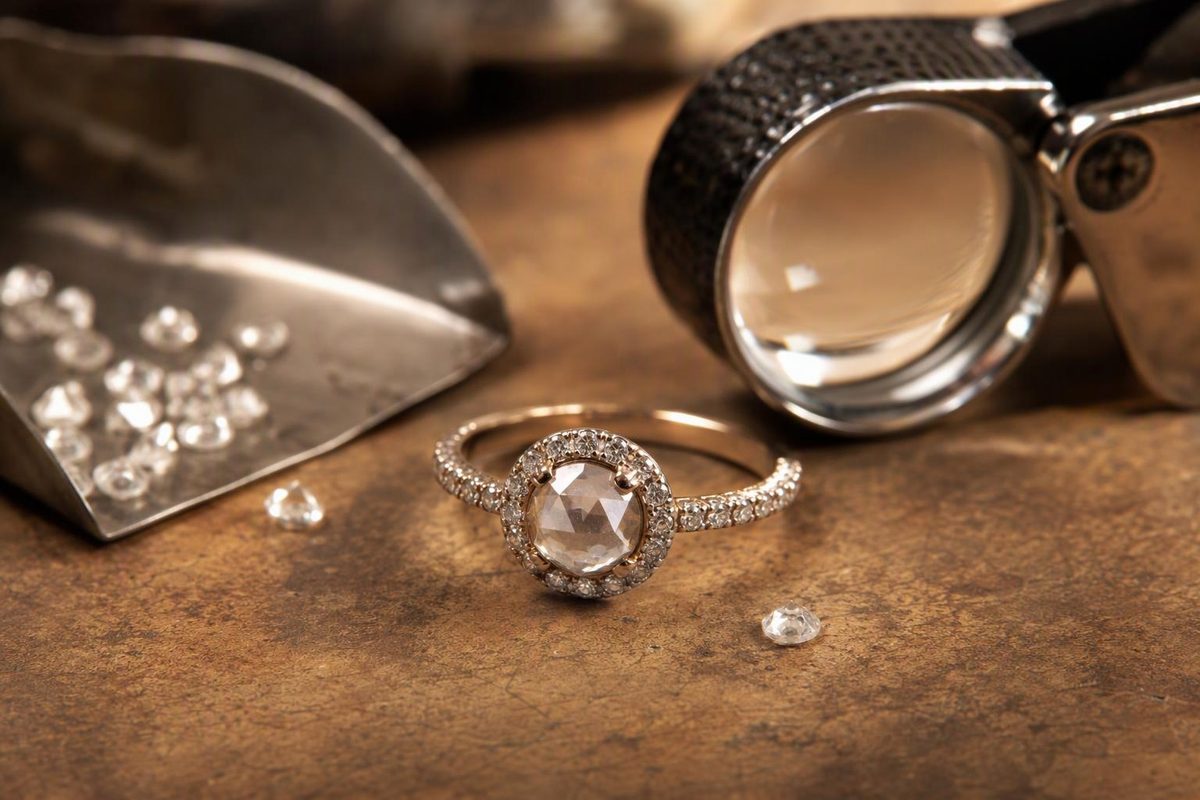
A rose-cut diamond with pavé accents combines two distinct effects: soft flashes from the center and a finer line of sparkle from the small accent diamonds. It suits a buyer who prefers texture and an antique-influenced look over the brightness of a modern round brilliant. It also requires more upkeep than a plain solitaire.
First, separate the terms. Rose cut describes the center diamond’s faceting. Pavé describes small stones set closely together with tiny beads or prongs, usually along the band or around a center stone. Pavé does not explain how the rose-cut center is held; that stone might be secured by a bezel, prongs or another type of head. Our guide to ring setting types explains the distinction.
How the combination looks
A rose cut has a flat base and a faceted, dome-shaped top rather than the table and pavilion of a modern brilliant. GIA defines the style as a flat bottom beneath a domed crown formed by at least three facets and traces its use in diamonds to the 1500s (GIA). A modern rose-cut ring is therefore vintage-inspired unless its age and provenance are established separately.
Because little weight sits below the girdle, a rose cut can face up larger than another cut of the same carat weight. The trade-off is optical: expect luster and restrained flashes rather than intense brilliance and fire. Its shallow depth and open faceting can also make color and inclusions more apparent (GIA’s diamond-shape guide).
Pavé adds sparkle around that quieter center. It may run along the shank, form a halo or do both. The contrast can be attractive, but bright, colorless accents may also make warmth in the center more noticeable. Compare the finished ring with a plain-band rose-cut ring and, if brilliance matters, a modern brilliant in pavé.
Compare dimensions, not carat weight alone
Carat measures weight, not visible size. Request the center’s length, width and depth in millimeters, then compare actual face-up dimensions rather than assuming every 1-carat rose cut has the same spread.
Inspect the center for:
- an outline and dome that look intentionally balanced;
- a pleasing facet pattern as the ring moves;
- inclusions you can accept at normal viewing distance;
- chips, abrasions or a very thin exposed edge; and
- color that works with both the metal and accent diamonds.
A laboratory report can establish important quality information, but it cannot decide whether the facet pattern is attractive. GIA’s Excellent-to-Poor cut-grading system was designed for unmodified round brilliants, so a rose cut does not have an equivalent GIA Excellent cut grade (GIA). GIA also issues its standard natural-diamond grading reports for loose stones, not mounted centers (GIA report services). Confirm that any report number belongs to the center diamond and that the report’s measurements match it.
View the ring in diffuse daylight, ordinary indoor light and jewelry-store spotlights. GIA notes that concentrated store lighting can make diamonds look more dazzling than they do in typical daily conditions (GIA).
Inspect the center setting and pavé separately
Identify exactly what supports or crosses the center’s edge. A full bezel surrounds the perimeter and offers more protection; prongs expose more of the outline. Check that a bezel follows the stone without unnecessarily hiding it, or that prongs are even, secure and free of lifted tips.
Then have the pavé examined under magnification. Rows should look even, beads should cover the edges of the accent stones, and no stone should move when tested by a jeweler. Construction quality matters more than the label. GIA notes that delicate pavé benefits from periodic inspection and that pavé bands can be harder to resize because work on the shank may disturb the small stones (GIA).
Before ordering, ask:
- Does the stated carat weight refer to the center, the pavé or the entire ring?
- Is each diamond natural or laboratory-grown, and is that stated in writing?
- What are the center’s exact dimensions, condition and disclosed treatments?
- How is the center secured?
- How far around the shank does the pavé extend, and what resizing range is possible?
- Does the jeweler cover tightening or replacing lost accent stones?
- Will the intended wedding band sit flush, or will the head create a gap?
For an estate piece, a rose cut, darkened metal and ornate pavé are style clues—not proof of age. Ask for provenance and inspect repairs, replaced stones and worn settings. The same due diligence applies when buying an antique bezel-set ring.
Is it practical for everyday wear?
It can be, if the setting is well made and the wearer accepts more maintenance than a plain shank. Pavé’s small recesses collect dirt, while its many accent stones create additional points that may eventually need tightening.
For a sound modern ring, warm water, mild soap and a soft brush are generally suitable. An ultrasonic cleaner can shake loose stones that are already insecure, so the ring should be inspected first (GIA). Do not assume the same routine is safe for an antique, foil-backed or heavily repaired piece; have a jeweler identify its construction and recommend a cleaning method.
Choose this combination for the contrast between a broad, low-key center and precise pinpoints of sparkle. If maximum brilliance, easy resizing or minimal maintenance matters more, a modern brilliant or a plain-shank rose-cut ring is the more direct choice.