
Pear Cut Diamond: How to Judge Shape, Sparkle and Safety
Learn how to compare a pear diamond’s bow tie, proportions, color and clarity, read its grading report, and choose a setting that protects the point.
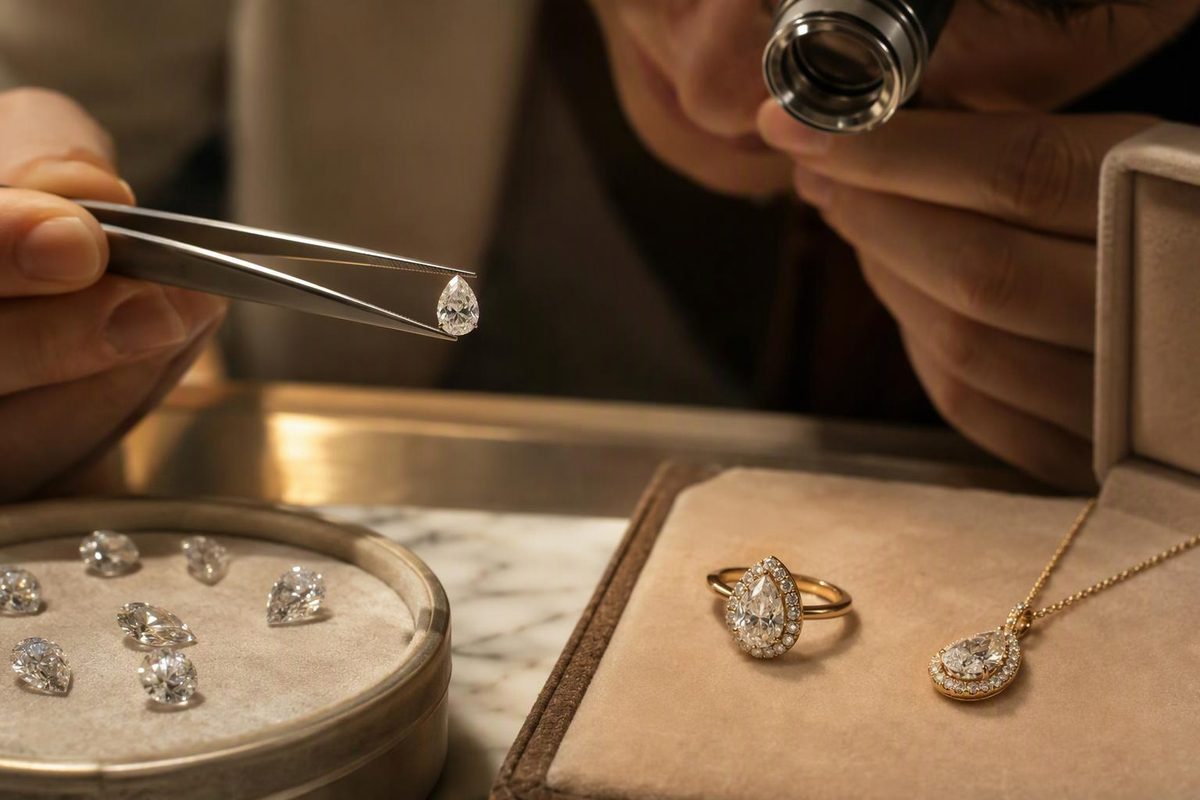
Buy a pear cut diamond for its balanced outline and lively appearance in motion—not a ratio or a seller’s “Ideal” label alone. Check for a persistent dark bow tie, assess color and inclusions in the individual stone, and choose a setting that protects the point. High color and clarity grades do not settle the cut question.
A pear has a rounded end that tapers to a single point. Most are brilliant-faceted, but pears vary in facet arrangement, geometry and light patterns even when their headline grades look similar. GIA’s research on fancy shapes explains why a proportions chart cannot reliably predict their cut performance.
Enter the stone’s length and width, then select what its center does in motion.
Check Proportions and the Bow Tie
The starting dimensions are an illustrative example, not a diamond recommendation.
Your Shape Check
Ratio: 1.64
Within the 1.50–1.75 range many experts prefer. This is an outline preference, not a cut grade.
Next step: request a face-up video with slow tilting. These dimensions cannot establish light performance.
Sources: GIA’s pear-buying guide (preferred ratio) and 2024 fancy-shape observation study (bow-tie preferences). No cut score is calculated.
Judge the Bow Tie in Motion
The bow tie is a pattern across the diamond’s middle that can resemble two dark triangles meeting at their tips. It is not an inclusion. Observer reflection contributes to the pattern, so its appearance depends partly on viewing conditions.
Some contrast is desirable; a pear need not look uniformly bright in every position. The useful distinction is between contrast that changes with movement and a broad, dark band that persists. GIA’s 2024 observation study found that particularly broad, dark or persistent bow ties were generally disliked. Opinions differed as patterns became narrower, less intense or changed from dark to light with motion.
Start face-up, looking directly through the top rather than judging an angled glamour shot. Rock the stone gently and watch the middle: it should contribute bright flashes rather than remain conspicuously dark while the ends sparkle.
Compare it in diffuse daylight and ordinary indoor light, not just under jewelry-store spotlights. Use magnification to inspect details, but decide whether the pattern bothers you at normal viewing size.
Online, request a video of the exact diamond viewed face-up with slow tilting, not only a rotation around its side. A single still image cannot show persistence. GIA’s pear-buying guide also recommends examining pears from different angles in the lighting conditions where they will be worn.
Separate Outline Preference From Symmetry
Imagine a line running from the point through the center of the rounded end. The two sides should look balanced. Compare the shoulders near the rounded end, the widest section and the curved “wings” leading toward the tip. The point should align with that centerline rather than lean to one side.
GIA identifies uneven shoulders, uneven wings and an off-center table—the large top facet—as features worth checking. Its pear-buying guide also notes that many experts prefer a length-to-width ratio around 1.50–1.75, while emphasizing that the best ratio is ultimately a preference, not a beauty grade.
Calculate length-to-width ratio by dividing length by width. An illustrative 9.0 × 5.5 mm pear has a ratio of about 1.64. That describes its elongation; it does not predict sparkle. A flattering ratio cannot rescue a distracting dark center.
Compare actual millimeter dimensions as well as carat weight. If you want a broader pear, do not reward extra length while ignoring width. Our diamond size guide explains how to use face-up measurements when comparing shapes.
Read the Report Without Treating It as a Cut Verdict
As of October 2026, GIA does not issue an overall cut grade for pears. GIA natural-diamond grading reports give them polish and symmetry grades, but those are not interchangeable with a round brilliant’s overall cut grade. GIA’s fancy-shape FAQ says its grading-system research remains underway. Rapaport reported in June 2026 that GIA plans to introduce cut grading for pears, ovals and marquises in 2027.
If a listing calls a GIA-graded pear “Excellent cut” or “Ideal,” ask who assigned that description and what it measures. Read the laboratory report rather than assuming the seller’s label came from GIA.
Table and depth percentages are useful descriptions, not a reliable shortcut to the best pear. GIA’s fancy-shape research concludes that the geometry is too complex for cut prediction from simple proportion charts. Polish and symmetry grades likewise do not tell you whether you will like the stone’s bow tie or outline.
Use GIA Report Check to confirm that the report’s information matches GIA’s database. That verifies the report data; matching the physical diamond to the report remains a separate step.
Check Color and Clarity in the Individual Pear
Pears tend to retain more visible color than round brilliants, according to GIA’s pear-buying guide. If a colorless appearance matters to you, compare shortlisted stones face-up under the same lighting. Do not assume the same letter grade will look identical across shapes.
For clarity, separate appearance from durability. First, assess whether you can see an inclusion without magnification at your usual viewing distance. Then have a professional assess whether an inclusion could affect durability, especially near the point.
GIA specifically flags inclusions near the tip because that area is sensitive to damage. A stone that looks clean still deserves a professional check there. Our color and clarity chart helps interpret grades, but the individual pear needs assessment rather than one universal minimum grade.
Protect the Point Before Committing
The point is the pear’s most vulnerable area. GIA recommends a V-prong over the tip or a bezel around the entire stone for protection. Do not assume a surrounding halo provides that protection. Ask to see how the actual mounting covers the tip from above and from the side.
Before paying, obtain the report, the exact stone’s video, written confirmation of natural or laboratory-grown origin, and the finished-ring price. Confirm the return terms, especially for a custom mounting, and whether you can arrange an independent inspection before that window closes.