
2-Carat Diamond Size in mm: How Big It Looks by Shape
Millimeter benchmarks for 2-carat rounds, ovals, cushions, emeralds, pears and princess cuts, plus how depth, girdle and setting change how big one looks.
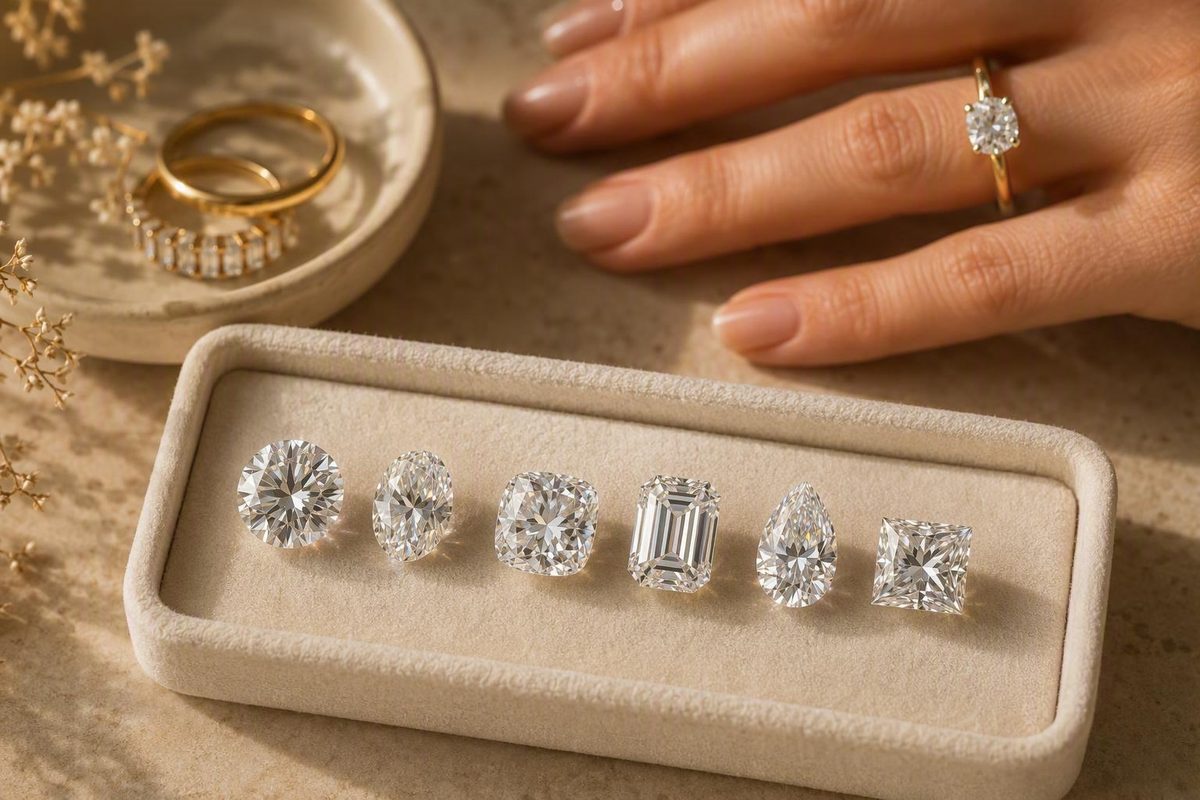
A typical 2-carat round brilliant measures about 8.0–8.2 mm across, and 8.1 mm works as a first-pass benchmark (round-diamond size benchmark). That range is illustrative, not a grading standard: 2 carats describes weight, while the grading report lists the individual diamond’s actual dimensions. Judge visible size from those millimeter measurements together with depth, girdle, proportions, cut information, photographs, and video.
Pick the shape and type the millimeter measurements from the grading report; the comparison updates as you type.
2-Carat Size Check
Compares one stone's report measurements with the chart range for a diamond weighing about 2.00 ct.
Add depth in mm (optional, rounds only)
Within the typical 2-carat round range
| Average diameter | 8.06 mm |
|---|---|
| Chart range, 2 ct round | ~8.0–8.2 mm |
| Against the 8.1 mm benchmark | −0.04 mm |
| Illustrative face-up area | ~51.0 mm² |
| Against a 1 ct round at 6.5 mm | ~+54% area |
Spread is ordinary for the weight. Move on to cut grade, motion video, color, clarity and price.
The three outlines share one scale but are not actual size on your screen. Outlines are simplified.
All six 2-carat chart ranges
| Shape | Length (mm) | Width (mm) |
|---|---|---|
| Round | ~8.0–8.2 | ~8.0–8.2 |
| Oval | ~10.0–10.7 | ~6.8–7.3 |
| Emerald | ~8.4–9.2 | ~6.2–6.5 |
| Cushion | ~7.5–8.0 | ~7.4–7.6 |
| Pear | ~10.5–11.7 | ~6.5–7.2 |
| Princess | ~6.9–7.2 | ~6.9–7.2 |
| 1 ct round, for scale | ~6.4–6.5 | ~6.4–6.5 |
Sources: round benchmarks from Diamond Banc's carat size chart; fancy-shape ranges combined from Washington Diamond and VRAI seller charts. Illustrative figures, not grading standards. Area uses the circle formula on the average diameter; no area is given for fancy shapes because their outlines vary.
Carat Is Weight, So 8.1 mm Is a Benchmark and Not a Rule
One metric carat equals 0.2 gram, so a 2-carat diamond weighs 0.4 gram. Carat is strictly a unit of weight; it does not specify diameter, length, width, depth, or visible surface area (GIA’s explanation of carat weight and the 4Cs).
A specific round may fall slightly above or below 8.1 mm because its weight can be distributed differently through the crown, girdle, and pavilion.
Four terms get blurred in listings and need to stay separate:
- Carat weight: the diamond’s mass.
- Physical dimensions: its diameter, or its length, width, and depth.
- Face-up spread: the space its outline occupies when viewed from above.
- Perceived size: how large it appears in its setting, on a particular hand, under particular viewing conditions.
A grading report for a round commonly lists minimum and maximum diameters rather than one figure. Even well-cut rounds are not perfectly circular, so laboratories measure them across several axes. A report might show 8.03 × 8.08 mm without implying that the diamond has one fixed diameter.
A stone outside the approximate range deserves closer inspection, but diameter alone cannot establish whether it is well cut, bright, durable, or appropriately priced.
Approximate 2-Carat Dimensions by Shape
The dimensions below are synthesized from commercial seller charts rather than laboratory grading standards. Washington Diamond supplies examples for round, oval, emerald, cushion, and pear shapes, while VRAI publishes broader shape-specific chart ranges, including princess cuts. Their figures differ because they describe illustrative diamonds rather than mandatory measurements (Washington Diamond’s examples).
| Shape | Approx. size (mm) | What to notice |
|---|---|---|
| Round | 8.0–8.2 | Diameter and roundness |
| Oval | 10.0–10.7 × 6.8–7.3 | Ratio, outline, and bowtie |
| Emerald | 8.4–9.2 × 6.2–6.5 | Open facets, color, and inclusions |
| Cushion | 7.5–8.0 × 7.4–7.6 | Outline, depth, and facet pattern |
| Pear | 10.5–11.7 × 6.5–7.2 | Bowtie, symmetry, and point |
| Princess | 6.9–7.2 | Depth and corner protection |
The oval, emerald, cushion, pear, and princess ranges combine rounded examples from the two seller charts rather than reproducing one universal conversion table. VRAI’s table, for example, places a 2-carat oval around 10.47–10.67 × 7.09–7.29 mm and a princess around 6.96–7.16 mm, but an individual report may show different dimensions (VRAI’s shape chart).
Fancy-shape measurements vary because these diamonds do not follow one outline or proportion set. An oval can be short and broad or long and narrow. Cushions range from square to elongated. Emerald cuts vary in length-to-width ratio, and different facet designs and depths change how the weight is distributed.
Elongated ovals and pears usually provide more visible length along the finger than an approximately 8.1 mm round. That can create a larger-looking silhouette, but length alone is not face-up area. A longer diamond may also be narrower, deeper, or shaped in a way that occupies less space than a simple length-times-width calculation suggests.
Size is only one part of the comparison. Ovals and pears can display a dark bowtie through the center. Emerald cuts use broad, open step facets that tend to reveal body color and inclusions more readily than brilliant-style cuts. Shape and cutting style also influence light behavior and perceived size (GIA’s guide to diamond shapes).
A chart that makes one shape look largest is a poor reason to choose it. Start with the outline you prefer, then evaluate the individual diamond’s dimensions, ratio, facet pattern, light return, and visual balance.
Depth and Girdle Explain Why Equal-Weight Stones Face Up Differently
Picture two diamonds from the side. Both contain the same total mass, but one distributes more material across the crown and girdle plane while the other carries more below the girdle in its pavilion. From above you see the face-up outline, not all the material contributing to the carat weight.
A deep pavilion can therefore retain weight without producing a proportional increase in diameter. A thick girdle can do something similar by placing more of the diamond’s weight around its perimeter instead of adding useful face-up spread.
The opposite extreme is not automatically better. An unusually shallow diamond may measure wider, but width gained at the expense of balanced proportions can weaken light return or create unattractive patterns.
For a round brilliant, face-up appearance reflects the interaction among total depth, table size, crown angle, pavilion angle, girdle thickness, facet alignment, and polish and symmetry. These variables work together. No single depth, table, or girdle measurement can be isolated from the rest of the diamond and treated as universally ideal. The same principle applies to fancy shapes, although their outlines and facet patterns require shape-specific assessment.
Spread is evidence, not a verdict. A broad diamond is not necessarily better cut, brighter, more durable, or more valuable. It is simply broader, and the additional width has to be weighed against light performance and construction.
Doubling the Weight Adds Roughly 1.6–1.7 mm of Diameter
A typical 1-carat round measures approximately 6.4–6.5 mm, compared with about 8.0–8.2 mm for a typical 2-carat round. Doubling the weight therefore adds roughly 1.6–1.7 mm of diameter, not another 6.5 mm. These are approximate chart benchmarks, and individual stones vary (1-carat and 2-carat round benchmarks).
The reason is three-dimensional. As mass increases, a diamond generally becomes deeper as well as wider. Some of the additional material sits in the crown, pavilion, and girdle rather than extending the outline seen from above.
A simplified circular calculation shows the difference:
| Round benchmark | Calculation | Area |
|---|---|---|
| 1 carat at 6.5 mm | π × 3.25² | 33.2 mm² |
| 2 carats at 8.1 mm | π × 4.05² | 51.5 mm² |
These figures use the circular-area formula and the two specific benchmark diameters shown, not the entire 6.4–6.5 mm or 8.0–8.2 mm ranges. They are illustrative geometry rather than measured face-up areas for every diamond.
On those two benchmarks the 2-carat round shows about 55% more face-up area. That is a substantial visual step, but neither diameter nor simplified area doubles. Visible size does not rise in direct proportion to carat weight.
Reading the Grading Report for Visible Size
Put the reports for two candidate diamonds side by side and compare the same fields in the same order. This is more reliable than switching between seller photographs, price, carat weight, and magnified video.
| Report field | Round brilliant | Fancy shape |
|---|---|---|
| Measurements | Min and max diameter, depth (mm) | Length, width, depth (mm) |
| Proportions | Depth %, table, girdle, culet, diagram | Depth %, table, girdle, culet, diagram |
| Finish | Polish and symmetry | Polish and symmetry |
| Cut grade | Overall grade when available | No GIA overall grade |
Then work through the fields that bear on size:
- Carat weight: are the stones close enough in weight for the dimensional comparison to mean anything?
- Length-to-width ratio: for a fancy shape, divide length by width or use the seller’s stated ratio.
- Outline: does the stone look balanced, or has it merely been stretched for length?
- Depth in millimeters and depth percentage: do they explain a comparatively small or broad face-up measurement?
- Proportions diagram: does the profile clarify the measurements?
- Photographs and motion video: does the stone stay bright as it moves, or show persistent dark areas?
For a round diamond, GIA calculates average girdle diameter by adding the minimum and maximum diameters and dividing by two. That average is then used in calculations such as total depth percentage and table percentage, so both reported diameters matter.
Use the approximate 8.0–8.2 mm round benchmark to raise questions, not to reject stones. If a 2.00-carat round measures appreciably smaller, investigate its depth, girdle, and profile for retained weight. If it measures unusually broad, inspect whether shallow proportions have compromised brightness or produced weak light-and-dark patterns.
The round benchmark does not transfer to an oval, cushion, emerald, pear, or princess cut. For fancy shapes, compare actual length, width, depth, ratio, outline, polish, symmetry, photographs, and video.
GIA assigns round brilliants an overall cut grade ranging from Excellent to Poor. Common fancy shapes do not receive a GIA overall cut grade, although their polish and symmetry are still evaluated (GIA’s explanation of cut grading).
When comparing videos, keep magnification, lighting, background, tilt, and playback conditions as similar as possible. Video is most useful for examining bowties, persistent dark areas, facet pattern, and brightness. It does not replace the millimeter measurements on the report.
Compare Matched Stones in Five Steps Before Picking the Widest
- Match the weights. Compare stones within a reasonably narrow weight group. The aim is to avoid treating every diamond marketed near 2 carats as dimensionally equivalent; there is no universal comparison interval.
- Compare report dimensions. For rounds, review both diameters and the depth in millimeters. For fancy shapes, review length, width, depth, and ratio.
- Investigate weight distribution. Use the depth, girdle description, and proportions diagram to understand why one stone faces up smaller or broader.
- Review cut information and actual-stone imagery. For rounds, consider the overall cut grade and component information. For fancy shapes, place greater weight on outline, proportions, finish, photographs, and comparable motion video.
- Add the setting and hand context. Consider finger width, band width, prongs, bezel edges, halos, and side stones only after establishing the center diamond’s actual dimensions.
| What you see | Question to ask | Next step |
|---|---|---|
| Typical dimensions, strong light performance | Are quality and price balanced? | Compare color, clarity, documentation, condition, and price |
| Smaller spread with greater depth or a thick girdle | Is weight hidden from face-up view? | Examine the profile and proportions diagram |
| Unusually broad dimensions | Was width gained through shallow proportions? | Inspect brightness and face-up pattern |
The Setting Changes Perceived Scale, Not Measured Size
A narrow band can make the center appear more dominant, while a wider band reduces that contrast. Prongs may extend or interrupt the outline. A bezel adds a visible metal border, and a halo surrounds the center with additional stones.
A halo creates a larger overall visual footprint, but it does not make the center diamond physically larger. No setting turns an 8.1 mm center into a wider measured stone.
Hand proportions matter as well. The same diamond may look more expansive on a narrower finger and less dominant on a wider one. An online simulator can help with rough comparison, but its result depends on screen calibration, ring width, finger dimensions, and model assumptions.
Apparent size is also not the same as value. Cut, color, clarity, shape, documentation, condition, mounting, and market context all affect what a particular diamond is worth. The stronger purchase is usually the stone that balances useful face-up spread with convincing light performance, not whichever report lists the largest millimeter measurement.
A 2-Carat Diamond Is Not the Same as 2 Carats Total Weight
“2-carat diamond” ordinarily refers to one diamond weighing 2.00 carats. “2 carats total weight,” “2 ctw,” or “2 tcw” refers to the combined weight of all diamonds in the piece. A halo ring advertised as 2 carats total may therefore have a center stone weighing less than 2 carats. Confirm the center stone’s individual weight in the listing and grading report (diamond size and total-weight terminology).
Carat Measures Weight, Karat Measures Gold Purity
Carat measures gemstone weight, with one metric carat equal to 0.2 gram. Karat describes the purity of gold. The similar spelling does not make the terms interchangeable.