
Elongated Cushion Cut Diamond: What to Check Before Buying
Compare elongated cushion cut diamonds by ratio, millimeter size, facet pattern and grading report, then check appearance before buying.
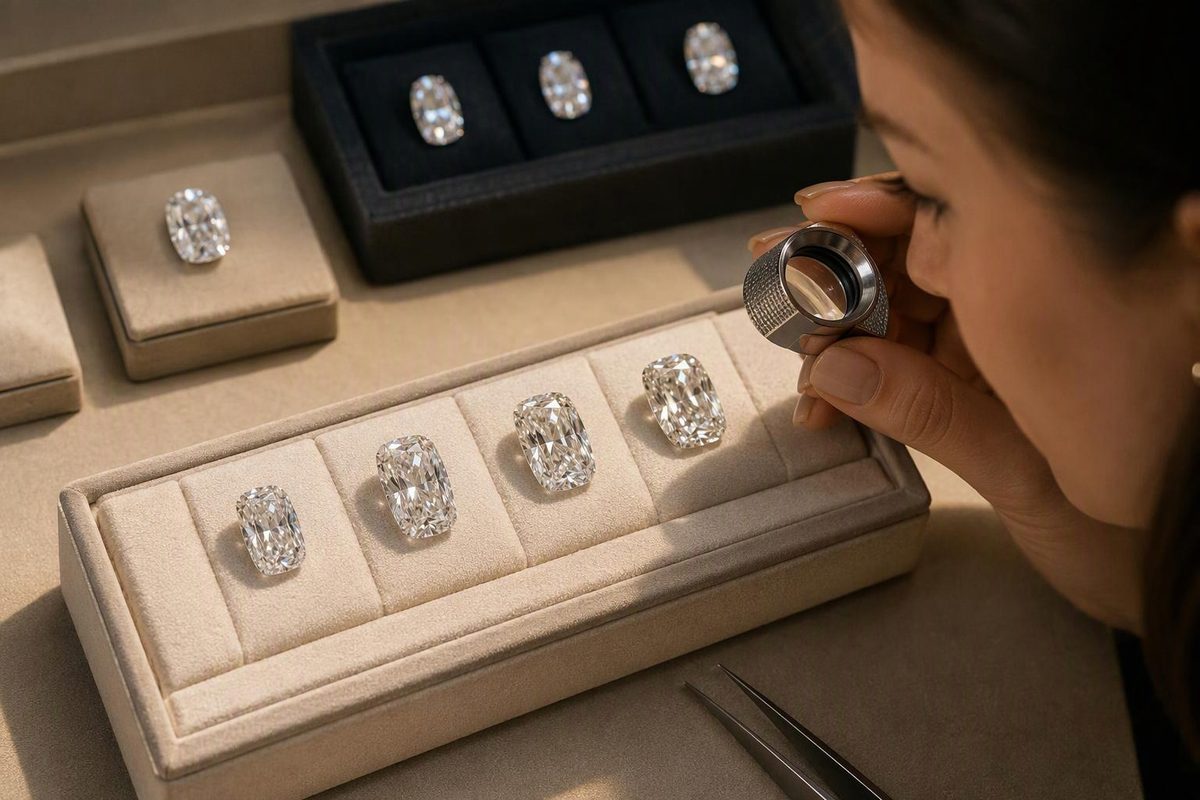
An elongated cushion cut diamond has a rectangular, pillow-like outline: longer than it is wide, with curved sides and rounded corners. It is a variation of the cushion shape, not a quality grade. GIA notes that cushions range from rounded squares to elongated rectangles, with different facet arrangements that affect their appearance. GIA’s cushion guide
The buying priority is straightforward: choose an outline you like, compare its actual millimeter dimensions, then inspect how it handles light. A desirable length-to-width ratio cannot rescue a diamond that looks dull.
Choose the ratio—but keep the width in view
Calculate length-to-width ratio by dividing the longer face-up measurement by the shorter one. Do not use the third measurement, which is the diamond’s depth.
Length-to-width ratio = length ÷ width
For example, a hypothetical cushion measuring 8.4 × 6.0 × 4.2 mm has a ratio of 1.40.
These examples show the arithmetic, not standard sizes for any carat weight:
| Hypothetical face-up dimensions | Ratio | What changes |
|---|---|---|
| 7.2 × 6.0 mm | 1.20 | Length is 20% greater than width |
| 7.8 × 6.0 mm | 1.30 | Length is 30% greater than width |
| 8.4 × 6.0 mm | 1.40 | Length is 40% greater than width |
There is no need to find one universally “best” ratio. As a shopping exercise, compare examples around 1.20, 1.30 and 1.40 to establish your preference. Also look at the curvature: two cushions with the same ratio can have noticeably different shoulders and corners.
Longer does not necessarily mean larger-looking overall. A higher ratio can come from extra length, reduced width, or both. Compare both dimensions rather than choosing the highest ratio. Carat measures weight, while proportions affect face-up size; excessive depth or girdle thickness can put weight where it adds little visible size. GIA on proportions and size
For broader comparisons, see our guide to diamond size in millimeters.
Decide which sparkle pattern you prefer
The cushion outline does not tell you everything about the diamond’s internal appearance.
Modern cushions may be described on reports as cushion brilliant or cushion modified brilliant. GIA explains that modified versions include additional facets on the crown or pavilion. Those labels describe cutting structure, not a ranking of beauty. GIA on cushion cutting styles
In seller descriptions, you may also encounter:
- Chunky or broad-flash: larger, more distinct areas of flashing light.
- Crushed ice: numerous small, fragmented-looking reflections.
- Antique-style: a look intended to evoke older cutting patterns.
Retailer Lumera describes a tendency for modified cushions to show a crushed-ice or needle-like pattern. Treat that as a tendency—not a substitute for viewing the individual stone. Lumera’s cushion guide
Neither broad flashes nor fine sparkle is automatically superior. Compare moving videos to decide which you enjoy. If a seller claims a diamond is genuinely antique, separate that claim from its appearance; our antique cushion buying guide addresses that different purchase.
Read the report without overreading “Excellent”
As of October 2026, GIA does not assign cushions an overall cut grade on its standard diamond grading reports. It does assess polish and symmetry. Consequently, “Excellent polish” and “Excellent symmetry” do not amount to an Excellent overall cut grade. Ask who assigned any “Ideal” or “Excellent cut” label displayed in the retailer’s filters. GIA’s cut-grade explanation
There is a separate option: eligible cushions with specific facet arrangements can qualify for a supplemental AGS Ideal Report by GIA, which assesses light performance, including brightness, fire and contrast. That is distinct from the standard grading report’s polish and symmetry grades. GIA’s supplemental report
Other laboratories differ. IGI grades fancy-shape cut using polish, symmetry, proportions, craftsmanship requirements and light return. IGI explicitly says proportions alone cannot determine fancy-shape cut quality, and its light-return assessment is not an assessment of fire or scintillation. An IGI cut grade is useful evidence, but you still need to judge the sparkle pattern you prefer. IGI’s cut-grading methodology
Avoid treating a retailer’s table-and-depth chart as a guarantee. Those measurements help compare candidates; they cannot fully describe the interaction of all the facets.
Inspect the actual diamond before paying
Request imagery of the specific stone, not a representative cushion. Ideally, compare finalists in person; for remote purchases, ask for slow movement in more than one lighting environment and confirm the return terms.
Check:
- Outline: Do opposing sides and corners mirror each other? GIA specifically recommends checking cushion outline symmetry. GIA’s cushion inspection advice
- Brightness in motion: Does the center participate in the sparkle, or does a broad area remain unappealingly dark as the stone tilts?
- Contrast: Do not reject every dark reflection. Light-and-dark contrast is part of diamond scintillation; the question is whether the overall pattern looks lively to you. GIA on diamond appearance
- Color and inclusions: Examine the stone at normal viewing distance as well as enlarged. GIA notes that inclusion position affects its impact—for example, directly beneath the table versus off to one side. GIA on clarity characteristics
- Girdle condition: Rounded corners do not make a cushion damage-proof. GIA warns that extremely thin girdle areas can be vulnerable to chipping and suggests considering bezel protection. GIA’s cushion inspection advice
When comparing prices, keep natural and laboratory-grown diamonds in separate groups, then align weight, grades, dimensions, facet style and report details. Price the mounting separately and obtain written return terms, especially before custom setting work.
Choose the stone whose outline, visible size and moving light pattern justify its price—not the one with the longest proportions or the most impressive retailer label.